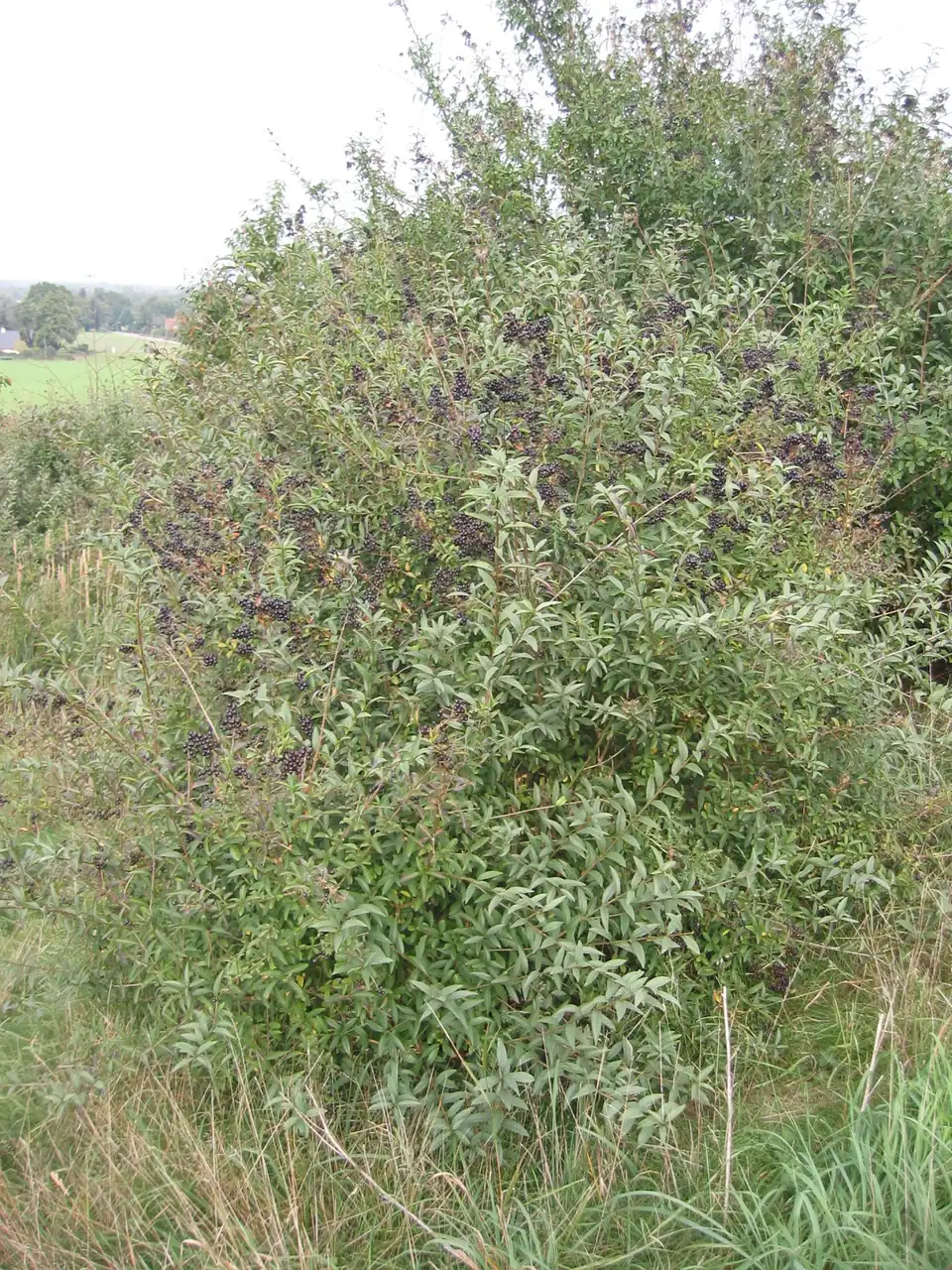


Cómo cultivar y cuidar Aligustre
Ligustrum vulgare
Escrito por Emilio Marruso · última revisión
Tóxica para: Gatos, Perros, Caballos, Personas · Por qué
De un vistazo
El aligustre es un arbusto perenne y sufrido que crece a pleno sol o en semisombra y aguanta la sequía, aunque prefiere un suelo húmedo y bien drenado. Sus bayas negras encantan a los pájaros, pero ellos también esparcen las semillas: corta las flores enseguida y mantendrás esta planta tan resistente y agradecida justo donde la quieres.
- Sol
Pleno sol o semisombra
Qué dicen las fuentes (3)
Luz: Pleno sol a semisombra
Common privet tolerates full sun or partial shade very well.
— Ligustrum vulgare (Amur, Common Privet, Ligustrum, Privet, Wax-leaf) | North Carolina Extension Gardener Plant Toolbox [1] Full sun to partial shade; moist, well-drained soils are best; tolerates alkaline soils.
— Common Privet (Ligustrum vulgare)-Hort Answers - University of Illinois Extension [2] Privet grows best in full sun, but tolerates some shade and occasional drought.
— Privet | University of Maryland Extension [5] - Riego
Aguanta bien la sequía, pero crece mejor con humedad constante
Qué dicen las fuentes (2)
Riego: Tolerante a la sequía; los suelos húmedos y bien drenados son los mejores
Common privet tolerates full sun or partial shade very well. Common privet is considered drought- and pollution-tolerant.
— Ligustrum vulgare (Amur, Common Privet, Ligustrum, Privet, Wax-leaf) | North Carolina Extension Gardener Plant Toolbox [1] Full sun to partial shade; moist, well-drained soils are best; tolerates alkaline soils.
— Common Privet (Ligustrum vulgare)-Hort Answers - University of Illinois Extension [2] - Frío
Aguanta inviernos de hasta −34,4 °C (−30 °F)
Muy rústica · USDA 4a · RHS H7 · Z4
Qué dicen las fuentes (2)
Rusticidad, zona más fría: 4a [mínima invernal de −34,4 a −31,7 °C (de −30 a −25 °F)]
USDA Plant Hardiness Zone: 4a, 4b, 5a, 5b, 6a, 6b, 7a, 7b
— Ligustrum vulgare (Amur, Common Privet, Ligustrum, Privet, Wax-leaf) | North Carolina Extension Gardener Plant Toolbox [1] Rusticidad, zona más cálida: 7b [mínima invernal de −15 a −12,2 °C (de 5 a 10 °F)]
USDA Plant Hardiness Zone: 4a, 4b, 5a, 5b, 6a, 6b, 7a, 7b
— Ligustrum vulgare (Amur, Common Privet, Ligustrum, Privet, Wax-leaf) | North Carolina Extension Gardener Plant Toolbox [1] - Suelo
Lo ideal es un suelo húmedo y bien drenado
Qué dicen las fuentes (2)
Riego: Tolerante a la sequía; los suelos húmedos y bien drenados son los mejores
Common privet tolerates full sun or partial shade very well. Common privet is considered drought- and pollution-tolerant.
— Ligustrum vulgare (Amur, Common Privet, Ligustrum, Privet, Wax-leaf) | North Carolina Extension Gardener Plant Toolbox [1] Full sun to partial shade; moist, well-drained soils are best; tolerates alkaline soils.
— Common Privet (Ligustrum vulgare)-Hort Answers - University of Illinois Extension [2] - Abonado
Vigila la falta de cobre: este arbusto la sufre con facilidad
Qué dicen las fuentes (1)
Microelementos: Cobre: la especie es susceptible a la deficiencia de cobre
Anthracnose, twig blight, cankers, powdery mildew, and root rot are common disease problems. Susceptible to copper deficiency.
— Ligustrum vulgare (Amur, Common Privet, Ligustrum, Privet, Wax-leaf) | North Carolina Extension Gardener Plant Toolbox [1] - Poda
Corta las flores enseguida para que no se formen bayas
Qué dicen las fuentes (1)
Poda: Poda las flores de inmediato para evitar la formación de frutos.
Birds tend to spread the seeds around so prune off flowers immediately to avoid setting fruit.
— Ligustrum vulgare (Amur, Common Privet, Ligustrum, Privet, Wax-leaf) | North Carolina Extension Gardener Plant Toolbox [1] - Plagas
Moscas blancas, gorgojos, cochinillas, pulgones y ácaros; puede sufrir oídio y podredumbre de raíz
Qué dicen las fuentes (5)
Plagas: moscas blancas, gorgojos japoneses, gorgojos del ligustro, escama blanca del durazno, ácaros del óxido del ligustro, cochinilla de concha de ostra, trips, oruga del nido feo, arañita roja de dos manchas, pulgones, minadores de hojas, cochinillas harinosas
Whiteflies, Japanese and ligustrum weevils, white peach scale, and privet rust mites are common insect problems.
— Ligustrum vulgare (Amur, Common Privet, Ligustrum, Privet, Wax-leaf) | North Carolina Extension Gardener Plant Toolbox [1] Insect Damage - Oystershell Scale ( Lepidosaphes ulmi ) - Thrips ( Many ) - Uglynest Caterpillar ( Archips cerasivorana )
— Common Privet (Ligustrum vulgare)-Hort Answers - University of Illinois Extension [2] A number of problems are common, most of which are not serious. These include leaf spots, powdery mildew, aphids, leaf miners, scale, mealybugs and mites.
— Common Privet (Ligustrum vulgare)-Hort Answers - University of Illinois Extension [2] Enfermedades: antracnosis, tizón de las ramas, cancros, mildiu polvoriento, pudrición de la raíz, moho gris, marchitez por verticillium, pudriciones de la madera, manchas foliares
Anthracnose, twig blight, cankers, powdery mildew, and root rot are common disease problems.
— Ligustrum vulgare (Amur, Common Privet, Ligustrum, Privet, Wax-leaf) | North Carolina Extension Gardener Plant Toolbox [1] Fungal Disease - Gray Mold [Trees and Shrubs] ( Botrytis cinerea and other species ) - Verticillium Wilt [Shrubs and Trees] ( Verticillium albo-atrum and V. dahliae ) - Wood Rots and Decays ( Many genus and species involved )
— Common Privet (Ligustrum vulgare)-Hort Answers - University of Illinois Extension [2] - Atención
Invasor: los pájaros esparcen las semillas; arranca las plantas jóvenes con todas sus raíces, porque los trozos rebrotan
- Seguridad
Tóxico para personas, gatos, perros y caballos: provoca dolor de estómago, vómitos y diarrea
Resumen
El ligustro común es un arbusto vigoroso, semiperennifolio, que crece hasta 10 a 15 pies [3–4,6 m] de altura y es una opción popular para setos. [1] Tolera pleno sol o semisombra y se considera tolerante a la sequía. [1] Está catalogado como invasivo en Carolina del Norte y otros estados, y sus frutos y hojas son venenosos. [1]
Citado en inglés, como en la fuente.
Esta ficha está incompleta: las fuentes consultadas aún no cubren todos los campos.
Aún no cubierto por nuestras fuentes: Propagación
Cuidados
Las medidas entre corchetes son nuestra conversión al otro sistema de unidades; el texto citado no cambia.
Riego
Tolerante a la sequía; los suelos húmedos y bien drenados son los mejores
Qué dicen las fuentes (2)
Common privet tolerates full sun or partial shade very well. Common privet is considered drought- and pollution-tolerant.Full sun to partial shade; moist, well-drained soils are best; tolerates alkaline soils.Luz
Pleno sol a semisombra
Qué dicen las fuentes (3)
Common privet tolerates full sun or partial shade very well.Full sun to partial shade; moist, well-drained soils are best; tolerates alkaline soils.Privet grows best in full sun, but tolerates some shade and occasional drought.Clima y frío
Rusticidad, zona más fría
4a [mínima invernal de −34,4 a −31,7 °C (de −30 a −25 °F)]
Qué dicen las fuentes (1)
USDA Plant Hardiness Zone: 4a, 4b, 5a, 5b, 6a, 6b, 7a, 7bRusticidad, zona más cálida
7b [mínima invernal de −15 a −12,2 °C (de 5 a 10 °F)]
Qué dicen las fuentes (1)
USDA Plant Hardiness Zone: 4a, 4b, 5a, 5b, 6a, 6b, 7a, 7bPropagación
No figura en las fuentes consultadas.
Cultivo
La planta
Ciclo de vida
perenne
Qué dicen las fuentes (1)
Common privet is a vigorous, semi-evergreen, perennial shrub in the olive family (Oleaceae) native to Eurasia.Familia
Oleaceae
Qué dicen las fuentes (1)
Common privet is a vigorous, semi-evergreen, perennial shrub in the olive family (Oleaceae) native to Eurasia.Altura adulta
Plagas y enfermedades
Plagas
moscas blancas, gorgojos japoneses, gorgojos del ligustro, escama blanca del durazno, ácaros del óxido del ligustro, cochinilla de concha de ostra, trips, oruga del nido feo, arañita roja de dos manchas, pulgones, minadores de hojas, cochinillas harinosas
Qué dicen las fuentes (3)
Whiteflies, Japanese and ligustrum weevils, white peach scale, and privet rust mites are common insect problems.Insect Damage
- Oystershell Scale ( Lepidosaphes ulmi )
- Thrips ( Many )
- Uglynest Caterpillar ( Archips cerasivorana )A number of problems are common, most of which are not serious. These include leaf spots, powdery mildew, aphids, leaf miners, scale, mealybugs and mites.Enfermedades
antracnosis, tizón de las ramas, cancros, mildiu polvoriento, pudrición de la raíz, moho gris, marchitez por verticillium, pudriciones de la madera, manchas foliares
Qué dicen las fuentes (2)
Anthracnose, twig blight, cankers, powdery mildew, and root rot are common disease problems.Fungal Disease
- Gray Mold [Trees and Shrubs] ( Botrytis cinerea and other species )
- Verticillium Wilt [Shrubs and Trees] ( Verticillium albo-atrum and V. dahliae )
- Wood Rots and Decays ( Many genus and species involved )Abonado
Microelementos
Cobre: la especie es susceptible a la deficiencia de cobre
Qué dicen las fuentes (1)
Anthracnose, twig blight, cankers, powdery mildew, and root rot are common disease problems. Susceptible to copper deficiency.Problemas
Propagación invasiva
Síntoma: Las aves comen las bayas y dispersan las semillas; el arbusto forma matorrales densos en áreas naturales e impide el crecimiento de las plantas nativas
Qué hacer: Las plantas pequeñas individuales se pueden arrancar a mano, eliminando todas las raíces porque los fragmentos pueden rebrotar
Qué dicen las fuentes (2)
Birds eat the berries and aid in seed dispersal. Border privet and European privet in particular can form dense thickets in natural areas
— Privet | University of Maryland Extension [5] Individual small plants can be pulled by hand. However, all roots must be removed, as fragments have the possibility of resprouting.
— Privet [7] Problemas de insectos y enfermedades
Síntoma: Moscas blancas, gorgojos japoneses y del ligustro, cochinilla blanca del melocotonero y ácaros del óxido del ligustro; antracnosis, tizón de ramas, cancros, mildiu polvoriento y pudrición de raíces
Qué hacer: No especificado en los documentos
Qué dicen las fuentes (2)
Whiteflies, Japanese and ligustrum weevils, white peach scale, and privet rust mites are common insect problems.
— Ligustrum vulgare (Amur, Common Privet, Ligustrum, Privet, Wax-leaf) | North Carolina Extension Gardener Plant Toolbox [1] Anthracnose twig blight can be a serious problem on this species.
— Common Privet (Ligustrum vulgare)-Hort Answers - University of Illinois Extension [2]
Remedios
Cada remedio indica qué dicen las fuentes oficiales; los remedios tradicionales sin fuente oficial aparecen marcados. Los perjudiciales están para que sepas evitarlos.
Cuidar la planta
moscas blancas
jabón insecticida Funciona
Foliar injury from soaps and oils may occur on plants under drought stress. Therefore, water the plants well the day before spraying.
— Ligustrum | Home & Garden Information Center [6] Cómo: Rocía bien para que el jabón entre en contacto con los insectos en el envés de las hojas.
Insecticidal soap or horticultural oil sprays are effective against whiteflies, but the plant must be sprayed thoroughly so that the soap or oil contacts the insects on the underside of leaves.
— Ligustrum | Home & Garden Information Center [6] Qué dicen las pruebas Insecticidal soap or horticultural oil sprays are effective against whiteflies, but the plant must be sprayed thoroughly so that the soap or oil contacts the insects on the underside of leaves.
— Ligustrum | Home & Garden Information Center [6]
manchas foliares por hongos
eliminación manual de hojas manchadas Funciona
Cómo: Elimina manualmente las hojas manchadas en plantas con infección leve; rastrilla y destruye las hojas caídas infectadas.
Hand remove spotted leaves on lightly diseased plants. Rake up and destroy infected fallen leaves. The removal of this leaf material will minimize the chances of the disease reoccurring the next season.
— Ligustrum | Home & Garden Information Center [6] Qué dicen las pruebas Many insect and disease issues can be solved in the home garden by hand-picking insects or clipping and disposing of diseased plant parts.
— extension.unh.edu [9]
Cómo eliminarla
ligustro invasor
arrancado a mano Funciona en parte
Cómo: Arranca las plantas pequeñas a mano, quitando todas las raíces porque los fragmentos pueden rebrotar; el arrancado es viable para troncos de menos de 1 pulgada de diámetro.
Privet tends to have shallow roots, making uprooting an easy method of control. Some woody invasive trees and shrubs have deeper tap roots that make hand pulling difficult. If the trunk has a diameter of less than 1” hand pulling could be a viable option.
— treesatlanta.org [10] Qué dicen las pruebas Individual small plants can be pulled by hand. However, all roots must be removed, as fragments have the possibility of resprouting.
— Privet [7] segado o cortado Funciona en parte
Cómo: Las infestaciones pequeñas se pueden segar o cortar; las plantas rebrotarán fácilmente.
Cutting or mowing effectively eliminates the shrub canopy and provides access to overgrown sites, but the plants will readily resprout.
— Privet [7] Qué dicen las pruebas Small infestations can be mowed or cut to control spread, though this will not eradicate a population.
— Invasive Privet | Invasives | Illinois Extension | Illinois [4] excavando la corona de la raíz Fuente oficial, sin prueba independiente
Cómo: Las plantas más grandes se pueden cavar o arrancar con una herramienta de desenraizamiento; quita la corona de la raíz para evitar que broten.
Larger plants can be dug or pulled using a grubbing tool. Care should be taken to remove the root crown to prevent sprouting.
— Invasive Privet | Invasives | Illinois Extension | Illinois [4]
Venenosa para los animales
Según la fuente, citada textualmente. No es un consejo médico ni veterinario: si una persona o un animal pudo haber ingerido esta planta, contacta con un centro de toxicología o con un veterinario.
Animales
#poisonous #problem for cats #problem for dogs #problem for horses
[1]La fuente señala el riesgo para este animal pero no explica por qué.
Personas
Poison Severity: Medium Poison Symptoms: Abdominal pain, nausea, vomiting, drooling, diarrhea, headache, weakness, low blood pressure
[1]- Partes venenosas
Poison Part: Fruits Leaves
[1]- Principio tóxico
Glycosides: syringin (ligustrin), a glycoside; shikimic acid (lowest toxic dose 4,000mg); saponins, protoanemonin and others
[1]- Síntomas
Abdominal pain, nausea, vomiting, drooling, diarrhea, headache, weakness, low blood pressure, cold and clammy skin possibly lasting 48 to 72 hours, colic, depression.
[1]- Gravedad
This plant has medium severity poison characteristics.
[1]
Calendario
Poda
Poda las flores de inmediato para evitar la formación de frutos.
Qué dicen las fuentes (1)
Birds tend to spread the seeds around so prune off flowers immediately to avoid setting fruit.Meses tal como los dan las fuentes, en su mayoría de Estados Unidos (hemisferio norte). En el hemisferio sur se desplazan unos seis meses.
Comestibilidad
Según la fuente, citada textualmente. No comas una planta basándote solo en esta página: los errores de identificación pueden ser peligrosos.
followed by dark black fleshy berries that are enjoyed by birds
[1]
Valores orientativos
Valores de una fuente secundaria, no comprobados palabra por palabra como el resto de esta página. Úselos como punto de partida.
- Resiste la sequía
- SíValor orientativo, adáptalo a tu clima · Fuente secundaria
- pH del suelo
- 6-7.5Valor orientativo, adáptalo a tu clima · Fuente secundaria
- Crecimiento
- AltaValor orientativo, adáptalo a tu clima · Fuente secundaria
- Propagación
- Esqueje, propagación por acodo, propagación por injerto, división, propagación por semillaValor orientativo, adáptalo a tu clima · Fuente secundaria
Plantas similares
- Amur privet Ligustrum amurense
- Aligustrina Ligustrum sinense
- Glossy Privet Ligustrum lucidum
- Aligustrón Ligustrum japonicum
- California privet Ligustrum ovalifolium
- Fresno negro Fraxinus nigra
- Fresno azul Fraxinus quadrangulata
- Chinese Fringetree Chionanthus retusus
Fuentes
Cada valor anterior se cita de estos documentos. Los enlaces llevan al editor original.
- Ligustrum vulgare (Amur, Common Privet, Ligustrum, Privet, Wax-leaf) | North Carolina Extension Gardener Plant Toolbox · plants.ces.ncsu.edu, consultado
- Common Privet (Ligustrum vulgare)-Hort Answers - University of Illinois Extension · web.extension.illinois.edu, consultado
- Wax-leaf - Ligustrum vulgare | North Carolina Extension Gardener Plant Toolbox · plants.ces.ncsu.edu, consultado
- Invasive Privet | Invasives | Illinois Extension | Illinois · extension.illinois.edu, consultado
- Privet | University of Maryland Extension · extension.umd.edu, consultado
- Ligustrum | Home & Garden Information Center · hgic.clemson.edu, consultado
- Privet · extension.psu.edu, consultado
- Common Privet - Ligustrum vulgare | North Carolina Extension Gardener Plant Toolbox · plants.ces.ncsu.edu, consultado
- extension.unh.edu · extension.unh.edu
- treesatlanta.org · treesatlanta.org
Escrito por Emilio Marruso · última revisión