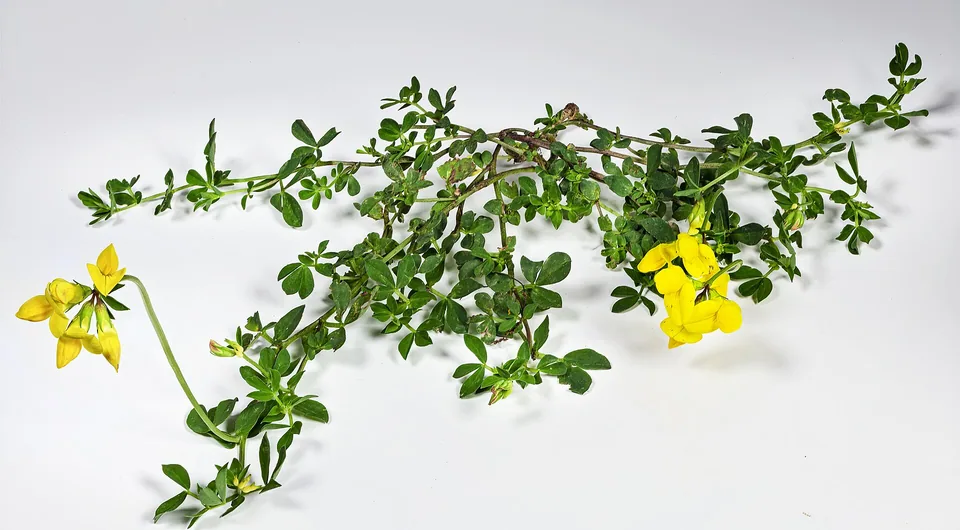
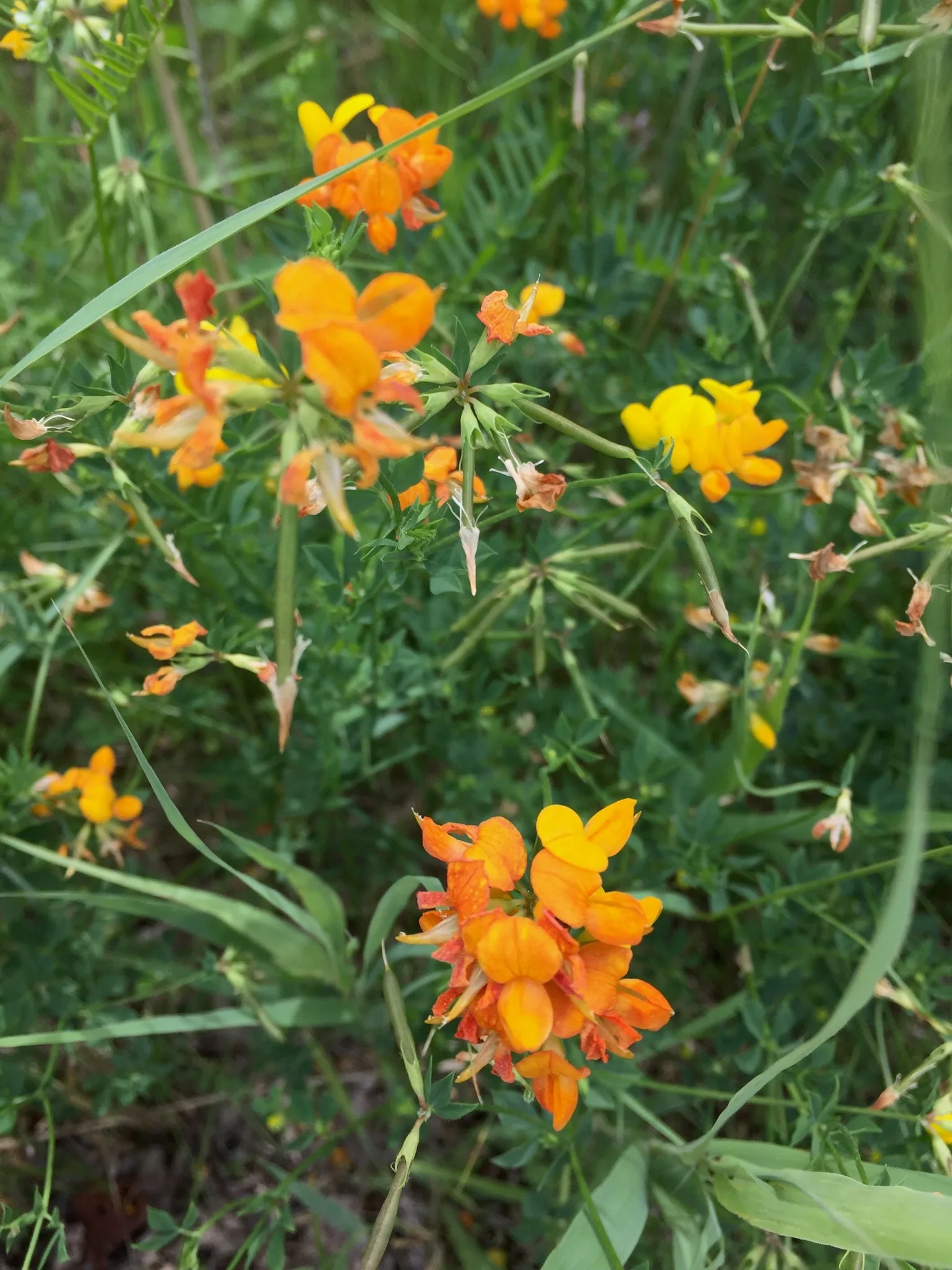

Cómo cultivar y cuidar Common Bird's-foot-trefoil
Lotus corniculatus
Escrito por Emilio Marruso · última revisión
Tóxica para: Ganado, Personas · Por qué
De un vistazo
El cuernecillo es una planta vivaz y resistente que adora el sol y aguanta bien la sequía. Crece en suelos desde muy ácidos hasta alcalinos, con pH de 4,5 a 8,2, y alcanza 30–61 cm de alto. Siembra las semillas a no más de 6 mm de profundidad y, en las mejores condiciones, pueden germinar en solo 1–2 días.
- Sol
Sol pleno; no le gusta la sombra
- Riego
Tolera la sequía, pero no sobrevive al agua encharcada en verano
Qué dicen las fuentes (4)
Riego: Tolerante a la sequía.
Birdsfoot trefoil is also drought and salt tolerant.
— Control of Birdsfoot Trefoil in the Lawn | Yard and Garden [8] Drought tolerant. Planting should occur between from August
— Birdsfoot Trefoil (Lotus corniculatus) | Mississippi State University Extension Service [5] Notas sobre el riego: Tolera suelos con mal drenaje, pero no sobrevive donde el agua estancada persiste en verano; crece mejor con 20 pulgadas [51 cm] o más de precipitación.
Trefoil tolerates poorly drained soils but will not survive in areas where standing water persists in summer
— North Central Regional [2] Bird’s-foot trefoil grows best in areas that receive 20 inches or more of precipitation.
— BIRD’S-FOOT TREFOIL [3] - Suelo
Suelo de ácido a alcalino, pH 4,5–8,2
- Abonado
Cal, fósforo y potasio antes de sembrar; nada de nitrógeno una vez establecidas las plantas
Qué dicen las fuentes (5)
Cuándo: Encala de 6 a 12 meses antes de la siembra (dos años antes cuando se siembra sin labranza sobre césped); fertilizante de fósforo y potasio antes de la siembra, incorporado con labranza; para praderas establecidas, según análisis de suelo
When lime is needed, apply 6 to 12 months before seeding and work it into the soil. If no-till seed-ing trefoil into sod, apply lime two years before seeding.
— North Central Regional [2] Where soil nutrient levels are low, especially for phosphorus, apply fertilizer before seeding and incor-porate the fertilizer with tillage.
— North Central Regional [2] Soil testing is the best guide for determining fertilizer requirements of established stands of trefoil.
— Birdsfoot Trefoil [6] Evitar: Fertilizante nitrogenado en praderas establecidas: reduce la fijación de nitrógeno y hace que los pastos y malezas sean más competitivos; no se necesita nitrógeno cuando el trébol es más del 30% de una mezcla
Nitrogen fertilization of a trefoil stand with fertilizer N or manure will reduce the N fixing ability of trefoil and increase the competitiveness of grass or weeds that also may be in the stand.
— Birdsfoot Trefoil [6] When the trefoil makes up more than 30 percent of a mixed trefoil and grass stand, no nitrogen (N) fertilizer should be needed.
— Birdsfoot Trefoil [6] - Cosecha
Para heno, corta al inicio de la floración y otra vez de mediados a finales de agosto
Qué dicen las fuentes (2)
Cosecha: Primer corte de heno al inicio de la floración, segundo a mediados o finales de agosto
the first cutting should be taken at early bloom and a second cutting in mid to late August
— Birdsfoot Trefoil (Lotus corniculatus) | Mississippi State University Extension Service [5] Cómo cosechar: Para heno, haz el primer corte al inicio de la floración y un segundo corte a mediados o finales de agosto
When harvesting trefoil for hay, the first cutting should be taken at early bloom and a second cutting in mid to late August.
— Birdsfoot Trefoil (Lotus corniculatus) | Mississippi State University Extension Service [5] - Plagas
Salivazo y cicadélidos; podredumbre del cuello y de la raíz, y fusariosis
Qué dicen las fuentes (4)
Plagas: espumadoras, chicharritas, avispa de la semilla del trébol
Control pests, especially spittlebugs and leafhoppers. To protect the life of the stand, bird’s-foot trefoil requires careful management.
— BIRD’S-FOOT TREFOIL [3] The trefoil seed chalcid, Bruchophagus kolobovae Fed., is a small, black, wasp-like insect that can be destructive in seed fields
— BIRD’S-FOOT TREFOIL [3] Enfermedades: pudriciones de corona y raíz, marchitez por Fusarium
Crown and root rots are the most significant diseases of bird’s-foot trefoil, particularly in wet conditions
— BIRD’S-FOOT TREFOIL [3] Fusarium wilt has caused significant decline of bird’s-foot trefoil, but there have been efforts to breed higher resistance to this disease
— BIRD’S-FOOT TREFOIL [3] - Atención
Las plántulas son débiles y las malas hierbas las superan; también persiste en el césped
- Tamaño
30–61 cm de alto
Qué dicen las fuentes (1)
Altura adulta: 30-61 cm (12-24 pulgadas)
Birdsfoot trefoil ( Lotus corniculatus ) is a perennial herbaceous forb, 12–24 inches tall.
— Birdsfoot trefoil [1] - Multiplicación
Se multiplica por semilla
- Siembra
Siembra a no más de 6 mm de profundidad; puede germinar en 1–2 días
Qué dicen las fuentes (3)
Profundidad de siembra: no más profundo que 0.6 (¼ de pulgada)
Seed placement should be no deeper than ¼ inch into a clean and firm seedbed.
— BIRD’S-FOOT TREFOIL [3] Planting should occur between from August 20 to September 15 using a cultipacker seeder at a rate 6 to 8 lbs/ac and a 1/4-inch depth.
— Birdsfoot Trefoil (Lotus corniculatus) | Mississippi State University Extension Service [5] Días de germinación: 1-2 (24-48 horas en condiciones óptimas; cantidad significativa de semilla dura)
Germination occurs within 24-48 hours under optimal conditions, though there is a significant amount of hard seed
— BIRD’S-FOOT TREFOIL [3] - Seguridad
Todas sus partes son tóxicas para las personas: no la comas
Resumen
El trébol de pájaro es una leguminosa perenne forrajera que puede volverse invasiva en áreas naturales y es una maleza ocasional del césped. [1][3][8] Tolera suelos con mal drenaje, pero no sobrevive donde el agua estancada persiste en verano, y es tolerante a la sequía. [2][8] Una referencia indica que todas las partes de la planta son venenosas debido a los glucósidos cianogénicos, mientras que el trébol pastoreado no causa hinchazón en los animales. [4][6]
Citado en inglés, como en la fuente.
Esta ficha está incompleta: las fuentes consultadas aún no cubren todos los campos.
Aún no cubierto por nuestras fuentes: Rusticidad, zona más fría, Rusticidad, zona más cálida
Cuidados
Las medidas entre corchetes son nuestra conversión al otro sistema de unidades; el texto citado no cambia.
Riego
Riego
Tolerante a la sequía.
Notas sobre el riego
Tolera suelos con mal drenaje, pero no sobrevive donde el agua estancada persiste en verano; crece mejor con 20 pulgadas [51 cm] o más de precipitación.
Luz
Clima y frío
Rusticidad, zona más fría
No figura en las fuentes consultadas.
Rusticidad, zona más cálida
No figura en las fuentes consultadas.
Suelo
pH del suelo, mínimo
4.5
Qué dicen las fuentes (1)
Prefers a pH in the range 6 - 7, tolerating 4.5 - 8.2pH del suelo, máximo
8.2
Qué dicen las fuentes (1)
Prefers a pH in the range 6 - 7, tolerating 4.5 - 8.2Propagación
Cultivo
La planta
Ciclo de vida
perenne
Qué dicen las fuentes (1)
Birdsfoot trefoil ( Lotus corniculatus ) is a perennial herbaceous forb, 12–24 inches tall.Altura adulta
30-61 cm (12-24 pulgadas)
Qué dicen las fuentes (1)
Birdsfoot trefoil ( Lotus corniculatus ) is a perennial herbaceous forb, 12–24 inches tall.Siembra y crecimiento
Días de germinación
1-2 (24-48 horas en condiciones óptimas; cantidad significativa de semilla dura)
Qué dicen las fuentes (1)
Germination occurs within 24-48 hours under optimal conditions, though there is a significant amount of hard seedProfundidad de siembra
no más profundo que 0.6 (¼ de pulgada)
Qué dicen las fuentes (2)
Seed placement should be no deeper than ¼ inch into a clean and firm seedbed.Planting should occur between from August 20 to September 15 using a cultipacker seeder at a rate 6 to 8 lbs/ac and a 1/4-inch depth.Cosecha y conservación
Cómo cosechar
Para heno, haz el primer corte al inicio de la floración y un segundo corte a mediados o finales de agosto
Qué dicen las fuentes (1)
When harvesting trefoil for hay, the first cutting should be taken at early bloom and a second cutting in mid to late August.Guardar semillas
Para evitar la pérdida de semilla por desgranamiento, corta el cultivo justo antes de la madurez por la mañana mientras las plantas aún estén húmedas por el rocío, y luego seca las plantas antes de trillar
Qué dicen las fuentes (1)
To avoid seed loss from shattering, researchers suggest cutting the crop just before maturity in the morning while the plants are still moist with dew and then drying the plants before threshing them laterPlagas y enfermedades
Plagas
espumadoras, chicharritas, avispa de la semilla del trébol
Qué dicen las fuentes (2)
Control pests, especially spittlebugs and leafhoppers. To protect the life of the stand, bird’s-foot trefoil requires careful management.The trefoil seed chalcid, Bruchophagus kolobovae Fed., is a small, black, wasp-like insect that can be destructive in seed fieldsEnfermedades
pudriciones de corona y raíz, marchitez por Fusarium
Qué dicen las fuentes (2)
Crown and root rots are the most significant diseases of bird’s-foot trefoil, particularly in wet conditionsFusarium wilt has caused significant decline of bird’s-foot trefoil, but there have been efforts to breed higher resistance to this diseaseAbonado
Cuándo
Encala de 6 a 12 meses antes de la siembra (dos años antes cuando se siembra sin labranza sobre césped); fertilizante de fósforo y potasio antes de la siembra, incorporado con labranza; para praderas establecidas, según análisis de suelo
Qué dicen las fuentes (3)
When lime is needed, apply 6 to 12 months before seeding and work it into the soil. If no-till seed-ing trefoil into sod, apply lime two years before seeding.Where soil nutrient levels are low, especially for phosphorus, apply fertilizer before seeding and incor-porate the fertilizer with tillage.Soil testing is the best guide for determining fertilizer requirements of established stands of trefoil.Frecuencia
Una vez al año (aplicar fosfato y/o potasa al voleo) donde los análisis de suelo muestren fósforo por debajo de 15 ppm y potasio por debajo de 90 ppm
Qué dicen las fuentes (2)
Research shows that soil test phos-phorus of about 15 ppm (parts per million) and potassium of about 90 ppm appear adequate for aver-age yield levels (2 to 3 t/a dry mat-ter).These levels are lower than recommended for alfalfa but are similar to those for red clover. Where soil tests are below these levels annual broadcast applica-tion with phosphate and/or potash is recommended.Abonos naturales
Las fuentes no coinciden:
Manure can be used to fertilize trefoil and will reduce the need for adding commercial fertilizer.
[2]Nitrogen fertilization of a trefoil stand with fertilizer N or manure will reduce the N fixing ability of trefoil and increase the competitiveness of grass or weeds that also may be in the stand.
[6]
Abonos minerales
Según análisis de suelo; sin uno, en suelo de fertilidad media: N-P₂O₅-K₂O a 0, 50.4 y 151 kg [111,1–332,9 lb]/ha incorporados, más 22.4, 67.3 y 22.4 kg [148,4–49,4 lb]/ha en la línea de siembra, en banda si es posible; en suelos pobres en fósforo, aplícalo en banda a 3.8-5.1 cm [1,5–2 in] directamente debajo de la semilla
Lo que dice cada fuente
suelos con menos de 2% de materia orgánica, al plantar: 33.6 kg [74 lb]/ha de nitrógeno
Qué dicen las fuentes (4)
suelos con menos de 2% de materia orgánica, al plantar: Research on trefoil fertility has not shown responses to broadcast or banded fertilizers at planting except for a small amount of nitro-gen (about 30 lb/a) on soils with less than 2% organic matter.In the absence of a soil test, assuming a medium-fertility soil, plow down 0-45-135 lb per acre and apply 20-60-20 lb per acre in the row at seeding (banded if possible).In the absence of a soil test, assuming a medium-fertility soil level, plow down 0-45-135 lb/ac and apply 20-60-20 lb/ac in the row at seeding (banded if possible).Use soil tests for appropriate fertilizer and lime recommendations. In soils low in phosphorous, place in bands 1½ - 2” directly below the seed for best utilization.Microelementos
Alto requerimiento de boro; el molibdeno, esencial para la fijación de nitrógeno, puede volverse deficiente cuando el cultivo se establece en suelos con pH inferior a 5.6
Qué dicen las fuentes (2)
It also has a high requirement for boron, often showing deficiency symp-toms when alfalfa does not.Trefoil establishment in soils with a pH less than 5.6 may result in molybdenum (Mo) deficiencies. Molybdenum is an essential nutrient for nitrogen fixation.Evitar
Fertilizante nitrogenado en praderas establecidas: reduce la fijación de nitrógeno y hace que los pastos y malezas sean más competitivos; no se necesita nitrógeno cuando el trébol es más del 30% de una mezcla
Qué dicen las fuentes (2)
Nitrogen fertilization of a trefoil stand with fertilizer N or manure will reduce the N fixing ability of trefoil and increase the competitiveness of grass or weeds that also may be in the stand.When the trefoil makes up more than 30 percent of a mixed trefoil and grass stand, no nitrogen (N) fertilizer should be needed.Problemas
Vigor deficiente de las plántulas
Síntoma: Las malezas crecen más rápido y son más competitivas que el trébol.
Qué hacer: Manejo cuidadoso al sembrar; el control químico de malezas generalmente es necesario para siembras puras.
Qué dicen las fuentes (1)
For pure seedings of trefoil, chemical weed control is generally necessary because most weeds grow faster and are more competitive than trefoil.
— Birdsfoot Trefoil [6] Maleza de césped
Síntoma: El trébol pie de pájaro persiste en céspedes bajo el corte.
Qué hacer: Los herbicidas de hoja ancha lo controlan.
Qué dicen las fuentes (1)
Birdsfoot trefoil in lawns can be controlled with broadleaf herbicides.
— Control of Birdsfoot Trefoil in the Lawn | Yard and Garden [8]
Remedios
Cada remedio indica qué dicen las fuentes oficiales; los remedios tradicionales sin fuente oficial aparecen marcados. Los perjudiciales están para que sepas evitarlos.
Cómo eliminarla
propagación invasiva en césped y jardín
eliminación manual Funciona en parte
Cómo: Elimina todas las partes de las raíces y los brotes para evitar que vuelva a crecer.
Hand removal is effective for removing small patches but may need to be repeated.
— extension.umn.edu [9] Qué dicen las pruebas Hand removal is effective for removing small patches but may need to be repeated.
— extension.umn.edu [9] siega regular Funciona en parte
Cómo: Corta el césped regularmente a una altura de 3 pulgadas o más.
Regular mowing at a height of 3 inches or higher helps to manage birdsfoot trefoil.
— extension.umn.edu [9] Qué dicen las pruebas Regular mowing at a height of 3 inches or higher helps to manage birdsfoot trefoil.
— extension.umn.edu [9]
propagación invasiva en el césped
fertilización con nitrógeno del césped Funciona en parte
Cómo: Mejora la densidad del césped mediante buenos procedimientos de establecimiento, fertilización y gramíneas bien adaptadas.
Infestations of birdsfoot trefoil can be reduced by improving turf density through good establishment procedures, fertilization, and use of turfgrasses well-adapted to site conditions.
— extension.psu.edu [10] Qué dicen las pruebas Infestations of birdsfoot trefoil can be reduced by improving turf density through good establishment procedures, fertilization, and use of turfgrasses well-adapted to site conditions.
— extension.psu.edu [10]
propagación invasiva en áreas naturales
Venenosa para los animales
Según la fuente, citada textualmente. No es un consejo médico ni veterinario: si una persona o un animal pudo haber ingerido esta planta, contacta con un centro de toxicología o con un veterinario.
Animales
Unlike alfalfa, grazed trefoil does not cause animals to bloat.
[6]La fuente señala el riesgo para este animal pero no explica por qué.
Personas
All parts of the plant are poisonous, containing cyanogenic glycosides(hydrogen cyanide)
[4]
Calendario
Las fuentes dan valores distintos según la región, la zona o las condiciones de cultivo.
Lo que dice cada fuente
Según USDA NRCS: Principios de primavera
Según Penn State Extension: Principios de primavera
Misisipi (Extensión de la Universidad Estatal de Misisipi): 20 de agosto - 15 de septiembre
Según University of Wisconsin Extension: Cuando el suelo alcanza 50°F (10°C) a una profundidad de 4 pulgadas [10 cm]
Según Useful Temperate Plants: Primavera u otoño.
Qué dicen las fuentes (6)
Según USDA NRCS: Seedings are more successful in early spring than in late summer or fallSegún Penn State Extension: Early spring seedings are generally more successful than late summer seedings.Misisipi (Extensión de la Universidad Estatal de Misisipi): Planting should occur between from August 20 to September 15Según University of Wisconsin Extension: Plant when soil temperatures reach 50°F at a 4-inch depth.Según Useful Temperate Plants: sow in the spring or autumn in situSeedings are more successful in early spring than in late summer or fallPrimer corte de heno al inicio de la floración, segundo a mediados o finales de agosto
Qué dicen las fuentes (1)
the first cutting should be taken at early bloom and a second cutting in mid to late AugustMeses tal como los dan las fuentes, en su mayoría de Estados Unidos (hemisferio norte). En el hemisferio sur se desplazan unos seis meses.
Comestibilidad
Según la fuente, citada textualmente. No comas una planta basándote solo en esta página: los errores de identificación pueden ser peligrosos.
Plantas similares
- Pico de paloma Lotus berthelotii
- Winged Pea Lotus tetragonolobus
- Hipérico rastrero Hypericum calycinum
- Abraham Trachystemon orientalis
- Acacia longifolia Acacia longifolia
- Acónito común Aconitum napellus
- Palma de aguja Yucca flaccida
- Afghan Cherry Prunus jacquemontii
Fuentes
Cada valor anterior se cita de estos documentos. Los enlaces llevan al editor original.
- Birdsfoot trefoil · extension.umn.edu, consultado
- North Central Regional · cropsandsoils.extension.wisc.edu, consultado
- BIRD’S-FOOT TREFOIL · nrcs.usda.gov, consultado
- Lotus corniculatus - Useful Temperate Plants · temperate.theferns.info, consultado
- Birdsfoot Trefoil (Lotus corniculatus) | Mississippi State University Extension Service · extension.msstate.edu, consultado
- Birdsfoot Trefoil · extension.psu.edu, consultado
- Lotus corniculatus, Birdsfoot Trefoil: identification, distribution, habitat · first-nature.com, consultado
- Control of Birdsfoot Trefoil in the Lawn | Yard and Garden · hortnews.extension.iastate.edu, consultado
- extension.umn.edu · extension.umn.edu
- extension.psu.edu · extension.psu.edu
Escrito por Emilio Marruso · última revisión