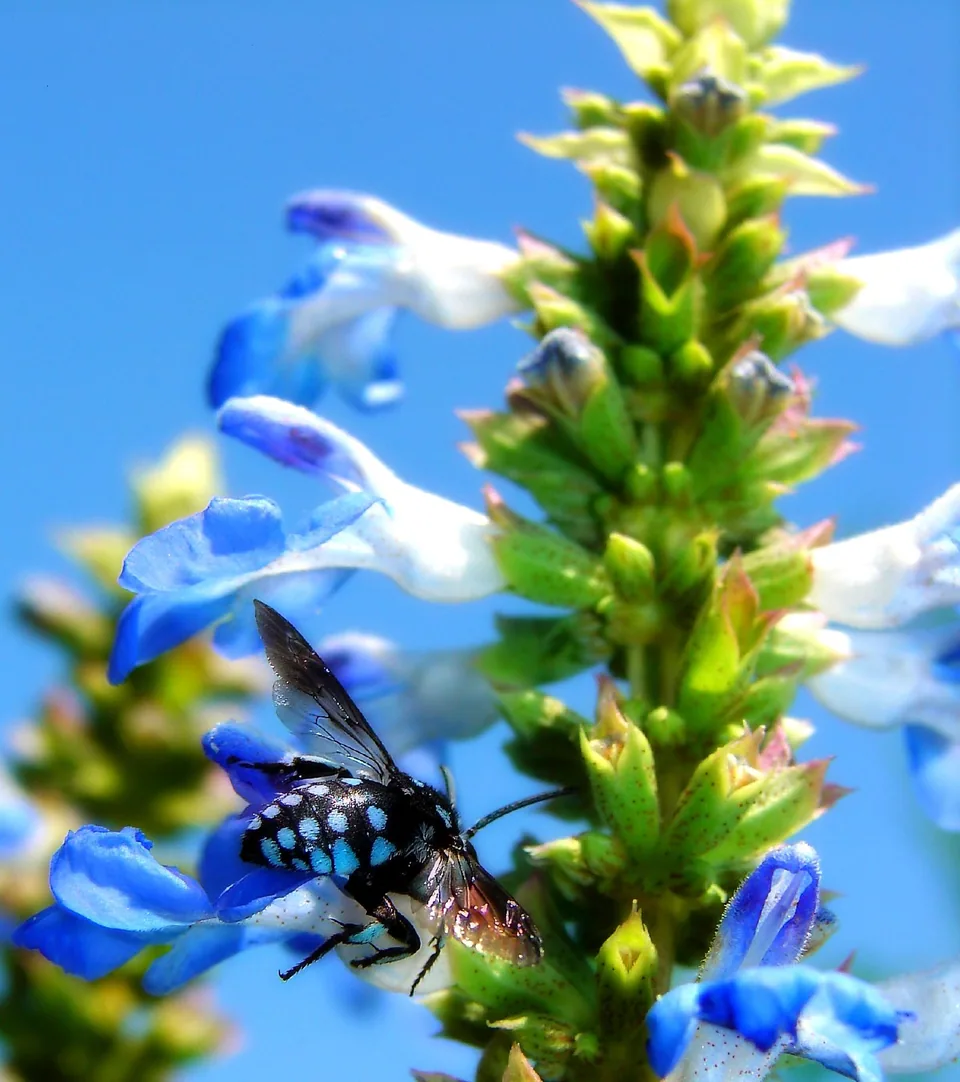


Cómo cultivar y cuidar Bog Sage
Salvia uliginosa
Escrito por Emilio Marruso · última revisión
De un vistazo
La salvia uliginosa es una perenne agradecida que disfruta en suelos húmedos, incluso encharcados, pero también crece bien en tierra de jardín corriente. Dale sol pleno o semisombra y mucho espacio, porque puede alcanzar 1,2–2,4 m de ancho. Una poda fuerte a finales de abril la mantiene más baja y ordenada, y a menudo el compost en un suelo bien preparado es todo el abono que necesita.
- Sol
Sol pleno o semisombra
Qué dicen las fuentes (2)
Luz: Pleno sol a semisombra
Light: Full sun (6 or more hours of direct sunlight a day) Partial Shade (Direct sunlight only part of the day, 2-6 hours)
— Salvia uliginosa (Blue Spike Sage, Bog Sage, Sky-blue Sage) | North Carolina Extension Gardener Plant Toolbox [1] It thrives in full sun to partial shade and can adapt to both wet and dry conditions, although it can become invasive in wet areas.
— Ask IFAS: Topic - Lamiaceae [4] - Riego
Le encanta el suelo húmedo o encharcado, pero también tolera sitios más secos y tierra de jardín normal
Qué dicen las fuentes (3)
Riego: Prospera en suelo húmedo a pantanoso; tolera suelos con mal drenaje; también crece bien en suelo de jardín ordinario.
This salvia performs best in full sun and thrives in damp to boggy soil. It tolerates poorly drained soils, but will also grow well in ordinary garden soil.
— Salvia uliginosa (Blue Spike Sage, Bog Sage, Sky-blue Sage) | North Carolina Extension Gardener Plant Toolbox [1] Unlike most salvias, it thrives in damp to boggy soil, although it will grow well in ordinary garden soil.
— Salvia | Home & Garden Information Center [5] Notas sobre el riego: Puede adaptarse tanto a condiciones húmedas como secas.
It thrives in full sun to partial shade and can adapt to both wet and dry conditions, although it can become invasive in wet areas.
— Ask IFAS: Topic - Lamiaceae [4] - Frío
Aguanta inviernos de hasta −23,3 °C (−10 °F)
Muy rústica · USDA 6a · RHS H7 · Z6
Qué dicen las fuentes (2)
Rusticidad, zona más fría: 6a [mínima invernal de −23,3 a −20,6 °C (de −10 a −5 °F)]
USDA Plant Hardiness Zone: 6a, 6b, 7a, 7b, 8a, 8b, 9a, 9b, 10a, 10b
— Salvia uliginosa (Blue Spike Sage, Bog Sage, Sky-blue Sage) | North Carolina Extension Gardener Plant Toolbox [1] Rusticidad, zona más cálida: 10b [mínima invernal de 1,7 a 4,4 °C (de 35 a 40 °F)]
USDA Plant Hardiness Zone: 6a, 6b, 7a, 7b, 8a, 8b, 9a, 9b, 10a, 10b
— Salvia uliginosa (Blue Spike Sage, Bog Sage, Sky-blue Sage) | North Carolina Extension Gardener Plant Toolbox [1] - Suelo
Suelo ácido, con pH de hasta 6,0
Qué dicen las fuentes (1)
pH del suelo, máximo: 6.0
Soil pH: Acid (<6.0) Soil Drainage: Good Drainage
— Salvia uliginosa (Blue Spike Sage, Bog Sage, Sky-blue Sage) | North Carolina Extension Gardener Plant Toolbox [1] - Abonado
Basta con compost en el suelo; demasiado abono favorece las enfermedades por hongos
Qué dicen las fuentes (2)
Abonos naturales: Compost en un suelo bien preparado; muchas salvias perennes no necesitan fertilizante adicional
Many perennial salvias will grow well without supplemental fertility if sited in a well-prepared soil containing compost.
— Salvia | Home & Garden Information Center [5] Evitar: Exceso de fertilizante, que puede aumentar los problemas de enfermedades fúngicas
Excessive water and fertilizer can increase fungal disease problems for salvias.
— Salvia | Home & Garden Information Center [5] - Poda
Poda fuerte a finales de abril, quitando entre un tercio y la mitad de los tallos
Qué dicen las fuentes (2)
Poda: Finales de abril (poda fuerte, eliminando un tercio a la mitad de los tallos).
This salvia, more than any other species, benefits from a hard pruning (removing one-third to one-half of the stems) in late April.
— Salvia uliginosa (Blue Spike Sage, Bog Sage, Sky-blue Sage) | North Carolina Extension Gardener Plant Toolbox [1] or bring it to the front and remember to prune it every April.
— Salvia uliginosa (Blue Spike Sage, Bog Sage, Sky-blue Sage) | North Carolina Extension Gardener Plant Toolbox [1] - Plagas
Pulgón, araña roja y mosca blanca; también oídio y podredumbres de tallo y raíz
Qué dicen las fuentes (2)
Plagas: pulgones, arañitas rojas, moscas blancas
Potential problems for salvias include damping-off of seedlings, stem and root rots, powdery mildew, Botrytis blight, aphids, spider mites, and whiteflies.
— Salvia | Home & Garden Information Center [5] Enfermedades: mal de los semilleros, pudriciones de tallo y raíz, mildiu polvoriento, tizón por Botrytis
Potential problems for salvias include damping-off of seedlings, stem and root rots, powdery mildew, Botrytis blight, aphids, spider mites, and whiteflies.
— Salvia | Home & Garden Information Center [5] - Atención
Se extiende rápido por tallos subterráneos y puede volverse invasora en suelo húmedo; entutora sus tallos
- Tamaño
De 1,2 a 2,4 m de ancho
Qué dicen las fuentes (1)
Anchura adulta: 122-244 cm (4-8 pies)
It is a member of the Lamiaceae (mint) family and grows 4 to 5 feet in height and 4 to 8 feet in width.
— Salvia uliginosa (Blue Spike Sage, Bog Sage, Sky-blue Sage) | North Carolina Extension Gardener Plant Toolbox [1] - Multiplicación
Por división, acodo, esquejes de raíz o esquejes de tallo
Qué dicen las fuentes (1)
Propagación: División; acodo; esquejes de raíz; esquejes de tallo.
Recommended Propagation Strategy: Division Layering Root Cutting Stem Cutting
— Salvia uliginosa (Blue Spike Sage, Bog Sage, Sky-blue Sage) | North Carolina Extension Gardener Plant Toolbox [1]
Resumen
La salvia de los pantanos es una salvia abierta, erguida y extendida, nativa de Brasil y el norte de Argentina, cultivada por sus espigas de flores azul cielo. [1] Rinde mejor a pleno sol y prospera en suelos húmedos o pantanosos, pero también crece bien en suelo de jardín ordinario. [1] Puede extenderse agresivamente por rizomas y puede volverse maleza en suelos húmedos. [1]
Citado en inglés, como en la fuente.
Cuidados
Riego
Riego
Prospera en suelo húmedo a pantanoso; tolera suelos con mal drenaje; también crece bien en suelo de jardín ordinario.
Qué dicen las fuentes (2)
This salvia performs best in full sun and thrives in damp to boggy soil. It tolerates poorly drained soils, but will also grow well in ordinary garden soil.Unlike most salvias, it thrives in damp to boggy soil, although it will grow well in ordinary garden soil.Notas sobre el riego
Puede adaptarse tanto a condiciones húmedas como secas.
Qué dicen las fuentes (1)
It thrives in full sun to partial shade and can adapt to both wet and dry conditions, although it can become invasive in wet areas.Luz
Pleno sol a semisombra
Qué dicen las fuentes (2)
Light:
Full sun (6 or more hours of direct sunlight a day)
Partial Shade (Direct sunlight only part of the day, 2-6 hours)It thrives in full sun to partial shade and can adapt to both wet and dry conditions, although it can become invasive in wet areas.Clima y frío
Rusticidad, zona más fría
6a [mínima invernal de −23,3 a −20,6 °C (de −10 a −5 °F)]
Qué dicen las fuentes (1)
USDA Plant Hardiness Zone:
6a, 6b, 7a, 7b, 8a, 8b, 9a, 9b, 10a, 10bRusticidad, zona más cálida
10b [mínima invernal de 1,7 a 4,4 °C (de 35 a 40 °F)]
Qué dicen las fuentes (1)
USDA Plant Hardiness Zone:
6a, 6b, 7a, 7b, 8a, 8b, 9a, 9b, 10a, 10bSuelo
6.0
Qué dicen las fuentes (1)
Soil pH:
Acid (<6.0)
Soil Drainage:
Good DrainagePropagación
División; acodo; esquejes de raíz; esquejes de tallo.
Qué dicen las fuentes (1)
Recommended Propagation Strategy:
Division
Layering
Root Cutting
Stem CuttingCultivo
La planta
Ciclo de vida
perenne
Qué dicen las fuentes (1)
It describes the plant as an upright to spreading perennial that can reach heights of 3 to 4 feet.Familia
Lamiaceae
Qué dicen las fuentes (1)
It is a member of the Lamiaceae (mint) family and grows 4 to 5 feet in height and 4 to 8 feet in width.Altura adulta
Anchura adulta
122-244 cm (4-8 pies)
Qué dicen las fuentes (1)
It is a member of the Lamiaceae (mint) family and grows 4 to 5 feet in height and 4 to 8 feet in width.Plagas y enfermedades
Plagas
pulgones, arañitas rojas, moscas blancas
Qué dicen las fuentes (1)
Potential problems for salvias include damping-off of seedlings, stem and root rots, powdery mildew, Botrytis blight, aphids, spider mites, and whiteflies.Enfermedades
mal de los semilleros, pudriciones de tallo y raíz, mildiu polvoriento, tizón por Botrytis
Qué dicen las fuentes (1)
Potential problems for salvias include damping-off of seedlings, stem and root rots, powdery mildew, Botrytis blight, aphids, spider mites, and whiteflies.Abonado
Abonos naturales
Compost en un suelo bien preparado; muchas salvias perennes no necesitan fertilizante adicional
Qué dicen las fuentes (1)
Many perennial salvias will grow well without supplemental fertility if sited in a well-prepared soil containing compost.Evitar
Exceso de fertilizante, que puede aumentar los problemas de enfermedades fúngicas
Qué dicen las fuentes (1)
Excessive water and fertilizer can increase fungal disease problems for salvias.Problemas
Maleza y propagación agresiva.
Síntoma: Puede propagarse agresivamente por rizomas y puede volverse maleza en suelos húmedos; IFAS añade que puede volverse invasiva en áreas húmedas.
Qué hacer: Poda drásticamente cada abril; entutora o mezcla con otras plantas para mantener los tallos erguidos.
Hábito flácido.
Síntoma: La planta es laxa y podría beneficiarse de un tutor.
Qué hacer: Planta al fondo del borde, entutora o mezcla con otras plantas; la poda drástica la mantiene más baja y menos inclinada.
Qué dicen las fuentes (2)
It will cause the stems to branch and will keep the plant a bit shorter and less floppy.
— Salvia uliginosa (Blue Spike Sage, Bog Sage, Sky-blue Sage) | North Carolina Extension Gardener Plant Toolbox [1] as it could benefit from staking or mixing with other plants to hold it upright
— Salvia uliginosa (Blue Spike Sage, Bog Sage, Sky-blue Sage) | North Carolina Extension Gardener Plant Toolbox [1]
Remedios
Cada remedio indica qué dicen las fuentes oficiales; los remedios tradicionales sin fuente oficial aparecen marcados. Los perjudiciales están para que sepas evitarlos.
Cuidar la planta
ácaros araña
spray de jabón insecticida Funciona
Special care should be taken with soap or oil to obtain thorough spray coverage, because they only work on contact.
— portal.ct.gov [7] Cómo: Rocía con jabón insecticida, aplicado al menos dos veces con intervalos de 7 a 10 días, con cobertura completa porque el jabón solo funciona por contacto.
Spraying with insecticidal soap will give sufficient control if applied at least twice at 7-10 day intervals.
— portal.ct.gov [7] Qué dicen las pruebas Spraying with insecticidal soap will give sufficient control if applied at least twice at 7-10 day intervals.
— portal.ct.gov [7]
moscas blancas
jabón insecticida o spray de aceite hortícola Funciona
Cómo: Rocía en el envés de las hojas; probablemente se necesitarán aplicaciones repetidas.
Insecticidal soap or ultra-fine horticultural oil, which are among the compounds registered for control of this pest in Connecticut, sprayed on the undersides of leaves, can be used against whiteflies in the greenhouse or the field.
— portal.ct.gov [7] Qué dicen las pruebas Insecticidal soap or ultra-fine horticultural oil, which are among the compounds registered for control of this pest in Connecticut, sprayed on the undersides of leaves, can be used against whiteflies in the greenhouse or the field.
— portal.ct.gov [7] spray de neem Funciona
Cómo: Azadiractina (neem) dirigida al envés de las hojas.
Azadiractin (neem), also directed to the undersides of the leaves, can also be used.
— portal.ct.gov [7] Qué dicen las pruebas Azadiractin (neem), also directed to the undersides of the leaves, can also be used.
— portal.ct.gov [7]
orugas de oso lanudo amarillas
Recoge y destruye las orugas a mano. Funciona
Cómo: El control rara vez es necesario; recoge y destruye las orugas a mano.
Control is seldom needed. Handpicking and destroying caterpillars is easily done.
— portal.ct.gov [7] Qué dicen las pruebas Control is seldom needed. Handpicking and destroying caterpillars is easily done.
— portal.ct.gov [7]
Calendario
Finales de abril (poda fuerte, eliminando un tercio a la mitad de los tallos).
Qué dicen las fuentes (2)
This salvia, more than any other species, benefits from a hard pruning (removing one-third to one-half of the stems) in late April.or bring it to the front and remember to prune it every April.Meses tal como los dan las fuentes, en su mayoría de Estados Unidos (hemisferio norte). En el hemisferio sur se desplazan unos seis meses.
Respecto a las heladas
Estimación menos precisa: no hay ninguna estación meteorológica a menos de 300 km.
Busca las fechas de heladas por código postal o ciudad
Plantación: hacia la última helada
The best time to plant salvias is in spring after the danger of frost is passed.
— Salvia | Home & Garden Information Center [5]
Cuenta desde las fechas medias de las heladas de tu zona.
Plantas similares
- Anise Sage Salvia guaranitica
- Salvia real Salvia sagittata
- Autumn Sage Salvia greggii
- Blue Sage Salvia azurea
- Cedar Sage Salvia roemeriana
- Esclarea Salvia sclarea
- Little Leaf Sage Salvia microphylla
- Lyreleaf Sage Salvia lyrata
Fuentes
Cada valor anterior se cita de estos documentos. Los enlaces llevan al editor original.
- Salvia uliginosa (Blue Spike Sage, Bog Sage, Sky-blue Sage) | North Carolina Extension Gardener Plant Toolbox · plants.ces.ncsu.edu, consultado
- Salvia (Sage, Salvia) | North Carolina Extension Gardener Plant Toolbox · plants.ces.ncsu.edu, consultado
- Salvia - Salvia | North Carolina Extension Gardener Plant Toolbox · plants.ces.ncsu.edu, consultado
- Ask IFAS: Topic - Lamiaceae · ask.ifas.ufl.edu, consultado
- Salvia | Home & Garden Information Center · hgic.clemson.edu, consultado
- Ask IFAS: Topic - Salvia · ask.ifas.ufl.edu, consultado
- portal.ct.gov · portal.ct.gov
Escrito por Emilio Marruso · última revisión