

How to Grow and Care for Bog Sage
Salvia uliginosa
Written by Emilio Marruso · last checked
At a glance
Salvia uliginosa is an easygoing perennial that thrives in damp, even boggy soil, yet also grows well in ordinary garden soil. Give it full sun or partial shade and plenty of room, since it can spread 4–8 ft wide. A hard pruning in late April keeps it shorter and tidier, and compost in well-prepared soil is often all the feeding it needs.
- Sun
Full sun to partial shade
What the sources say (2)
Light: Full sun to partial shade
Light: Full sun (6 or more hours of direct sunlight a day) Partial Shade (Direct sunlight only part of the day, 2-6 hours)
— Salvia uliginosa (Blue Spike Sage, Bog Sage, Sky-blue Sage) | North Carolina Extension Gardener Plant Toolbox [1] It thrives in full sun to partial shade and can adapt to both wet and dry conditions, although it can become invasive in wet areas.
— Ask IFAS: Topic - Lamiaceae [4] - Water
Loves damp to boggy soil, but also handles drier spots and ordinary garden soil
What the sources say (3)
Watering: Thrives in damp to boggy soil; tolerates poorly drained soils; also grows well in ordinary garden soil
This salvia performs best in full sun and thrives in damp to boggy soil. It tolerates poorly drained soils, but will also grow well in ordinary garden soil.
— Salvia uliginosa (Blue Spike Sage, Bog Sage, Sky-blue Sage) | North Carolina Extension Gardener Plant Toolbox [1] Unlike most salvias, it thrives in damp to boggy soil, although it will grow well in ordinary garden soil.
— Salvia | Home & Garden Information Center [5] Watering notes: Can adapt to both wet and dry conditions
It thrives in full sun to partial shade and can adapt to both wet and dry conditions, although it can become invasive in wet areas.
— Ask IFAS: Topic - Lamiaceae [4] - Cold
Survives winters down to −10 °F (−23.3 °C)
Very hardy · USDA 6a · RHS H7 · Z6
What the sources say (2)
Hardiness, coldest zone: 6a [winter low −23.3 to −20.6 °C (−10 to −5 °F)]
USDA Plant Hardiness Zone: 6a, 6b, 7a, 7b, 8a, 8b, 9a, 9b, 10a, 10b
— Salvia uliginosa (Blue Spike Sage, Bog Sage, Sky-blue Sage) | North Carolina Extension Gardener Plant Toolbox [1] Hardiness, warmest zone: 10b [winter low 1.7 to 4.4 °C (35 to 40 °F)]
USDA Plant Hardiness Zone: 6a, 6b, 7a, 7b, 8a, 8b, 9a, 9b, 10a, 10b
— Salvia uliginosa (Blue Spike Sage, Bog Sage, Sky-blue Sage) | North Carolina Extension Gardener Plant Toolbox [1] - Soil
Acidic soil, pH up to 6.0
What the sources say (1)
Soil pH, maximum: 6.0
Soil pH: Acid (<6.0) Soil Drainage: Good Drainage
— Salvia uliginosa (Blue Spike Sage, Bog Sage, Sky-blue Sage) | North Carolina Extension Gardener Plant Toolbox [1] - Feeding
Compost in the soil is usually enough; too much fertilizer brings more fungal disease
What the sources say (2)
Natural fertilizers: Compost in a well-prepared soil; many perennial salvias then need no supplemental fertilizer
Many perennial salvias will grow well without supplemental fertility if sited in a well-prepared soil containing compost.
— Salvia | Home & Garden Information Center [5] Avoid: Excessive fertilizer, which can increase fungal disease problems
Excessive water and fertilizer can increase fungal disease problems for salvias.
— Salvia | Home & Garden Information Center [5] - Pruning
Cut back hard in late April, removing one-third to one-half of the stems
What the sources say (2)
Pruning: Late April (hard pruning, removing one-third to one-half of the stems)
This salvia, more than any other species, benefits from a hard pruning (removing one-third to one-half of the stems) in late April.
— Salvia uliginosa (Blue Spike Sage, Bog Sage, Sky-blue Sage) | North Carolina Extension Gardener Plant Toolbox [1] or bring it to the front and remember to prune it every April.
— Salvia uliginosa (Blue Spike Sage, Bog Sage, Sky-blue Sage) | North Carolina Extension Gardener Plant Toolbox [1] - Pests
Aphids, spider mites and whiteflies; also powdery mildew and stem and root rots
What the sources say (2)
Pests: aphids, spider mites, whiteflies
Potential problems for salvias include damping-off of seedlings, stem and root rots, powdery mildew, Botrytis blight, aphids, spider mites, and whiteflies.
— Salvia | Home & Garden Information Center [5] Diseases: damping-off of seedlings, stem and root rots, powdery mildew, Botrytis blight
Potential problems for salvias include damping-off of seedlings, stem and root rots, powdery mildew, Botrytis blight, aphids, spider mites, and whiteflies.
— Salvia | Home & Garden Information Center [5] - Watch out
Spreads fast by underground stems and can turn invasive in wet soil; stake its floppy stems
- Size
Spreads 4 to 8 ft wide
What the sources say (1)
Mature width: 122-244 cm (4-8 ft)
It is a member of the Lamiaceae (mint) family and grows 4 to 5 feet in height and 4 to 8 feet in width.
— Salvia uliginosa (Blue Spike Sage, Bog Sage, Sky-blue Sage) | North Carolina Extension Gardener Plant Toolbox [1] - Propagation
By division, layering, root cuttings or stem cuttings
What the sources say (1)
Propagation: Division; layering; root cuttings; stem cuttings
Recommended Propagation Strategy: Division Layering Root Cutting Stem Cutting
— Salvia uliginosa (Blue Spike Sage, Bog Sage, Sky-blue Sage) | North Carolina Extension Gardener Plant Toolbox [1]
Overview
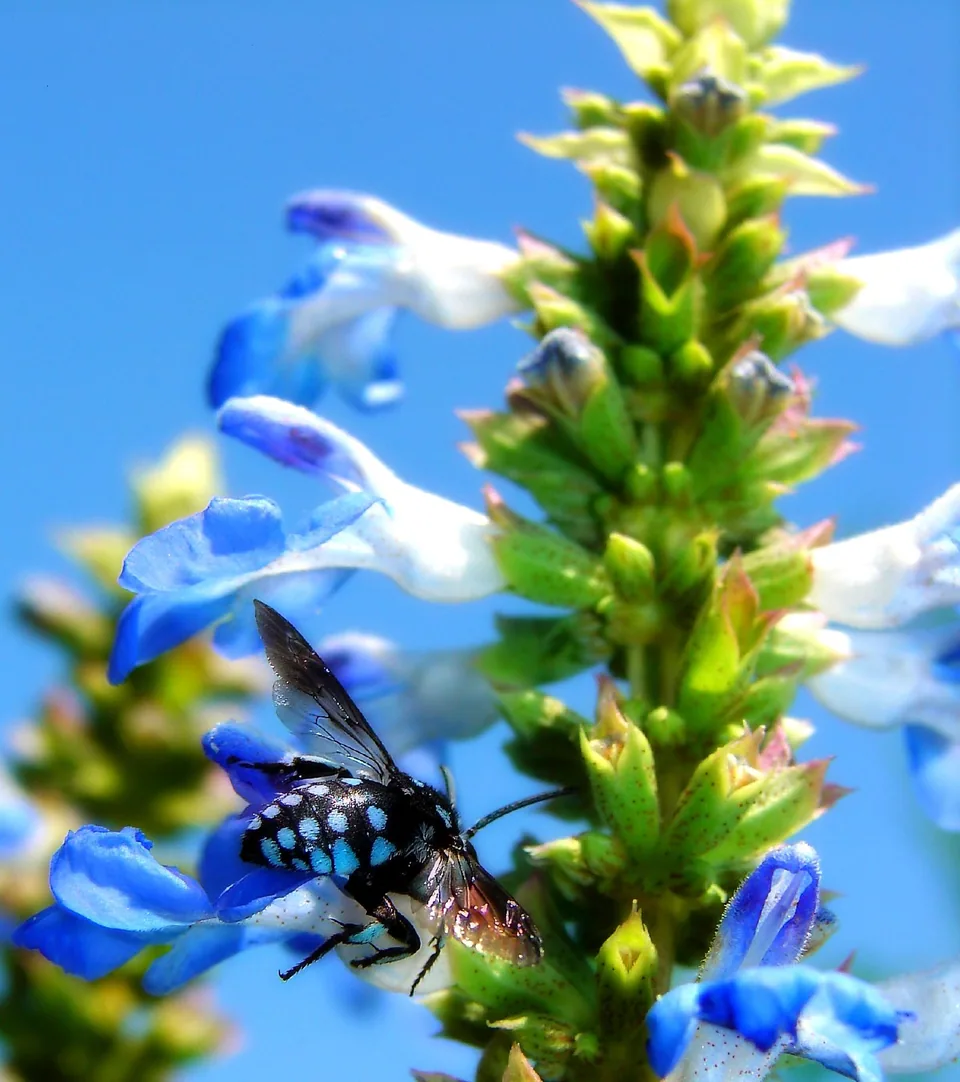
Bog sage is an open, upright, spreading sage native to Brazil and northern Argentina, grown for its sky-blue flower spikes. [1] It performs best in full sun and thrives in damp to boggy soil, but also grows well in ordinary garden soil. [1] It can spread aggressively by rhizomes and may become weedy in wet soils. [1]
Bog Sage care
How to water Bog Sage
Watering
Thrives in damp to boggy soil; tolerates poorly drained soils; also grows well in ordinary garden soil
What the sources say (2)
This salvia performs best in full sun and thrives in damp to boggy soil. It tolerates poorly drained soils, but will also grow well in ordinary garden soil.Unlike most salvias, it thrives in damp to boggy soil, although it will grow well in ordinary garden soil.Watering notes
Can adapt to both wet and dry conditions
What the sources say (1)
It thrives in full sun to partial shade and can adapt to both wet and dry conditions, although it can become invasive in wet areas.How much light Bog Sage needs
Full sun to partial shade
What the sources say (2)
Light:
Full sun (6 or more hours of direct sunlight a day)
Partial Shade (Direct sunlight only part of the day, 2-6 hours)It thrives in full sun to partial shade and can adapt to both wet and dry conditions, although it can become invasive in wet areas.How much cold Bog Sage can take
Hardiness, coldest zone
6a [winter low −23.3 to −20.6 °C (−10 to −5 °F)]
What the sources say (1)
USDA Plant Hardiness Zone:
6a, 6b, 7a, 7b, 8a, 8b, 9a, 9b, 10a, 10bHardiness, warmest zone
10b [winter low 1.7 to 4.4 °C (35 to 40 °F)]
What the sources say (1)
USDA Plant Hardiness Zone:
6a, 6b, 7a, 7b, 8a, 8b, 9a, 9b, 10a, 10bBest soil for Bog Sage
6.0
What the sources say (1)
Soil pH:
Acid (<6.0)
Soil Drainage:
Good DrainageHow to propagate Bog Sage
Division; layering; root cuttings; stem cuttings
What the sources say (1)
Recommended Propagation Strategy:
Division
Layering
Root Cutting
Stem CuttingHow to grow Bog Sage
The plant
Life cycle
perennial
What the sources say (1)
It describes the plant as an upright to spreading perennial that can reach heights of 3 to 4 feet.Family
Lamiaceae
What the sources say (1)
It is a member of the Lamiaceae (mint) family and grows 4 to 5 feet in height and 4 to 8 feet in width.Mature height
Mature width
122-244 cm (4-8 ft)
What the sources say (1)
It is a member of the Lamiaceae (mint) family and grows 4 to 5 feet in height and 4 to 8 feet in width.Pests and diseases
Pests
aphids, spider mites, whiteflies
What the sources say (1)
Potential problems for salvias include damping-off of seedlings, stem and root rots, powdery mildew, Botrytis blight, aphids, spider mites, and whiteflies.Diseases
damping-off of seedlings, stem and root rots, powdery mildew, Botrytis blight
What the sources say (1)
Potential problems for salvias include damping-off of seedlings, stem and root rots, powdery mildew, Botrytis blight, aphids, spider mites, and whiteflies.Fertilizing
Natural fertilizers
Compost in a well-prepared soil; many perennial salvias then need no supplemental fertilizer
What the sources say (1)
Many perennial salvias will grow well without supplemental fertility if sited in a well-prepared soil containing compost.Avoid
Excessive fertilizer, which can increase fungal disease problems
What the sources say (1)
Excessive water and fertilizer can increase fungal disease problems for salvias.Bog Sage pests and problems
Weediness and aggressive spread
Symptom: It can spread aggressively by rhizomes and may become weedy in wet soils; IFAS adds that it can become invasive in wet areas.
What to do: Prune hard every April; stake or mix with other plants to hold the stems upright.
Floppy habit
Symptom: The plant is lax and could benefit from staking.
What to do: Plant at the back of the border, stake or mix with other plants; hard pruning keeps it shorter and less floppy.
What the sources say (2)
It will cause the stems to branch and will keep the plant a bit shorter and less floppy.
— Salvia uliginosa (Blue Spike Sage, Bog Sage, Sky-blue Sage) | North Carolina Extension Gardener Plant Toolbox [1] as it could benefit from staking or mixing with other plants to hold it upright
— Salvia uliginosa (Blue Spike Sage, Bog Sage, Sky-blue Sage) | North Carolina Extension Gardener Plant Toolbox [1]
Remedies
Each remedy shows what official sources say about it; traditional remedies without an official source are marked as such. Harmful ones are listed so you know to avoid them.
Treating the plant
spider mites
insecticidal soap spray Works
Special care should be taken with soap or oil to obtain thorough spray coverage, because they only work on contact.
— portal.ct.gov [7] How: Spray with insecticidal soap, applied at least twice at 7-10 day intervals, with thorough coverage because soap only works on contact.
Spraying with insecticidal soap will give sufficient control if applied at least twice at 7-10 day intervals.
— portal.ct.gov [7] What the evidence says Spraying with insecticidal soap will give sufficient control if applied at least twice at 7-10 day intervals.
— portal.ct.gov [7]
whiteflies
insecticidal soap or horticultural oil spray Works
How: Spray on the undersides of the leaves; repeat applications will probably be needed.
Insecticidal soap or ultra-fine horticultural oil, which are among the compounds registered for control of this pest in Connecticut, sprayed on the undersides of leaves, can be used against whiteflies in the greenhouse or the field.
— portal.ct.gov [7] What the evidence says Insecticidal soap or ultra-fine horticultural oil, which are among the compounds registered for control of this pest in Connecticut, sprayed on the undersides of leaves, can be used against whiteflies in the greenhouse or the field.
— portal.ct.gov [7] neem spray Works
How: Azadiractin (neem) directed to the undersides of the leaves.
Azadiractin (neem), also directed to the undersides of the leaves, can also be used.
— portal.ct.gov [7] What the evidence says Azadiractin (neem), also directed to the undersides of the leaves, can also be used.
— portal.ct.gov [7]
yellow woollybear caterpillars
handpicking and destroying caterpillars Works
How: Control is seldom needed; handpick and destroy the caterpillars.
Control is seldom needed. Handpicking and destroying caterpillars is easily done.
— portal.ct.gov [7] What the evidence says Control is seldom needed. Handpicking and destroying caterpillars is easily done.
— portal.ct.gov [7]
Calendar
Late April (hard pruning, removing one-third to one-half of the stems)
What the sources say (2)
This salvia, more than any other species, benefits from a hard pruning (removing one-third to one-half of the stems) in late April.or bring it to the front and remember to prune it every April.Months as given by the sources, which are mostly from the United States (northern hemisphere). In the southern hemisphere they shift by about six months.
Relative to frost
Less precise estimate: there is no weather station within 300 km.
Find frost dates by ZIP code or city
Plant: around the last frost
The best time to plant salvias is in spring after the danger of frost is passed.
— Salvia | Home & Garden Information Center [5]
Count from the average frost dates where you live.
Similar plants
- Anise Sage Salvia guaranitica
- Arrowleaf Sage Salvia sagittata
- Autumn Sage Salvia greggii
- Blue Sage Salvia azurea
- Cedar Sage Salvia roemeriana
- Clary Sage Salvia sclarea
- Little Leaf Sage Salvia microphylla
- Lyreleaf Sage Salvia lyrata
Sources
Every value above is quoted from these documents. Links lead to the original publisher.
- Salvia uliginosa (Blue Spike Sage, Bog Sage, Sky-blue Sage) | North Carolina Extension Gardener Plant Toolbox · plants.ces.ncsu.edu, consulted
- Salvia (Sage, Salvia) | North Carolina Extension Gardener Plant Toolbox · plants.ces.ncsu.edu, consulted
- Salvia - Salvia | North Carolina Extension Gardener Plant Toolbox · plants.ces.ncsu.edu, consulted
- Ask IFAS: Topic - Lamiaceae · ask.ifas.ufl.edu, consulted
- Salvia | Home & Garden Information Center · hgic.clemson.edu, consulted
- Ask IFAS: Topic - Salvia · ask.ifas.ufl.edu, consulted
- portal.ct.gov · portal.ct.gov
Written by Emilio Marruso · last checked