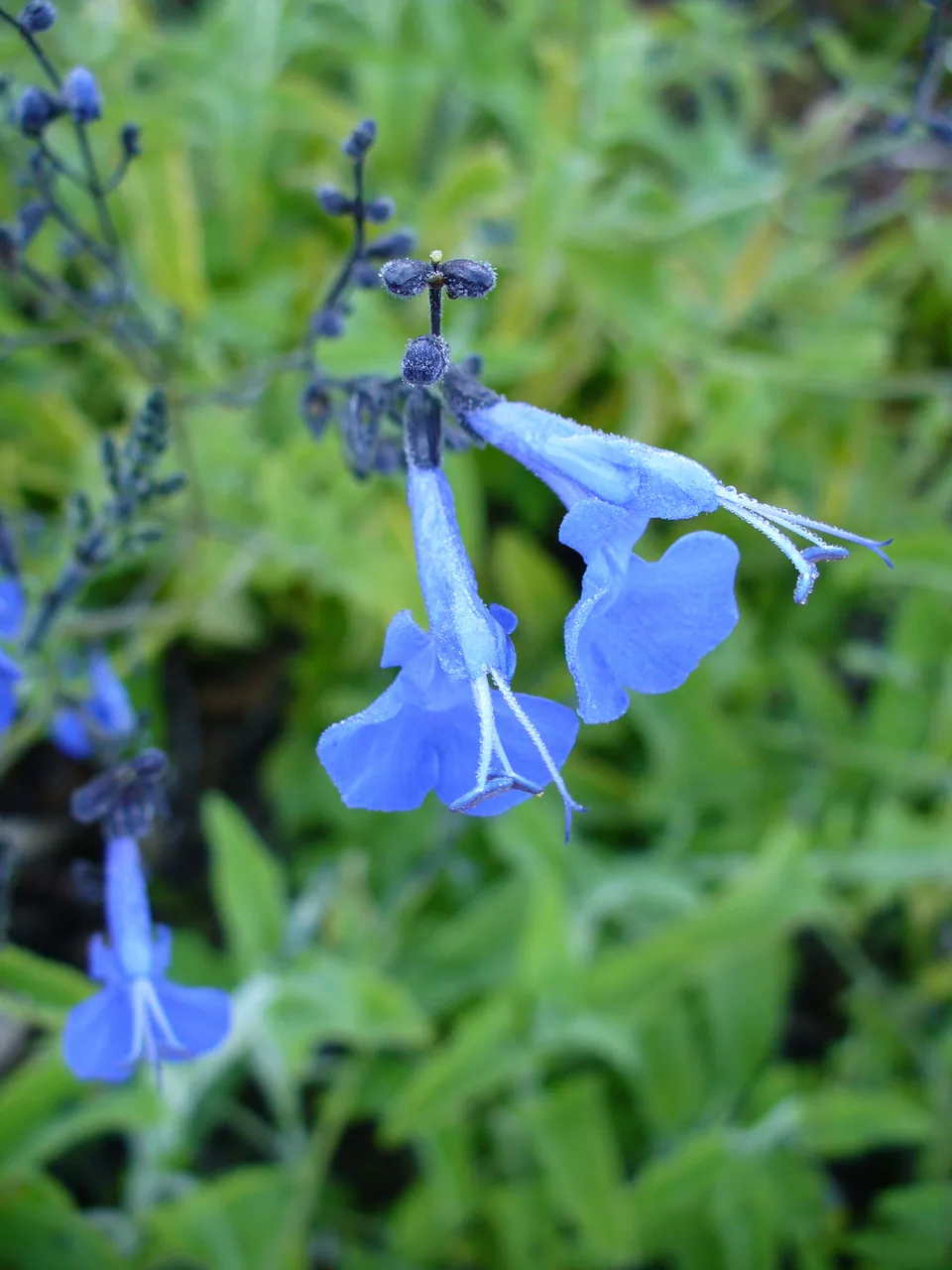


How to Grow and Care for Arrowleaf Sage
Salvia sagittata
Written by Emilio Marruso · last checked
At a glance
This sage grows into a generous plant 3–5 feet tall and 3–4 feet wide, happy with at least half a day of full sun. Give it well-drained, rich soil, regular water in dry spells and a mulch around the roots, then feed it once each spring. It even grows in containers, and you can start new plants from seed or stem cuttings.
- Sun
At least half a day of full sun
What the sources say (1)
Light: At least half a day of full sun
Plant in well-drained, highly organic soils where this sage will get at least half a day of full sun, and you will enjoy the flowers from early summer until frost.
— Salvia sagittata (Arrowleaf Sage) | North Carolina Extension Gardener Plant Toolbox [1] - Water
Water regularly, especially in dry spells; mulch around the roots
What the sources say (3)
Watering: Water regularly, especially during dry spells
Water regularly, especially during dry spells, and mulch around the roots.
— Salvia sagittata (Arrowleaf Sage) | North Carolina Extension Gardener Plant Toolbox [1] Watering notes: Mulch around the roots; well-drained, highly organic soil
Water regularly, especially during dry spells, and mulch around the roots.
— Salvia sagittata (Arrowleaf Sage) | North Carolina Extension Gardener Plant Toolbox [1] Plant in well-drained, highly organic soils where this sage will get at least half a day of full sun, and you will enjoy the flowers from early summer until frost.
— Salvia sagittata (Arrowleaf Sage) | North Carolina Extension Gardener Plant Toolbox [1] - Cold
Survives winters down to 10 °F (−12.2 °C)
Hardy in cold winters · USDA 8a · RHS H5 · Z8
What the sources say (2)
Hardiness, coldest zone: 8a [winter low −12.2 to −9.4 °C (10 to 15 °F)]
USDA Plant Hardiness Zone: 8a, 8b, 9a, 9b, 10a, 10b, 11a, 11b
— Salvia sagittata (Arrowleaf Sage) | North Carolina Extension Gardener Plant Toolbox [1] Hardiness, warmest zone: 11b [winter low 7.2 to 10 °C (45 to 50 °F)]
USDA Plant Hardiness Zone: 8a, 8b, 9a, 9b, 10a, 10b, 11a, 11b
— Salvia sagittata (Arrowleaf Sage) | North Carolina Extension Gardener Plant Toolbox [1] - Soil
Well-drained soil rich in organic matter, pH 6.0–8.0
What the sources say (4)
Soil pH, minimum: 6.0
Soil pH: Neutral (6.0-8.0)
— Salvia sagittata (Arrowleaf Sage) | North Carolina Extension Gardener Plant Toolbox [1] Soil pH, maximum: 8.0
Soil pH: Neutral (6.0-8.0)
— Salvia sagittata (Arrowleaf Sage) | North Carolina Extension Gardener Plant Toolbox [1] Watering notes: Mulch around the roots; well-drained, highly organic soil
Water regularly, especially during dry spells, and mulch around the roots.
— Salvia sagittata (Arrowleaf Sage) | North Carolina Extension Gardener Plant Toolbox [1] Plant in well-drained, highly organic soils where this sage will get at least half a day of full sun, and you will enjoy the flowers from early summer until frost.
— Salvia sagittata (Arrowleaf Sage) | North Carolina Extension Gardener Plant Toolbox [1] - Planting
Plant in spring; in colder areas, set out rooted stem cuttings
What the sources say (1)
Planting: Spring (rooted stem cuttings, in colder areas)
In colder areas, stem cuttings can be taken, rooted on a sunny windowsill and planted out in spring.
— Salvia sagittata (Arrowleaf Sage) | North Carolina Extension Gardener Plant Toolbox [1] - Feeding
Once a year in spring, with a balanced slow-release fertilizer
What the sources say (3)
When: Spring
Additionally, salvia will do best with an application of a balanced, slow-release fertilizer each spring.
— [5] How often: Once a year, each spring
Additionally, salvia will do best with an application of a balanced, slow-release fertilizer each spring.
— [5] Mineral fertilizers: Balanced, slow-release fertilizer
Additionally, salvia will do best with an application of a balanced, slow-release fertilizer each spring.
— [5] - Pests
Whiteflies, aphids, mealybugs and spider mites; rust, powdery mildew and stem rot
What the sources say (2)
Pests: whitefly, aphids, mealybugs, spider mites
Insects, Diseases, and Other Plant Problems: Whitefly, aphids, mealybugs, and spider mites are insect problems. Rust, powdery mildew, stem rot, and fungal leaf spot are disease problems.
— Salvia sagittata (Arrowleaf Sage) | North Carolina Extension Gardener Plant Toolbox [1] Diseases: rust, powdery mildew, stem rot, fungal leaf spot
Insects, Diseases, and Other Plant Problems: Whitefly, aphids, mealybugs, and spider mites are insect problems. Rust, powdery mildew, stem rot, and fungal leaf spot are disease problems.
— Salvia sagittata (Arrowleaf Sage) | North Carolina Extension Gardener Plant Toolbox [1] - Watch out
It may struggle with heat and humidity
- Size
3–5 ft tall and 3–4 ft wide
What the sources say (2)
Mature height: 91.44-152.4 cm (3-5 ft)
Dimensions: Height: 3 ft. 0 in. - 5 ft. 0 in. Width: 3 ft. 0 in. - 4 ft. 0 in.
— Salvia sagittata (Arrowleaf Sage) | North Carolina Extension Gardener Plant Toolbox [1] Mature width: 91.44-121.92 cm (3-4 ft)
Dimensions: Height: 3 ft. 0 in. - 5 ft. 0 in. Width: 3 ft. 0 in. - 4 ft. 0 in.
— Salvia sagittata (Arrowleaf Sage) | North Carolina Extension Gardener Plant Toolbox [1] - Propagation
From seed or stem cuttings
What the sources say (2)
Propagation: Seed; stem cuttings
Recommended Propagation Strategy: Seed Stem Cutting
— Salvia sagittata (Arrowleaf Sage) | North Carolina Extension Gardener Plant Toolbox [1] In colder areas, stem cuttings can be taken, rooted on a sunny windowsill and planted out in spring.
— Salvia sagittata (Arrowleaf Sage) | North Carolina Extension Gardener Plant Toolbox [1] - Containers
Grows in containers too
What the sources say (1)
In containers: Yes
It is suitable for container culture.
— Salvia sagittata (Arrowleaf Sage) | North Carolina Extension Gardener Plant Toolbox [1]
Overview
Arrowleaf sage is a blue-flowered herbaceous perennial from the high Andes, growing 3 to 5 feet [0.9–1.5 m] tall. [1] It wants well-drained, highly organic soil, regular water and at least half a day of full sun. [1] It is suitable for container culture and attracts pollinators. [1]
This record is incomplete: the sources we read do not cover every field yet.
Not yet covered by our sources: Pruning
Arrowleaf Sage care
Measurements in square brackets are our conversion into the other unit system; the quoted text is unchanged.
How to water Arrowleaf Sage
Watering
Water regularly, especially during dry spells
What the sources say (1)
Water regularly, especially during dry spells, and mulch around the roots.Watering notes
Mulch around the roots; well-drained, highly organic soil
What the sources say (2)
Water regularly, especially during dry spells, and mulch around the roots.Plant in well-drained, highly organic soils where this sage will get at least half a day of full sun, and you will enjoy the flowers from early summer until frost.How much light Arrowleaf Sage needs
At least half a day of full sun
What the sources say (1)
Plant in well-drained, highly organic soils where this sage will get at least half a day of full sun, and you will enjoy the flowers from early summer until frost.How much cold Arrowleaf Sage can take
Hardiness, coldest zone
8a [winter low −12.2 to −9.4 °C (10 to 15 °F)]
What the sources say (1)
USDA Plant Hardiness Zone:
8a, 8b, 9a, 9b, 10a, 10b, 11a, 11bHardiness, warmest zone
11b [winter low 7.2 to 10 °C (45 to 50 °F)]
What the sources say (1)
USDA Plant Hardiness Zone:
8a, 8b, 9a, 9b, 10a, 10b, 11a, 11bBest soil for Arrowleaf Sage
Soil pH, minimum
6.0
What the sources say (1)
Soil pH:
Neutral (6.0-8.0)Soil pH, maximum
8.0
What the sources say (1)
Soil pH:
Neutral (6.0-8.0)Where to grow Arrowleaf Sage
Yes
What the sources say (1)
It is suitable for container culture.How to propagate Arrowleaf Sage
Seed; stem cuttings
What the sources say (2)
Recommended Propagation Strategy:
Seed
Stem CuttingIn colder areas, stem cuttings can be taken, rooted on a sunny windowsill and planted out in spring.How to grow Arrowleaf Sage
The plant
Life cycle
annual, perennial
What the sources say (1)
Life Cycle:
Annual
Perennial
Recommended Propagation Strategy:
Seed
Stem CuttingFamily
Lamiaceae
What the sources say (1)
Species:
sagittata
Family:
Lamiaceae
Uses (Ethnobotany):
Used in herbal medicineMature height
91.44-152.4 cm (3-5 ft)
What the sources say (1)
Dimensions:
Height: 3 ft. 0 in. - 5 ft. 0 in.
Width: 3 ft. 0 in. - 4 ft. 0 in.Mature width
91.44-121.92 cm (3-4 ft)
What the sources say (1)
Dimensions:
Height: 3 ft. 0 in. - 5 ft. 0 in.
Width: 3 ft. 0 in. - 4 ft. 0 in.Pests and diseases
Pests
whitefly, aphids, mealybugs, spider mites
What the sources say (1)
Insects, Diseases, and Other Plant Problems: Whitefly, aphids, mealybugs, and spider mites are insect problems. Rust, powdery mildew, stem rot, and fungal leaf spot are disease problems.Diseases
rust, powdery mildew, stem rot, fungal leaf spot
What the sources say (1)
Insects, Diseases, and Other Plant Problems: Whitefly, aphids, mealybugs, and spider mites are insect problems. Rust, powdery mildew, stem rot, and fungal leaf spot are disease problems.Fertilizing
When
Spring
What the sources say (1)
Additionally, salvia will do best with an application of a balanced, slow-release fertilizer each spring.How often
Once a year, each spring
What the sources say (1)
Additionally, salvia will do best with an application of a balanced, slow-release fertilizer each spring.Mineral fertilizers
Balanced, slow-release fertilizer
What the sources say (1)
Additionally, salvia will do best with an application of a balanced, slow-release fertilizer each spring.Arrowleaf Sage pests and problems
Insect and disease problems
Symptom: Whitefly, aphids, mealybugs and spider mites; rust, powdery mildew, stem rot and fungal leaf spot; may have problems with heat and humidity.
What the sources say (1)
Insects, Diseases, and Other Plant Problems: Whitefly, aphids, mealybugs, and spider mites are insect problems. Rust, powdery mildew, stem rot, and fungal leaf spot are disease problems.
— Salvia sagittata (Arrowleaf Sage) | North Carolina Extension Gardener Plant Toolbox [1]
Remedies
Each remedy shows what official sources say about it; traditional remedies without an official source are marked as such. Harmful ones are listed so you know to avoid them.
Treating the plant
whiteflies
insecticidal soap Official source, not independently tested
How: Spray on the undersides of leaves; repeat applications will probably be needed.
Insecticidal soap or ultra-fine horticultural oil, which are among the compounds registered for control of this pest in Connecticut, sprayed on the undersides of leaves, can be used against whiteflies in the greenhouse or the field.
— portal.ct.gov [6] ultra-fine horticultural oil Official source, not independently tested
How: Spray on the undersides of leaves; repeat applications will probably be needed.
Insecticidal soap or ultra-fine horticultural oil, which are among the compounds registered for control of this pest in Connecticut, sprayed on the undersides of leaves, can be used against whiteflies in the greenhouse or the field.
— portal.ct.gov [6] neem Official source, not independently tested
How: Direct the neem spray to the undersides of the leaves.
Azadiractin (neem), also directed to the undersides of the leaves, can also be used.
— portal.ct.gov [6] yellow sticky traps Official source, not independently tested
How: Yellow sticky traps monitor whitefly populations and can reduce minor infestations.
Yellow sticky traps are an effective way to monitor populations of whiteflies, and may even be attractive enough to reduce minor infestations.
— portal.ct.gov [6]
twospotted spider mite
insecticidal soap Official source, not independently tested
How: Spray at least twice at 7-10 day intervals with thorough coverage.
Spraying with insecticidal soap will give sufficient control if applied at least twice at 7-10 day intervals.
— portal.ct.gov [6]
yellow woollybear caterpillars
handpicking Official source, not independently tested
How: Handpick and destroy the caterpillars.
Control is seldom needed. Handpicking and destroying caterpillars is easily done.
— portal.ct.gov [6]
Calendar
Planting
Spring (rooted stem cuttings, in colder areas)
What the sources say (1)
In colder areas, stem cuttings can be taken, rooted on a sunny windowsill and planted out in spring.Pruning
Not stated in the sources we read.
Months as given by the sources, which are mostly from the United States (northern hemisphere). In the southern hemisphere they shift by about six months.
Similar plants
- Anise Sage Salvia guaranitica
- Autumn Sage Salvia greggii
- Blue Sage Salvia azurea
- Bog Sage Salvia uliginosa
- Cedar Sage Salvia roemeriana
- Clary Sage Salvia sclarea
- Little Leaf Sage Salvia microphylla
- Lyreleaf Sage Salvia lyrata
Sources
Every value above is quoted from these documents. Links lead to the original publisher.
- Salvia sagittata (Arrowleaf Sage) | North Carolina Extension Gardener Plant Toolbox · plants.ces.ncsu.edu, consulted
- Salvia (Sage, Salvia) | North Carolina Extension Gardener Plant Toolbox · plants.ces.ncsu.edu, consulted
- Salvia - Salvia | North Carolina Extension Gardener Plant Toolbox · plants.ces.ncsu.edu, consulted
- Colorful Borders | North Carolina Extension Gardener Plant Toolbox · plants.ces.ncsu.edu, consulted
- gardeningsolutions.ifas.ufl.edu · gardeningsolutions.ifas.ufl.edu
- portal.ct.gov · portal.ct.gov
Written by Emilio Marruso · last checked