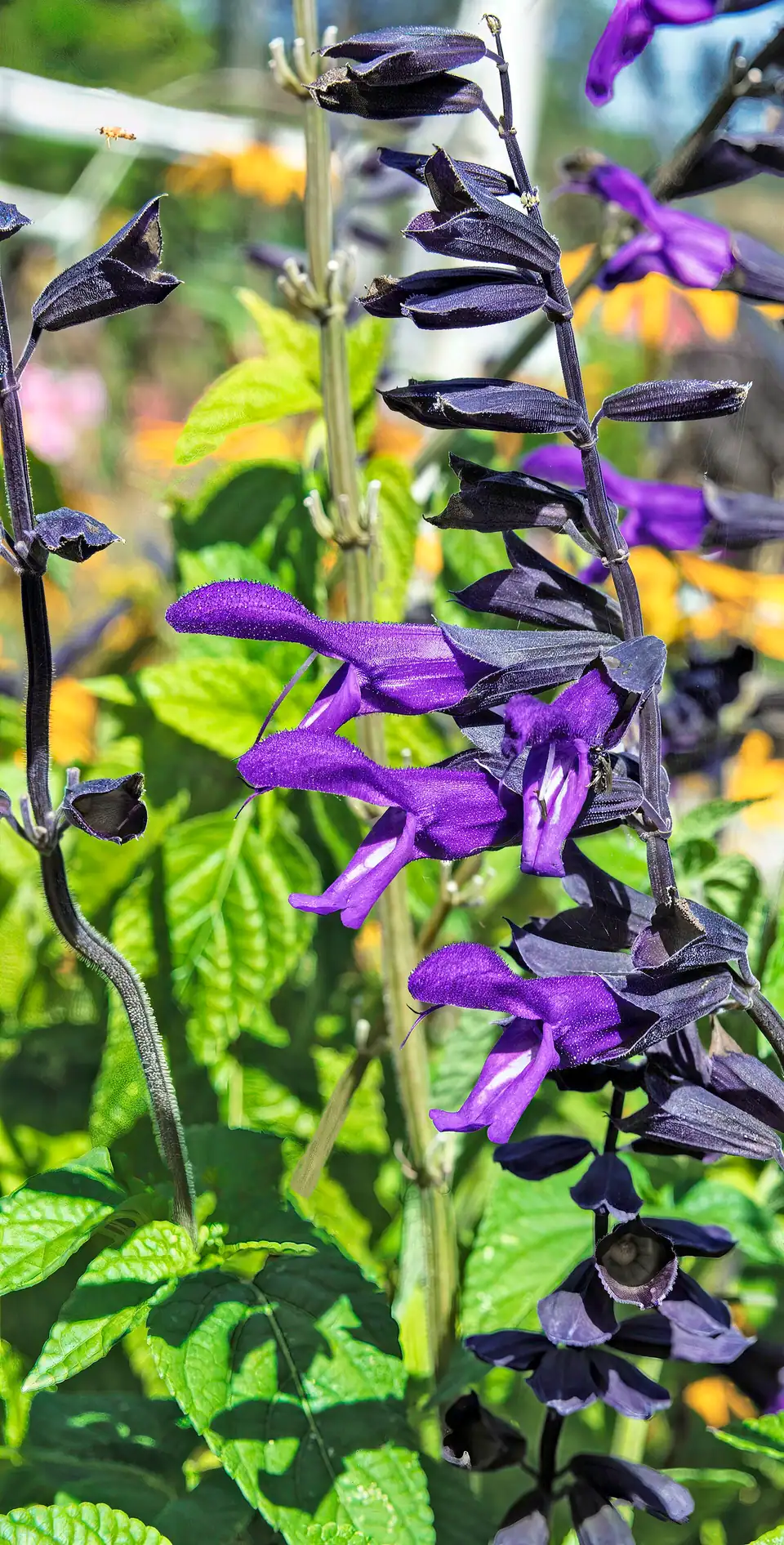


How to Grow and Care for Anise Sage
Salvia guaranitica
Written by Emilio Marruso · last checked
At a glance
This perennial salvia is easy to please: it grows in full sun to partial shade, likes well-drained soil and becomes drought tolerant once established. Start seeds indoors 6–8 weeks before the last spring frost, or make new plants by division and stem cuttings. It reaches 2–5 ft tall and wide, and it grows happily in containers too.
- Sun
Full sun to partial shade
What the sources say (3)
Light: Full sun to partial shade
This plant grows in full sun to partial shade and prefers humus-rich, evenly moist, well-drained soil.
— Salvia guaranitica (Anise Sage, Anise-scented Sage, Blue Anise Sage, Brazillian Sage) | North Carolina Extension Gardener Plant Toolbox [1] Bloom Color : Blue Bloom Description: Deep blue with purple-blue calyx Sun: Full sun to part shade
— Fact sheet: Anise-scented sage - UF/IFAS Extension Nassau County [5] Grow blue anise sage in full sun . It will survive in partial shade but will be gangly and floppy with fewer flowers.
— Blue Anise Sage, Salvia guaranitica – Wisconsin Horticulture [2] - Water
Keep the soil evenly moist; drought tolerant once established
What the sources say (1)
Watering: Evenly moist, well-drained soil; drought tolerant once established
prefers humus-rich, evenly moist, well-drained soil. It is drought and heat tolerant once established.
— Salvia guaranitica (Anise Sage, Anise-scented Sage, Blue Anise Sage, Brazillian Sage) | North Carolina Extension Gardener Plant Toolbox [1] - Soil
Well-drained soil
What the sources say (1)
Watering: Evenly moist, well-drained soil; drought tolerant once established
prefers humus-rich, evenly moist, well-drained soil. It is drought and heat tolerant once established.
— Salvia guaranitica (Anise Sage, Anise-scented Sage, Blue Anise Sage, Brazillian Sage) | North Carolina Extension Gardener Plant Toolbox [1] - Planting
Plant out after the last frost, once the soil has warmed
What the sources say (2)
Planting: After the last frost, once the soil has warmed
transplant outdoors when the soil has warmed and after all threat of frost is past.
— Blue Anise Sage, Salvia guaranitica – Wisconsin Horticulture [2] Set out seedlings or purchased plants after last frost date.
— Fact sheet: Anise-scented sage - UF/IFAS Extension Nassau County [5] - Feeding
Slow-release fertilizer at planting; monthly in pots, very little in the ground
What the sources say (6)
When: At planting
Applying controlled-release fertilizer at planting will supply sufficient nutrition for the summer season.
— Salvia for the Mississippi Gardener | Mississippi State University Extension Service [4] Mineral fertilizers: Controlled-release fertilizer at planting
Applying controlled-release fertilizer at planting will supply sufficient nutrition for the summer season.
— Salvia for the Mississippi Gardener | Mississippi State University Extension Service [4] How often: Monthly for container plants; little additional fertilizer in the ground
in containers: Fertilize container-grown plants monthly.
— Blue Anise Sage, Salvia guaranitica – Wisconsin Horticulture [2] in the ground: In the landscape, little additional fertilizer is needed, and over fertilizing will reduce flower production and produce taller, more brittle stems.
— Blue Anise Sage, Salvia guaranitica – Wisconsin Horticulture [2] Fertilize container-grown plants monthly.
— Blue Anise Sage, Salvia guaranitica – Wisconsin Horticulture [2] In the landscape, little additional fertilizer is needed, and over fertilizing will reduce flower production and produce taller, more brittle stems.
— Blue Anise Sage, Salvia guaranitica – Wisconsin Horticulture [2] - Pruning
Cut the stems back in late spring to keep the plant shorter
What the sources say (1)
Pruning: Late spring (to reduce plant height)
Plant height can be reduced by cutting back stems in late spring.
— Fact sheet: Anise-scented sage - UF/IFAS Extension Nassau County [5] - Pests
Whiteflies, aphids, mealybugs and spider mites; rust and mildew
What the sources say (3)
Pests: whitefly, aphids, mealybugs, spider mites
Whitefly, aphids, mealybugs, and spider mites are insect problems. Rust, powdery mildew, stem rot, and fungal leaf spot are disease problems.
— Salvia guaranitica (Anise Sage, Anise-scented Sage, Blue Anise Sage, Brazillian Sage) | North Carolina Extension Gardener Plant Toolbox [1] Diseases: rust, powdery mildew, stem rot, fungal leaf spot, downy mildew
Whitefly, aphids, mealybugs, and spider mites are insect problems. Rust, powdery mildew, stem rot, and fungal leaf spot are disease problems.
— Salvia guaranitica (Anise Sage, Anise-scented Sage, Blue Anise Sage, Brazillian Sage) | North Carolina Extension Gardener Plant Toolbox [1] No serious insect or disease problems. Susceptible to downy and powdery mildew.
— Fact sheet: Anise-scented sage - UF/IFAS Extension Nassau County [5] - Watch out
Too much shade makes stems stretch and flop; too much fertilizer means fewer flowers
What the sources say (1)
Signs of excess: Fewer flowers and taller, more brittle stems
In the landscape, little additional fertilizer is needed, and over fertilizing will reduce flower production and produce taller, more brittle stems.
— Blue Anise Sage, Salvia guaranitica – Wisconsin Horticulture [2] - Size
2 to 5 ft tall and wide
What the sources say (6)
Mature height: 61-152 cm (2-5 ft)
cultivar 'Black and Bloom': Plant size: up to 48 inches tall, 36 inches wide
— Salvia for the Mississippi Gardener | Mississippi State University Extension Service [4] Dimensions: Height: 2 ft. 0 in. - 5 ft. 0 in. Width: 2 ft. 0 in. - 5 ft. 0 in.
— Salvia guaranitica (Anise Sage, Anise-scented Sage, Blue Anise Sage, Brazillian Sage) | North Carolina Extension Gardener Plant Toolbox [1] Height: 2 to 5 feet Spread : 2 to 5 feet Bloom Time: July to October
— Fact sheet: Anise-scented sage - UF/IFAS Extension Nassau County [5] Mature width: 61-152 cm (2-5 ft)
cultivar 'Black and Bloom': Plant size: up to 48 inches tall, 36 inches wide
— Salvia for the Mississippi Gardener | Mississippi State University Extension Service [4] Dimensions: Height: 2 ft. 0 in. - 5 ft. 0 in. Width: 2 ft. 0 in. - 5 ft. 0 in.
— Salvia guaranitica (Anise Sage, Anise-scented Sage, Blue Anise Sage, Brazillian Sage) | North Carolina Extension Gardener Plant Toolbox [1] Height: 2 to 5 feet Spread : 2 to 5 feet Bloom Time: July to October
— Fact sheet: Anise-scented sage - UF/IFAS Extension Nassau County [5] - Propagation
By division, stem cuttings or seed
What the sources say (2)
Propagation: Division, stem cuttings, seed
Recommended Propagation Strategy: Division Stem Cutting Country Or Region Of Origin:
— Salvia guaranitica (Anise Sage, Anise-scented Sage, Blue Anise Sage, Brazillian Sage) | North Carolina Extension Gardener Plant Toolbox [1] The species can be grown from seed but named cultivars are propagated from cuttings or by division in spring
— Blue Anise Sage, Salvia guaranitica – Wisconsin Horticulture [2] - Sowing
Sow indoors 6–8 weeks before the last spring frost
What the sources say (2)
Sowing: Indoors, 6-8 weeks before the last spring frost
Start seeds indoors 6 to 8 weeks before the average last frost
— Blue Anise Sage, Salvia guaranitica – Wisconsin Horticulture [2] Seed should be started indoors 6-8 weeks before last spring frost date.
— Fact sheet: Anise-scented sage - UF/IFAS Extension Nassau County [5] - Containers
Grows in containers too; feed potted plants monthly
What the sources say (6)
In containers: Yes
It can be readily contained in a large pot, but potted plants must be brought under protection when temperatures plummet.
— Salvia guaranitica (Anise Sage, Anise-scented Sage, Blue Anise Sage, Brazillian Sage) | North Carolina Extension Gardener Plant Toolbox [1] Blue anise sage is a good addition to annual or mixed beds. It also does well in containers.
— Blue Anise Sage, Salvia guaranitica – Wisconsin Horticulture [2] How often: Monthly for container plants; little additional fertilizer in the ground
in containers: Fertilize container-grown plants monthly.
— Blue Anise Sage, Salvia guaranitica – Wisconsin Horticulture [2] in the ground: In the landscape, little additional fertilizer is needed, and over fertilizing will reduce flower production and produce taller, more brittle stems.
— Blue Anise Sage, Salvia guaranitica – Wisconsin Horticulture [2] Fertilize container-grown plants monthly.
— Blue Anise Sage, Salvia guaranitica – Wisconsin Horticulture [2] In the landscape, little additional fertilizer is needed, and over fertilizing will reduce flower production and produce taller, more brittle stems.
— Blue Anise Sage, Salvia guaranitica – Wisconsin Horticulture [2]
Overview
Blue anise sage is a tender herbaceous perennial from South America grown for its blue flowers. [1] It grows in full sun to partial shade and is drought and heat tolerant once established. [1] It can be grown in containers and is propagated by division, stem cuttings or seed. [2][1]
Anise Sage care
How to water Anise Sage
Evenly moist, well-drained soil; drought tolerant once established
What the sources say (1)
prefers humus-rich, evenly moist, well-drained soil. It is drought and heat tolerant once established.How much light Anise Sage needs
Full sun to partial shade
What the sources say (3)
This plant grows in full sun to partial shade and prefers humus-rich, evenly moist, well-drained soil.Bloom Color : Blue
Bloom Description: Deep blue with purple-blue calyx
Sun: Full sun to part shadeGrow blue anise sage in full sun . It will survive in partial shade but will be gangly and floppy with fewer flowers.How much cold Anise Sage can take
Hardiness, coldest zone
The sources give different values depending on region, zone or growing conditions.
What each source says
According to NC State Extension: 7b [winter low −15 to −12.2 °C (5 to 10 °F)]
According to University of Wisconsin Extension: 8a [winter low −12.2 to −9.4 °C (10 to 15 °F)]
According to UF/IFAS Extension Nassau County: 8 [winter low −12.2 to −6.7 °C (10 to 20 °F)]
What the sources say (3)
According to NC State Extension: USDA Plant Hardiness Zone:
7b, 8a, 8b, 9a, 9b, 10a, 10bAccording to University of Wisconsin Extension: This attractive tender subshrub is hardy in zones 8a to 10bAccording to UF/IFAS Extension Nassau County: Blue anise sage is winter hardy to USDA Zones 8-10.Hardiness, warmest zone
10b [winter low 1.7 to 4.4 °C (35 to 40 °F)]
What the sources say (2)
USDA Plant Hardiness Zone:
7b, 8a, 8b, 9a, 9b, 10a, 10bThis attractive tender subshrub is hardy in zones 8a to 10bWhere to grow Anise Sage
Yes
What the sources say (2)
It can be readily contained in a large pot, but potted plants must be brought under protection when temperatures plummet.Blue anise sage is a good addition to annual or mixed beds. It also does well in containers.How to propagate Anise Sage
Division, stem cuttings, seed
What the sources say (2)
Recommended Propagation Strategy:
Division
Stem Cutting
Country Or Region Of Origin:The species can be grown from seed but named cultivars are propagated from cuttings or by division in springHow to grow Anise Sage
The plant
Life cycle
perennial
What the sources say (1)
Blue anise sage is an herbaceous perennial in the mint family (Lamiaceae) from Brazil, Paraguay, Uruguay and Argentina.Family
Lamiaceae
What the sources say (1)
Blue anise sage is an herbaceous perennial in the mint family (Lamiaceae) from Brazil, Paraguay, Uruguay and Argentina.Mature height
61-152 cm (2-5 ft)
What each source says
cultivar 'Black and Bloom': 122 cm (48 in)
What the sources say (3)
cultivar 'Black and Bloom': Plant size: up to 48 inches tall, 36 inches wideDimensions:
Height: 2 ft. 0 in. - 5 ft. 0 in.
Width: 2 ft. 0 in. - 5 ft. 0 in.Height: 2 to 5 feet
Spread : 2 to 5 feet
Bloom Time: July to OctoberMature width
61-152 cm (2-5 ft)
What each source says
cultivar 'Black and Bloom': 91 cm (36 in)
What the sources say (3)
cultivar 'Black and Bloom': Plant size: up to 48 inches tall, 36 inches wideDimensions:
Height: 2 ft. 0 in. - 5 ft. 0 in.
Width: 2 ft. 0 in. - 5 ft. 0 in.Height: 2 to 5 feet
Spread : 2 to 5 feet
Bloom Time: July to OctoberPests and diseases
Pests
whitefly, aphids, mealybugs, spider mites
What the sources say (1)
Whitefly, aphids, mealybugs, and spider mites are insect problems. Rust, powdery mildew, stem rot, and fungal leaf spot are disease problems.Diseases
rust, powdery mildew, stem rot, fungal leaf spot, downy mildew
What the sources say (2)
Whitefly, aphids, mealybugs, and spider mites are insect problems. Rust, powdery mildew, stem rot, and fungal leaf spot are disease problems.No serious insect or disease problems. Susceptible to downy and powdery mildew.Fertilizing
When
At planting
What the sources say (1)
Applying controlled-release fertilizer at planting will supply sufficient nutrition for the summer season.How often
Monthly for container plants; little additional fertilizer in the ground
What each source says
in containers: Monthly
in the ground: Little additional fertilizer
What the sources say (4)
in containers: Fertilize container-grown plants monthly.in the ground: In the landscape, little additional fertilizer is needed, and over fertilizing will reduce flower production and produce taller, more brittle stems.Fertilize container-grown plants monthly.In the landscape, little additional fertilizer is needed, and over fertilizing will reduce flower production and produce taller, more brittle stems.Mineral fertilizers
Controlled-release fertilizer at planting
What the sources say (1)
Applying controlled-release fertilizer at planting will supply sufficient nutrition for the summer season.Avoid
Over-fertilizing plants in the ground
What the sources say (1)
In the landscape, little additional fertilizer is needed, and over fertilizing will reduce flower production and produce taller, more brittle stems.Signs of excess
Fewer flowers and taller, more brittle stems
What the sources say (1)
In the landscape, little additional fertilizer is needed, and over fertilizing will reduce flower production and produce taller, more brittle stems.Anise Sage pests and problems
Insect and disease problems
Symptom: Whitefly, aphids, mealybugs and spider mites; rust, powdery mildew, stem rot and fungal leaf spot.
What the sources say (1)
Whitefly, aphids, mealybugs, and spider mites are insect problems. Rust, powdery mildew, stem rot, and fungal leaf spot are disease problems.
— Salvia guaranitica (Anise Sage, Anise-scented Sage, Blue Anise Sage, Brazillian Sage) | North Carolina Extension Gardener Plant Toolbox [1] Mildew
Symptom: Susceptible to downy and powdery mildew.
What the sources say (1)
No serious insect or disease problems. Susceptible to downy and powdery mildew.
— Fact sheet: Anise-scented sage - UF/IFAS Extension Nassau County [5] Leggy growth in shade
Symptom: In too much shade, plant stems tend to elongate and fall over.
What to do: Cutting back stems in late spring reduces plant height.
What the sources say (2)
If grown in too much shade, plant stems tend to elongate and fall over.
— Fact sheet: Anise-scented sage - UF/IFAS Extension Nassau County [5] Plant height can be reduced by cutting back stems in late spring.
— Fact sheet: Anise-scented sage - UF/IFAS Extension Nassau County [5]
Remedies
The sources we checked give no remedies for this plant.
Calendar
Sowing
Indoors, 6-8 weeks before the last spring frost
Planting
After the last frost, once the soil has warmed
What the sources say (2)
transplant outdoors when the soil has warmed and after all threat of frost is past.Set out seedlings or purchased plants after last frost date.Pruning
Late spring (to reduce plant height)
What the sources say (1)
Plant height can be reduced by cutting back stems in late spring.Months as given by the sources, which are mostly from the United States (northern hemisphere). In the southern hemisphere they shift by about six months.
Relative to frost
Less precise estimate: there is no weather station within 300 km.
Find frost dates by ZIP code or city
Sow indoors: 6 to 8 weeks before the last frost
Seed should be started indoors 6-8 weeks before last spring frost date.
— Fact sheet: Anise-scented sage - UF/IFAS Extension Nassau County [5] Transplant: around the last frost
Set out seedlings or purchased plants after last frost date.
— Fact sheet: Anise-scented sage - UF/IFAS Extension Nassau County [5]
Count from the average frost dates where you live.
Indicative values
Values from a secondary source, not checked word for word like the rest of this page. Use them as a starting point.
- Drought tolerant
- yesIndicative value, adapt it to your climate · Secondary source
- Soil pH
- 6-7.5Indicative value, adapt it to your climate · Secondary source
- Care level
- MediumIndicative value, adapt it to your climate · Secondary source
- Growth rate
- HighIndicative value, adapt it to your climate · Secondary source
Similar plants
- Arrowleaf Sage Salvia sagittata
- Autumn Sage Salvia greggii
- Blue Sage Salvia azurea
- Bog Sage Salvia uliginosa
- Cedar Sage Salvia roemeriana
- Clary Sage Salvia sclarea
- Little Leaf Sage Salvia microphylla
- Lyreleaf Sage Salvia lyrata
Sources
Every value above is quoted from these documents. Links lead to the original publisher.
- Salvia guaranitica (Anise Sage, Anise-scented Sage, Blue Anise Sage, Brazillian Sage) | North Carolina Extension Gardener Plant Toolbox · plants.ces.ncsu.edu, consulted
- Blue Anise Sage, Salvia guaranitica – Wisconsin Horticulture · hort.extension.wisc.edu, consulted
- Brazillian Sage - Salvia guaranitica | North Carolina Extension Gardener Plant Toolbox · plants.ces.ncsu.edu, consulted
- Salvia for the Mississippi Gardener | Mississippi State University Extension Service · extension.msstate.edu, consulted
- Fact sheet: Anise-scented sage - UF/IFAS Extension Nassau County · blogs.ifas.ufl.edu, consulted
- Salvia (Sage, Salvia) | North Carolina Extension Gardener Plant Toolbox · plants.ces.ncsu.edu, consulted
- Salvia - Salvia | North Carolina Extension Gardener Plant Toolbox · plants.ces.ncsu.edu, consulted
Written by Emilio Marruso · last checked