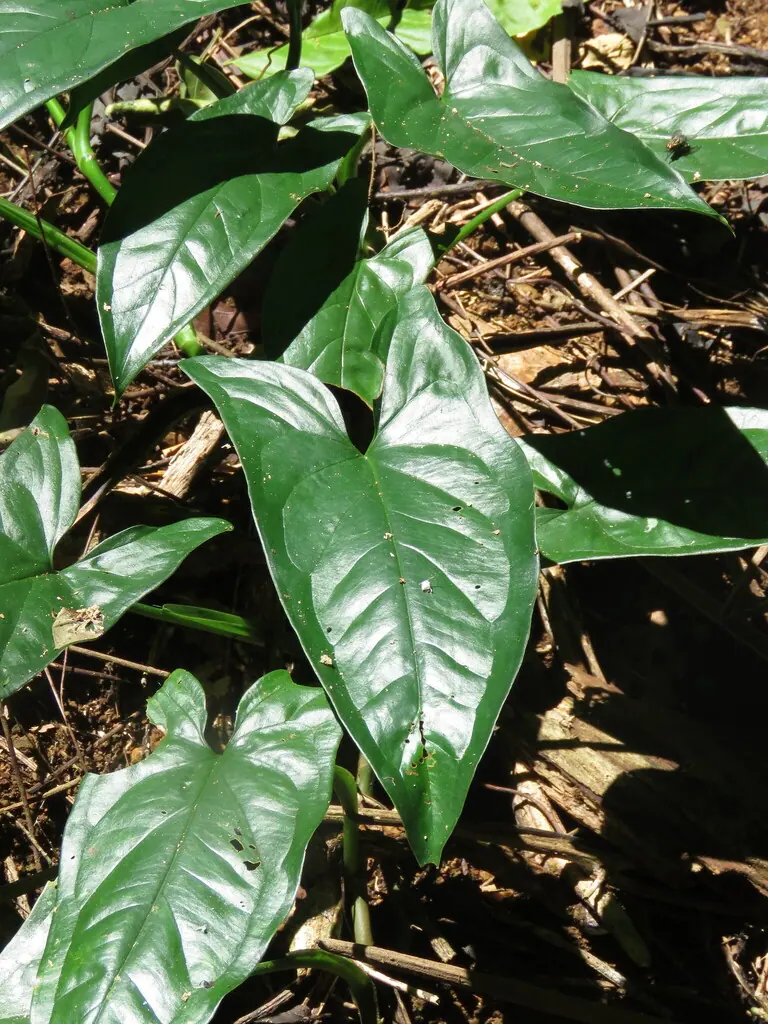
Cómo cultivar y cuidar Arrowhead Plant
Syngonium podophyllum
Escrito por Emilio Marruso · última revisión
Tóxica para: Gatos, Perros, Caballos, Personas · Por qué
De un vistazo
El singonio es una perenne agradecida que crece feliz en interior o en maceta. Dale luz filtrada o semisombra, lejos del sol pleno que quema sus hojas, y puede alcanzar de 90 cm a 1,8 m de alto. Abónalo una vez al mes en primavera y verano, y consigue plantas nuevas con esquejes de tallo, división o acodo.
- Sol
Luz filtrada o semisombra; el sol pleno quema las hojas
Qué dicen las fuentes (2)
Luz: Luz filtrada a semisombra; evita el pleno sol, que quema o blanquea el follaje
Light: Dappled Sunlight (Shade through upper canopy all day) Partial Shade (Direct sunlight only part of the day, 2-6 hours)
— Syngonium podophyllum (American Evergreen, Arrowhead Plant, Arrow-Head Vine, Arrowhead Vine, Trileaf Wonder) | North Carolina Extension Gardener Plant Toolbox [1] Avoid locations with full sun, as direct sunlight will tend to burn or bleach the foliage.
— Syngonium podophyllum (American Evergreen, Arrowhead Plant, Arrow-Head Vine, Arrowhead Vine, Trileaf Wonder) | North Carolina Extension Gardener Plant Toolbox [1] - Frío
Aguanta inviernos de hasta −1,1 °C (30 °F)
Semirrústica: inviernos suaves o invernadero sin calefacción · USDA 10a · RHS H3 · Z10
Qué dicen las fuentes (2)
Rusticidad, zona más fría: 10a [mínima invernal de −1,1 a 1,7 °C (de 30 a 35 °F)]
USDA Plant Hardiness Zone: 10a, 10b, 11a, 11b, 12a, 12b
— Syngonium podophyllum (American Evergreen, Arrowhead Plant, Arrow-Head Vine, Arrowhead Vine, Trileaf Wonder) | North Carolina Extension Gardener Plant Toolbox [1] Rusticidad, zona más cálida: 12b [mínima invernal de 12,8 a 15,6 °C (de 55 a 60 °F)]
USDA Plant Hardiness Zone: 10a, 10b, 11a, 11b, 12a, 12b
— Syngonium podophyllum (American Evergreen, Arrowhead Plant, Arrow-Head Vine, Arrowhead Vine, Trileaf Wonder) | North Carolina Extension Gardener Plant Toolbox [1] - Abonado
Una vez al mes en primavera y verano, con abono equilibrado a dosis reducida
Qué dicen las fuentes (7)
Cuándo: Temporada de crecimiento de primavera y verano
Fertilize with a balanced fertilizer, such as 20-20-20 or 10-10-10 , at a reduced rate once a month during the spring and summer growing season.
— [3] Frecuencia: Una vez al mes con una dosis reducida; no muy a menudo si se mantiene la planta joven o en poca luz
producción comercial: If a controlled-release fertilizer with the N-P2O5-K2O ratio of 3-1-2 is used, apply it at rate of 6.5 lb N per 1,000 square feet on a quarterly basis
— [4] Fertilize with a balanced fertilizer, such as 20-20-20 or 10-10-10 , at a reduced rate once a month during the spring and summer growing season.
— [3] Arrowhead vines are not heavy feeders and should not be fertilized often if trying to keep the plant in a juvenile state or growing in low light.
— [3] Abonos minerales: Fertilizante equilibrado como 20-20-20 o 10-10-10, con una dosis reducida
producción comercial, fertirrigación: a nutrient solution with N at 150 ppm can be used. This solution can be made using a water-soluble fertilizer with N-P2O5-K2O at a 3-1-2 ratio, such as a 24-8-16 or 18-6-12 with micronutrients.
— [4] producción comercial, liberación controlada: If a controlled-release fertilizer with the N-P2O5-K2O ratio of 3-1-2 is used, apply it at rate of 6.5 lb N per 1,000 square feet on a quarterly basis or 26 lbs N/1000 sq. ft annually.
— [4] Fertilize with a balanced fertilizer, such as 20-20-20 or 10-10-10 , at a reduced rate once a month during the spring and summer growing season.
— [3] - Plagas
Pulgones, cochinillas algodonosas y araña roja; también manchas foliares y podredumbre blanda
Qué dicen las fuentes (2)
Plagas: pulgones, cochinillas harinosas, arañitas rojas
Watch for aphids, mealybugs, and spider mites. Bacterial leaf spots and soft rot can occur.
— Syngonium podophyllum (American Evergreen, Arrowhead Plant, Arrow-Head Vine, Arrowhead Vine, Trileaf Wonder) | North Carolina Extension Gardener Plant Toolbox [1] Enfermedades: manchas bacterianas en las hojas, pudrición blanda
Watch for aphids, mealybugs, and spider mites. Bacterial leaf spots and soft rot can occur.
— Syngonium podophyllum (American Evergreen, Arrowhead Plant, Arrow-Head Vine, Arrowhead Vine, Trileaf Wonder) | North Carolina Extension Gardener Plant Toolbox [1] - Tamaño
De 90 cm a 1,8 m de alto y 30–60 cm de ancho
Qué dicen las fuentes (2)
Altura adulta: 91-183 cm (3-6 pies)
Dimensions: Height: 3 ft. 0 in. - 6 ft. 0 in. Width: 1 ft. 0 in. - 2 ft. 0 in.
— Syngonium podophyllum (American Evergreen, Arrowhead Plant, Arrow-Head Vine, Arrowhead Vine, Trileaf Wonder) | North Carolina Extension Gardener Plant Toolbox [1] Anchura adulta: 30-61 cm (1-2 pies)
Dimensions: Height: 3 ft. 0 in. - 6 ft. 0 in. Width: 1 ft. 0 in. - 2 ft. 0 in.
— Syngonium podophyllum (American Evergreen, Arrowhead Plant, Arrow-Head Vine, Arrowhead Vine, Trileaf Wonder) | North Carolina Extension Gardener Plant Toolbox [1] - Multiplicación
Plantas nuevas con esquejes de tallo, división o acodo
Qué dicen las fuentes (1)
Propagación: División, acodo, esqueje de tallo
Recommended Propagation Strategy: Division Layering Stem Cutting Country Or Region Of Origin:
— Syngonium podophyllum (American Evergreen, Arrowhead Plant, Arrow-Head Vine, Arrowhead Vine, Trileaf Wonder) | North Carolina Extension Gardener Plant Toolbox [1] - Maceta
Crece bien en maceta y en interior
Qué dicen las fuentes (2)
En maceta: Sí
it can be grown as an annual for your containers or other bright but shady locations.
— Syngonium podophyllum (American Evergreen, Arrowhead Plant, Arrow-Head Vine, Arrowhead Vine, Trileaf Wonder) | North Carolina Extension Gardener Plant Toolbox [1] En interior: Sí
It is desired in interior settings for its low-maintenance, green or variegated, long-petioled leaves
— Syngonium podophyllum (American Evergreen, Arrowhead Plant, Arrow-Head Vine, Arrowhead Vine, Trileaf Wonder) | North Carolina Extension Gardener Plant Toolbox [1] - Seguridad
Tóxica para personas, gatos, perros y caballos: irrita e hincha la boca y puede irritar la piel
Resumen
El siempreverde americano es un arbusto o enredadera tropical perenne, que trepa hasta 6 pies [1,8 m], utilizado en interiores. [1] Prefiere luz solar filtrada a semisombra, y el sol directo quema o blanquea el follaje. [1]
Citado en inglés, como en la fuente.
Esta ficha está incompleta: las fuentes consultadas aún no cubren todos los campos.
Aún no cubierto por nuestras fuentes: Riego
Cuidados
Las medidas entre corchetes son nuestra conversión al otro sistema de unidades; el texto citado no cambia.
Riego
No figura en las fuentes consultadas.
Luz
Luz filtrada a semisombra; evita el pleno sol, que quema o blanquea el follaje
Qué dicen las fuentes (2)
Light:
Dappled Sunlight (Shade through upper canopy all day)
Partial Shade (Direct sunlight only part of the day, 2-6 hours)Avoid locations with full sun, as direct sunlight will tend to burn or bleach the foliage.Clima y frío
Rusticidad, zona más fría
10a [mínima invernal de −1,1 a 1,7 °C (de 30 a 35 °F)]
Qué dicen las fuentes (1)
USDA Plant Hardiness Zone:
10a, 10b, 11a, 11b, 12a, 12bRusticidad, zona más cálida
12b [mínima invernal de 12,8 a 15,6 °C (de 55 a 60 °F)]
Qué dicen las fuentes (1)
USDA Plant Hardiness Zone:
10a, 10b, 11a, 11b, 12a, 12bDónde cultivarla
En interior
Sí
Qué dicen las fuentes (1)
It is desired in interior settings for its low-maintenance, green or variegated, long-petioled leavesEn maceta
Sí
Qué dicen las fuentes (1)
it can be grown as an annual for your containers or other bright but shady locations.Propagación
División, acodo, esqueje de tallo
Qué dicen las fuentes (1)
Recommended Propagation Strategy:
Division
Layering
Stem Cutting
Country Or Region Of Origin:Cultivo
La planta
Ciclo de vida
perenne (se puede cultivar como anual)
Qué dicen las fuentes (1)
Typically a perennial, it can be grown as an annual for your containers or other bright but shady locations.Familia
Araceae
Qué dicen las fuentes (1)
The American evergreen is a tropical perennial shrub or vine in the Araceae family climbing to 6 feet.Altura adulta
91-183 cm (3-6 pies)
Qué dicen las fuentes (1)
Dimensions:
Height: 3 ft. 0 in. - 6 ft. 0 in.
Width: 1 ft. 0 in. - 2 ft. 0 in.Anchura adulta
30-61 cm (1-2 pies)
Qué dicen las fuentes (1)
Dimensions:
Height: 3 ft. 0 in. - 6 ft. 0 in.
Width: 1 ft. 0 in. - 2 ft. 0 in.Plagas y enfermedades
Plagas
pulgones, cochinillas harinosas, arañitas rojas
Qué dicen las fuentes (1)
Watch for aphids, mealybugs, and spider mites. Bacterial leaf spots and soft rot can occur.Enfermedades
manchas bacterianas en las hojas, pudrición blanda
Qué dicen las fuentes (1)
Watch for aphids, mealybugs, and spider mites. Bacterial leaf spots and soft rot can occur.Abonado
Cuándo
Temporada de crecimiento de primavera y verano
Qué dicen las fuentes (1)
Fertilize with a balanced fertilizer, such as 20-20-20 or 10-10-10 , at a reduced rate once a month during the spring and summer growing season.Frecuencia
Una vez al mes con una dosis reducida; no muy a menudo si se mantiene la planta joven o en poca luz
Lo que dice cada fuente
producción comercial: Cada trimestre con fertilizante de liberación controlada
Qué dicen las fuentes (3)
producción comercial: If a controlled-release fertilizer with the N-P2O5-K2O ratio of 3-1-2 is used, apply it at rate of 6.5 lb N per 1,000 square feet on a quarterly basisFertilize with a balanced fertilizer, such as 20-20-20 or 10-10-10 , at a reduced rate once a month during the spring and summer growing season.Arrowhead vines are not heavy feeders and should not be fertilized often if trying to keep the plant in a juvenile state or growing in low light.Abonos minerales
Fertilizante equilibrado como 20-20-20 o 10-10-10, con una dosis reducida
Lo que dice cada fuente
producción comercial, fertirrigación: Fertilizante soluble en agua con una relación N-P2O5-K2O de 3-1-2 (24-8-16 o 18-6-12) con micronutrientes, N a 150 ppm
producción comercial, liberación controlada: Fertilizante de liberación controlada con una relación 3-1-2 a 31.7 g N/m² por trimestre (127 g N/m² al año)
Qué dicen las fuentes (3)
producción comercial, fertirrigación: a nutrient solution with N at 150 ppm can be used. This solution can be made using a water-soluble fertilizer with N-P2O5-K2O at a 3-1-2 ratio, such as a 24-8-16 or 18-6-12 with micronutrients.producción comercial, liberación controlada: If a controlled-release fertilizer with the N-P2O5-K2O ratio of 3-1-2 is used, apply it at rate of 6.5 lb N per 1,000 square feet on a quarterly basis or 26 lbs N/1000 sq. ft annually.Fertilize with a balanced fertilizer, such as 20-20-20 or 10-10-10 , at a reduced rate once a month during the spring and summer growing season.Evitar
Las fuentes dan valores distintos según la región, la zona o las condiciones de cultivo.
Lo que dice cada fuente
producción comercial: Reduce o deja de fertilizar un mes antes de que se envíen las plantas
producción comercial: Reduce la frecuencia o la cantidad de fertilizante cuando las lecturas de EC del sustrato superen 3.0 dS/m
Qué dicen las fuentes (2)
producción comercial: It is recommended that fertilizer applications be reduced or eliminated one month before plants are shipped.producción comercial: whereas if EC readings are above 3.0 dS/m, growers should reduce either the frequency or amount of applied fertilizer.Signos de carencia
Las fuentes dan valores distintos según la región, la zona o las condiciones de cultivo.
Lo que dice cada fuente
producción comercial: Las hojas más viejas se vuelven amarillas (deficiencia de nitrógeno o sustrato demasiado seco)
producción comercial: Crecimiento reducido y manchas necróticas en las hojas inferiores (fósforo)
Qué dicen las fuentes (2)
producción comercial: Old leaves tend to turn yellow. N deficiency or media run to dry. Apply N at 150 ppm weekly or maintain media moisture.producción comercial: Reduced growth and necrotic spots on lower leaves. Phosphorus deficiency. Apply P into media by supplying a fertilizer with a 3-1-2 (N-P2O5-K2O) ratio.Problemas
Plagas de insectos y enfermedades foliares
Síntoma: Pueden aparecer pulgones, cochinillas harinosas y arañitas rojas; también manchas bacterianas en las hojas y pudrición blanda.
Qué hacer: Está atento a estos problemas.
Qué dicen las fuentes (1)
Watch for aphids, mealybugs, and spider mites. Bacterial leaf spots and soft rot can occur.
— Syngonium podophyllum (American Evergreen, Arrowhead Plant, Arrow-Head Vine, Arrowhead Vine, Trileaf Wonder) | North Carolina Extension Gardener Plant Toolbox [1]
Remedios
Cada remedio indica qué dicen las fuentes oficiales; los remedios tradicionales sin fuente oficial aparecen marcados. Los perjudiciales están para que sepas evitarlos.
Primeros auxilios
Primeros auxilios: no sustituyen al médico
partes de la planta en la boca o en las manos después del contacto o la ingestión
retira las partes de la planta y enjuaga la boca y las manos Fuente oficial, sin prueba independiente
Call the Poison Hotline at 1-800-222-1222 —even if you are not sure, it will not be a waste of time
— calpoison.org [5] Do NOT induce vomiting - Do not wait for symptoms to appear—treatment will be more difficult once symptoms have developed
— calpoison.org [5] Cómo: Retira cualquier parte de la planta de la boca o las manos, lava alrededor de la boca y las manos y da algunos sorbos de agua; no induzcas el vómito.
Remove any plant or mushroom parts from the mouth or hands - Wash around the mouth and hands and give a few sips of water
— calpoison.org [5]
Venenosa para los animales
Según la fuente, citada textualmente. No es un consejo médico ni veterinario: si una persona o un animal pudo haber ingerido esta planta, contacta con un centro de toxicología o con un veterinario.
Animales
#problem for cats #problem for dogs #problem for horses
[1]- Gravedad
This plant has medium severity poison characteristics. See below
[1]
Personas
Oral irritation, pain and swelling of mouth, tongue, and lips, excessive drooling, vomiting (not horses), difficulty swallowing
[1]- Partes venenosas
Causes Contact Dermatitis: Yes Poison Part: Flowers Leaves Roots Sap/Juice Seeds Stems
[1]- Principio tóxico
Poison Toxic Principle: Calcium oxalate crystals Causes Contact Dermatitis: Yes
[1]- Síntomas
Oral irritation, pain and swelling of mouth, tongue, and lips, excessive drooling, vomiting (not horses), difficulty swallowing
[1]- Gravedad
This plant has medium severity poison characteristics. See below
[1]
Poison Toxic Principle: Calcium oxalate crystals Causes Contact Dermatitis:
[1]
Valores orientativos
Valores de una fuente secundaria, no comprobados palabra por palabra como el resto de esta página. Úselos como punto de partida.
- Riego
- PromedioValor orientativo, adáptalo a tu clima · Fuente secundaria
- pH del suelo
- 5.5-6.5Valor orientativo, adáptalo a tu clima · Fuente secundaria
- Nivel de cuidado
- MedioValor orientativo, adáptalo a tu clima · Fuente secundaria
- Crecimiento
- BajoValor orientativo, adáptalo a tu clima · Fuente secundaria
- Poda
- Mayo, junio, julioValor orientativo, adáptalo a tu clima · Fuente secundaria
Plantas similares
- Anthurium Anthurium andraeanum
- Aro Arum maculatum
- Black Calla Arum palaestinum
- Blushing Philodendron Philodendron erubescens
- Cala Zantedeschia aethiopica
- Chinese Evergreen Aglaonema commutatum
- Cobra Lily Arisaema ringens
- Dancing Crane Cobra Lily Arisaema heterophyllum
Fuentes
Cada valor anterior se cita de estos documentos. Los enlaces llevan al editor original.
- Syngonium podophyllum (American Evergreen, Arrowhead Plant, Arrow-Head Vine, Arrowhead Vine, Trileaf Wonder) | North Carolina Extension Gardener Plant Toolbox · plants.ces.ncsu.edu, consultado
- Arrowhead Vine - Syngonium podophyllum | North Carolina Extension Gardener Plant Toolbox · plants.ces.ncsu.edu, consultado
- hgic.clemson.edu · hgic.clemson.edu
- edis.ifas.ufl.edu · edis.ifas.ufl.edu
- calpoison.org · calpoison.org
Escrito por Emilio Marruso · última revisión