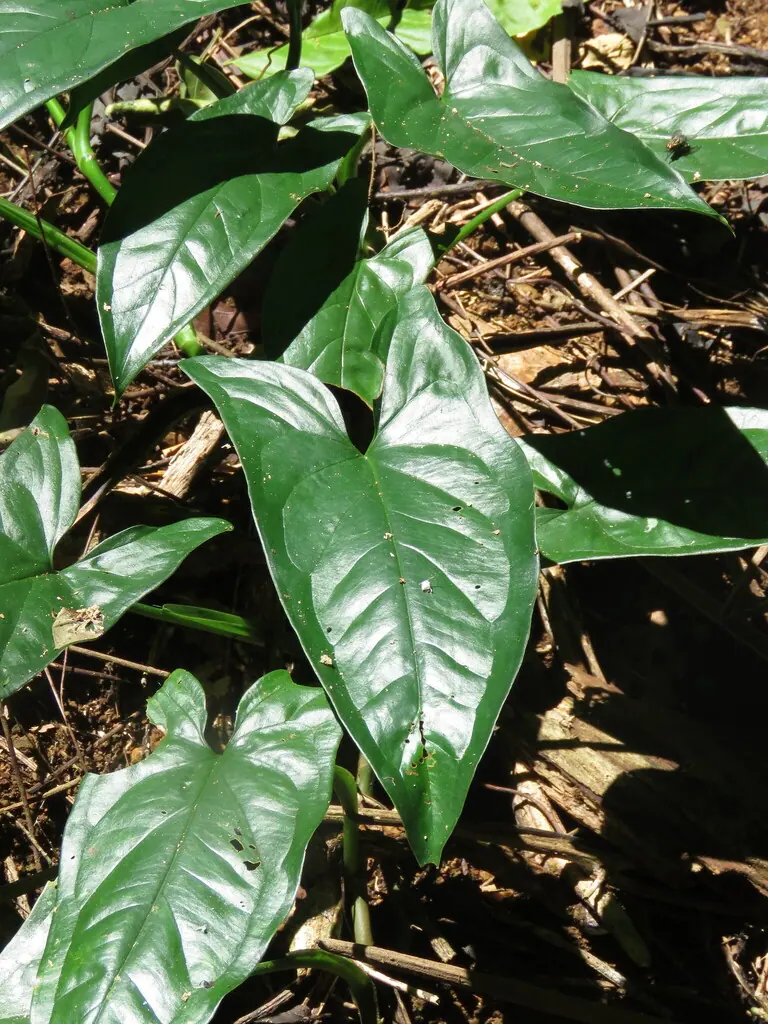
How to Grow and Care for Arrowhead Plant
Syngonium podophyllum
Written by Emilio Marruso · last checked
Toxic to: Cats, Dogs, Horses, People · Why
At a glance
Syngonium is an easygoing perennial that grows happily indoors or in a container. Give it dappled sunlight or partial shade, away from the full sun that burns its leaves, and it can reach 3–6 ft tall. Feed it once a month in spring and summer, and make new plants from stem cuttings, division or layering.
- Sun
Dappled sun or partial shade; full sun burns the leaves
What the sources say (2)
Light: Dappled sunlight to partial shade; avoid full sun, which burns or bleaches the foliage
Light: Dappled Sunlight (Shade through upper canopy all day) Partial Shade (Direct sunlight only part of the day, 2-6 hours)
— Syngonium podophyllum (American Evergreen, Arrowhead Plant, Arrow-Head Vine, Arrowhead Vine, Trileaf Wonder) | North Carolina Extension Gardener Plant Toolbox [1] Avoid locations with full sun, as direct sunlight will tend to burn or bleach the foliage.
— Syngonium podophyllum (American Evergreen, Arrowhead Plant, Arrow-Head Vine, Arrowhead Vine, Trileaf Wonder) | North Carolina Extension Gardener Plant Toolbox [1] - Cold
Survives winters down to 30 °F (−1.1 °C)
Half hardy: mild winters or an unheated greenhouse · USDA 10a · RHS H3 · Z10
What the sources say (2)
Hardiness, coldest zone: 10a [winter low −1.1 to 1.7 °C (30 to 35 °F)]
USDA Plant Hardiness Zone: 10a, 10b, 11a, 11b, 12a, 12b
— Syngonium podophyllum (American Evergreen, Arrowhead Plant, Arrow-Head Vine, Arrowhead Vine, Trileaf Wonder) | North Carolina Extension Gardener Plant Toolbox [1] Hardiness, warmest zone: 12b [winter low 12.8 to 15.6 °C (55 to 60 °F)]
USDA Plant Hardiness Zone: 10a, 10b, 11a, 11b, 12a, 12b
— Syngonium podophyllum (American Evergreen, Arrowhead Plant, Arrow-Head Vine, Arrowhead Vine, Trileaf Wonder) | North Carolina Extension Gardener Plant Toolbox [1] - Feeding
Once a month in spring and summer, with a balanced fertilizer at a reduced dose
What the sources say (7)
When: Spring and summer growing season
Fertilize with a balanced fertilizer, such as 20-20-20 or 10-10-10 , at a reduced rate once a month during the spring and summer growing season.
— [3] How often: Once a month at a reduced rate; not often if keeping the plant juvenile or in low light
commercial production: If a controlled-release fertilizer with the N-P2O5-K2O ratio of 3-1-2 is used, apply it at rate of 6.5 lb N per 1,000 square feet on a quarterly basis
— [4] Fertilize with a balanced fertilizer, such as 20-20-20 or 10-10-10 , at a reduced rate once a month during the spring and summer growing season.
— [3] Arrowhead vines are not heavy feeders and should not be fertilized often if trying to keep the plant in a juvenile state or growing in low light.
— [3] Mineral fertilizers: Balanced fertilizer such as 20-20-20 or 10-10-10, at a reduced rate
commercial production, fertigation: a nutrient solution with N at 150 ppm can be used. This solution can be made using a water-soluble fertilizer with N-P2O5-K2O at a 3-1-2 ratio, such as a 24-8-16 or 18-6-12 with micronutrients.
— [4] commercial production, controlled-release: If a controlled-release fertilizer with the N-P2O5-K2O ratio of 3-1-2 is used, apply it at rate of 6.5 lb N per 1,000 square feet on a quarterly basis or 26 lbs N/1000 sq. ft annually.
— [4] Fertilize with a balanced fertilizer, such as 20-20-20 or 10-10-10 , at a reduced rate once a month during the spring and summer growing season.
— [3] - Pests
Aphids, mealybugs and spider mites; also leaf spots and soft rot
What the sources say (2)
Pests: aphids, mealybugs, spider mites
Watch for aphids, mealybugs, and spider mites. Bacterial leaf spots and soft rot can occur.
— Syngonium podophyllum (American Evergreen, Arrowhead Plant, Arrow-Head Vine, Arrowhead Vine, Trileaf Wonder) | North Carolina Extension Gardener Plant Toolbox [1] Diseases: bacterial leaf spots, soft rot
Watch for aphids, mealybugs, and spider mites. Bacterial leaf spots and soft rot can occur.
— Syngonium podophyllum (American Evergreen, Arrowhead Plant, Arrow-Head Vine, Arrowhead Vine, Trileaf Wonder) | North Carolina Extension Gardener Plant Toolbox [1] - Size
3–6 ft tall and 1–2 ft wide
What the sources say (2)
Mature height: 91-183 cm (3-6 ft)
Dimensions: Height: 3 ft. 0 in. - 6 ft. 0 in. Width: 1 ft. 0 in. - 2 ft. 0 in.
— Syngonium podophyllum (American Evergreen, Arrowhead Plant, Arrow-Head Vine, Arrowhead Vine, Trileaf Wonder) | North Carolina Extension Gardener Plant Toolbox [1] Mature width: 30-61 cm (1-2 ft)
Dimensions: Height: 3 ft. 0 in. - 6 ft. 0 in. Width: 1 ft. 0 in. - 2 ft. 0 in.
— Syngonium podophyllum (American Evergreen, Arrowhead Plant, Arrow-Head Vine, Arrowhead Vine, Trileaf Wonder) | North Carolina Extension Gardener Plant Toolbox [1] - Propagation
New plants from stem cuttings, division or layering
What the sources say (1)
Propagation: Division, layering, stem cutting
Recommended Propagation Strategy: Division Layering Stem Cutting Country Or Region Of Origin:
— Syngonium podophyllum (American Evergreen, Arrowhead Plant, Arrow-Head Vine, Arrowhead Vine, Trileaf Wonder) | North Carolina Extension Gardener Plant Toolbox [1] - Containers
Grows well in containers and indoors
What the sources say (2)
In containers: Yes
it can be grown as an annual for your containers or other bright but shady locations.
— Syngonium podophyllum (American Evergreen, Arrowhead Plant, Arrow-Head Vine, Arrowhead Vine, Trileaf Wonder) | North Carolina Extension Gardener Plant Toolbox [1] Indoors: Yes
It is desired in interior settings for its low-maintenance, green or variegated, long-petioled leaves
— Syngonium podophyllum (American Evergreen, Arrowhead Plant, Arrow-Head Vine, Arrowhead Vine, Trileaf Wonder) | North Carolina Extension Gardener Plant Toolbox [1] - Safety
Toxic to people, cats, dogs and horses: it irritates and swells the mouth and can irritate skin
Overview
American evergreen is a tropical perennial shrub or vine, climbing to 6 feet [1.8 m], used in interior settings. [1] It prefers dappled sunlight to partial shade, and direct sun burns or bleaches the foliage. [1]
This record is incomplete: the sources we read do not cover every field yet.
Not yet covered by our sources: Watering
Arrowhead Plant care
Measurements in square brackets are our conversion into the other unit system; the quoted text is unchanged.
How to water Arrowhead Plant
Not stated in the sources we read.
How much light Arrowhead Plant needs
Dappled sunlight to partial shade; avoid full sun, which burns or bleaches the foliage
What the sources say (2)
Light:
Dappled Sunlight (Shade through upper canopy all day)
Partial Shade (Direct sunlight only part of the day, 2-6 hours)Avoid locations with full sun, as direct sunlight will tend to burn or bleach the foliage.How much cold Arrowhead Plant can take
Hardiness, coldest zone
10a [winter low −1.1 to 1.7 °C (30 to 35 °F)]
What the sources say (1)
USDA Plant Hardiness Zone:
10a, 10b, 11a, 11b, 12a, 12bHardiness, warmest zone
12b [winter low 12.8 to 15.6 °C (55 to 60 °F)]
What the sources say (1)
USDA Plant Hardiness Zone:
10a, 10b, 11a, 11b, 12a, 12bWhere to grow Arrowhead Plant
Indoors
Yes
What the sources say (1)
It is desired in interior settings for its low-maintenance, green or variegated, long-petioled leavesIn containers
Yes
What the sources say (1)
it can be grown as an annual for your containers or other bright but shady locations.How to propagate Arrowhead Plant
Division, layering, stem cutting
What the sources say (1)
Recommended Propagation Strategy:
Division
Layering
Stem Cutting
Country Or Region Of Origin:How to grow Arrowhead Plant
The plant
Life cycle
perennial (can be grown as an annual)
What the sources say (1)
Typically a perennial, it can be grown as an annual for your containers or other bright but shady locations.Family
Araceae
What the sources say (1)
The American evergreen is a tropical perennial shrub or vine in the Araceae family climbing to 6 feet.Mature height
91-183 cm (3-6 ft)
What the sources say (1)
Dimensions:
Height: 3 ft. 0 in. - 6 ft. 0 in.
Width: 1 ft. 0 in. - 2 ft. 0 in.Mature width
30-61 cm (1-2 ft)
What the sources say (1)
Dimensions:
Height: 3 ft. 0 in. - 6 ft. 0 in.
Width: 1 ft. 0 in. - 2 ft. 0 in.Pests and diseases
Pests
aphids, mealybugs, spider mites
What the sources say (1)
Watch for aphids, mealybugs, and spider mites. Bacterial leaf spots and soft rot can occur.Diseases
bacterial leaf spots, soft rot
What the sources say (1)
Watch for aphids, mealybugs, and spider mites. Bacterial leaf spots and soft rot can occur.Fertilizing
When
Spring and summer growing season
What the sources say (1)
Fertilize with a balanced fertilizer, such as 20-20-20 or 10-10-10 , at a reduced rate once a month during the spring and summer growing season.How often
Once a month at a reduced rate; not often if keeping the plant juvenile or in low light
What each source says
commercial production: Every quarter with controlled-release fertilizer
What the sources say (3)
commercial production: If a controlled-release fertilizer with the N-P2O5-K2O ratio of 3-1-2 is used, apply it at rate of 6.5 lb N per 1,000 square feet on a quarterly basisFertilize with a balanced fertilizer, such as 20-20-20 or 10-10-10 , at a reduced rate once a month during the spring and summer growing season.Arrowhead vines are not heavy feeders and should not be fertilized often if trying to keep the plant in a juvenile state or growing in low light.Mineral fertilizers
Balanced fertilizer such as 20-20-20 or 10-10-10, at a reduced rate
What each source says
commercial production, fertigation: Water-soluble fertilizer with a 3-1-2 N-P2O5-K2O ratio (24-8-16 or 18-6-12) with micronutrients, N at 150 ppm
commercial production, controlled-release: Controlled-release fertilizer with a 3-1-2 ratio at 31.7 g N/m² per quarter (127 g N/m² per year)
What the sources say (3)
commercial production, fertigation: a nutrient solution with N at 150 ppm can be used. This solution can be made using a water-soluble fertilizer with N-P2O5-K2O at a 3-1-2 ratio, such as a 24-8-16 or 18-6-12 with micronutrients.commercial production, controlled-release: If a controlled-release fertilizer with the N-P2O5-K2O ratio of 3-1-2 is used, apply it at rate of 6.5 lb N per 1,000 square feet on a quarterly basis or 26 lbs N/1000 sq. ft annually.Fertilize with a balanced fertilizer, such as 20-20-20 or 10-10-10 , at a reduced rate once a month during the spring and summer growing season.Avoid
The sources give different values depending on region, zone or growing conditions.
What each source says
commercial production: Reduce or stop fertilizing one month before plants are shipped
commercial production: Reduce frequency or amount of fertilizer when media EC readings are above 3.0 dS/m
What the sources say (2)
commercial production: It is recommended that fertilizer applications be reduced or eliminated one month before plants are shipped.commercial production: whereas if EC readings are above 3.0 dS/m, growers should reduce either the frequency or amount of applied fertilizer.Signs of deficiency
The sources give different values depending on region, zone or growing conditions.
What each source says
commercial production: Older leaves turning yellow (nitrogen deficiency or medium run too dry)
commercial production: Reduced growth and necrotic spots on lower leaves (phosphorus)
What the sources say (2)
commercial production: Old leaves tend to turn yellow. N deficiency or media run to dry. Apply N at 150 ppm weekly or maintain media moisture.commercial production: Reduced growth and necrotic spots on lower leaves. Phosphorus deficiency. Apply P into media by supplying a fertilizer with a 3-1-2 (N-P2O5-K2O) ratio.Arrowhead Plant pests and problems
Insect pests and leaf diseases
Symptom: Aphids, mealybugs and spider mites; bacterial leaf spots and soft rot can occur.
What to do: Watch for these problems.
What the sources say (1)
Watch for aphids, mealybugs, and spider mites. Bacterial leaf spots and soft rot can occur.
— Syngonium podophyllum (American Evergreen, Arrowhead Plant, Arrow-Head Vine, Arrowhead Vine, Trileaf Wonder) | North Carolina Extension Gardener Plant Toolbox [1]
Remedies
Each remedy shows what official sources say about it; traditional remedies without an official source are marked as such. Harmful ones are listed so you know to avoid them.
First aid
First aid: not a substitute for a doctor
plant parts in mouth or on hands after contact or ingestion
remove plant parts and rinse mouth and hands Official source, not independently tested
Call the Poison Hotline at 1-800-222-1222 —even if you are not sure, it will not be a waste of time
— calpoison.org [5] Do NOT induce vomiting - Do not wait for symptoms to appear—treatment will be more difficult once symptoms have developed
— calpoison.org [5] How: Remove any plant parts from the mouth or hands, wash around the mouth and hands and give a few sips of water; do not induce vomiting.
Remove any plant or mushroom parts from the mouth or hands - Wash around the mouth and hands and give a few sips of water
— calpoison.org [5]
Is Arrowhead Plant toxic to pets?
Reported by the source, quoted verbatim. This is not medical or veterinary advice: if a person or an animal may have eaten this plant, contact a poison control centre or a veterinarian.
Animals
#problem for cats #problem for dogs #problem for horses
[1]- Severity
This plant has medium severity poison characteristics. See below
[1]
People
Oral irritation, pain and swelling of mouth, tongue, and lips, excessive drooling, vomiting (not horses), difficulty swallowing
[1]- Poisonous parts
Causes Contact Dermatitis: Yes Poison Part: Flowers Leaves Roots Sap/Juice Seeds Stems
[1]- Toxic principle
Poison Toxic Principle: Calcium oxalate crystals Causes Contact Dermatitis: Yes
[1]- Symptoms
Oral irritation, pain and swelling of mouth, tongue, and lips, excessive drooling, vomiting (not horses), difficulty swallowing
[1]- Severity
This plant has medium severity poison characteristics. See below
[1]
Poison Toxic Principle: Calcium oxalate crystals Causes Contact Dermatitis:
[1]
Indicative values
Values from a secondary source, not checked word for word like the rest of this page. Use them as a starting point.
- Watering
- AverageIndicative value, adapt it to your climate · Secondary source
- Soil pH
- 5.5-6.5Indicative value, adapt it to your climate · Secondary source
- Care level
- MediumIndicative value, adapt it to your climate · Secondary source
- Growth rate
- LowIndicative value, adapt it to your climate · Secondary source
- Pruning
- May, June, JulyIndicative value, adapt it to your climate · Secondary source
Similar plants
- Anthurium Anthurium andraeanum
- Arum Arum maculatum
- Black Calla Arum palaestinum
- Blushing Philodendron Philodendron erubescens
- Calla Lily Zantedeschia aethiopica
- Chinese Evergreen Aglaonema commutatum
- Cobra Lily Arisaema ringens
- Dancing Crane Cobra Lily Arisaema heterophyllum
Sources
Every value above is quoted from these documents. Links lead to the original publisher.
- Syngonium podophyllum (American Evergreen, Arrowhead Plant, Arrow-Head Vine, Arrowhead Vine, Trileaf Wonder) | North Carolina Extension Gardener Plant Toolbox · plants.ces.ncsu.edu, consulted
- Arrowhead Vine - Syngonium podophyllum | North Carolina Extension Gardener Plant Toolbox · plants.ces.ncsu.edu, consulted
- hgic.clemson.edu · hgic.clemson.edu
- edis.ifas.ufl.edu · edis.ifas.ufl.edu
- calpoison.org · calpoison.org
Written by Emilio Marruso · last checked