
How to Grow and Care for Chinese Evergreen
Aglaonema commutatum
Written by Emilio Marruso · last checked
Toxic to: Animals · Why
At a glance
Aglaonema is a perennial houseplant that is happy in shade or indirect light, so it fits spots away from direct sun. Water it moderately and regularly, let the soil dry slightly in between, and water less in winter. It grows well in a pot, lives for years, and you can make new plants from the shoots at its base.
- Sun
Shade or indirect light; keep it out of direct sun
What the sources say (3)
Light: Shade to partial shade; indirect light indoors; avoid direct sunlight
Outdoors: Avoid direct sunlight, this is a great plant to grow in areas of heavy shade (and does well in partial shade too).
— Chinese Evergreen (Aglaonema commutatum) Growing & Care Guide for Gardeners [6] when grown indoors Aglaonema commutatum requires indirect light
— Chinese Evergreen (Aglaonema commutatum) Growing & Care Guide for Gardeners [6] The venerable Chinese Evergreen seems to have been invented for dim corners.
— Chinese Evergreens [1] - Water
Let the soil dry slightly between waterings, never until it wilts; water less in winter
What the sources say (4)
Watering: Allow to dry slightly between waterings, never to the point of wilting; water moderately and regularly during the growing season
Aglaonemas should be allowed to dry slightly between waterings, but never to the point of wilting.
— Chinese Evergreens [1] Water moderately and regularly during the growing season.
— Chinese Evergreen (Aglaonema commutatum) Growing & Care Guide for Gardeners [6] Watering notes: Moisten the soil enough for it to drain from the pot holes without over-watering, which can lead to root rot; reduce watering in winter
When watering the Aglaonema commutatum , moisten the soil enough for it to drain from the holes in the pot, but do not over-water, as this can lead to root rot.
— Chinese Evergreen (Aglaonema commutatum) Growing & Care Guide for Gardeners [6] Keep the soil moist during the growing season, but let off watering in the winter
— Chinese Evergreen (Aglaonema commutatum) Growing & Care Guide for Gardeners [6] - Cold
Survives winters down to 30 °F (−1.1 °C)
Half hardy: mild winters or an unheated greenhouse · USDA 10 · RHS H3 · Z10
What the sources say (2)
- Feeding
Go easy on fertilizer: too much burns the leaf edges
What the sources say (1)
Signs of excess: Burned leaf edges
Excessive fertilizer can cause leaf edge burn.
— Chinese Evergreen (Aglaonema) Care, Cultivation & Growing Guide | Home & Garden Information Center [5] - Pests
Watch for mealybugs and scale; too much water rots the roots
What the sources say (2)
Pests: mealybugs, brown fern scale
Mealybugs and occasionally brown fern scale are the main problem found on these plants.
— Chinese Evergreens [1] Diseases: root rot (from over-watering)
Root rots can occur with over-watering; allow the medium to dry between waterings and avoid using cold water.
— Aglaonema (Chinese Evergreen, Golden Evergreen, Philippine Evergreen, Poison Dart Plant) | North Carolina Extension Gardener Plant Toolbox [4] - Propagation
Divide the plant or root the shoots from its base or young stems
What the sources say (3)
Propagation: Basal shoots or division; stem cuttings from newly grown shoots with five leaves; seed (may not stay true)
Propagate from basal shoots or by division.
— Chinese Evergreen (Aglaonema commutatum) Growing & Care Guide for Gardeners [6] it is easy to propagate from stem cuttings. Use newly grown shoots with five leaves.
— Chinese Evergreen (Aglaonema commutatum) Growing & Care Guide for Gardeners [6] Seeds may not stay true, but if you wish to try your luck
— Chinese Evergreen (Aglaonema commutatum) Growing & Care Guide for Gardeners [6] - Containers
Grows well indoors in a pot
What the sources say (2)
Indoors: Yes
It is a common houseplant that is grown for its attractive foliage.
— Chinese Evergreen (Aglaonema commutatum) Growing & Care Guide for Gardeners [6] In containers: Yes
Grow in containers and bring indoors as soon as temperatures drop to about 50
— Chinese Evergreen (Aglaonema commutatum) Growing & Care Guide for Gardeners [6] - Safety
Toxic to pets if eaten: keep it out of their reach
Overview
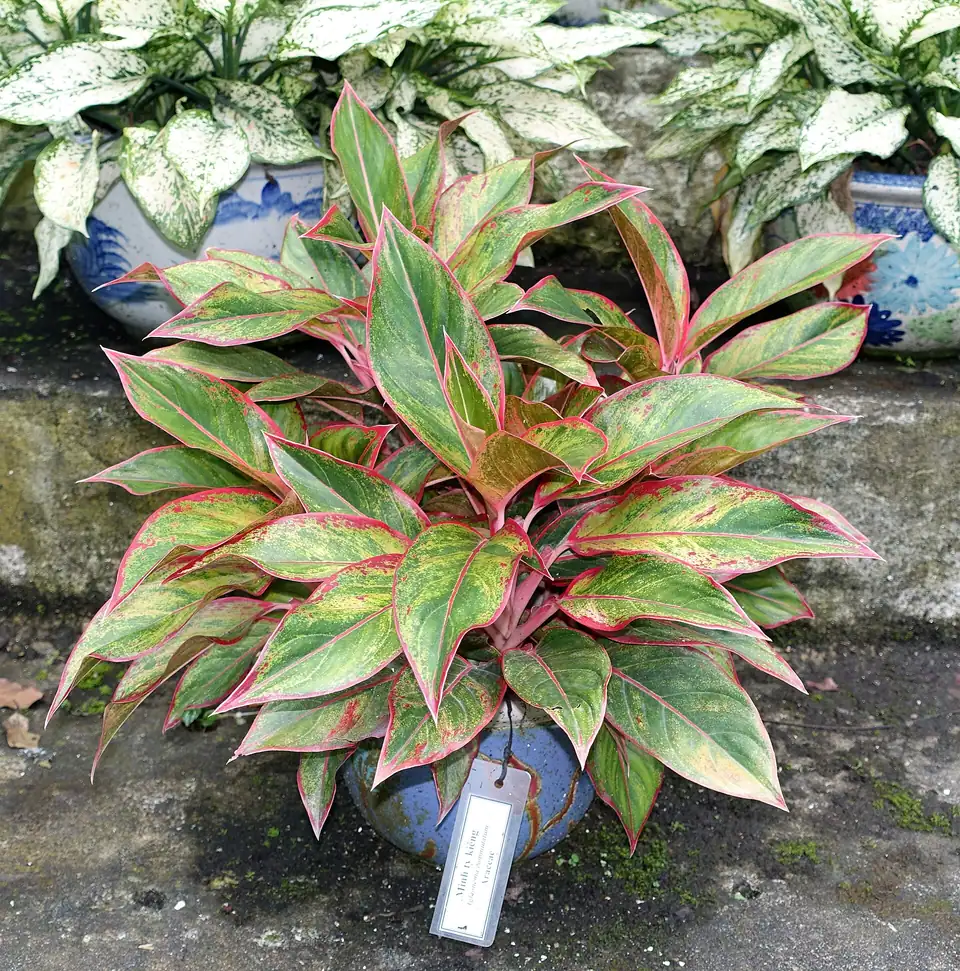
Aglaonema commutatum is an upright plant to nearly 2 m [6.6 ft] tall, found in the Philippines and north-eastern Sulawesi. [2][3] It suits dim corners and should be allowed to dry slightly between waterings, but never to the point of wilting. [1] It is commonly cultivated as an ornamental and pot plant, and is toxic to pets if ingested. [3][6]
Chinese Evergreen care
Measurements in square brackets are our conversion into the other unit system; the quoted text is unchanged.
How to water Chinese Evergreen
Watering
Allow to dry slightly between waterings, never to the point of wilting; water moderately and regularly during the growing season
Watering notes
Moisten the soil enough for it to drain from the pot holes without over-watering, which can lead to root rot; reduce watering in winter
What the sources say (2)
When watering the Aglaonema commutatum , moisten the soil enough for it to drain from the holes in the pot, but do not over-water, as this can lead to root rot.Keep the soil moist during the growing season, but let off watering in the winterHow much light Chinese Evergreen needs
Shade to partial shade; indirect light indoors; avoid direct sunlight
What the sources say (3)
Outdoors: Avoid direct sunlight, this is a great plant to grow in areas of heavy shade (and does well in partial shade too).when grown indoors Aglaonema commutatum requires indirect lightThe venerable
Chinese Evergreen seems to have been invented for dim corners.How much cold Chinese Evergreen can take
Where to grow Chinese Evergreen
Indoors
Yes
What the sources say (1)
It is a common houseplant that is grown for its attractive foliage.In containers
Yes
What the sources say (1)
Grow in containers and bring indoors as soon as temperatures drop to about 50How to propagate Chinese Evergreen
Basal shoots or division; stem cuttings from newly grown shoots with five leaves; seed (may not stay true)
What the sources say (3)
Propagate from basal shoots or by division.it is easy to propagate from stem cuttings. Use newly grown shoots with five leaves.Seeds may not stay true, but if you wish to try your luckHow to grow Chinese Evergreen
The plant
Life cycle
perennial
What the sources say (1)
Chinese evergreen is an herbaceous perennial in the Araceae (arum) family and is native to the tropical and subtropical areas of Southeast Asia and New Guinea.Family
Araceae
What the sources say (1)
Chinese evergreen is an herbaceous perennial in the Araceae (arum) family and is native to the tropical and subtropical areas of Southeast Asia and New Guinea.Pests and diseases
Pests
mealybugs, brown fern scale
What the sources say (1)
Mealybugs and occasionally
brown fern scale are the main problem found on these plants.Diseases
root rot (from over-watering)
What the sources say (1)
Root rots can occur with over-watering; allow the medium to dry between waterings and avoid using cold water.Fertilizing
Signs of excess
Burned leaf edges
What the sources say (1)
Excessive fertilizer can cause leaf edge burn.Chinese Evergreen pests and problems
Root rot
Symptom: Root rot from over-watering
What to do: Moisten the soil enough for it to drain from the pot holes, without over-watering
What the sources say (1)
but do not over-water, as this can lead to root rot.
— Chinese Evergreen (Aglaonema commutatum) Growing & Care Guide for Gardeners [6] Mealybugs and brown fern scale
Symptom: Mealybugs and occasionally brown fern scale are the main problem on these plants
What the sources say (1)
Mealybugs and occasionally brown fern scale are the main problem found on these plants.
— Chinese Evergreens [1] Aphids and spider mites
Symptom: Aphids or spider mites appear on the plant
What to do: Wash them off with soapy water
What the sources say (1)
If aphids or spider mites appear wash them off with soapy water.
— Chinese Evergreen (Aglaonema commutatum) Growing & Care Guide for Gardeners [6]
Remedies
Each remedy shows what official sources say about it; traditional remedies without an official source are marked as such. Harmful ones are listed so you know to avoid them.
First aid
First aid: not a substitute for a doctor
sap or plant juice on skin or clothes
flush the skin with water Official source, not independently tested
DO NOT make a person throw up unless told to do so by poison control or a health care professional.
— medlineplus.gov [7] How: If the poison has spilled on the person's clothes, remove the clothing and flush the skin with water.
If the poison has spilled on the person's clothes, remove the clothing and flush the skin with water.
— medlineplus.gov [7]
Is Chinese Evergreen toxic to pets?
Reported by the source, quoted verbatim. This is not medical or veterinary advice: if a person or an animal may have eaten this plant, contact a poison control centre or a veterinarian.
Be mindful that this plant is toxic to pets if ingested.
[6]The source flags the risk for this animal but does not explain why.
Indicative values
Values from a secondary source, not checked word for word like the rest of this page. Use them as a starting point.
- Mature height
- 30.5-45.7 cm (1-1.5 ft)Indicative value, adapt it to your climate · Secondary source
- Hours of sun
- 4-5 hoursIndicative value, adapt it to your climate · Secondary source
- Drought tolerant
- yesIndicative value, adapt it to your climate · Secondary source
- Soil pH
- 5.5-6.5Indicative value, adapt it to your climate · Secondary source
- Care level
- MediumIndicative value, adapt it to your climate · Secondary source
- Growth rate
- LowIndicative value, adapt it to your climate · Secondary source
- Pruning
- May, AugustIndicative value, adapt it to your climate · Secondary source
Similar plants
- Anthurium Anthurium andraeanum
- Arrowhead Plant Syngonium podophyllum
- Arum Arum maculatum
- Black Calla Arum palaestinum
- Blushing Philodendron Philodendron erubescens
- Calla Lily Zantedeschia aethiopica
- Cobra Lily Arisaema ringens
- Common Duckweed Lemna minor
Sources
Every value above is quoted from these documents. Links lead to the original publisher.
- Chinese Evergreens · uaex.uada.edu, consulted
- HortFlora · hortflora.rbg.vic.gov.au, consulted
- Aglaonema commutatum (PROSEA) - Pl@ntUse · uses.plantnet-project.org, consulted
- Aglaonema (Chinese Evergreen, Golden Evergreen, Philippine Evergreen, Poison Dart Plant) | North Carolina Extension Gardener Plant Toolbox · plants.ces.ncsu.edu, consulted
- Chinese Evergreen (Aglaonema) Care, Cultivation & Growing Guide | Home & Garden Information Center · hgic.clemson.edu, consulted
- Chinese Evergreen (Aglaonema commutatum) Growing & Care Guide for Gardeners · gardenershq.com, consulted
- medlineplus.gov · medlineplus.gov
Written by Emilio Marruso · last checked