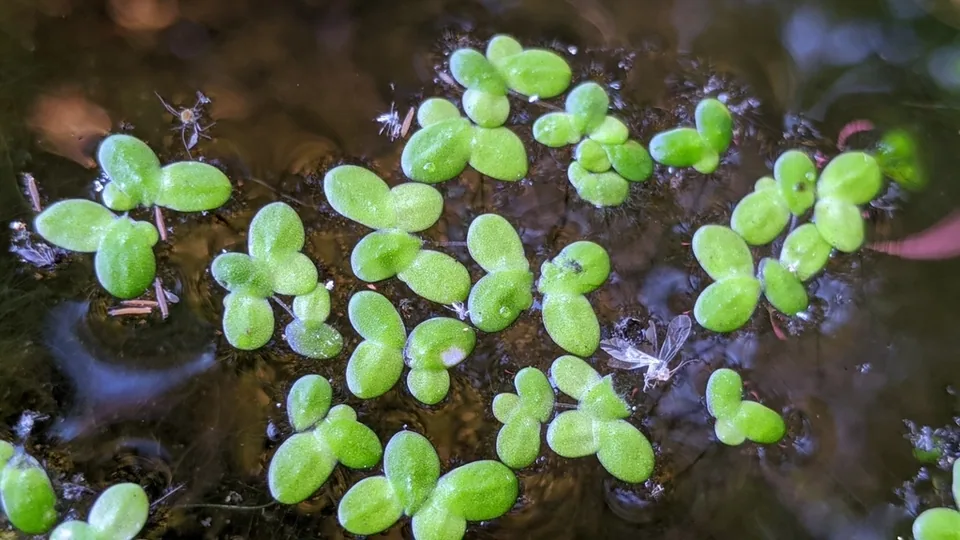
How to Grow and Care for Common Duckweed
Lemna minor
Written by Emilio Marruso · last checked
At a glance
Duckweed is a tiny perennial for ponds that is happy anywhere from full sun to partial shade. It feeds straight from the water, so it never needs fertilizer, and ducks and other waterfowl love to eat it; that's where its name comes from. Just keep an eye on it: if it starts covering open water, act right away to protect your fish.
- Sun
Full sun to partial shade
What the sources say (1)
Light: Full sun to partial shade
Common Duckweed prefers full sun or partial shade and a standing water environment.
— Lemna minor (Common Duckweed, Lesser Duckweed) | North Carolina Extension Gardener Plant Toolbox [1] - Cold
Survives winters down to −30 °F (−34.4 °C)
Very hardy · USDA 4a · RHS H7 · Z4
What the sources say (2)
Hardiness, coldest zone: 4a [winter low −34.4 to −31.7 °C (−30 to −25 °F)]
4a, 4b, 5a, 5b, 6a, 6b, 7a, 7b, 8a, 8b, 9a, 9b, 10a, 10b
— Lemna minor (Common Duckweed, Lesser Duckweed) | North Carolina Extension Gardener Plant Toolbox [1] Hardiness, warmest zone: 10b [winter low 1.7 to 4.4 °C (35 to 40 °F)]
4a, 4b, 5a, 5b, 6a, 6b, 7a, 7b, 8a, 8b, 9a, 9b, 10a, 10b
— Lemna minor (Common Duckweed, Lesser Duckweed) | North Carolina Extension Gardener Plant Toolbox [1] - Feeding
Never fertilize its pond: it takes its food straight from the water
What the sources say (1)
Avoid: Fertilizing ponds that contain duckweed: it takes its nutrients directly from the water
Duckweed draws nutrients directly from the water; therefore, fertilizing waterbodies that contain duckweed is discouraged.
— Duckweed | Lemna spp. | Mississippi State University Extension Service [2] - Harvest
Ducks and other waterfowl love to eat it
- Watch out
It can cover the water, block light and kill fish: act as soon as it starts spreading
- Size
3 in tall, spreading 1 to 3 ft wide
What the sources say (2)
Mature height: 7.6 cm (3 in)
Dimensions: Height: 0 ft. 3 in. - 0 ft. 3 in. Width: 1 ft. 0 in. - 3 ft. 0 in.
— Lemna minor (Common Duckweed, Lesser Duckweed) | North Carolina Extension Gardener Plant Toolbox [1] Mature width: 30.5-91.4 cm (1-3 ft)
Dimensions: Height: 0 ft. 3 in. - 0 ft. 3 in. Width: 1 ft. 0 in. - 3 ft. 0 in.
— Lemna minor (Common Duckweed, Lesser Duckweed) | North Carolina Extension Gardener Plant Toolbox [1] - Propagation
Grows from seed
What the sources say (1)
Propagation: Seed
Recommended Propagation Strategy: Seed Country Or Region Of Origin: Native Worldwide
— Lemna minor (Common Duckweed, Lesser Duckweed) | North Carolina Extension Gardener Plant Toolbox [1]
Overview
Common duckweed is a small floating aquatic perennial that forms a carpet on still water. [1] It prefers full sun or partial shade and standing water. [1] It can cover a pond surface and cause oxygen depletion that can kill fish. [2]
Common Duckweed care
How much light Common Duckweed needs
Full sun to partial shade
What the sources say (1)
Common Duckweed prefers full sun or partial shade and a standing water environment.How much cold Common Duckweed can take
Hardiness, coldest zone
4a [winter low −34.4 to −31.7 °C (−30 to −25 °F)]
What the sources say (1)
4a, 4b, 5a, 5b, 6a, 6b, 7a, 7b, 8a, 8b, 9a, 9b, 10a, 10bHardiness, warmest zone
10b [winter low 1.7 to 4.4 °C (35 to 40 °F)]
What the sources say (1)
4a, 4b, 5a, 5b, 6a, 6b, 7a, 7b, 8a, 8b, 9a, 9b, 10a, 10bHow to propagate Common Duckweed
Seed
What the sources say (1)
Recommended Propagation Strategy:
Seed
Country Or Region Of Origin:
Native WorldwideHow to grow Common Duckweed
The plant
Life cycle
perennial
What the sources say (1)
a small, aquatic, herbaceous perennial in the arum family reaching only 3 inches highFamily
Araceae
What the sources say (1)
Genus: Lemna Species: minor Family: Araceae Uses (Ethnobotany): Used as animal food.Mature height
7.6 cm (3 in)
What the sources say (1)
Dimensions: Height: 0 ft. 3 in. - 0 ft. 3 in. Width: 1 ft. 0 in. - 3 ft. 0 in.Mature width
30.5-91.4 cm (1-3 ft)
What the sources say (1)
Dimensions: Height: 0 ft. 3 in. - 0 ft. 3 in. Width: 1 ft. 0 in. - 3 ft. 0 in.Fertilizing
Avoid
Fertilizing ponds that contain duckweed: it takes its nutrients directly from the water
What the sources say (1)
Duckweed draws nutrients directly from the water; therefore, fertilizing waterbodies that contain duckweed is discouraged.Common Duckweed pests and problems
Excessive spread over open water
Symptom: Covers the open water surface, blocks sunlight and can deplete oxygen enough to kill fish.
What to do: Treat immediately when it begins to cover open water: diquat, flumioxazin or fluridone are the listed options; do not fertilize waterbodies that contain duckweed.
What the sources say (3)
However, when duckweed begins to cover the open water surface, it should be immediately treated.
— Duckweed | Lemna spp. | Mississippi State University Extension Service [2] Duckweed draws nutrients directly from the water; therefore, fertilizing waterbodies that contain duckweed is discouraged.
— Duckweed | Lemna spp. | Mississippi State University Extension Service [2] Option 1: Diquat (3.73-pound formulation). For each gallon of water, mix 1.28 ounces diquat and 1.3 ounces non-ionic surfactant.
— Duckweed | Lemna spp. | Mississippi State University Extension Service [2]
Remedies
Each remedy shows what official sources say about it; traditional remedies without an official source are marked as such. Harmful ones are listed so you know to avoid them.
Getting rid of it
duckweed mat on pond
raking or netting by hand Works
How: Use a net or rake to regularly scoop fronds from the water, weekly during the summer months.
Remove duckweed by hand – use a net or rake to regularly scoop fronds from the water. Do this weekly during the summer months when duckweed numbers can double every few days.
— rhs.org.uk [3] What the evidence says Duckweed can be removed by raking or seining it from the pond’s surface.
— aquaplant.tamu.edu [4] floating boom Official source, not independently tested
How: Sweep a boom from end to end to collect duckweed and make removal with a net easier.
Use a floating boom on larger ponds – sweep a boom from end to end to collect duckweed and make removal with a net easier.
— rhs.org.uk [3] aeration Partly works
How: Aerators that disrupt the surface of the water limit growth to the sides of the pond, where the plants can be removed more easily with nets.
Another physical control strategy is the use of aeration. Duckweed and watermeal prefer to grow in stagnant water.
— extension.psu.edu [5] What the evidence says Another physical control strategy is the use of aeration. Duckweed and watermeal prefer to grow in stagnant water. Aerators that disrupt the surface of the water will limit the growth of these plants to the sides of the ponds
— extension.psu.edu [5] fountain Official source, not independently tested
How: Install a fountain to disturb the water surface.
Install a fountain – this disturbs the water surface, making it more difficult for duckweed to grow and spread.
— rhs.org.uk [3] floating-leaved pond plants Official source, not independently tested
How: Keep the pond well stocked with floating-leaved plants such as waterlilies, which compete with duckweed.
Stock your pond with floating-leaved pond plants – duckweed doesn’t compete well with other floating aquatic plants
— rhs.org.uk [3] removing leaf debris Official source, not independently tested
How: Remove leaves and other rotting vegetation; place mesh over the pond to collect leaves as they fall in autumn.
Remove debris – leaves and other rotting vegetation increase the nutrient content of pond water, encouraging duckweed growth.
— rhs.org.uk [3] shading the pond Official source, not independently tested
How: Create shade by planting tall marginals on the south bank of the pond.
Create some shade over your pond – duckweed grows and spreads fastest in full sun.
— rhs.org.uk [3] domestic ducks Partly works
How: In large ponds, water birds such as domestic ducks can be introduced to eat duckweed.
Introduce duckweed grazers – in large ponds you could consider introducing fish, such as goldfish, koi and grass carp, or water birds, such as domestic ducks, to eat duckweed.
— rhs.org.uk [3] What the evidence says Ducks will eat duckweed, but they seldom control it.
— aquaplant.tamu.edu [4] reducing nutrient inputs Works
How: Reduce fertilizer applications near the pond, maintain septic systems and redirect nutrient-rich runoff away from the pond.
Long-term control of overabundant aquatic plants is best accomplished by reducing or redirecting nutrient sources from the pond.
— extension.psu.edu [5] What the evidence says Long-term control of overabundant aquatic plants is best accomplished by reducing or redirecting nutrient sources from the pond.
— extension.psu.edu [5]
duckweed entering pond
quarantining new pond plants Official source, not independently tested
How: Keep new or shared aquatic plants in a bucket of water for a few weeks before introducing them to the pond, removing any duckweed by hand.
Quarantine new pond plants – keep new (or shared) aquatic plants in a bucket of water for a few weeks before introducing them to your pond.
— rhs.org.uk [3]
Edibility
Reported by the source, quoted verbatim. Do not eat a plant on the basis of this page alone: identification mistakes can be dangerous.
The common name comes from the fact that ducks, along with other waterfowl, like to eat it.
[1]
Indicative values
Values from a secondary source, not checked word for word like the rest of this page. Use them as a starting point.
- Watering
- FrequentIndicative value, adapt it to your climate · Secondary source
- Soil pH
- 6.5-7.5Indicative value, adapt it to your climate · Secondary source
- Care level
- LowIndicative value, adapt it to your climate · Secondary source
- Growth rate
- HighIndicative value, adapt it to your climate · Secondary source
- Pests
- Pest resistant, Disease resistantIndicative value, adapt it to your climate · Secondary source
Similar plants
- Tiny Duckweed Lemna perpusilla
- Anthurium Anthurium andraeanum
- Arum Arum maculatum
- Black Calla Arum palaestinum
- Calla Lily Zantedeschia aethiopica
- Chinese Evergreen Aglaonema commutatum
- Cobra Lily Arisaema ringens
- Dancing Crane Cobra Lily Arisaema heterophyllum
Sources
Every value above is quoted from these documents. Links lead to the original publisher.
- Lemna minor (Common Duckweed, Lesser Duckweed) | North Carolina Extension Gardener Plant Toolbox · plants.ces.ncsu.edu, consulted
- Duckweed | Lemna spp. | Mississippi State University Extension Service · extension.msstate.edu, consulted
- rhs.org.uk · rhs.org.uk
- aquaplant.tamu.edu · aquaplant.tamu.edu
- extension.psu.edu · extension.psu.edu
Written by Emilio Marruso · last checked