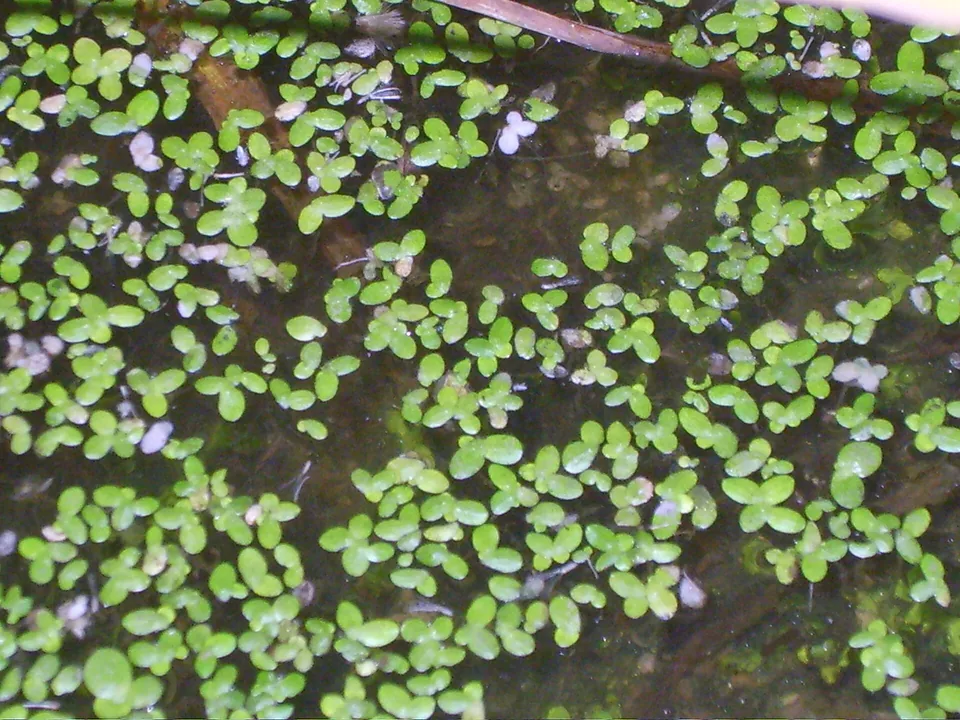


How to Grow and Care for Tiny Duckweed
Lemna perpusilla
Written by Emilio Marruso · last checked
At a glance
Growing this tiny floating plant takes just one step: scatter small bunches on still, nutrient-rich water after the last frost. It's happy anywhere from full sun to full shade, and it feeds muskrats, beavers, birds and frogs. It spreads quickly in cool weather, so add fish to your pond and they'll help keep it in check.
- Sun
Anything from full sun to full shade
What the sources say (1)
Light: Full sun to full shade
Tiny Duckweed grows in nutrient-rich, still waters in full sun to full shade
— Lemna perpusilla (Minute Duckweed, Tiny Duckweed) | North Carolina Extension Gardener Plant Toolbox [1] - Water
Floats on still, nutrient-rich water; can keep growing on wet mud if the water drops
What the sources say (2)
Watering notes: Grows in nutrient-rich, still waters; can grow on wet mud if the water recedes
Tiny Duckweed grows in nutrient-rich, still waters in full sun to full shade and does best in the cool weather of spring or autumn.
— Lemna perpusilla (Minute Duckweed, Tiny Duckweed) | North Carolina Extension Gardener Plant Toolbox [1] If the plant's watery home should recede, it can grow on wet mud.
— Lemna perpusilla (Minute Duckweed, Tiny Duckweed) | North Carolina Extension Gardener Plant Toolbox [1] - Cold
Survives winters down to −30 °F (−34.4 °C)
Very hardy · USDA 4a · RHS H7 · Z4
What the sources say (2)
Hardiness, coldest zone: 4a [winter low −34.4 to −31.7 °C (−30 to −25 °F)]
USDA Plant Hardiness Zone: 4a, 4b, 5a, 5b, 6a, 6b, 7a, 7b, 8a, 8b, 9a, 9b, 10a, 10b
— Lemna perpusilla (Minute Duckweed, Tiny Duckweed) | North Carolina Extension Gardener Plant Toolbox [1] Hardiness, warmest zone: 10b [winter low 1.7 to 4.4 °C (35 to 40 °F)]
USDA Plant Hardiness Zone: 4a, 4b, 5a, 5b, 6a, 6b, 7a, 7b, 8a, 8b, 9a, 9b, 10a, 10b
— Lemna perpusilla (Minute Duckweed, Tiny Duckweed) | North Carolina Extension Gardener Plant Toolbox [1] - Planting
After the last frost, scatter small bunches on the water
What the sources say (1)
Planting: After last frost (scatter small bunches on the water surface)
To plant, scatter small bunches of Tiny Duckweed on the water surface after last frost.
— Lemna perpusilla (Minute Duckweed, Tiny Duckweed) | North Carolina Extension Gardener Plant Toolbox [1] - Watch out
Can become invasive and spreads fast in cool weather; fish eat it and keep it in check
Overview
Lemna perpusilla is a small free-floating aquatic perennial of still or slowly moving waters. [1] It is recommended for water gardens and ponds, but can be invasive in frost-free climates. [1]
This record is incomplete: the sources we read do not cover every field yet.
Not yet covered by our sources: Watering, Pruning, Propagation
Tiny Duckweed care
How to water Tiny Duckweed
Watering
Not stated in the sources we read.
Watering notes
Grows in nutrient-rich, still waters; can grow on wet mud if the water recedes
What the sources say (2)
Tiny Duckweed grows in nutrient-rich, still waters in full sun to full shade and does best in the cool weather of spring or autumn.If the plant's watery home should recede, it can grow on wet mud.How much light Tiny Duckweed needs
Full sun to full shade
What the sources say (1)
Tiny Duckweed grows in nutrient-rich, still waters in full sun to full shadeHow much cold Tiny Duckweed can take
Hardiness, coldest zone
4a [winter low −34.4 to −31.7 °C (−30 to −25 °F)]
What the sources say (1)
USDA Plant Hardiness Zone:
4a, 4b, 5a, 5b, 6a, 6b, 7a, 7b, 8a, 8b, 9a, 9b, 10a, 10bHardiness, warmest zone
10b [winter low 1.7 to 4.4 °C (35 to 40 °F)]
What the sources say (1)
USDA Plant Hardiness Zone:
4a, 4b, 5a, 5b, 6a, 6b, 7a, 7b, 8a, 8b, 9a, 9b, 10a, 10bHow to propagate Tiny Duckweed
Not stated in the sources we read.
How to grow Tiny Duckweed
The plant
Life cycle
perennial
What the sources say (1)
Tiny Duckweed is an aquatic, free floating, hydroannual or herbaceous perennial in the arum family found in still or slowly moving waters of swamps, ponds or lakes.Family
Araceae
What the sources say (1)
Tiny Duckweed is an aquatic, free floating, hydroannual or herbaceous perennial in the arum family found in still or slowly moving waters of swamps, ponds or lakes.Tiny Duckweed pests and problems
Invasiveness
Symptom: Can become invasive; spreads quickly in cool conditions
What to do: Fish consume the plants and can be used to control its spread in ornamental ponds
What the sources say (2)
No known diseses or insect pests. Can become invasive.
— Lemna perpusilla (Minute Duckweed, Tiny Duckweed) | North Carolina Extension Gardener Plant Toolbox [1] Fish also consume the plants and can be used to control the spread of the plant in ornamental ponds.
— Lemna perpusilla (Minute Duckweed, Tiny Duckweed) | North Carolina Extension Gardener Plant Toolbox [1]
Remedies
Each remedy shows what official sources say about it; traditional remedies without an official source are marked as such. Harmful ones are listed so you know to avoid them.
Getting rid of it
invasive duckweed
net or rake removal Official source, not independently tested
How: Use a net or rake to regularly scoop fronds from the water, weekly in summer.
Remove duckweed by hand – use a net or rake to regularly scoop fronds from the water. Do this weekly during the summer months when duckweed numbers can double every few days.
— rhs.org.uk [2] fountain Official source, not independently tested
How: Install a fountain to disturb the water surface.
Install a fountain – this disturbs the water surface, making it more difficult for duckweed to grow and spread.
— rhs.org.uk [2] floating-leaved pond plants Official source, not independently tested
How: Keep the pond well stocked with floating-leaved plants such as waterlilies.
Stock your pond with floating-leaved pond plants – duckweed doesn’t compete well with other floating aquatic plants , like waterlilies
— rhs.org.uk [2] shade over the pond Official source, not independently tested
How: Create shade over the pond with tall marginal plants on the south bank.
Create some shade over your pond – duckweed grows and spreads fastest in full sun. Create shade by planting tall marginals on the south bank of the pond.
— rhs.org.uk [2] mesh over the pond against falling leaves Official source, not independently tested
How: Place mesh over the pond to collect leaves as they fall in autumn.
Place mesh over your pond to collect leaves as they fall in autumn
— rhs.org.uk [2] grass carp Not proven
How: In large ponds introduce duckweed-eating fish such as goldfish, koi and grass carp.
Introduce duckweed grazers – in large ponds you could consider introducing fish, such as goldfish, koi and grass carp, or water birds, such as domestic ducks, to eat duckweed.
— rhs.org.uk [2] What the evidence says Grass carp may eat some duckweed and watermeal, but these plants reproduce so quickly that the grass carp are generally not an effective control measure.
— mdc.mo.gov [3]
Calendar
Planting
After last frost (scatter small bunches on the water surface)
What the sources say (1)
To plant, scatter small bunches of Tiny Duckweed on the water surface after last frost.Pruning
Not stated in the sources we read.
Months as given by the sources, which are mostly from the United States (northern hemisphere). In the southern hemisphere they shift by about six months.
Edibility
Reported by the source, quoted verbatim. Do not eat a plant on the basis of this page alone: identification mistakes can be dangerous.
Similar plants
- Common Duckweed Lemna minor
- Black Calla Arum palaestinum
- Calla Lily Zantedeschia aethiopica
- Cobra Lily Arisaema ringens
- Dragon Arum Dracunculus vulgaris
- Giant elephant ear Colocasia gigantea
- Green Dragon Arisaema dracontium
- Green Dragon Pinellia tripartita
Sources
Every value above is quoted from these documents. Links lead to the original publisher.
- Lemna perpusilla (Minute Duckweed, Tiny Duckweed) | North Carolina Extension Gardener Plant Toolbox · plants.ces.ncsu.edu, consulted
- rhs.org.uk · rhs.org.uk
- mdc.mo.gov · mdc.mo.gov
Written by Emilio Marruso · last checked