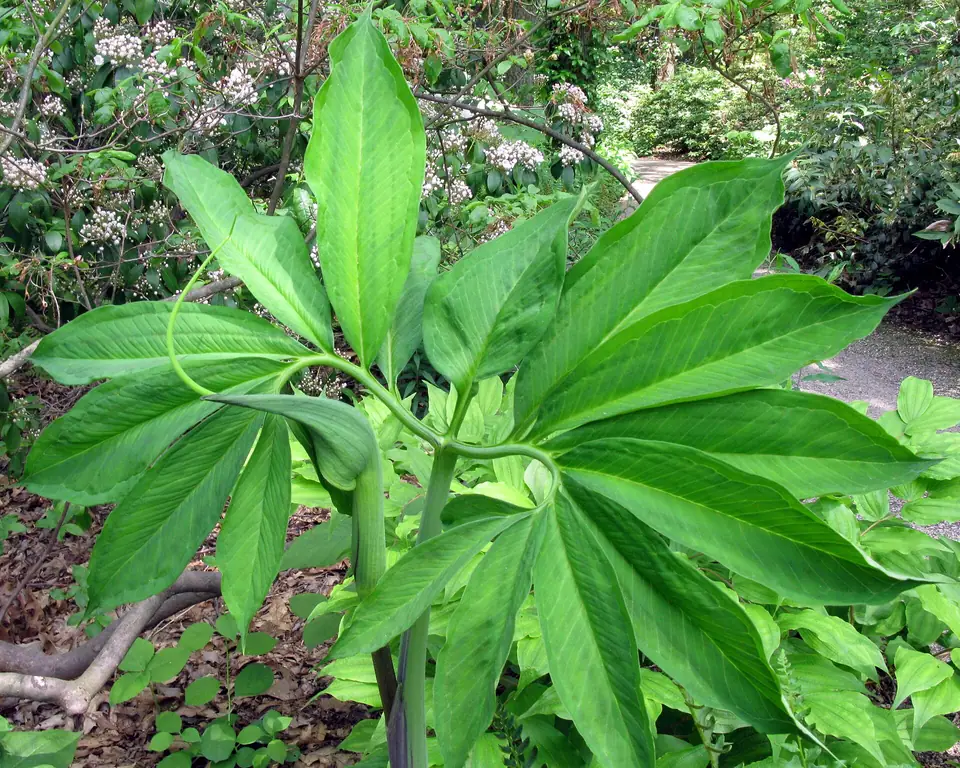


How to Grow and Care for Green Dragon
Arisaema dracontium
Written by Emilio Marruso · last checked
Toxic to: Cats, Dogs, Horses, People · Why
At a glance
Green dragon is a perennial made for the shady corners of your garden, happy in partial to full shade. It grows 1 to 3 feet tall and 1 to 1.5 feet wide, and you can make new plants by dividing it or by sowing its seed. Just keep it away from cats, dogs and horses, because it is mildly poisonous.
- Sun
Partial to full shade
What the sources say (2)
Light: Partial to full shade
Green dragon grows in fertile, moist, neutral to acidic woodland soils in partial to full shade.
— Arisaema dracontium (Dragon Arum, Dragon-Root, Green Dragon) | North Carolina Extension Gardener Plant Toolbox [1] Partial to full shade; moist, well drained soils to wet organic soils.
— Green Dragon (Arisaema dracontium)-Hort Answers - University of Illinois Extension [2] - Cold
Survives winters down to −30 °F (−34.4 °C)
Very hardy · USDA 4a · RHS H7 · Z4
What the sources say (2)
Hardiness, coldest zone: 4a [winter low −34.4 to −31.7 °C (−30 to −25 °F)]
4a, 4b, 5a, 5b, 6a, 6b, 7a, 7b, 8a, 8b, 9a, 9b
— Arisaema dracontium (Dragon Arum, Dragon-Root, Green Dragon) | North Carolina Extension Gardener Plant Toolbox [1] Hardiness, warmest zone: 9b [winter low −3.9 to −1.1 °C (25 to 30 °F)]
4a, 4b, 5a, 5b, 6a, 6b, 7a, 7b, 8a, 8b, 9a, 9b
— Arisaema dracontium (Dragon Arum, Dragon-Root, Green Dragon) | North Carolina Extension Gardener Plant Toolbox [1] - Harvest
The root is edible only after it has been dried, aged and processed
- Size
1 to 3 ft tall and 1 to 1.5 ft wide
What the sources say (2)
Mature height: 30.48-91.44 cm (1-3 ft)
It will grow 1 to 3 feet tall and 1 to 1.5 feet wide.
— Arisaema dracontium (Dragon Arum, Dragon-Root, Green Dragon) | North Carolina Extension Gardener Plant Toolbox [1] Mature width: 30.48-45.72 cm (1-1.5 ft)
It will grow 1 to 3 feet tall and 1 to 1.5 feet wide.
— Arisaema dracontium (Dragon Arum, Dragon-Root, Green Dragon) | North Carolina Extension Gardener Plant Toolbox [1] - Propagation
Divide the plant or grow it from seed
What the sources say (1)
Propagation: Division; seed
Propagation is by division or seeds.
— Arisaema dracontium (Dragon Arum, Dragon-Root, Green Dragon) | North Carolina Extension Gardener Plant Toolbox [1] - Safety
Mildly poisonous to people; harmful to cats, dogs and horses
Overview
Green dragon is an herbaceous perennial of the arum family that grows from a corm in damp woods. [1] It grows in partial to full shade in moist, fertile soil and is propagated by division or seed. [1] The plant has low poison severity and is listed as a problem for humans, cats, dogs and horses. [1]
This record is incomplete: the sources we read do not cover every field yet.
Not yet covered by our sources: Watering, Pruning
Green Dragon care
How to water Green Dragon
Not stated in the sources we read.
How much light Green Dragon needs
Partial to full shade
What the sources say (2)
Green dragon grows in fertile, moist, neutral to acidic woodland soils in partial to full shade.Partial to full shade; moist, well drained soils to wet organic soils.How much cold Green Dragon can take
Hardiness, coldest zone
4a [winter low −34.4 to −31.7 °C (−30 to −25 °F)]
What the sources say (1)
4a, 4b, 5a, 5b, 6a, 6b, 7a, 7b, 8a, 8b, 9a, 9bHardiness, warmest zone
9b [winter low −3.9 to −1.1 °C (25 to 30 °F)]
What the sources say (1)
4a, 4b, 5a, 5b, 6a, 6b, 7a, 7b, 8a, 8b, 9a, 9bHow to propagate Green Dragon
Division; seed
What the sources say (1)
Propagation is by division or seeds.How to grow Green Dragon
The plant
Life cycle
perennial
What the sources say (1)
Green dragon is an herbaceous perennial plant in the arum family (Araceae).Family
Araceae
What the sources say (1)
Green dragon is an herbaceous perennial plant in the arum family (Araceae).Mature height
30.48-91.44 cm (1-3 ft)
What the sources say (1)
It will grow 1 to 3 feet tall and 1 to 1.5 feet wide.Mature width
30.48-45.72 cm (1-1.5 ft)
What the sources say (1)
It will grow 1 to 3 feet tall and 1 to 1.5 feet wide.Remedies
Each remedy shows what official sources say about it; traditional remedies without an official source are marked as such. Harmful ones are listed so you know to avoid them.
First aid
First aid: not a substitute for a doctor
calcium oxalate skin contact
lather with soap and rinse with warm running water Official source, not independently tested
If the pain continues, contact your child's physician.
— chop.edu [4] How: Lather the exposed area repeatedly with soap and rinse with warm running water to ease the irritation.
Lather the exposed area repeatedly with soap and rinse with warm running water to ease the irritation.
— chop.edu [4]
calcium oxalate ingestion
wipe out the mouth and offer a cool drink or soft food Official source, not independently tested
If there is swelling that prevents the child taking anything by mouth or causes difficulty breathing, go to the nearest emergency department immediately.
— chop.edu [4] How: Wipe out the residue of the plant from the mouth and offer a cool drink or snack such as a popsicle, applesauce or yogurt.
wipe out the residue of the plant from the mouth and offer a cool drink or snack such as a popsicle, applesauce or yogurt.
— chop.edu [4]
Treating the plant
slugs
crushed eggshells around the corms Not proven
How: Place eggshells around the patch of corms to deter pests from damaging young shoots.
To deter pests from damaging young shoot systems, you can place eggshells, diatomaceous earth, or gravel around the patch of corms.
— pondinformer.com [5] What the evidence says Crushed egg shells or coffee grounds have not been shown to be effective deterrents.
— ipm.ucanr.edu [6] diatomaceous earth around the corms Partly works
How: Place diatomaceous earth around the patch of corms to deter pests from damaging young shoots.
To deter pests from damaging young shoot systems, you can place eggshells, diatomaceous earth, or gravel around the patch of corms.
— pondinformer.com [5] What the evidence says Diatomaceous earth (tiny fossilized skeletons of ancient aquatic diatoms) is coarse and can scratch up slugs. It is most effective when used in dry conditions and has little effect when it absorbs moisture.
— extension.umn.edu [7] gravel around the corms Not verified
Traditional remedy, not verified by an official source.
How: Place gravel around the patch of corms to deter pests from damaging young shoots.
beer trap Partly works
How: Small containers filled with beer may keep pests away.
Small containers filled with beer may successfully keep pests away as well!
— pondinformer.com [5] What the evidence says Beer/yeast traps attract slugs and snails within an area of only a few feet, and you must replenish the bait every few days to keep the level deep enough to drown the mollusks.
— ipm.ucanr.edu [6]
Is Green Dragon toxic to pets?
Reported by the source, quoted verbatim. This is not medical or veterinary advice: if a person or an animal may have eaten this plant, contact a poison control centre or a veterinarian.
Animals
Problem for Cats
[1]The source flags the risk for this animal but does not explain why.
Problem for Dogs
[1]The source flags the risk for this animal but does not explain why.
Problem for Horses
[1]The source flags the risk for this animal but does not explain why.
People
This plant has low severity poison characteristics.
[1]
Calendar
Pruning
Not stated in the sources we read.
Months as given by the sources, which are mostly from the United States (northern hemisphere). In the southern hemisphere they shift by about six months.
Edibility
Reported by the source, quoted verbatim. Do not eat a plant on the basis of this page alone: identification mistakes can be dangerous.
The root is considered edible once it has been dried, aged and processed.
[1]
Similar plants
- Cobra Lily Arisaema ringens
- Jack-in-the-pulpit Arisaema triphyllum
- Japanese Jack-in-the-pulpit Arisaema sikokianum
- Dancing Crane Cobra Lily Arisaema heterophyllum
- Green Dragon Pinellia tripartita
- Tiny Duckweed Lemna perpusilla
- ZZ Plant Zamioculcas zamiifolia
- Anthurium Anthurium andraeanum
Sources
Every value above is quoted from these documents. Links lead to the original publisher.
- Arisaema dracontium (Dragon Arum, Dragon-Root, Green Dragon) | North Carolina Extension Gardener Plant Toolbox · plants.ces.ncsu.edu, consulted
- Green Dragon (Arisaema dracontium)-Hort Answers - University of Illinois Extension · web.extension.illinois.edu, consulted
- Dragon-Root - Arisaema dracontium | North Carolina Extension Gardener Plant Toolbox · plants.ces.ncsu.edu, consulted
- chop.edu · chop.edu
- pondinformer.com · pondinformer.com
- ipm.ucanr.edu · ipm.ucanr.edu
- extension.umn.edu · extension.umn.edu
Written by Emilio Marruso · last checked