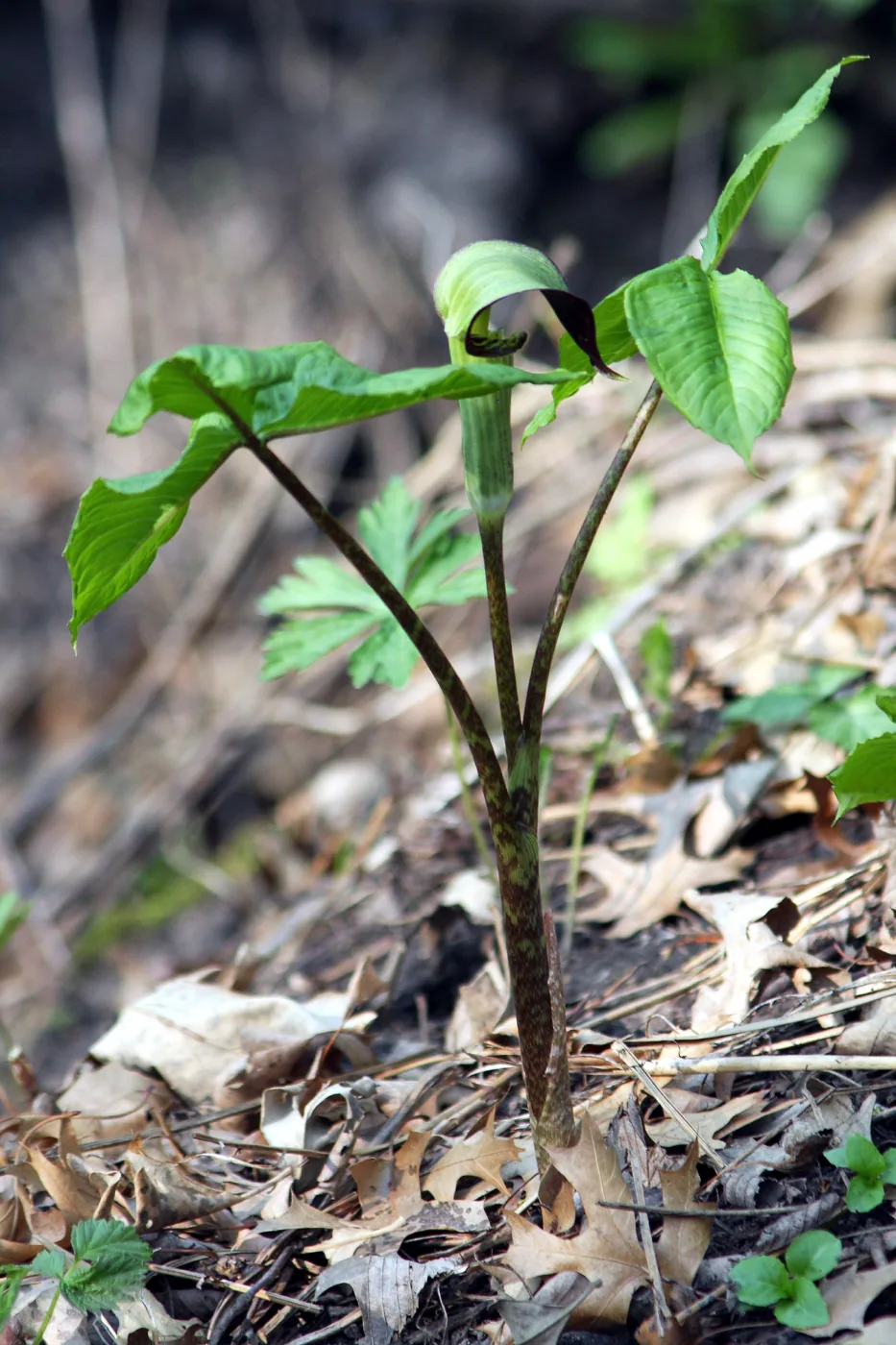


How to Grow and Care for Jack-in-the-pulpit
Arisaema triphyllum
Written by Emilio Marruso · last checked
Toxic to: People · Why
At a glance
Jack-in-the-pulpit is a perennial made for shady corners: it thrives in part to full shade, in soil that stays constantly moist and rich in organic matter. It grows 1 to 2.5 ft tall, and its fruits feed songbirds and eastern box turtles. Patience pays off: seeds can take up to 2 years to sprout, or you can simply divide the plant.
- Sun
Part shade to full shade
What the sources say (4)
Light: Part shade to full shade
According to NC State Extension: Jack-in-the-pulpit is best grown in fertile, medium to wet soil in part shade to full shade.
— Arisaema triphyllum (Bog onion, Brown dragon, Common Jack-in-the-Pulpit, Devil's ear, Dragon root, Indian Cradle, Indian Jack in The Pulpit, Indian Turnip, Jack-in-the-pulpit, Lady-in-a-chaise, Lord-and-Lady, Memory root, Parson-in-the-Pulpit, Pepper turnip, Starch wort, Three-leaved indian turnip, Wake robin, Wild turnip) | North Carolina Extension Gardener Plant Toolbox [1] According to University of Illinois Extension: It loves heavy shade and wet ground, it's relatively unaffected by insects and diseases
— Jack-in-the-Pulpit – a most mystical plant | A Nature Journal | Illinois Extension | Illinois [2] According to University of Arkansas: Jack-in-the-pulpit is easy to grow in any shaded, woodland site with high organic matter soil and sufficient moisture in the spring.
— Arisaema triphyllum Jack in the Pulpit [4] Jack-in-the-pulpit is best grown in fertile, medium to wet soil in part shade to full shade. It needs constantly moist soil rich in organic matter.
— Arisaema triphyllum (Bog onion, Brown dragon, Common Jack-in-the-Pulpit, Devil's ear, Dragon root, Indian Cradle, Indian Jack in The Pulpit, Indian Turnip, Jack-in-the-pulpit, Lady-in-a-chaise, Lord-and-Lady, Memory root, Parson-in-the-Pulpit, Pepper turnip, Starch wort, Three-leaved indian turnip, Wake robin, Wild turnip) | North Carolina Extension Gardener Plant Toolbox [1] - Water
Keep the soil constantly moist, especially in spring
What the sources say (4)
Watering: Needs constantly moist soil rich in organic matter
According to NC State Extension: It needs constantly moist soil rich in organic matter. It does poorly in heavy clay soils.
— Arisaema triphyllum (Bog onion, Brown dragon, Common Jack-in-the-Pulpit, Devil's ear, Dragon root, Indian Cradle, Indian Jack in The Pulpit, Indian Turnip, Jack-in-the-pulpit, Lady-in-a-chaise, Lord-and-Lady, Memory root, Parson-in-the-Pulpit, Pepper turnip, Starch wort, Three-leaved indian turnip, Wake robin, Wild turnip) | North Carolina Extension Gardener Plant Toolbox [1] According to University of Illinois Extension: It loves heavy shade and wet ground, it's relatively unaffected by insects and diseases
— Jack-in-the-Pulpit – a most mystical plant | A Nature Journal | Illinois Extension | Illinois [2] spring (University of Arkansas): Jack-in-the-pulpit is easy to grow in any shaded, woodland site with high organic matter soil and sufficient moisture in the spring.
— Arisaema triphyllum Jack in the Pulpit [4] Jack-in-the-pulpit is best grown in fertile, medium to wet soil in part shade to full shade. It needs constantly moist soil rich in organic matter.
— Arisaema triphyllum (Bog onion, Brown dragon, Common Jack-in-the-Pulpit, Devil's ear, Dragon root, Indian Cradle, Indian Jack in The Pulpit, Indian Turnip, Jack-in-the-pulpit, Lady-in-a-chaise, Lord-and-Lady, Memory root, Parson-in-the-Pulpit, Pepper turnip, Starch wort, Three-leaved indian turnip, Wake robin, Wild turnip) | North Carolina Extension Gardener Plant Toolbox [1] - Cold
Survives winters down to −30 °F (−34.4 °C)
Very hardy · USDA 4a · RHS H7 · Z4
What the sources say (2)
Hardiness, coldest zone: 4a [winter low −34.4 to −31.7 °C (−30 to −25 °F)]
4a, 4b, 5a, 5b, 6a, 6b, 7a, 7b, 8a, 8b, 9a, 9b
— Arisaema triphyllum (Bog onion, Brown dragon, Common Jack-in-the-Pulpit, Devil's ear, Dragon root, Indian Cradle, Indian Jack in The Pulpit, Indian Turnip, Jack-in-the-pulpit, Lady-in-a-chaise, Lord-and-Lady, Memory root, Parson-in-the-Pulpit, Pepper turnip, Starch wort, Three-leaved indian turnip, Wake robin, Wild turnip) | North Carolina Extension Gardener Plant Toolbox [1] Hardiness, warmest zone: 9b [winter low −3.9 to −1.1 °C (25 to 30 °F)]
4a, 4b, 5a, 5b, 6a, 6b, 7a, 7b, 8a, 8b, 9a, 9b
— Arisaema triphyllum (Bog onion, Brown dragon, Common Jack-in-the-Pulpit, Devil's ear, Dragon root, Indian Cradle, Indian Jack in The Pulpit, Indian Turnip, Jack-in-the-pulpit, Lady-in-a-chaise, Lord-and-Lady, Memory root, Parson-in-the-Pulpit, Pepper turnip, Starch wort, Three-leaved indian turnip, Wake robin, Wild turnip) | North Carolina Extension Gardener Plant Toolbox [1] - Soil
Soil rich in organic matter; it does poorly in heavy clay
What the sources say (5)
Watering: Needs constantly moist soil rich in organic matter
According to NC State Extension: It needs constantly moist soil rich in organic matter. It does poorly in heavy clay soils.
— Arisaema triphyllum (Bog onion, Brown dragon, Common Jack-in-the-Pulpit, Devil's ear, Dragon root, Indian Cradle, Indian Jack in The Pulpit, Indian Turnip, Jack-in-the-pulpit, Lady-in-a-chaise, Lord-and-Lady, Memory root, Parson-in-the-Pulpit, Pepper turnip, Starch wort, Three-leaved indian turnip, Wake robin, Wild turnip) | North Carolina Extension Gardener Plant Toolbox [1] According to University of Illinois Extension: It loves heavy shade and wet ground, it's relatively unaffected by insects and diseases
— Jack-in-the-Pulpit – a most mystical plant | A Nature Journal | Illinois Extension | Illinois [2] spring (University of Arkansas): Jack-in-the-pulpit is easy to grow in any shaded, woodland site with high organic matter soil and sufficient moisture in the spring.
— Arisaema triphyllum Jack in the Pulpit [4] Jack-in-the-pulpit is best grown in fertile, medium to wet soil in part shade to full shade. It needs constantly moist soil rich in organic matter.
— Arisaema triphyllum (Bog onion, Brown dragon, Common Jack-in-the-Pulpit, Devil's ear, Dragon root, Indian Cradle, Indian Jack in The Pulpit, Indian Turnip, Jack-in-the-pulpit, Lady-in-a-chaise, Lord-and-Lady, Memory root, Parson-in-the-Pulpit, Pepper turnip, Starch wort, Three-leaved indian turnip, Wake robin, Wild turnip) | North Carolina Extension Gardener Plant Toolbox [1] Watering notes: Does poorly in heavy clay soils
It does poorly in heavy clay soils. It may be grown from seed, but takes five years for the plant to flower.
— Arisaema triphyllum (Bog onion, Brown dragon, Common Jack-in-the-Pulpit, Devil's ear, Dragon root, Indian Cradle, Indian Jack in The Pulpit, Indian Turnip, Jack-in-the-pulpit, Lady-in-a-chaise, Lord-and-Lady, Memory root, Parson-in-the-Pulpit, Pepper turnip, Starch wort, Three-leaved indian turnip, Wake robin, Wild turnip) | North Carolina Extension Gardener Plant Toolbox [1] - Size
1 to 2.5 ft tall and 1 to 2 ft wide
What the sources say (2)
Mature height: 30-76 cm (1-2.5 ft)
Dimensions: Height: 1 ft. 0 in. - 2 ft. 6 in. Width: 1 ft. 0 in. - 2 ft. 0 in.
— Arisaema triphyllum (Bog onion, Brown dragon, Common Jack-in-the-Pulpit, Devil's ear, Dragon root, Indian Cradle, Indian Jack in The Pulpit, Indian Turnip, Jack-in-the-pulpit, Lady-in-a-chaise, Lord-and-Lady, Memory root, Parson-in-the-Pulpit, Pepper turnip, Starch wort, Three-leaved indian turnip, Wake robin, Wild turnip) | North Carolina Extension Gardener Plant Toolbox [1] Mature width: 30-61 cm (1-2 ft)
Dimensions: Height: 1 ft. 0 in. - 2 ft. 6 in. Width: 1 ft. 0 in. - 2 ft. 0 in.
— Arisaema triphyllum (Bog onion, Brown dragon, Common Jack-in-the-Pulpit, Devil's ear, Dragon root, Indian Cradle, Indian Jack in The Pulpit, Indian Turnip, Jack-in-the-pulpit, Lady-in-a-chaise, Lord-and-Lady, Memory root, Parson-in-the-Pulpit, Pepper turnip, Starch wort, Three-leaved indian turnip, Wake robin, Wild turnip) | North Carolina Extension Gardener Plant Toolbox [1] - Propagation
Divide the plant or grow it from seed
What the sources say (1)
Propagation: Division; seed
Propagation can be accomplished by division or from seed. When the seed method is used, it can take up to 2 years for germination to occur.
— Arisaema triphyllum (Bog onion, Brown dragon, Common Jack-in-the-Pulpit, Devil's ear, Dragon root, Indian Cradle, Indian Jack in The Pulpit, Indian Turnip, Jack-in-the-pulpit, Lady-in-a-chaise, Lord-and-Lady, Memory root, Parson-in-the-Pulpit, Pepper turnip, Starch wort, Three-leaved indian turnip, Wake robin, Wild turnip) | North Carolina Extension Gardener Plant Toolbox [1] - Sowing
Be patient: seeds can take up to 2 years to sprout
What the sources say (1)
Days to germination: up to 2 years (730 days)
Propagation can be accomplished by division or from seed. When the seed method is used, it can take up to 2 years for germination to occur.
— Arisaema triphyllum (Bog onion, Brown dragon, Common Jack-in-the-Pulpit, Devil's ear, Dragon root, Indian Cradle, Indian Jack in The Pulpit, Indian Turnip, Jack-in-the-pulpit, Lady-in-a-chaise, Lord-and-Lady, Memory root, Parson-in-the-Pulpit, Pepper turnip, Starch wort, Three-leaved indian turnip, Wake robin, Wild turnip) | North Carolina Extension Gardener Plant Toolbox [1] - Safety
All parts are poisonous: eating it causes severe pain and swelling in the mouth
Overview
Jack-in-the-pulpit is a native spring woodland wildflower that usually grows 1 to 2 feet [30–61 cm] tall. [1] It grows best in fertile, constantly moist soil rich in organic matter in part shade to full shade. [1] The plant contains calcium oxalate crystals and is poisonous if eaten raw. [4]
This record is incomplete: the sources we read do not cover every field yet.
Not yet covered by our sources: Pruning
Jack-in-the-pulpit care
Measurements in square brackets are our conversion into the other unit system; the quoted text is unchanged.
How to water Jack-in-the-pulpit
Watering
Needs constantly moist soil rich in organic matter
What each source says
According to NC State Extension: Constantly moist soil rich in organic matter
According to University of Illinois Extension: Wet ground
spring (University of Arkansas): Sufficient moisture in the spring
What the sources say (4)
According to NC State Extension: It needs constantly moist soil rich in organic matter. It does poorly in heavy clay soils.According to University of Illinois Extension: It loves heavy shade and wet ground, it's relatively unaffected by insects and diseasesspring (University of Arkansas): Jack-in-the-pulpit is easy to grow in any shaded, woodland site with high organic matter soil and sufficient moisture in the spring.Jack-in-the-pulpit is best grown in fertile, medium to wet soil in part shade to full shade. It needs constantly moist soil rich in organic matter.Watering notes
Does poorly in heavy clay soils
What the sources say (1)
It does poorly in heavy clay soils. It may be grown from seed, but takes five years for the plant to flower.How much light Jack-in-the-pulpit needs
Part shade to full shade
What each source says
According to NC State Extension: Part shade to full shade
According to University of Illinois Extension: Heavy shade
According to University of Arkansas: Any shaded woodland site
What the sources say (4)
According to NC State Extension: Jack-in-the-pulpit is best grown in fertile, medium to wet soil in part shade to full shade.According to University of Illinois Extension: It loves heavy shade and wet ground, it's relatively unaffected by insects and diseasesAccording to University of Arkansas: Jack-in-the-pulpit is easy to grow in any shaded, woodland site with high organic matter soil and sufficient moisture in the spring.Jack-in-the-pulpit is best grown in fertile, medium to wet soil in part shade to full shade. It needs constantly moist soil rich in organic matter.How much cold Jack-in-the-pulpit can take
Hardiness, coldest zone
4a [winter low −34.4 to −31.7 °C (−30 to −25 °F)]
What the sources say (1)
4a, 4b, 5a, 5b, 6a, 6b, 7a, 7b, 8a, 8b, 9a, 9bHardiness, warmest zone
9b [winter low −3.9 to −1.1 °C (25 to 30 °F)]
What the sources say (1)
4a, 4b, 5a, 5b, 6a, 6b, 7a, 7b, 8a, 8b, 9a, 9bHow to propagate Jack-in-the-pulpit
Division; seed
What the sources say (1)
Propagation can be accomplished by division or from seed. When the seed method is used, it can take up to 2 years for germination to occur.How to grow Jack-in-the-pulpit
The plant
Life cycle
perennial
What the sources say (2)
Genus: Arisaema Species: triphyllum Family: Araceae Life Cycle: Perennial Recommended Propagation Strategy: Division SeedJack-in-the-pulpit is a perennial herb growing 1-2 feet tall from a starchy corm.Family
Araceae
What the sources say (1)
Genus: Arisaema Species: triphyllum Family: Araceae Life Cycle: Perennial Recommended Propagation Strategy: Division SeedMature height
30-76 cm (1-2.5 ft)
What the sources say (1)
Dimensions: Height: 1 ft. 0 in. - 2 ft. 6 in. Width: 1 ft. 0 in. - 2 ft. 0 in.Mature width
30-61 cm (1-2 ft)
What the sources say (1)
Dimensions: Height: 1 ft. 0 in. - 2 ft. 6 in. Width: 1 ft. 0 in. - 2 ft. 0 in.Sowing and growth
Days to germination
up to 2 years (730 days)
What the sources say (1)
Propagation can be accomplished by division or from seed. When the seed method is used, it can take up to 2 years for germination to occur.Remedies
Each remedy shows what official sources say about it; traditional remedies without an official source are marked as such. Harmful ones are listed so you know to avoid them.
First aid
First aid: not a substitute for a doctor
ingestion of any part
wipe the mouth with a cold wet cloth and give milk Official source, not independently tested
This article is for information only. DO NOT use it to treat or manage an actual poison exposure.
— medlineplus.gov [6] DO NOT make a person throw up unless told to do so by poison control or a health care provider.
— medlineplus.gov [6] DO NOT give milk if the person is having symptoms (such as vomiting, seizures , or a decreased level of alertness) that make it hard to swallow.
— medlineplus.gov [6] If there is swelling that prevents the child taking anything by mouth or causes difficulty breathing, go to the nearest emergency department immediately.
— chop.edu [7] How: Wipe out the mouth with a cold, wet cloth. Immediately give the person milk to drink, unless instructed otherwise by poison control or a provider.
Wipe out the mouth with a cold, wet cloth. Immediately give the person milk to drink, unless instructed otherwise by poison control or a provider.
— medlineplus.gov [6]
skin or eye contact with the plant
wash the skin with water Official source, not independently tested
This article is for information only. DO NOT use it to treat or manage an actual poison exposure.
— medlineplus.gov [6] How: Wash the skin with water. If the plant material touched the eyes, rinse the eyes with water.
Wash the skin with water. If the plant material touched the eyes, rinse the eyes with water.
— medlineplus.gov [6]
skin contact with the plant juice
lather with soap and rinse with warm water Official source, not independently tested
If the pain continues, contact your child's physician.
— chop.edu [7] How: Lather the exposed area repeatedly with soap and rinse with warm running water to ease the irritation.
Lather the exposed area repeatedly with soap and rinse with warm running water to ease the irritation. If the pain continues, contact your child's physician.
— chop.edu [7]
Treating the plant
slugs
hand picking Not verified
Traditional remedy, not verified by an official source.
How: go out into your garden at night with a flashlight, grab any slugs or snails that you find, and dispose of them in sealed plastic bags.
board and flower pot traps Not verified
Traditional remedy, not verified by an official source.
How: Place hiding places, such as boards and upturned flower pots, in the garden as traps and check them early in the morning. Drop the slugs in a bucket of soapy water to kill them.
removing hiding spots Not verified
Traditional remedy, not verified by an official source.
How: eliminate nearby hiding spots such as plant debris, weeds, or stones.
Is Jack-in-the-pulpit poisonous?
Reported by the source, quoted verbatim. This is not medical or veterinary advice: if a person or an animal may have eaten this plant, contact a poison control centre or a veterinarian.
CAUSES SEVERE PAIN IN THE MOUTH IF EATEN! Poisonous through ingestion. (Poisonous parts: all parts).
[1]- Poisonous parts
IF EATEN! Poisonous through ingestion. (Poisonous parts: all parts). Symptoms may include
[1]- Toxic principle
Poison Toxic Principle: Calcium oxalate crystals Causes Contact Dermatitis: No Poison Part
[1]- Severity
Poisonous to Humans: Poison Severity: Low Poison Symptoms: CAUSES SEVERE PAIN IN THE MOUTH IF EATEN!
[1]
Symptoms may include: Irritation and swelling of lips, tongue, and throat, excessive drooling, and vomiting (not horses).
[1]Like most members of the aroid family, plants contain calcium oxalate crystals and can cause swelling and severe inflammation if eaten raw.
[4]Beware if you're hungry, the roots contain oxalic acid and are poisonous, unless appropriately prepared.
[2]
Calendar
Pruning
Not stated in the sources we read.
Months as given by the sources, which are mostly from the United States (northern hemisphere). In the southern hemisphere they shift by about six months.
Edibility
Reported by the source, quoted verbatim. Do not eat a plant on the basis of this page alone: identification mistakes can be dangerous.
Indicative values
Values from a secondary source, not checked word for word like the rest of this page. Use them as a starting point.
- Hours of sun
- 2-5 hoursIndicative value, adapt it to your climate · Secondary source
- Soil
- Loamy HumusIndicative value, adapt it to your climate · Secondary source
- Soil pH
- 5.5-6.5Indicative value, adapt it to your climate · Secondary source
- Care level
- MediumIndicative value, adapt it to your climate · Secondary source
- Growth rate
- LowIndicative value, adapt it to your climate · Secondary source
- Pruning
- February, March, April, May, June, July, AugustIndicative value, adapt it to your climate · Secondary source
Similar plants
- Cobra Lily Arisaema ringens
- Dancing Crane Cobra Lily Arisaema heterophyllum
- Green Dragon Arisaema dracontium
- Japanese Jack-in-the-pulpit Arisaema sikokianum
- Anthurium Anthurium andraeanum
- Arrowhead Plant Syngonium podophyllum
- Arum Arum maculatum
- Black Calla Arum palaestinum
Sources
Every value above is quoted from these documents. Links lead to the original publisher.
- Arisaema triphyllum (Bog onion, Brown dragon, Common Jack-in-the-Pulpit, Devil's ear, Dragon root, Indian Cradle, Indian Jack in The Pulpit, Indian Turnip, Jack-in-the-pulpit, Lady-in-a-chaise, Lord-and-Lady, Memory root, Parson-in-the-Pulpit, Pepper turnip, Starch wort, Three-leaved indian turnip, Wake robin, Wild turnip) | North Carolina Extension Gardener Plant Toolbox · plants.ces.ncsu.edu, consulted
- Jack-in-the-Pulpit – a most mystical plant | A Nature Journal | Illinois Extension | Illinois · extension.illinois.edu, consulted
- Lord-and-Lady - Arisaema triphyllum | North Carolina Extension Gardener Plant Toolbox · plants.ces.ncsu.edu, consulted
- Arisaema triphyllum Jack in the Pulpit · uaex.uada.edu, consulted
- Wild turnip - Arisaema triphyllum | North Carolina Extension Gardener Plant Toolbox · plants.ces.ncsu.edu, consulted
- medlineplus.gov · medlineplus.gov
- chop.edu · chop.edu
Written by Emilio Marruso · last checked