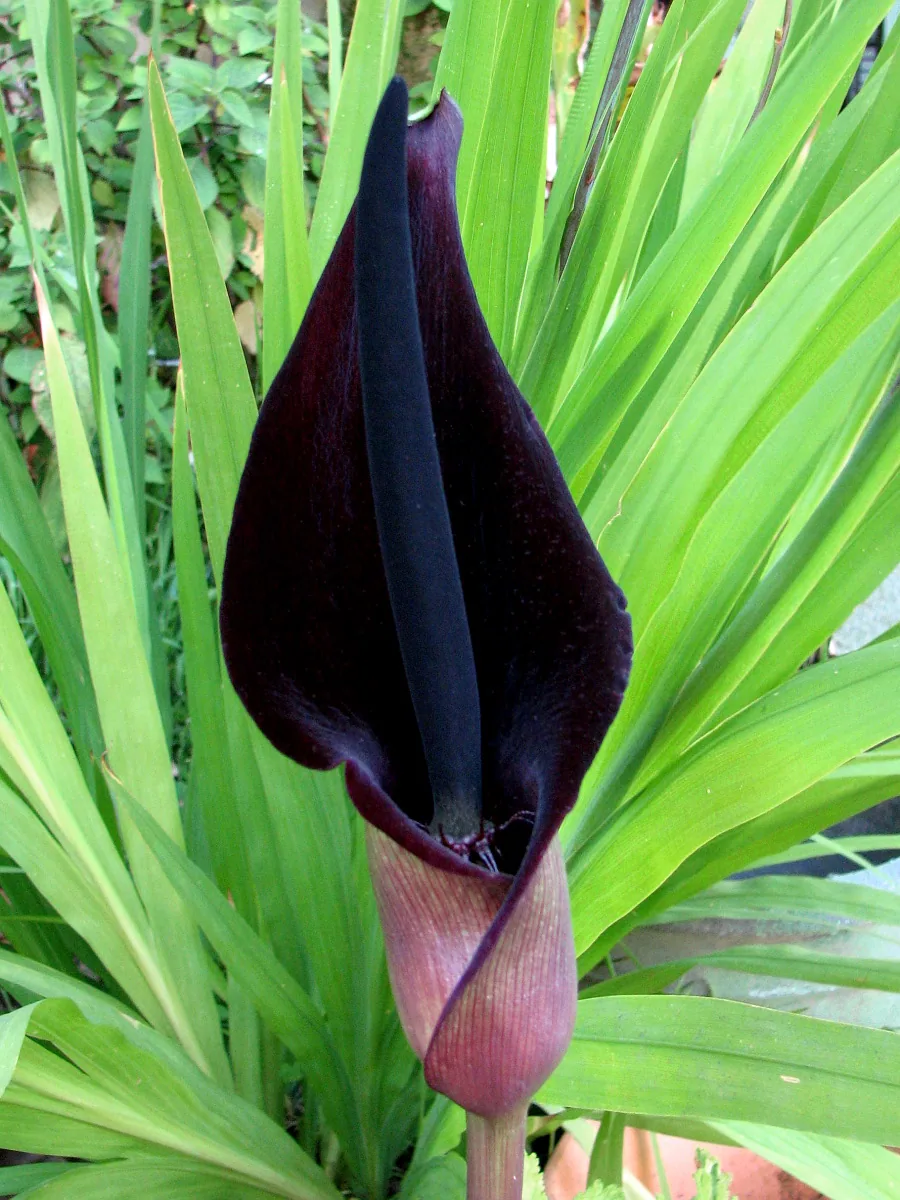
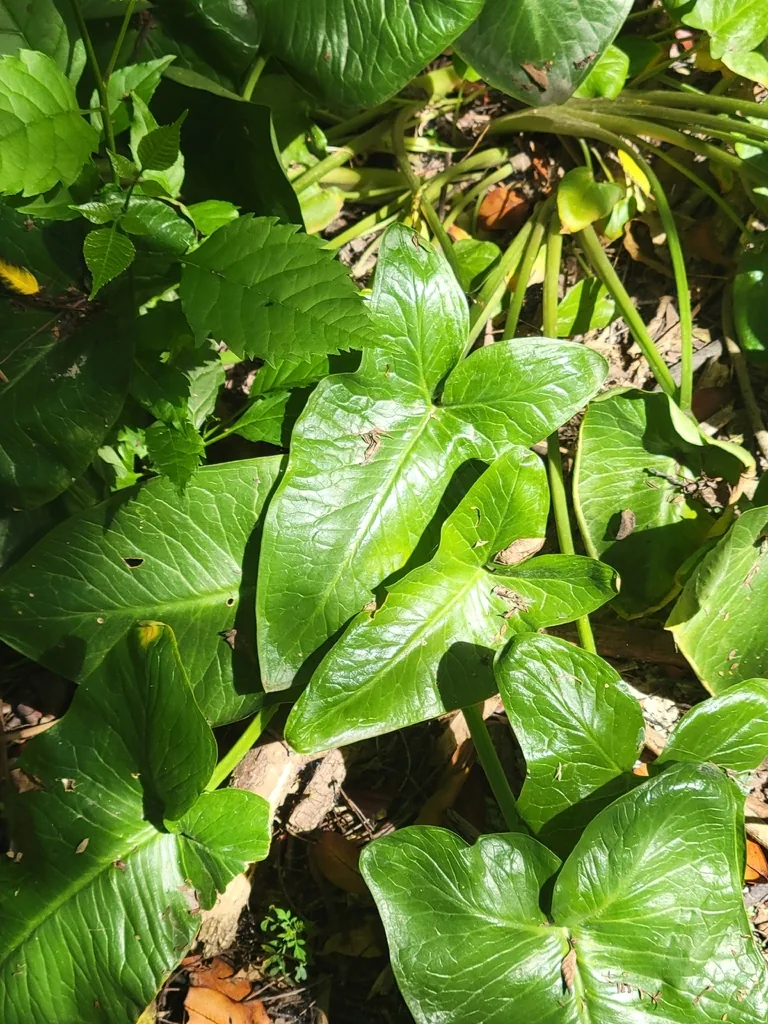

How to Grow and Care for Black Calla
Arum palaestinum
Written by Emilio Marruso · last checked
Toxic to: Cats, Dogs, Horses, People · Why
At a glance
This drought-tolerant perennial is happy in full sun to partial shade, and it flowers best with more sun. Give it a very well-drained spot, let it rest through its summer dormancy, and it asks for little else. It grows in containers too, and you can easily make new plants by dividing it.
- Sun
Full sun to partial shade; flowers best with more sun
What the sources say (2)
Light: Full sun to partial shade (flowering best with more sun)
Light: Full sun (6 or more hours of direct sunlight a day) Partial Shade (Direct sunlight only part of the day, 2-6 hours)
— Arum palaestinum (Black Calla, Black Calla Lily, Solomon's Lily, Wild Arum, Wild Calla) | North Carolina Extension Gardener Plant Toolbox [1] It will grow in sun or shade but flowering is best with more sun.
— Arum palaestinum (Black Calla, Black Calla Lily, Solomon's Lily, Wild Arum, Wild Calla) | North Carolina Extension Gardener Plant Toolbox [1] - Water
Drought tolerant; too much water rots the roots. It rests in summer
What the sources say (4)
Watering: Drought tolerant; needs a very well-drained site
#showy flowers #black flowers #problem for cats #rock garden #drought tolerant #naturalized area
— Arum palaestinum (Black Calla, Black Calla Lily, Solomon's Lily, Wild Arum, Wild Calla) | North Carolina Extension Gardener Plant Toolbox [1] It is important to have it in a very well-drained site.
— Arum palaestinum (Black Calla, Black Calla Lily, Solomon's Lily, Wild Arum, Wild Calla) | North Carolina Extension Gardener Plant Toolbox [1] Watering notes: Overwatering and root rot are listed problems; plant is dormant during summer
C aterpillars, brown spot, and problems related to overwatering or root rot.
— Arum palaestinum (Black Calla, Black Calla Lily, Solomon's Lily, Wild Arum, Wild Calla) | North Carolina Extension Gardener Plant Toolbox [1] The plant is dormant during the summer.
— Arum palaestinum (Black Calla, Black Calla Lily, Solomon's Lily, Wild Arum, Wild Calla) | North Carolina Extension Gardener Plant Toolbox [1] - Cold
Survives winters down to 0 °F (−17.8 °C)
Hardy in very cold winters · USDA 7a · RHS H6 · Z7
What the sources say (2)
Hardiness, coldest zone: 7a [winter low −17.8 to −15 °C (0 to 5 °F)]
USDA Plant Hardiness Zone: 7a, 7b, 8a, 8b, 9a, 9b, 10a, 10b
— Arum palaestinum (Black Calla, Black Calla Lily, Solomon's Lily, Wild Arum, Wild Calla) | North Carolina Extension Gardener Plant Toolbox [1] Hardiness, warmest zone: 10b [winter low 1.7 to 4.4 °C (35 to 40 °F)]
USDA Plant Hardiness Zone: 7a, 7b, 8a, 8b, 9a, 9b, 10a, 10b
— Arum palaestinum (Black Calla, Black Calla Lily, Solomon's Lily, Wild Arum, Wild Calla) | North Carolina Extension Gardener Plant Toolbox [1] - Soil
Needs a very well-drained spot
What the sources say (2)
Watering: Drought tolerant; needs a very well-drained site
#showy flowers #black flowers #problem for cats #rock garden #drought tolerant #naturalized area
— Arum palaestinum (Black Calla, Black Calla Lily, Solomon's Lily, Wild Arum, Wild Calla) | North Carolina Extension Gardener Plant Toolbox [1] It is important to have it in a very well-drained site.
— Arum palaestinum (Black Calla, Black Calla Lily, Solomon's Lily, Wild Arum, Wild Calla) | North Carolina Extension Gardener Plant Toolbox [1] - Harvest
The leaves are eaten only cooked, as in Middle Eastern cooking
- Pests
Caterpillars, brown spot and root rot
What the sources say (2)
Pests: caterpillars
Insects, Diseases, and Other Plant Problems: C aterpillars, brown spot, and problems related to overwatering or root rot.
— Arum palaestinum (Black Calla, Black Calla Lily, Solomon's Lily, Wild Arum, Wild Calla) | North Carolina Extension Gardener Plant Toolbox [1] Diseases: brown spot, root rot
Insects, Diseases, and Other Plant Problems: C aterpillars, brown spot, and problems related to overwatering or root rot.
— Arum palaestinum (Black Calla, Black Calla Lily, Solomon's Lily, Wild Arum, Wild Calla) | North Carolina Extension Gardener Plant Toolbox [1] - Watch out
Once settled in, it spreads and is hard to get rid of
- Propagation
Make new plants by dividing it
What the sources say (1)
Propagation: Division
Recommended Propagation Strategy: Division
— Arum palaestinum (Black Calla, Black Calla Lily, Solomon's Lily, Wild Arum, Wild Calla) | North Carolina Extension Gardener Plant Toolbox [1] - Containers
Grows in containers too
What the sources say (1)
In containers: Yes
Use in a rock garden, border, naturalized area or containers.
— Arum palaestinum (Black Calla, Black Calla Lily, Solomon's Lily, Wild Arum, Wild Calla) | North Carolina Extension Gardener Plant Toolbox [1] - Safety
Harmful to cats, dogs and horses; eaten raw, it irritates and burns the mouth
Overview
Black calla lily is a flowering perennial of the arum family used in rock gardens, borders and containers. [1] It spreads by offsets and needs a very well-drained site. [1] It is rated as a medium severity poison, with oxalate salts as the toxic principle. [1]
This record is incomplete: the sources we read do not cover every field yet.
Not yet covered by our sources: Pruning
Black Calla care
How to water Black Calla
Watering
Drought tolerant; needs a very well-drained site
What the sources say (2)
#showy flowers #black flowers #problem for cats #rock garden #drought tolerant #naturalized areaIt is important to have it in a very well-drained site.Watering notes
Overwatering and root rot are listed problems; plant is dormant during summer
What the sources say (2)
C aterpillars, brown spot, and problems related to overwatering or root rot.The plant is dormant during the summer.How much light Black Calla needs
Full sun to partial shade (flowering best with more sun)
What the sources say (2)
Light:
Full sun (6 or more hours of direct sunlight a day)
Partial Shade (Direct sunlight only part of the day, 2-6 hours)It will grow in sun or shade but flowering is best with more sun.How much cold Black Calla can take
Hardiness, coldest zone
7a [winter low −17.8 to −15 °C (0 to 5 °F)]
What the sources say (1)
USDA Plant Hardiness Zone:
7a, 7b, 8a, 8b, 9a, 9b, 10a, 10bHardiness, warmest zone
10b [winter low 1.7 to 4.4 °C (35 to 40 °F)]
What the sources say (1)
USDA Plant Hardiness Zone:
7a, 7b, 8a, 8b, 9a, 9b, 10a, 10bWhere to grow Black Calla
Yes
What the sources say (1)
Use in a rock garden, border, naturalized area or containers.How to propagate Black Calla
Division
What the sources say (1)
Recommended Propagation Strategy:
DivisionHow to grow Black Calla
The plant
Life cycle
perennial
What the sources say (1)
'Black Calla Lily' is a flowering perennial in the arum family that is native to eastern Mediterranean areas.Family
Araceae
What the sources say (1)
Genus:
Arum
Species:
palaestinum
Family:
Araceae
Uses (Ethnobotany):
Used in Middle Eastern herbal medicinePests and diseases
Pests
caterpillars
What the sources say (1)
Insects, Diseases, and Other Plant Problems: C aterpillars, brown spot, and problems related to overwatering or root rot.Diseases
brown spot, root rot
What the sources say (1)
Insects, Diseases, and Other Plant Problems: C aterpillars, brown spot, and problems related to overwatering or root rot.Black Calla pests and problems
Overwatering and root rot
Symptom: Caterpillars, brown spot, and problems related to overwatering or root rot
What to do: Plant in a very well-drained site
What the sources say (2)
C aterpillars, brown spot, and problems related to overwatering or root rot.
— Arum palaestinum (Black Calla, Black Calla Lily, Solomon's Lily, Wild Arum, Wild Calla) | North Carolina Extension Gardener Plant Toolbox [1] It is important to have it in a very well-drained site.
— Arum palaestinum (Black Calla, Black Calla Lily, Solomon's Lily, Wild Arum, Wild Calla) | North Carolina Extension Gardener Plant Toolbox [1] Persistent spread
Symptom: Can be difficult to eradicate once established
What to do: Not stated
What the sources say (1)
This plant spreads by offsets and can be difficult to eradicate once established.
— Arum palaestinum (Black Calla, Black Calla Lily, Solomon's Lily, Wild Arum, Wild Calla) | North Carolina Extension Gardener Plant Toolbox [1]
Remedies
Each remedy shows what official sources say about it; traditional remedies without an official source are marked as such. Harmful ones are listed so you know to avoid them.
First aid
First aid: not a substitute for a doctor
skin contact with sap
rinse the skin with warm water Official source, not independently tested
See a GP if you have persistent, recurrent or severe symptoms of contact dermatitis.
— nhs.uk [2] How: If you come into contact with an allergen or irritant, rinse the affected skin with warm water and an emollient as soon as possible.
cleaning your skin – if you come into contact with an allergen or irritant, rinse the affected skin with warm water and an emollient as soon as possible
— nhs.uk [2]
Getting rid of it
persistent arum tubers
digging out tubers and roots Partly works
All parts of Italian arum contain calcium oxalate crystals and are toxic. Wear gloves, long sleeves, and avoid contact with sap.
— ask.extension.org [4] Be aware that disturbing the soil can sometimes spread fragments, which is why repeated monitoring is important.
— extension.oregonstate.edu [3] How: Dig out plants as completely as possible, including tubers, roots and stems, and sift the soil to remove remaining plant parts; expect to repeat over several years.
Dig out plants as completely as possible, including tubers, roots and stems.
— extension.oregonstate.edu [3] What the evidence says Digging is effective only if nearly all tubers and bulblets are removed.
— ask.extension.org [4] removing berries before they ripen Works
All parts of Italian arum contain calcium oxalate crystals and are toxic. Wear gloves, long sleeves, and avoid contact with sap.
— ask.extension.org [4] How: Remove and dispose of berries before they ripen to prevent seed spread; place all plant material in the trash, not in compost.
Remove and dispose of berries before they ripen to prevent seed spread.
— extension.oregonstate.edu [3] What the evidence says Cutting and bagging the stems with berries will prevent seeds from being spread and beginning new infestations.
— nwcb.wa.gov [5] repeated removal of new shoots Official source, not independently tested
All parts of Italian arum contain calcium oxalate crystals and are toxic. Wear gloves, long sleeves, and avoid contact with sap.
— ask.extension.org [4] How: Inspect the area several times each year and remove new shoots promptly.
Continue to Monitor and remove new shoots promptly. Inspect the area several times each year.
— ask.extension.org [4]
Is Black Calla toxic to pets?
Reported by the source, quoted verbatim. This is not medical or veterinary advice: if a person or an animal may have eaten this plant, contact a poison control centre or a veterinarian.
Animals
Problems: Poisonous to Humans Problem for Cats Problem for Dogs Problem for Horses
[1]- Severity
This plant has medium severity poison characteristics.
[1]
People
Eating small amounts of the raw plant causes mucous membrane irritation, and burning.
[1]- Poisonous parts
Poison Part: Flowers Fruits Leaves Roots Sap/Juice Stems
[1]- Toxic principle
Poison Toxic Principle: oxalate salts
[1]- Symptoms
Eating small amounts of the raw plant causes mucous membrane irritation, and burning. Consuming larger amounts causes nausea, diarrhea, cramping, excessive drooling, vomiting (not horses), and difficulty swallowing.
[1]- Severity
This plant has medium severity poison characteristics.
[1]
Calendar
Pruning
Not stated in the sources we read.
Months as given by the sources, which are mostly from the United States (northern hemisphere). In the southern hemisphere they shift by about six months.
Edibility
Reported by the source, quoted verbatim. Do not eat a plant on the basis of this page alone: identification mistakes can be dangerous.
The leaves can be eaten if cooked and are used in Middle Eastern diets.
[1]
Similar plants
- Arum Arum maculatum
- Italian Arum Arum italicum
- Arum pictum Arum pictum
- Anthurium Anthurium andraeanum
- Arrowhead Plant Syngonium podophyllum
- Blushing Philodendron Philodendron erubescens
- Calla Lily Zantedeschia aethiopica
- Chinese Evergreen Aglaonema commutatum
Sources
Every value above is quoted from these documents. Links lead to the original publisher.
- Arum palaestinum (Black Calla, Black Calla Lily, Solomon's Lily, Wild Arum, Wild Calla) | North Carolina Extension Gardener Plant Toolbox · plants.ces.ncsu.edu, consulted
- nhs.uk · nhs.uk
- extension.oregonstate.edu · extension.oregonstate.edu
- ask.extension.org · ask.extension.org
- nwcb.wa.gov · nwcb.wa.gov
Written by Emilio Marruso · last checked