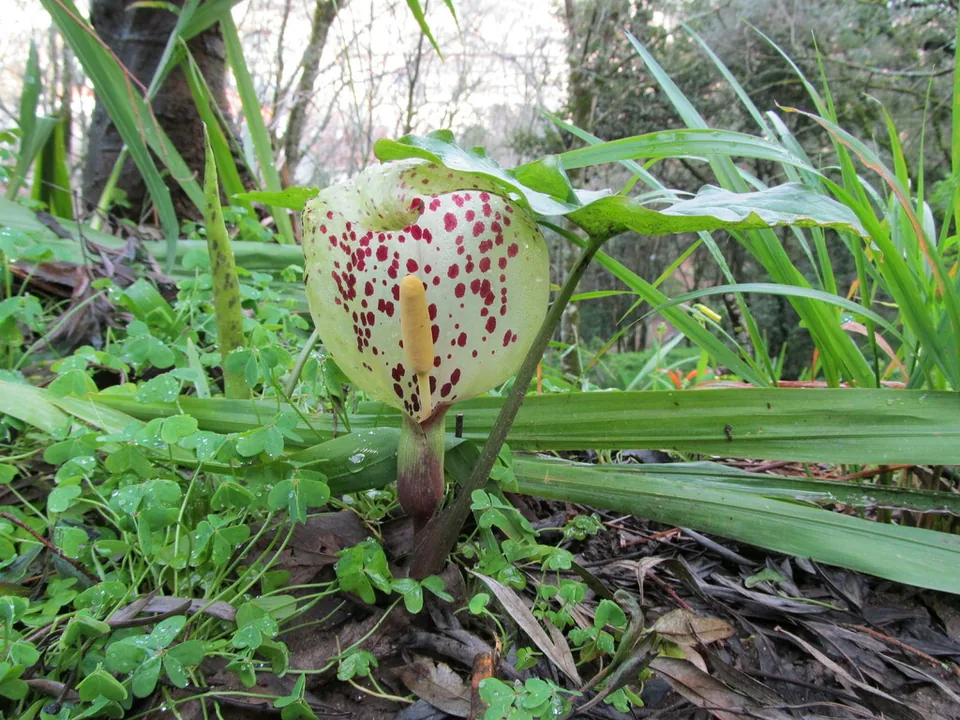
How to Grow and Care for Italian Arum
Arum italicum
Written by Emilio Marruso · last checked
Toxic to: People · Why
At a glance
Italian arum is a perennial that fits shady woodland corners as well as sunny spots, from partial shade to full sun. Give it moist soil rich in humus and it grows into a tidy clump 1 to 2 feet tall and wide, and it is happy in a pot too. Wear gloves when you handle it, and keep it in check: it spreads easily.
- Sun
Partial shade to full sun; great under trees that lose their leaves
What the sources say (4)
Light: Partial shade to full sun
According to NC State Extension: The plant grows in partial shade to full sun and is tolerant of most soil types.
— Arum italicum (Cuckoo Pint, Italian Arum, Italian Lily, Lords and Ladies, Orange Candle Flower) | North Carolina Extension Gardener Plant Toolbox [1] According to University of Arkansas Division of Agriculture: They’re most often grown in the deciduous woodland garden but do fine in full sun.
— Italian Arum [2] The plant grows in partial shade to full sun and is tolerant of most soil types. It prefers moist humus soils.
— Arum italicum (Cuckoo Pint, Italian Arum, Italian Lily, Lords and Ladies, Orange Candle Flower) | North Carolina Extension Gardener Plant Toolbox [1] garden but do fine in full sun. If you wish to increase the size of the colony, divide
— Italian Arum [2] - Water
Keep the soil moist
What the sources say (1)
Watering notes: Prefers moist humus soils
The plant grows in partial shade to full sun and is tolerant of most soil types. It prefers moist humus soils.
— Arum italicum (Cuckoo Pint, Italian Arum, Italian Lily, Lords and Ladies, Orange Candle Flower) | North Carolina Extension Gardener Plant Toolbox [1] - Cold
Survives winters down to −20 °F (−28.9 °C)
Very hardy · USDA 5a · RHS H7 · Z5
What the sources say (4)
Hardiness, coldest zone: 5a [winter low −28.9 to −26.1 °C (−20 to −15 °F)]
5a, 5b, 6a, 6b, 7a, 7b, 8a, 8b, 9a, 9b
— Arum italicum (Cuckoo Pint, Italian Arum, Italian Lily, Lords and Ladies, Orange Candle Flower) | North Carolina Extension Gardener Plant Toolbox [1] Hardiness, warmest zone:
According to NC State Extension: 5a, 5b, 6a, 6b, 7a, 7b, 8a, 8b, 9a, 9b
— Arum italicum (Cuckoo Pint, Italian Arum, Italian Lily, Lords and Ladies, Orange Candle Flower) | North Carolina Extension Gardener Plant Toolbox [1] According to University of Arkansas Division of Agriculture: winter hardy through most of zone 6
— Italian Arum [2] 5a, 5b, 6a, 6b, 7a, 7b, 8a, 8b, 9a, 9b
— Arum italicum (Cuckoo Pint, Italian Arum, Italian Lily, Lords and Ladies, Orange Candle Flower) | North Carolina Extension Gardener Plant Toolbox [1] - Soil
Soil rich in humus
What the sources say (1)
Watering notes: Prefers moist humus soils
The plant grows in partial shade to full sun and is tolerant of most soil types. It prefers moist humus soils.
— Arum italicum (Cuckoo Pint, Italian Arum, Italian Lily, Lords and Ladies, Orange Candle Flower) | North Carolina Extension Gardener Plant Toolbox [1] - Watch out
Spreads hard by seed and underground bulbs; throw pulled plants in the trash, not the compost
- Size
1 to 2 ft tall and wide
What the sources say (2)
Mature height: 30-61 cm (1-2 ft)
Dimensions: Height: 1 ft. 0 in. - 2 ft. 0 in. Width: 1 ft. 0 in. - 2 ft. 0 in.
— Arum italicum (Cuckoo Pint, Italian Arum, Italian Lily, Lords and Ladies, Orange Candle Flower) | North Carolina Extension Gardener Plant Toolbox [1] Mature width: 30-61 cm (1-2 ft)
Dimensions: Height: 1 ft. 0 in. - 2 ft. 0 in. Width: 1 ft. 0 in. - 2 ft. 0 in.
— Arum italicum (Cuckoo Pint, Italian Arum, Italian Lily, Lords and Ladies, Orange Candle Flower) | North Carolina Extension Gardener Plant Toolbox [1] - Propagation
Divide the clump, sow seeds or plant its underground bulbs
What the sources say (2)
Propagation: Division, seed, corms
The plant is reproduced by seeds and corms.
— Arum italicum (Cuckoo Pint, Italian Arum, Italian Lily, Lords and Ladies, Orange Candle Flower) | North Carolina Extension Gardener Plant Toolbox [1] If you wish to increase the size of the colony, divide in the summer during their dormant season.
— Italian Arum [2] - Containers
Grows in containers too
What the sources say (1)
In containers: Yes
Alternatively, keep the plant confined in a container and remove fruits before they are ripe.
— Arum italicum (Cuckoo Pint, Italian Arum, Italian Lily, Lords and Ladies, Orange Candle Flower) | North Carolina Extension Gardener Plant Toolbox [1] - Safety
Every part is poisonous if eaten and irritates skin: wear gloves when you handle it
Overview
Italian arum is an herbaceous perennial groundcover in the arum family, considered invasive in some parts of the United States. [1] All plant parts can cause skin irritation, and ingesting any part may cause throat and tongue swelling. [1]
This record is incomplete: the sources we read do not cover every field yet.
Not yet covered by our sources: Watering, Pruning
Italian Arum care
How to water Italian Arum
Watering
Not stated in the sources we read.
Watering notes
Prefers moist humus soils
What the sources say (1)
The plant grows in partial shade to full sun and is tolerant of most soil types. It prefers moist humus soils.How much light Italian Arum needs
Partial shade to full sun
What each source says
According to NC State Extension: Partial shade to full sun
According to University of Arkansas Division of Agriculture: Deciduous woodland garden, also full sun
What the sources say (4)
According to NC State Extension: The plant grows in partial shade to full sun and is tolerant of most soil types.According to University of Arkansas Division of Agriculture: They’re most often grown in the deciduous woodland
garden but do fine in full sun.The plant grows in partial shade to full sun and is tolerant of most soil types. It prefers moist humus soils.garden but do fine in full sun. If you wish to increase the size of the colony, divideHow much cold Italian Arum can take
Hardiness, coldest zone
5a [winter low −28.9 to −26.1 °C (−20 to −15 °F)]
What the sources say (1)
5a, 5b, 6a, 6b, 7a, 7b, 8a, 8b, 9a, 9bHardiness, warmest zone
The sources give different values depending on region, zone or growing conditions.
What each source says
According to NC State Extension: 9b [winter low −3.9 to −1.1 °C (25 to 30 °F)]
According to University of Arkansas Division of Agriculture: 6 [winter low −23.3 to −17.8 °C (−10 to 0 °F)]
What the sources say (3)
According to NC State Extension: 5a, 5b, 6a, 6b, 7a, 7b, 8a, 8b, 9a, 9bAccording to University of Arkansas Division of Agriculture: winter hardy through most of
zone 65a, 5b, 6a, 6b, 7a, 7b, 8a, 8b, 9a, 9bWhere to grow Italian Arum
Yes
What the sources say (1)
Alternatively, keep the plant confined in a container and remove fruits before they are ripe.How to propagate Italian Arum
Division, seed, corms
What the sources say (2)
The plant is reproduced by seeds and corms.If you wish to increase the size of the colony, divide
in the summer during their dormant season.How to grow Italian Arum
The plant
Life cycle
perennial
What the sources say (1)
Italian arum is an herbaceous perennial groundcover and a member of the arum family (Araceae).Family
Araceae
What the sources say (1)
Italian arum is an herbaceous perennial groundcover and a member of the arum family (Araceae).Mature height
30-61 cm (1-2 ft)
What the sources say (1)
Dimensions: Height: 1 ft. 0 in. - 2 ft. 0 in. Width: 1 ft. 0 in. - 2 ft. 0 in.Mature width
30-61 cm (1-2 ft)
What the sources say (1)
Dimensions: Height: 1 ft. 0 in. - 2 ft. 0 in. Width: 1 ft. 0 in. - 2 ft. 0 in.Italian Arum pests and problems
Invasiveness
Symptom: The plant is very difficult to control and spreads by seeds and underground corms; it is unresponsive to herbicides.
What to do: Manual removal is difficult; if removed, all parts of the plant should be placed in the trash and not the compost bin.
What the sources say (2)
If removed, all parts of the plant should be placed in the trash and not your compost bin.
— Arum italicum (Cuckoo Pint, Italian Arum, Italian Lily, Lords and Ladies, Orange Candle Flower) | North Carolina Extension Gardener Plant Toolbox [1] There are no effective ways to control the plant, and it is unresponsive to herbicides.
— Arum italicum (Cuckoo Pint, Italian Arum, Italian Lily, Lords and Ladies, Orange Candle Flower) | North Carolina Extension Gardener Plant Toolbox [1]
Remedies
Each remedy shows what official sources say about it; traditional remedies without an official source are marked as such. Harmful ones are listed so you know to avoid them.
Treating the plant
slugs
hand-picking Not verified
Traditional remedy, not verified by an official source.
How: Hand-pick slugs and snails in the evening and reduce hiding places such as dense debris or boards.
copper tape or coarse grit barrier Not verified
Traditional remedy, not verified by an official source.
How: Copper tape barriers or coarse grit around crowns help protect emerging leaves and shoots.
aphids
strong stream of water Not verified
Traditional remedy, not verified by an official source.
How: Rinse colonies off with a firm stream of water, especially from the undersides of leaves and flowering stems.
insecticidal soap Works
For example, spraying home remedies that contain dish detergent on plants on a sunny day can injure the plant, essentially burning it.
— extension.psu.edu [5] How: If numbers remain high, apply insecticidal soap, ensuring good coverage while avoiding application in strong sun or very high temperatures.
If numbers remain high, apply insecticidal soap or a light horticultural oil, ensuring good coverage while avoiding application in strong sun or very high temperatures.
— botanapp.com [3] What the evidence says For example, insecticidal soap is a safe, effective organic insecticide with minimal environmental impact.
— extension.psu.edu [4]
Getting rid of it
invasive weed
manual removal (digging out tubers) Partly works
Be sure to wear gloves and protective clothing when handling this plant. All the plant parts can cause skin irritation.
— Arum italicum (Cuckoo Pint, Italian Arum, Italian Lily, Lords and Ladies, Orange Candle Flower) | North Carolina Extension Gardener Plant Toolbox [1] Control by digging is most effective for small invasions. All parts of the plant must be removed from the soil or an even worse infestation could occur.
— gardeningknowhow.com [8] How: Dig out individual plants when the soil is moist and sift the soil; remove all stems, tubers and root pieces; bag them and put them in the trash, not in the compost.
Dig out individual plants and sift the soil. Remove all the stems, tubers, and root pieces.
— solvepestproblems.oregonstate.edu [6] What the evidence says If you want to avoid herbicides, manual removal is the primary option, but it typically requires persistence over multiple years.
— extension.oregonstate.edu [7] boiling water Not verified
Traditional remedy, not verified by an official source.
How: Boiling water can also be effective for killing the plants' roots.
industrial-strength vinegar Partly works
Homeowners should note that concentrations of acetic acid this high are incredibly harmful to humans.
— extension.illinois.edu [10] How: Several applications of industrial-strength vinegar will kill the foliage; it may not reach the underground structure.
While it may not reach the weeds' underground structure, several applications of industrial-strength vinegar will kill the foliage. Wear heavy gloves for this process.
— gardeningknowhow.com [8] What the evidence says Vinegar can treat and kill weeds, but it must be herbicidal vinegar or acetic acid, not household vinegar ( Fiola and Gill 2024 ).
— extension.illinois.edu [9] removing berries before they ripen Works
How: Cut off berry clusters before they ripen and dispose of them in the trash.
At minimum, cut off berry clusters before they ripen and dispose of them in the trash.
— solvepestproblems.oregonstate.edu [6] What the evidence says Remove and dispose of berries before they ripen to prevent seed spread.
— extension.oregonstate.edu [7]
Is Italian Arum poisonous?
Reported by the source, quoted verbatim. This is not medical or veterinary advice: if a person or an animal may have eaten this plant, contact a poison control centre or a veterinarian.
Ingesting any part of this plant may lead to symptoms of throat and tongue swelling. This may cause increased difficulty breathing and result in possible death.
[1]- Poisonous parts
Poison Part: Bark Flowers Fruits Leaves Roots Seeds Stems
[1]- Toxic principle
Poison Toxic Principle: Calcium oxalate crystals
[1]- Symptoms
Poison Symptoms: Ingesting any part of this plant may lead to symptoms of throat and tongue swelling. This may cause increased difficulty breathing and result in possible death. Physical contact with this plant can cause skin irritation.
[1]- Severity
Poison Severity: High
[1]
Be sure to wear gloves and protective clothing when handling this plant. All the plant parts can cause skin irritation.
[1]
Calendar
Pruning
Not stated in the sources we read.
Months as given by the sources, which are mostly from the United States (northern hemisphere). In the southern hemisphere they shift by about six months.
Indicative values
Values from a secondary source, not checked word for word like the rest of this page. Use them as a starting point.
- Watering
- AverageIndicative value, adapt it to your climate · Secondary source
- Soil pH
- 6-7Indicative value, adapt it to your climate · Secondary source
- Care level
- MediumIndicative value, adapt it to your climate · Secondary source
- Growth rate
- LowIndicative value, adapt it to your climate · Secondary source
- Pruning
- May, June, JulyIndicative value, adapt it to your climate · Secondary source
Similar plants
- Arum Arum maculatum
- Black Calla Arum palaestinum
- Arum pictum Arum pictum
- Anthurium Anthurium andraeanum
- Arrowhead Plant Syngonium podophyllum
- Blushing Philodendron Philodendron erubescens
- Calla Lily Zantedeschia aethiopica
- Chinese Evergreen Aglaonema commutatum
Sources
Every value above is quoted from these documents. Links lead to the original publisher.
- Arum italicum (Cuckoo Pint, Italian Arum, Italian Lily, Lords and Ladies, Orange Candle Flower) | North Carolina Extension Gardener Plant Toolbox · plants.ces.ncsu.edu, consulted
- Italian Arum · uaex.uada.edu, consulted
- botanapp.com · botanapp.com
- extension.psu.edu · extension.psu.edu
- extension.psu.edu · extension.psu.edu
- solvepestproblems.oregonstate.edu · solvepestproblems.oregonstate.edu
- extension.oregonstate.edu · extension.oregonstate.edu
- gardeningknowhow.com · gardeningknowhow.com
- extension.illinois.edu · extension.illinois.edu
- extension.illinois.edu · extension.illinois.edu
Written by Emilio Marruso · last checked