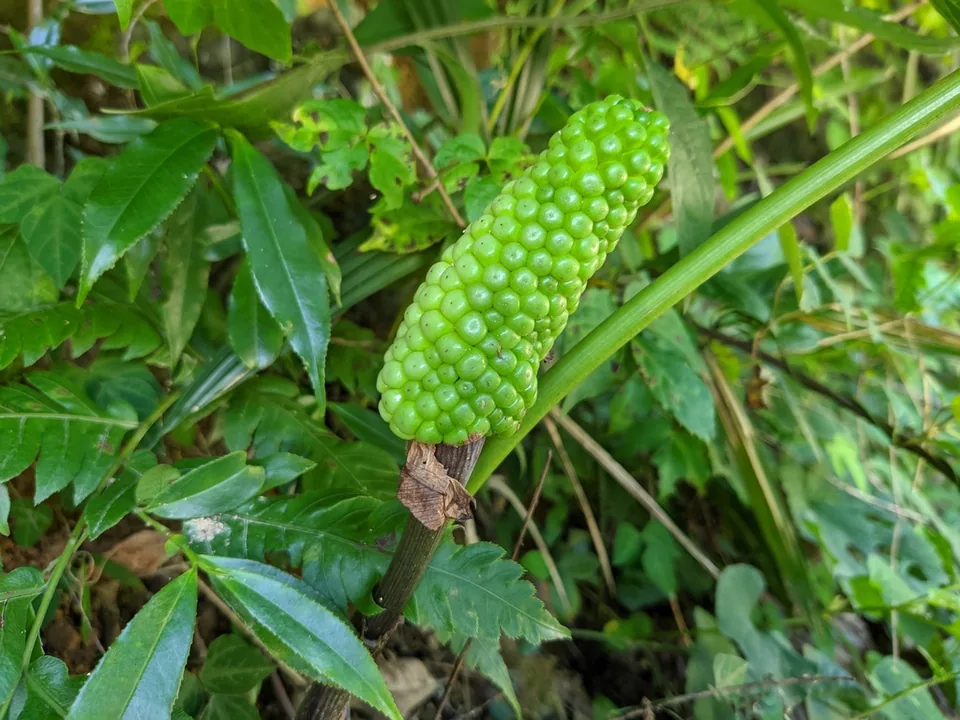
How to Grow and Care for Japanese Jack-in-the-pulpit
Arisaema sikokianum
Written by Emilio Marruso · last checked
Toxic to: Cats, Dogs, Horses, People · Why
At a glance
Looking for something special for a shady corner? This perennial thrives in partial to full shade and grows 1.5–2 ft tall and just as wide. It grows happily in containers too, and you can multiply it from corms or seed, so one plant can become many. Just keep an eye out for slugs and vine weevils.
- Sun
Partial to full shade
What the sources say (1)
Light: Partial to full shade
This plant grows 1.5 to 2 feet tall and wide in hummus-rich, moist, well-drained soils in partial to full shade.
— Arisaema sikokianum (Japanese cobra lily, Japanese Jack-in-the-pulpit) | North Carolina Extension Gardener Plant Toolbox [1] - Cold
Survives winters down to −20 °F (−28.9 °C)
Very hardy · USDA 5a · RHS H7 · Z5
What the sources say (2)
Hardiness, coldest zone: 5a [winter low −28.9 to −26.1 °C (−20 to −15 °F)]
USDA Plant Hardiness Zone: 5a, 5b, 6a, 6b, 7a, 7b, 8a, 8b, 9a
— Arisaema sikokianum (Japanese cobra lily, Japanese Jack-in-the-pulpit) | North Carolina Extension Gardener Plant Toolbox [1] Hardiness, warmest zone: 9a [winter low −6.7 to −3.9 °C (20 to 25 °F)]
USDA Plant Hardiness Zone: 5a, 5b, 6a, 6b, 7a, 7b, 8a, 8b, 9a
— Arisaema sikokianum (Japanese cobra lily, Japanese Jack-in-the-pulpit) | North Carolina Extension Gardener Plant Toolbox [1] - Pests
Watch for slugs and vine weevils
What the sources say (1)
Pests: slugs, vine weevils
Insects, Diseases, and Other Plant Problems: No significant problems. Watch for slugs and vine weevils.
— Arisaema sikokianum (Japanese cobra lily, Japanese Jack-in-the-pulpit) | North Carolina Extension Gardener Plant Toolbox [1] - Size
1.5–2 ft tall and 1.5–2 ft wide
What the sources say (2)
Mature height: 45.72-60.96 cm (1.5-2 ft)
This plant grows 1.5 to 2 feet tall and wide in hummus-rich, moist, well-drained soils in partial to full shade.
— Arisaema sikokianum (Japanese cobra lily, Japanese Jack-in-the-pulpit) | North Carolina Extension Gardener Plant Toolbox [1] Mature width: 45.72-60.96 cm (1.5-2 ft)
This plant grows 1.5 to 2 feet tall and wide in hummus-rich, moist, well-drained soils in partial to full shade.
— Arisaema sikokianum (Japanese cobra lily, Japanese Jack-in-the-pulpit) | North Carolina Extension Gardener Plant Toolbox [1] - Propagation
Multiply it from corms or seed
What the sources say (1)
Propagation: Corms; seed
It is best grown from corms, as plants grown from seed can take 3 to 5 years to bloom.
— Arisaema sikokianum (Japanese cobra lily, Japanese Jack-in-the-pulpit) | North Carolina Extension Gardener Plant Toolbox [1] - Containers
Grows in containers too
What the sources say (1)
In containers: Yes
Use in a cottage or Asian garden theme or in a container.
— Arisaema sikokianum (Japanese cobra lily, Japanese Jack-in-the-pulpit) | North Carolina Extension Gardener Plant Toolbox [1] - Safety
Keep away from kids and pets: eating it swells the lips and throat; the sap can irritate skin
Overview
Japanese Jack-in-the-pulpit is an herbaceous plant of shady, moist woodland sites that grows 1.5 to 2 feet [46–61 cm] tall and wide. [1] It is best grown from corms and goes dormant in mid- to late-summer. [1] The source rates it low severity poison for humans, with calcium oxalate as the toxic principle. [1]
This record is incomplete: the sources we read do not cover every field yet.
Not yet covered by our sources: Watering, Pruning
Japanese Jack-in-the-pulpit care
Measurements in square brackets are our conversion into the other unit system; the quoted text is unchanged.
How to water Japanese Jack-in-the-pulpit
Not stated in the sources we read.
How much light Japanese Jack-in-the-pulpit needs
Partial to full shade
What the sources say (1)
This plant grows 1.5 to 2 feet tall and wide in hummus-rich, moist, well-drained soils in partial to full shade.How much cold Japanese Jack-in-the-pulpit can take
Hardiness, coldest zone
5a [winter low −28.9 to −26.1 °C (−20 to −15 °F)]
What the sources say (1)
USDA Plant Hardiness Zone:
5a, 5b, 6a, 6b, 7a, 7b, 8a, 8b, 9aHardiness, warmest zone
9a [winter low −6.7 to −3.9 °C (20 to 25 °F)]
What the sources say (1)
USDA Plant Hardiness Zone:
5a, 5b, 6a, 6b, 7a, 7b, 8a, 8b, 9aWhere to grow Japanese Jack-in-the-pulpit
Yes
What the sources say (1)
Use in a cottage or Asian garden theme or in a container.How to propagate Japanese Jack-in-the-pulpit
Corms; seed
What the sources say (1)
It is best grown from corms, as plants grown from seed can take 3 to 5 years to bloom.How to grow Japanese Jack-in-the-pulpit
The plant
Life cycle
perennial
What the sources say (1)
Family:
Araceae
Life Cycle:
Perennial
Country Or Region Of Origin:
JapanFamily
Araceae
What the sources say (1)
Japanese Jack-in-the-pulpit is an herbaceous flowering plant in the aroid family (Araceae) native to the island of Shikoku in JapanMature height
45.72-60.96 cm (1.5-2 ft)
What the sources say (1)
This plant grows 1.5 to 2 feet tall and wide in hummus-rich, moist, well-drained soils in partial to full shade.Mature width
45.72-60.96 cm (1.5-2 ft)
What the sources say (1)
This plant grows 1.5 to 2 feet tall and wide in hummus-rich, moist, well-drained soils in partial to full shade.Pests and diseases
Pests
slugs, vine weevils
What the sources say (1)
Insects, Diseases, and Other Plant Problems: No significant problems. Watch for slugs and vine weevils.Japanese Jack-in-the-pulpit pests and problems
Slugs and vine weevils
Symptom: Pests to watch for
What to do: Watch for slugs and vine weevils.
What the sources say (1)
No significant problems. Watch for slugs and vine weevils.
— Arisaema sikokianum (Japanese cobra lily, Japanese Jack-in-the-pulpit) | North Carolina Extension Gardener Plant Toolbox [1]
Remedies
Each remedy shows what official sources say about it; traditional remedies without an official source are marked as such. Harmful ones are listed so you know to avoid them.
First aid
First aid: not a substitute for a doctor
skin contact with sap
wash skin with soap and warm running water Official source, not independently tested
If the pain continues, contact your child's physician.
— chop.edu [4] How: Lather the exposed area repeatedly with soap and rinse with warm running water to ease the irritation.
When the juices of the plant come in contact with the skin, burning, pain and swelling may occur. Lather the exposed area repeatedly with soap and rinse with warm running water to ease the irritation.
— chop.edu [4]
swallowing plant parts
wipe out the mouth and offer a cool drink Official source, not independently tested
If there is swelling that prevents the child taking anything by mouth or causes difficulty breathing, go to the nearest emergency department immediately.
— chop.edu [4] How: Wipe out the residue of the plant from the mouth and offer a cool drink or snack such as a popsicle, applesauce or yogurt.
If a child eats any part of an oxalate-containing plant, wipe out the residue of the plant from the mouth and offer a cool drink or snack such as a popsicle, applesauce or yogurt.
— chop.edu [4]
Treating the plant
slugs
picking by hand Works
How: Handpick at night, about two hours after sunset, with a flashlight; place captured slugs and snails in a container of hot soapy water for later disposal.
Picking by hand or with tweezers, although not an enjoyable task, is a very effective method of immediate control and can last a reasonably long time if combined with other techniques.
— extension.umd.edu [5] What the evidence says Picking by hand or with tweezers, although not an enjoyable task, is a very effective method of immediate control and can last a reasonably long time if combined with other techniques.
— extension.umd.edu [5] trapping Works
How: Overturned flower pots, boards, shingles or inverted grapefruit halves provide daytime shelter and act as traps; they can be baited with pieces of potato, apple or lettuce leaves.
Trapping is another successful tactic for control. Overturned flower pots, boards, shingles, inverted grapefruit halves, commercially available slug and snail traps, or just about anything that will provide daytime shelter can be an effective trap.
— extension.umd.edu [5] What the evidence says Trapping is another successful tactic for control. Overturned flower pots, boards, shingles, inverted grapefruit halves, commercially available slug and snail traps, or just about anything that will provide daytime shelter can be an effective trap.
— extension.umd.edu [5] beer trap Official source, not independently tested
The drawback to this type of trapping is that it requires frequent monitoring and bait replacement.
— extension.umd.edu [5] How: Shallow containers filled with beer; a simple mixture of any yeast and water will also work. Slugs attracted to the beer fall in and drown.
Most people are familiar with using shallow containers filled with beer as a method of baiting. Apparently, the yeast is what attracts them, and a simple mixture of any yeast and water will also work. Slugs attracted to beer become tipsy and fall in to drown.
— extension.umd.edu [5] copper strip barrier Official source, not independently tested
An important point to remember is that barriers will not be effective against slugs and snails already present in the area to be protected.
— extension.umd.edu [5] How: Strips of copper fastened around beds, flower boxes or greenhouse benches; homemade strips can be made from copper sheeting.
The best commercial barriers against slugs and snails are strips of copper that can be fastened around beds, flower boxes, or greenhouse benches. Homemade strips can be made from copper sheeting.
— extension.umd.edu [5]
vine weevils
hand-picking adults Official source, not independently tested
How: Adults feed at night: scout and hand-pick them; a sheet or burlap spread beneath the plant catches adults as they drop to the ground, and the beetles caught are destroyed.
As the adults feed at night, they are difficult to control using a contact insecticide although scouting and hand-picking are options. A sheet or burlap spread beneath the plant will catch the adults as they drop to the ground. Beetles caught in the burlap should be destroyed.
— homegarden.cahnr.uconn.edu [6]
Is Japanese Jack-in-the-pulpit toxic to pets?
Reported by the source, quoted verbatim. This is not medical or veterinary advice: if a person or an animal may have eaten this plant, contact a poison control centre or a veterinarian.
Animals
Problem for Cats Problem for Children Problem for Dogs Problem for Horses
[1]The source flags the risk for this animal but does not explain why.
People
Poison Severity: Low Poison Symptoms: Irritation and swelling of the lips, tongue, and throat if it is eaten raw.
[1]- Poisonous parts
Causes Contact Dermatitis: Yes Poison Part: Fruits Leaves Roots Sap/Juice
[1]- Toxic principle
Poison Toxic Principle: calcium oxalate Causes Contact Dermatitis: Yes
[1]- Symptoms
Irritation and swelling of the lips, tongue, and throat if it is eaten raw.
[1]- Severity
Poisonous to Humans: Poison Severity: Low Poison Symptoms:
[1]
Handling the fruit pulp or leaf sap may cause mild dermatitis.
[1]- Symptoms
Handling the fruit pulp or leaf sap may cause mild dermatitis.
[1]
Calendar
Pruning
Not stated in the sources we read.
Months as given by the sources, which are mostly from the United States (northern hemisphere). In the southern hemisphere they shift by about six months.
Indicative values
Values from a secondary source, not checked word for word like the rest of this page. Use them as a starting point.
- Watering
- AverageIndicative value, adapt it to your climate · Secondary source
- Drought tolerant
- yesIndicative value, adapt it to your climate · Secondary source
- Soil
- Humus rich, Well-drainedIndicative value, adapt it to your climate · Secondary source
- Soil pH
- 5.5-6.5Indicative value, adapt it to your climate · Secondary source
- Care level
- MediumIndicative value, adapt it to your climate · Secondary source
- Growth rate
- LowIndicative value, adapt it to your climate · Secondary source
- Pruning
- March, April, MayIndicative value, adapt it to your climate · Secondary source
Similar plants
- Cobra Lily Arisaema ringens
- Green Dragon Arisaema dracontium
- Jack-in-the-pulpit Arisaema triphyllum
- Dancing Crane Cobra Lily Arisaema heterophyllum
- Green Dragon Pinellia tripartita
- Tiny Duckweed Lemna perpusilla
- ZZ Plant Zamioculcas zamiifolia
- Anthurium Anthurium andraeanum
Sources
Every value above is quoted from these documents. Links lead to the original publisher.
- Arisaema sikokianum (Japanese cobra lily, Japanese Jack-in-the-pulpit) | North Carolina Extension Gardener Plant Toolbox · plants.ces.ncsu.edu, consulted
- Arisaema (Cobra Lilies, Jack-in-the-Pulpit) | North Carolina Extension Gardener Plant Toolbox · plants.ces.ncsu.edu, consulted
- Cobra Lilies - Arisaema | North Carolina Extension Gardener Plant Toolbox · plants.ces.ncsu.edu, consulted
- chop.edu · chop.edu
- extension.umd.edu · extension.umd.edu
- homegarden.cahnr.uconn.edu · homegarden.cahnr.uconn.edu
Written by Emilio Marruso · last checked