
How to Grow and Care for Dragon Arum
Dracunculus vulgaris
Written by Emilio Marruso · last checked
Toxic to: Cats, Dogs · Why
At a glance
Dragon arum is an easygoing perennial that is happy in full sun or partial shade and shrugs off dry spells. It grows 2–3 ft tall; its flowers draw flies and beetles, and birds feast on its berries. Over time it spreads by seed and bulb offsets, so one plant can turn into a clump you can divide and share.
- Sun
Full sun to partial shade
What the sources say (2)
Light: Full sun to partial shade
Dragon arum prefers full sun to partial shade in fertile moist loam. It is drought-tolerant and deer resistant.
— Dracunculus vulgaris (Black Arum, Dragon Arum, Dragon Lily, Vampire Lily) | North Carolina Extension Gardener Plant Toolbox [1] Light: Full sun (6 or more hours of direct sunlight a day) Partial Shade (Direct sunlight only part of the day, 2-6 hours)
— Dracunculus vulgaris (Black Arum, Dragon Arum, Dragon Lily, Vampire Lily) | North Carolina Extension Gardener Plant Toolbox [1] - Water
Handles dry spells well
What the sources say (1)
Watering: Drought-tolerant
Dragon arum prefers full sun to partial shade in fertile moist loam. It is drought-tolerant and deer resistant.
— Dracunculus vulgaris (Black Arum, Dragon Arum, Dragon Lily, Vampire Lily) | North Carolina Extension Gardener Plant Toolbox [1] - Cold
Survives winters down to 0 °F (−17.8 °C)
Hardy in very cold winters · USDA 7a · RHS H6 · Z7
What the sources say (2)
Hardiness, coldest zone: 7a [winter low −17.8 to −15 °C (0 to 5 °F)]
USDA Plant Hardiness Zone: 7a, 7b, 8a, 8b, 9a, 9b, 10a, 10b
— Dracunculus vulgaris (Black Arum, Dragon Arum, Dragon Lily, Vampire Lily) | North Carolina Extension Gardener Plant Toolbox [1] Hardiness, warmest zone: 10b [winter low 1.7 to 4.4 °C (35 to 40 °F)]
USDA Plant Hardiness Zone: 7a, 7b, 8a, 8b, 9a, 9b, 10a, 10b
— Dracunculus vulgaris (Black Arum, Dragon Arum, Dragon Lily, Vampire Lily) | North Carolina Extension Gardener Plant Toolbox [1] - Pollination
Its flowers draw flies and beetles
- Watch out
It spreads on its own by seed and bulb offsets
What the sources say (2)
Propagation: Division, seed; spreads by seeding and bulb offsets that can be divided
It spreads by seeding and bulb off-sets that can be divided. Use this plant as an accent
— Dracunculus vulgaris (Black Arum, Dragon Arum, Dragon Lily, Vampire Lily) | North Carolina Extension Gardener Plant Toolbox [1] Recommended Propagation Strategy: Division Seed Country Or Region Of Origin:
— Dracunculus vulgaris (Black Arum, Dragon Arum, Dragon Lily, Vampire Lily) | North Carolina Extension Gardener Plant Toolbox [1] - Size
2–3 ft tall and 1–2 ft wide
What the sources say (2)
Mature height: 61-91 cm (2-3 ft)
Dimensions: Height: 2 ft. 0 in. - 3 ft. 0 in.
— Dracunculus vulgaris (Black Arum, Dragon Arum, Dragon Lily, Vampire Lily) | North Carolina Extension Gardener Plant Toolbox [1] Mature width: 30-61 cm (1-2 ft)
Dimensions: Height: 2 ft. 0 in. - 3 ft. 0 in. Width: 1 ft. 0 in. - 2 ft. 0 in.
— Dracunculus vulgaris (Black Arum, Dragon Arum, Dragon Lily, Vampire Lily) | North Carolina Extension Gardener Plant Toolbox [1] - Propagation
Divide the bulb offsets or grow from seed
What the sources say (2)
Propagation: Division, seed; spreads by seeding and bulb offsets that can be divided
It spreads by seeding and bulb off-sets that can be divided. Use this plant as an accent
— Dracunculus vulgaris (Black Arum, Dragon Arum, Dragon Lily, Vampire Lily) | North Carolina Extension Gardener Plant Toolbox [1] Recommended Propagation Strategy: Division Seed Country Or Region Of Origin:
— Dracunculus vulgaris (Black Arum, Dragon Arum, Dragon Lily, Vampire Lily) | North Carolina Extension Gardener Plant Toolbox [1] - Safety
Harmful to cats and dogs
Overview
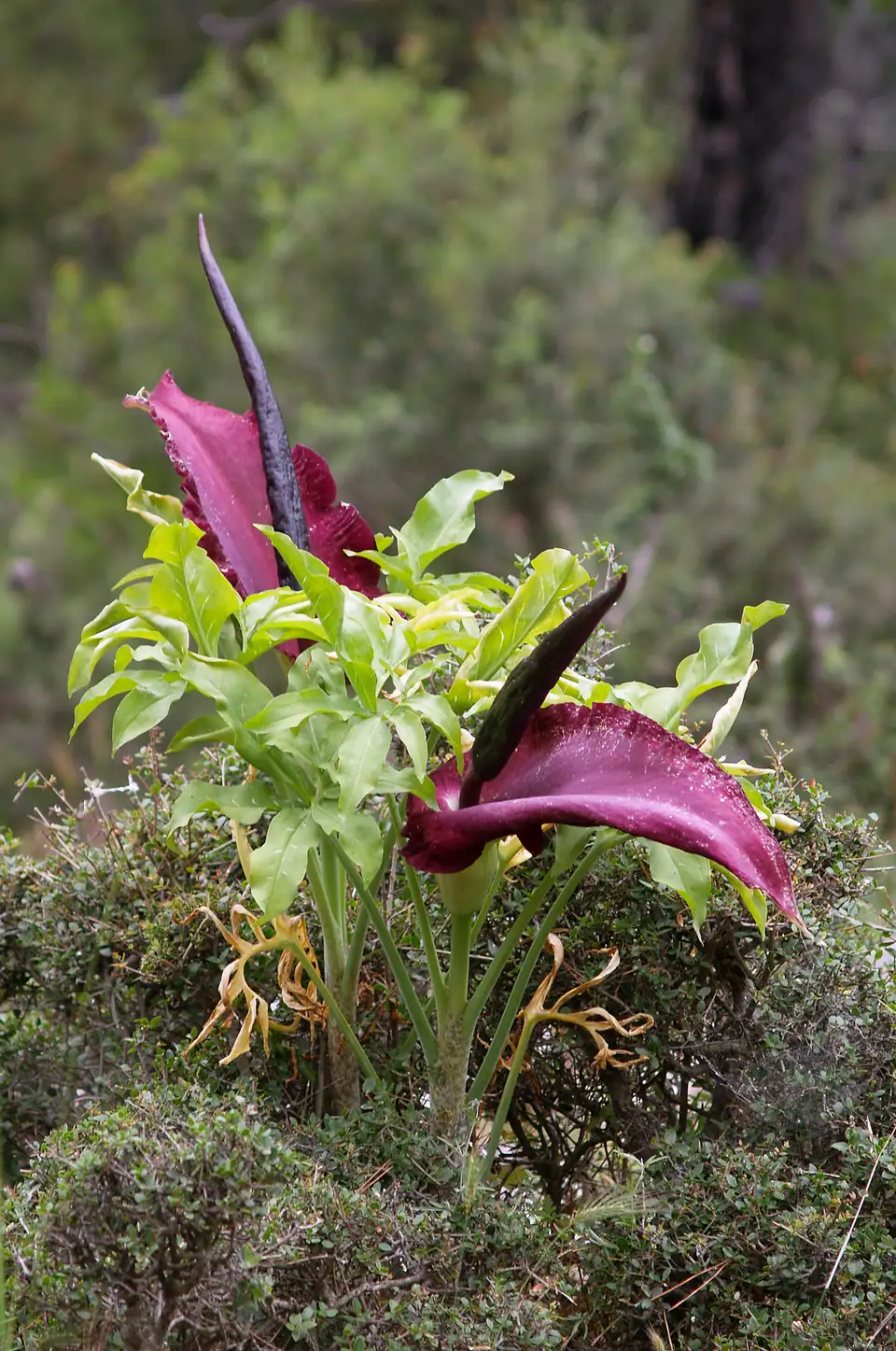
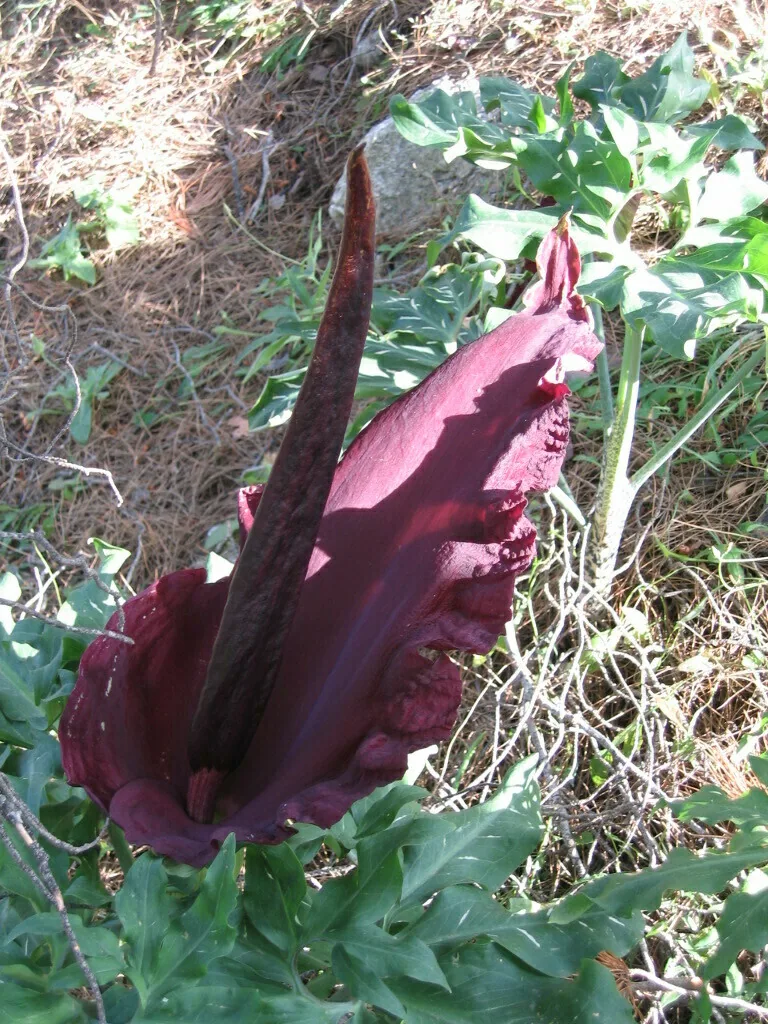
Dragon arum is a tuberous, herbaceous perennial with large lobed leaves and a large maroon spathe and spadix with an unpleasant smell. [1] It prefers full sun to partial shade in fertile moist loam and is drought-tolerant. [1]
This record is incomplete: the sources we read do not cover every field yet.
Not yet covered by our sources: Pruning
Dragon Arum care
How to water Dragon Arum
Drought-tolerant
What the sources say (1)
Dragon arum prefers full sun to partial shade in fertile moist loam. It is drought-tolerant and deer resistant.How much light Dragon Arum needs
Full sun to partial shade
What the sources say (2)
Dragon arum prefers full sun to partial shade in fertile moist loam. It is drought-tolerant and deer resistant.Light:
Full sun (6 or more hours of direct sunlight a day)
Partial Shade (Direct sunlight only part of the day, 2-6 hours)How much cold Dragon Arum can take
Hardiness, coldest zone
7a [winter low −17.8 to −15 °C (0 to 5 °F)]
What the sources say (1)
USDA Plant Hardiness Zone:
7a, 7b, 8a, 8b, 9a, 9b, 10a, 10bHardiness, warmest zone
10b [winter low 1.7 to 4.4 °C (35 to 40 °F)]
What the sources say (1)
USDA Plant Hardiness Zone:
7a, 7b, 8a, 8b, 9a, 9b, 10a, 10bHow to propagate Dragon Arum
Division, seed; spreads by seeding and bulb offsets that can be divided
What the sources say (2)
It spreads by seeding and bulb off-sets that can be divided. Use this plant as an accentRecommended Propagation Strategy:
Division
Seed
Country Or Region Of Origin:How to grow Dragon Arum
The plant
Life cycle
perennial
What the sources say (1)
Dragon arum is an tuberous, herbaceous perennial native to the rocky hills and slopes of the Mediterranean in the Araceae (arum) familyFamily
Araceae
What the sources say (1)
Dragon arum is an tuberous, herbaceous perennial native to the rocky hills and slopes of the Mediterranean in the Araceae (arum) familyMature height
61-91 cm (2-3 ft)
What the sources say (1)
Dimensions:
Height: 2 ft. 0 in. - 3 ft. 0 in.Mature width
30-61 cm (1-2 ft)
What the sources say (1)
Dimensions:
Height: 2 ft. 0 in. - 3 ft. 0 in.
Width: 1 ft. 0 in. - 2 ft. 0 in.Remedies
The sources we checked give no remedies for this plant.
Is Dragon Arum toxic to pets?
Reported by the source, quoted verbatim. This is not medical or veterinary advice: if a person or an animal may have eaten this plant, contact a poison control centre or a veterinarian.
Rabbits Problems: Problem for Cats Problem for Dogs
[1]The source flags the risk for this animal but does not explain why.
Calendar
Pruning
Not stated in the sources we read.
Months as given by the sources, which are mostly from the United States (northern hemisphere). In the southern hemisphere they shift by about six months.
Edibility
Reported by the source, quoted verbatim. Do not eat a plant on the basis of this page alone: identification mistakes can be dangerous.
Birds will eat the berries. Flies and beetles are attracted to the flower
[1]
Indicative values
Values from a secondary source, not checked word for word like the rest of this page. Use them as a starting point.
- Soil pH
- 6-7Indicative value, adapt it to your climate · Secondary source
- Care level
- MediumIndicative value, adapt it to your climate · Secondary source
- Growth rate
- LowIndicative value, adapt it to your climate · Secondary source
- Pruning
- March, April, MayIndicative value, adapt it to your climate · Secondary source
Similar plants
- Anthurium Anthurium andraeanum
- Arum Arum maculatum
- Black Calla Arum palaestinum
- Calla Lily Zantedeschia aethiopica
- Chinese Evergreen Aglaonema commutatum
- Cobra Lily Arisaema ringens
- Common Duckweed Lemna minor
- Dancing Crane Cobra Lily Arisaema heterophyllum
Sources
Every value above is quoted from these documents. Links lead to the original publisher.
- Dracunculus vulgaris (Black Arum, Dragon Arum, Dragon Lily, Vampire Lily) | North Carolina Extension Gardener Plant Toolbox · plants.ces.ncsu.edu, consulted
- More spooky and scary plants | Good Growing | Illinois Extension | Illinois · extension.illinois.edu, consulted
Written by Emilio Marruso · last checked