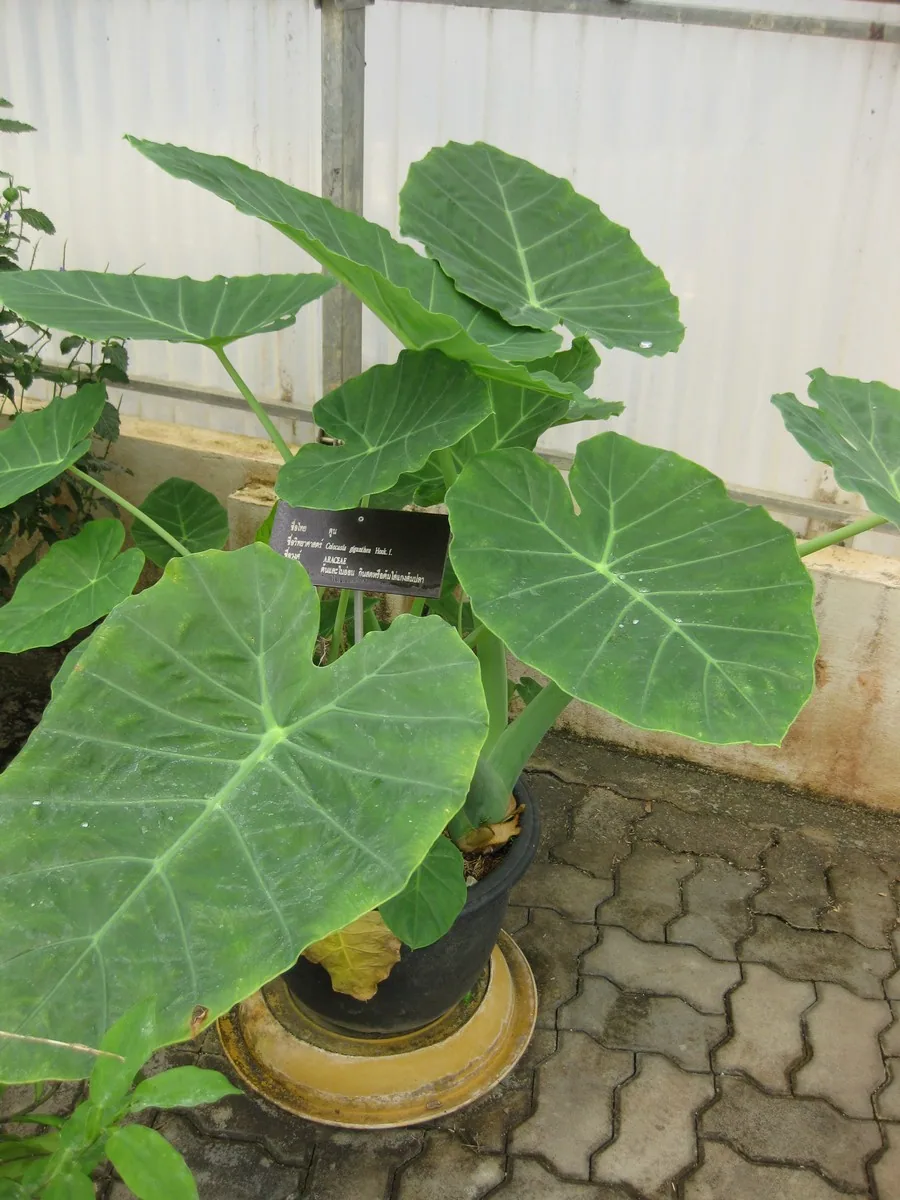
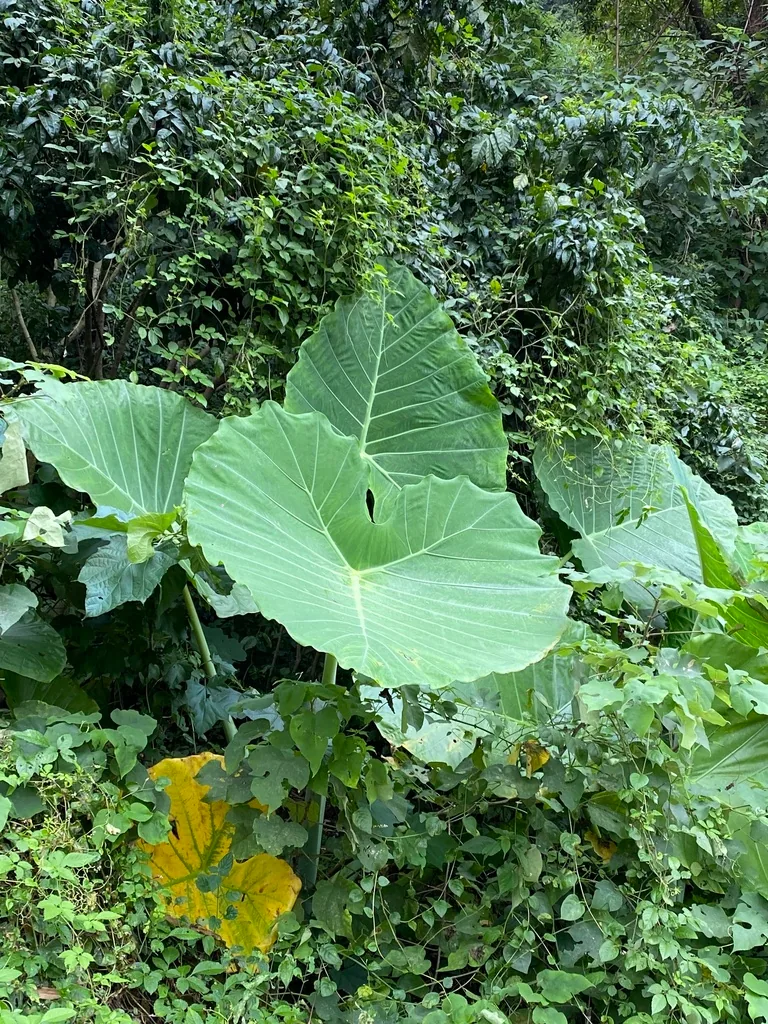

How to Grow and Care for Giant elephant ear
Colocasia gigantea
Written by Emilio Marruso · last checked
Toxic to: Cats, Dogs · Why
At a glance
This plant is as useful as it is easygoing: it grows in full sun or light shade, likes soil kept moderately moist, and does fine in a container. Its leaf stalks can be harvested all year and eaten raw in spicy papaya salad or cooked in curries. You can even make new plants from divisions, offsets or seed.
- Sun
Full sun to light shade
What the sources say (2)
Light: Full sun to light shade
plant in good garden soil in full sun to light shade
— Thailand Giant Elephant Ear Will Get All Your Neighbors Talking and Gawking | UT Gardens - The State Botanical Garden of Tennessee [1] Full Sun to Partial Shade Partial or Dappled
— Giant Elephant Ear (Leucocasia gigantea) in the Elephant Ears (Colocasia) Database - Garden.org [4] - Water
Keep the soil moderately moist; water less in winter
What the sources say (2)
Watering: Mesic
Water Preferences: | Mesic | Soil pH Preferences:
— Giant Elephant Ear (Leucocasia gigantea) in the Elephant Ears (Colocasia) Database - Garden.org [4] Watering notes: Avoid over-watering in winter when overwintering
Be careful not to over water it in the winter.
— Thailand Giant Elephant Ear Will Get All Your Neighbors Talking and Gawking | UT Gardens - The State Botanical Garden of Tennessee [1] - Cold
Survives winters down to 10 °F (−12.2 °C)
Hardy in cold winters · USDA 8a · RHS H5 · Z8
What the sources say (2)
Hardiness, coldest zone: 8a [winter low −12.2 to −9.4 °C (10 to 15 °F)]
Zone 8a -12.2 °C (10 °F) to -9.4
— Giant Elephant Ear (Leucocasia gigantea) in the Elephant Ears (Colocasia) Database - Garden.org [4] It is winter hardy in zone 8 but
— Thailand Giant Elephant Ear Will Get All Your Neighbors Talking and Gawking | UT Gardens - The State Botanical Garden of Tennessee [1] - Harvest
Pick leaf stalks all year; eat them raw in papaya salad or cooked in curries
What the sources say (1)
Harvest: Leaf stalks harvested year-round
Leaf stalks are harvested year-round and eaten raw in som tam
— Colocasia gigantea Hook.f. (Araceae) | Japan International Research Center for Agricultural Sciences | JIRCAS [2] - Propagation
Divide the clump, replant the offsets, or sow seed
What the sources say (2)
Propagation: Division; offsets (suckers); seed
Easily propagated by separating suckers from old stem bases.
— Colocasia gigantea Hook.f. (Araceae) | Japan International Research Center for Agricultural Sciences | JIRCAS [2] Propagation: Other methods: | Division Offsets | Containers:
— Giant Elephant Ear (Leucocasia gigantea) in the Elephant Ears (Colocasia) Database - Garden.org [4] - Containers
Grows in containers too
What the sources say (1)
In containers: Yes
It performs well in a large container but
— Thailand Giant Elephant Ear Will Get All Your Neighbors Talking and Gawking | UT Gardens - The State Botanical Garden of Tennessee [1] - Safety
Toxic to cats and dogs: every part irritates the mouth and throat
Overview
A very large perennial aroid whose leaf stalks are eaten as a vegetable in Southeast Asia and which is also grown as a garden ornamental. [3][1] It grows in full sun to light shade and is propagated by separating suckers from old stem bases. [1][2]
This record is incomplete: the sources we read do not cover every field yet.
Not yet covered by our sources: Sowing / Planting, Spacing
Giant elephant ear care
How to water Giant elephant ear
Watering
Mesic
What the sources say (1)
Water Preferences:
| Mesic
| Soil pH Preferences:Watering notes
Avoid over-watering in winter when overwintering
What the sources say (1)
Be careful not to over water it in the winter.How much light Giant elephant ear needs
Full sun to light shade
What the sources say (2)
plant in good garden soil in full sun to light shadeFull Sun to Partial Shade
Partial or DappledHow much cold Giant elephant ear can take
8a [winter low −12.2 to −9.4 °C (10 to 15 °F)]
What the sources say (2)
Zone 8a -12.2 °C (10 °F) to -9.4It is winter hardy in zone 8 butWhere to grow Giant elephant ear
In containers
Yes
What the sources say (1)
It performs well in a large container butSpacing
Not stated in the sources we read.
How to propagate Giant elephant ear
Division; offsets (suckers); seed
What the sources say (2)
Easily propagated by separating suckers from old stem bases.Propagation: Other methods:
| Division
Offsets
| Containers:How to grow Giant elephant ear
The plant
Family
Araceae
What the sources say (1)
Family Araceae ( 1ARMF ) Subfamily Aroideae ( 1ARMS ) Genus Leucocasia ( 1LWAG ) Species Leucocasia gigantea ( CXSGI )Mature height
The sources give different values depending on region, zone or growing conditions.
What each source says
cultivar 'Thailand Giant': 243.84-304.8 cm (8-10 ft):
What the sources say (1)
cultivar 'Thailand Giant': 243.84-304.8 cm (8-10 ft): From a 6-inch plant in May to 8 to 10 feet tall by September, it grows just that fast, with leaves that can get to 5 feet long and 4 to 5 feet wide.Remedies
Each remedy shows what official sources say about it; traditional remedies without an official source are marked as such. Harmful ones are listed so you know to avoid them.
First aid
First aid: not a substitute for a doctor
elephant ear poisoning
wipe out the mouth with a cold wet cloth, wash sap off the skin, rinse the eyes Official source, not independently tested
Do not make the person throw up unless poison control or a health care provider tells you to.
— medlineplus.gov [9] call the local emergency number (such as 911), or the local poison control center can be reached directly by calling the national toll-free Poison Help hotline (1-800-222-1222)
— medlineplus.gov [9] How: Wipe out the mouth with a cold, wet cloth. Wash off any plant sap on the skin. Rinse out the eyes.
Wipe out the mouth with a cold, wet cloth. Wash off any plant sap on the skin. Rinse out the eyes.
— medlineplus.gov [9]
Treating the plant
fungal leaf blight
avoiding overhead watering Not verified
Traditional remedy, not verified by an official source.
How: Avoid overhead watering to prevent consistently wet leaves.
pythium rot
good sanitation and pure irrigation water Not verified
Traditional remedy, not verified by an official source.
How: Use good sanitation practices and use pure irrigation water.
Is Giant elephant ear toxic to pets?
Reported by the source, quoted verbatim. This is not medical or veterinary advice: if a person or an animal may have eaten this plant, contact a poison control centre or a veterinarian.
All parts of plant contain calcium oxalate crystals, an irritant to the mouth and esophagus. Toxic to cats and dogs.
[4]- Poisonous parts
All parts of plant contain calcium oxalate crystals, an irritant to the mouth and esophagus.
[4]- Toxic principle
All parts of plant contain calcium oxalate crystals, an irritant to the mouth and esophagus.
[4]- Symptoms
All parts of plant contain calcium oxalate crystals, an irritant to the mouth and esophagus.
[4]
Calendar
Sowing
Not stated in the sources we read.
Planting
Not stated in the sources we read.
Harvest
Leaf stalks harvested year-round
What the sources say (1)
Leaf stalks are harvested year-round and eaten raw in som tamMonths as given by the sources, which are mostly from the United States (northern hemisphere). In the southern hemisphere they shift by about six months.
Edibility
Reported by the source, quoted verbatim. Do not eat a plant on the basis of this page alone: identification mistakes can be dangerous.
Indicative values
Values from a secondary source, not checked word for word like the rest of this page. Use them as a starting point.
- Life cycle
- Herbaceous PerennialIndicative value, adapt it to your climate · Secondary source
- Hours of sun
- 5-6 hoursIndicative value, adapt it to your climate · Secondary source
- Soil pH
- 5.5-7Indicative value, adapt it to your climate · Secondary source
- Care level
- HighIndicative value, adapt it to your climate · Secondary source
- Growth rate
- HighIndicative value, adapt it to your climate · Secondary source
- Pruning
- February, March, April, June, July, AugustIndicative value, adapt it to your climate · Secondary source
Similar plants
- Coco yam Colocasia esculenta
- Arrowhead Plant Syngonium podophyllum
- Black Calla Arum palaestinum
- Calla Lily Zantedeschia aethiopica
- Common Duckweed Lemna minor
- Dragon Arum Dracunculus vulgaris
- Italian Arum Arum italicum
- Mapoch Lily Zantedeschia pentlandii
Sources
Every value above is quoted from these documents. Links lead to the original publisher.
- Thailand Giant Elephant Ear Will Get All Your Neighbors Talking and Gawking | UT Gardens - The State Botanical Garden of Tennessee · utgardens.tennessee.edu, consulted
- Colocasia gigantea Hook.f. (Araceae) | Japan International Research Center for Agricultural Sciences | JIRCAS · jircas.go.jp, consulted
- Colocasia gigantea (PROSEA) - Pl@ntUse · uses.plantnet-project.org, consulted
- Giant Elephant Ear (Leucocasia gigantea) in the Elephant Ears (Colocasia) Database - Garden.org · garden.org, consulted
- What is kalo? · hbs.bishopmuseum.org, consulted
- VIRBOGA - Colocasia gigantea · virboga.de, consulted
- Kolokazja olbrzymia - Zamek Książ · ksiaz.walbrzych.pl, consulted
- Leucocasia gigantea (CXSGI)[Overview]| EPPO Global Database · gd.eppo.int, consulted
- medlineplus.gov · medlineplus.gov
Written by Emilio Marruso · last checked