
How to Grow and Care for Mapoch Lily
Zantedeschia pentlandii
Written by Emilio Marruso · last checked
Toxic to: People · Why
At a glance
This perennial calla comes back year after year and stays compact, 1–2 ft tall and 1–3 ft wide. Give it full sun and soil with good drainage, and it will grow happily in the garden, in a container or even indoors. To get more plants, simply divide it; just keep it away from children, because it is highly poisonous.
- Sun
Full sun
What the sources say (2)
Light: Full sun
Needs full sun to flower.
— Zantedeschia pentlandii (Mapoch Lily, Sekhukhune Gold Arum) | North Carolina Extension Gardener Plant Toolbox [1] Full sun (6 or more hours of direct sunlight a day)
— Zantedeschia pentlandii (Mapoch Lily, Sekhukhune Gold Arum) | North Carolina Extension Gardener Plant Toolbox [1] - Cold
Survives winters down to 10 °F (−12.2 °C)
Hardy in cold winters · USDA 8a · RHS H5 · Z8
What the sources say (2)
Hardiness, coldest zone: 8a [winter low −12.2 to −9.4 °C (10 to 15 °F)]
USDA Plant Hardiness Zone: 8a, 8b, 9a, 9b, 10a, 10b
— Zantedeschia pentlandii (Mapoch Lily, Sekhukhune Gold Arum) | North Carolina Extension Gardener Plant Toolbox [1] Hardiness, warmest zone: 10b [winter low 1.7 to 4.4 °C (35 to 40 °F)]
USDA Plant Hardiness Zone: 8a, 8b, 9a, 9b, 10a, 10b
— Zantedeschia pentlandii (Mapoch Lily, Sekhukhune Gold Arum) | North Carolina Extension Gardener Plant Toolbox [1] - Soil
Soil with good drainage
What the sources say (1)
Watering notes: Good drainage
Soil Drainage: Good Drainage
— Zantedeschia pentlandii (Mapoch Lily, Sekhukhune Gold Arum) | North Carolina Extension Gardener Plant Toolbox [1] - Size
1–2 ft tall and 1–3 ft wide
What the sources say (2)
Mature height: 30.48-60.96 cm (1-2 ft)
Dimensions: Height: 1 ft. 0 in. - 2 ft. 0 in. Width: 1 ft. 0 in. - 3 ft. 0 in.
— Zantedeschia pentlandii (Mapoch Lily, Sekhukhune Gold Arum) | North Carolina Extension Gardener Plant Toolbox [1] Mature width: 30.48-91.44 cm (1-3 ft)
Dimensions: Height: 1 ft. 0 in. - 2 ft. 0 in. Width: 1 ft. 0 in. - 3 ft. 0 in.
— Zantedeschia pentlandii (Mapoch Lily, Sekhukhune Gold Arum) | North Carolina Extension Gardener Plant Toolbox [1] - Propagation
Make new plants by dividing it
What the sources say (1)
Propagation: Division
Recommended Propagation Strategy: Division
— Zantedeschia pentlandii (Mapoch Lily, Sekhukhune Gold Arum) | North Carolina Extension Gardener Plant Toolbox [1] - Containers
Grows in containers and indoors too
What the sources say (2)
In containers: Yes
Works well planted in a water garden, along a border, or in a container outdoors or as a houseplant.
— Zantedeschia pentlandii (Mapoch Lily, Sekhukhune Gold Arum) | North Carolina Extension Gardener Plant Toolbox [1] Indoors: Yes
Works well planted in a water garden, along a border, or in a container outdoors or as a houseplant.
— Zantedeschia pentlandii (Mapoch Lily, Sekhukhune Gold Arum) | North Carolina Extension Gardener Plant Toolbox [1] - Safety
Highly poisonous to people: never eat any part of it
Overview
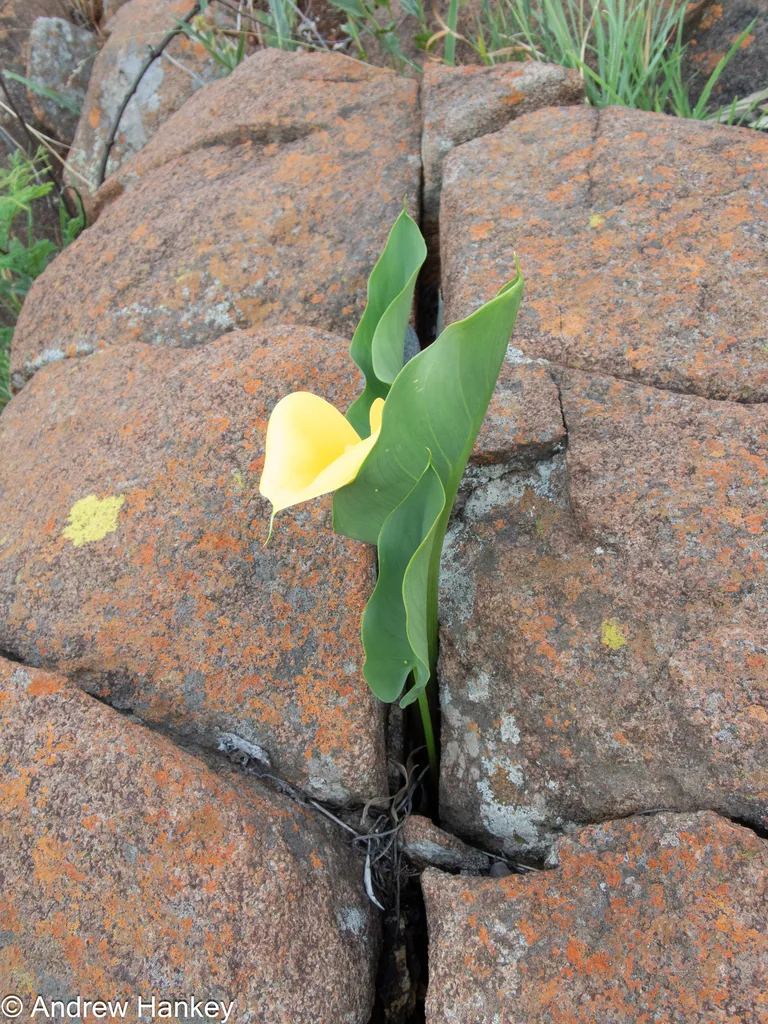
Mapoch lily is a deciduous herbaceous perennial from Mpumalanga, South Africa, grown for its yellow spathes. [1] It needs full sun to flower and is listed for soils with good drainage. [1] The plant is rated as high severity poison for humans. [1] Works well planted in a water garden, along a border, or in a container outdoors or as a houseplant. [1]
This record is incomplete: the sources we read do not cover every field yet.
Not yet covered by our sources: Watering, Pruning
Mapoch Lily care
How to water Mapoch Lily
Watering
Not stated in the sources we read.
Watering notes
Good drainage
What the sources say (1)
Soil Drainage:
Good DrainageHow much light Mapoch Lily needs
Full sun
What the sources say (2)
Needs full sun to flower.Full sun (6 or more hours of direct sunlight a day)How much cold Mapoch Lily can take
Hardiness, coldest zone
8a [winter low −12.2 to −9.4 °C (10 to 15 °F)]
What the sources say (1)
USDA Plant Hardiness Zone:
8a, 8b, 9a, 9b, 10a, 10bHardiness, warmest zone
10b [winter low 1.7 to 4.4 °C (35 to 40 °F)]
What the sources say (1)
USDA Plant Hardiness Zone:
8a, 8b, 9a, 9b, 10a, 10bWhere to grow Mapoch Lily
Indoors
Yes
What the sources say (1)
Works well planted in a water garden, along a border, or in a container outdoors or as a houseplant.In containers
Yes
What the sources say (1)
Works well planted in a water garden, along a border, or in a container outdoors or as a houseplant.How to propagate Mapoch Lily
Division
What the sources say (1)
Recommended Propagation Strategy:
DivisionHow to grow Mapoch Lily
The plant
Life cycle
perennial
What the sources say (1)
Plant Type:
Bulb
Herbaceous Perennial
Houseplant
Poisonous
Woody Plant Leaf Characteristics:
DeciduousFamily
Araceae
What the sources say (1)
Genus:
Zantedeschia
Species:
pentlandii
Family:
Araceae
Life Cycle:
Bulb
Recommended Propagation Strategy:
DivisionMature height
30.48-60.96 cm (1-2 ft)
What the sources say (1)
Dimensions:
Height: 1 ft. 0 in. - 2 ft. 0 in.
Width: 1 ft. 0 in. - 3 ft. 0 in.Mature width
30.48-91.44 cm (1-3 ft)
What the sources say (1)
Dimensions:
Height: 1 ft. 0 in. - 2 ft. 0 in.
Width: 1 ft. 0 in. - 3 ft. 0 in.Remedies
Each remedy shows what official sources say about it; traditional remedies without an official source are marked as such. Harmful ones are listed so you know to avoid them.
First aid
First aid: not a substitute for a doctor
mouth burning after chewing the plant
rinse the lips and wipe the tongue Official source, not independently tested
Use the web POISON CONTROL online tool to get help, or call your poison center at 1-800-222-1222 .
— poison.org [3] Do not give anything to eat or drink if there is swelling of the tongue or throat or if the person is having difficulty breathing.
— poison.org [3] Do not attempt to induce vomiting. - Try to gently remove any plant parts remaining in the mouth
— poison.org [3] How: Gently remove plant parts remaining in the mouth, wipe the tongue with a wet cloth and gently rinse the lips with water.
Try to gently remove any plant parts remaining in the mouth and wipe the tongue with a wet cloth. Gently rinse lips with water.
— poison.org [3]
skin or eye irritation from sap
rinse skin and eyes with water Official source, not independently tested
Use the web POISON CONTROL online tool to get help, or call your poison center at 1-800-222-1222 .
— poison.org [3] How: Immediately rinse the eyes and skin gently with room temperature water.
Immediately rinse the eyes and skin gently with room temperature water.
— poison.org [3]
Treating the plant
bacterial soft rot
avoid wounding rhizomes and overwatering Official source, not independently tested
How: Avoid injuries to the rhizomes and do not overwater.
Avoid injuries to the rhizomes. Do not overwater. Yellow callas are more susceptible than others, but there are new yellow cultivars that are more resistant.
— ipm.ucanr.edu [4]
phytophthora root rot
raised beds with good drainage Official source, not independently tested
How: Grow on raised beds, provide good drainage and do not overirrigate.
Grow on raised beds and provide good drainage. Do not overirrigate.
— ipm.ucanr.edu [4]
Is Mapoch Lily poisonous?
Reported by the source, quoted verbatim. This is not medical or veterinary advice: if a person or an animal may have eaten this plant, contact a poison control centre or a veterinarian.
This plant has high severity poison characteristics.
[1]
Calendar
Pruning
Not stated in the sources we read.
Months as given by the sources, which are mostly from the United States (northern hemisphere). In the southern hemisphere they shift by about six months.
Similar plants
- Calla Lily Zantedeschia aethiopica
- Pink Arum Zantedeschia rehmannii
- Zantedeschia elliottiana Zantedeschia elliottiana
- Arrowhead Plant Syngonium podophyllum
- Black Calla Arum palaestinum
- Common Duckweed Lemna minor
- Dragon Arum Dracunculus vulgaris
- Giant elephant ear Colocasia gigantea
Sources
Every value above is quoted from these documents. Links lead to the original publisher.
- Zantedeschia pentlandii (Mapoch Lily, Sekhukhune Gold Arum) | North Carolina Extension Gardener Plant Toolbox · plants.ces.ncsu.edu, consulted
- Zantedeschia (Calla Lily) | North Carolina Extension Gardener Plant Toolbox · plants.ces.ncsu.edu, consulted
- poison.org · poison.org
- ipm.ucanr.edu · ipm.ucanr.edu
Written by Emilio Marruso · last checked