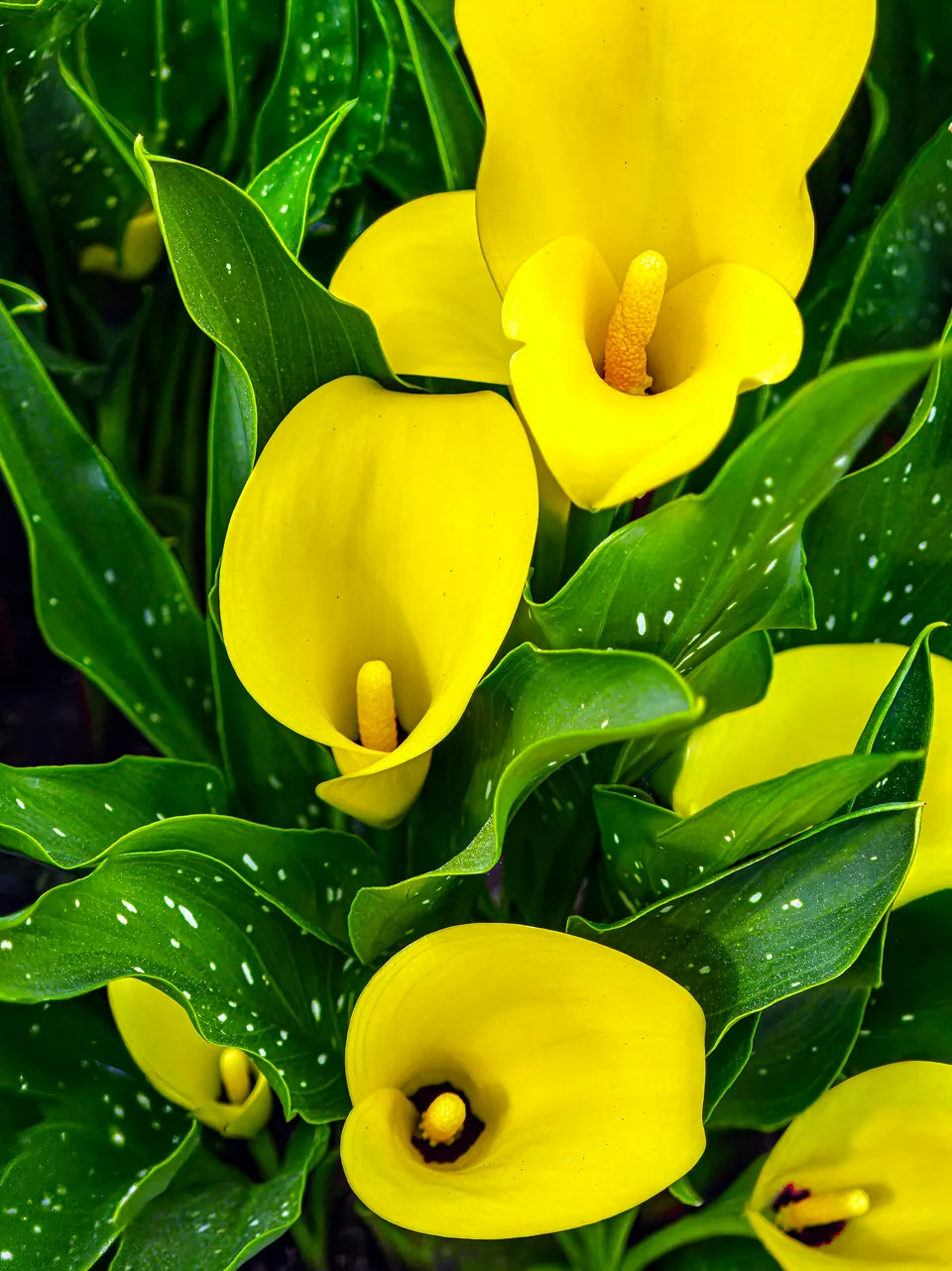

How to Grow and Care for Zantedeschia elliottiana
Zantedeschia elliottiana
Written by Emilio Marruso · last checked
Toxic to: Cats, Dogs, People · Why
At a glance
This perennial is easy to please: give it full sun or partial shade and keep the soil moist. Plant it in spring once the threat of frost has passed, 1 foot apart. After flowering, water less while it rests, and it will come back year after year. You can even collect its seeds in autumn to keep over winter.
- Sun
Full sun to partial shade
What the sources say (1)
Light: Full sun to partial shade
They prefer to be located in full sun or partial shade in warmer climates.
— Zantedeschia elliottiana (Golden Calla Lily) - World of Flowering Plants [3] - Water
Keep the soil moist; water less after flowering, while the plant rests
What the sources say (2)
Watering: Keep moist
Calla Lilies enjoy being kept moist and will also benefit from a monthly fertilizer dose throughout the growing season.
— Zantedeschia elliottiana (Golden Calla Lily) - World of Flowering Plants [3] Watering notes: Reduce watering after flowering during the dormant period
During this time, you should refrain from watering as much to allow the plant to die back.
— Zantedeschia elliottiana (Golden Calla Lily) - World of Flowering Plants [3] - Cold
Survives winters down to 20 °F (−6.7 °C)
Hardy in average winters · USDA 9a · RHS H4 · Z9
What the sources say (3)
Hardiness, coldest zone: 9a [winter low −6.7 to −3.9 °C (20 to 25 °F)]
USDA hardiness zone 9a to 10b: from 20 °F (−6.7 °C) to 40 °F (+4.4 °C).
— Zantedeschia elliottiana (Golden Calla Lily) - World of Flowering Plants [3] Hardiness, warmest zone:
According to World of Flowering Plants: USDA hardiness zone 9a to 10b: from 20 °F (−6.7 °C) to 40 °F (+4.4 °C).
— Zantedeschia elliottiana (Golden Calla Lily) - World of Flowering Plants [3] According to Harvest to Table: grow outdoors in Zones 9-11.
— How to Grow Zantedeschia - Calla Lily [2] - Spacing
1 ft between plants
What the sources say (1)
Spacing: 30.5 cm (1 ft)
They should be planted rather deep, about 4 inches (10 cm) for greater results, and spaced approximately a foot apart.
— Zantedeschia elliottiana (Golden Calla Lily) - World of Flowering Plants [3] - Planting
Plant in spring, once the threat of frost has passed
What the sources say (1)
Planting: Spring, after the threat of frost has passed
Plants are typically planted in the spring. However, wait until the threat of frost has passed and the soil has warmed sufficiently before planting.
— Zantedeschia elliottiana (Golden Calla Lily) - World of Flowering Plants [3] - Pests
Aphids, spider mites and whiteflies; the rhizome can rot
What the sources say (2)
Pests: aphids, red spider mites, whitefly
When grown indoors or in a greenhouse, they may attract common greenhouse pests, including: - Aphids - Red spider mites - Whitefly
— How to grow zantedeschia / RHS Growing Guide [1] Diseases: rhizome rot
Too much water, especially when not in growth, can cause the rhizomes to rot.
— How to grow zantedeschia / RHS Growing Guide [1] - Propagation
Collect the seeds in autumn and store them over winter
What the sources say (1)
Saving seeds: collect seeds in autumn and store them over winter
By seed – collect seeds in autumn and store over winter. Sow in spring, one seed per 7.5cm (3in) pot filled with peat-free seed compost
— How to grow zantedeschia / RHS Growing Guide [1] - Safety
Highly toxic if eaten, can be fatal; also harmful to cats and dogs
Overview
Zantedeschia elliottiana is a stemless herbaceous perennial with a yellow spathe, growing from tuberous rhizomes. [3] It is reportedly native to South Africa. [3]
This record is incomplete: the sources we read do not cover every field yet.
Not yet covered by our sources: Pruning, Propagation
Zantedeschia elliottiana care
How to water Zantedeschia elliottiana
Watering
Keep moist
What the sources say (1)
Calla Lilies enjoy being kept moist and will also benefit from a monthly fertilizer dose throughout the growing season.Watering notes
Reduce watering after flowering during the dormant period
What the sources say (1)
During this time, you should refrain from watering as much to allow the plant to die back.How much light Zantedeschia elliottiana needs
Full sun to partial shade
What the sources say (1)
They prefer to be located in full sun or partial shade in warmer climates.How much cold Zantedeschia elliottiana can take
Hardiness, coldest zone
9a [winter low −6.7 to −3.9 °C (20 to 25 °F)]
What the sources say (1)
USDA hardiness zone 9a to 10b: from 20 °F (−6.7 °C) to 40 °F (+4.4 °C).Hardiness, warmest zone
The sources give different values depending on region, zone or growing conditions.
What each source says
According to World of Flowering Plants: 10b [winter low 1.7 to 4.4 °C (35 to 40 °F)]
According to Harvest to Table: 11 [winter low 4.4 to 10 °C (40 to 50 °F)]
What the sources say (2)
According to World of Flowering Plants: USDA hardiness zone 9a to 10b: from 20 °F (−6.7 °C) to 40 °F (+4.4 °C).According to Harvest to Table: grow outdoors in Zones 9-11.Where to grow Zantedeschia elliottiana
30.5 cm (1 ft)
What the sources say (1)
They should be planted rather deep, about 4 inches (10 cm) for greater results, and spaced approximately a foot apart.How to propagate Zantedeschia elliottiana
Not stated in the sources we read.
How to grow Zantedeschia elliottiana
The plant
Life cycle
perennial
What the sources say (1)
They are perennials , so will last for many years, most going dormant in autumn then resprouting in spring.Harvest and storage
Saving seeds
collect seeds in autumn and store them over winter
What the sources say (1)
By seed – collect seeds in autumn and store over winter. Sow in spring, one seed per 7.5cm (3in) pot filled with peat-free seed compostPests and diseases
Pests
aphids, red spider mites, whitefly
What the sources say (1)
When grown indoors or in a greenhouse, they may attract common greenhouse pests, including:
- Aphids
- Red spider mites
- WhiteflyDiseases
rhizome rot
What the sources say (1)
Too much water, especially when not in growth, can cause the rhizomes to rot.Remedies
Each remedy shows what official sources say about it; traditional remedies without an official source are marked as such. Harmful ones are listed so you know to avoid them.
First aid
First aid: not a substitute for a doctor
ingestion
removing plant parts and rinsing the mouth Official source, not independently tested
Do not give anything to eat or drink if there is swelling of the tongue or throat or if the person is having difficulty breathing.
— poison.org [6] Use the web POISON CONTROL online tool to get help, or call your poison center at 1-800-222-1222
— poison.org [6] How: Gently remove any plant parts remaining in the mouth, wipe the tongue with a wet cloth and gently rinse lips with water.
Try to gently remove any plant parts remaining in the mouth and wipe the tongue with a wet cloth. Gently rinse lips with water.
— poison.org [6] cool creamy snack Official source, not independently tested
Do not give anything to eat or drink if there is swelling of the tongue or throat or if the person is having difficulty breathing.
— poison.org [6] How: Give milk or another cool and creamy snack like yogurt, ice cream or popsicle to relieve symptoms.
Giving milk or another cool and creamy snack like yogurt, ice cream, or popsicle can help relieve the symptoms.
— poison.org [6]
eye and skin contact
rinsing with room temperature water Official source, not independently tested
Use the web POISON CONTROL online tool to get help, or call your poison center at 1-800-222-1222
— poison.org [6] How: Immediately rinse the eyes and skin gently with room temperature water.
Immediately rinse the eyes and skin gently with room temperature water.
— poison.org [6]
Is Zantedeschia elliottiana toxic to pets?
Reported by the source, quoted verbatim. This is not medical or veterinary advice: if a person or an animal may have eaten this plant, contact a poison control centre or a veterinarian.
Animals
Problems: Poisonous to Humans Problem for Cats Problem for Dogs
[5]Genus-level warning: refers to the whole genus, not documented for this species
- Severity
This plant has high severity poison characteristics.
[5]
People
Poisonous to Humans: Poison Severity: High Poison Symptoms: HIGHLY TOXIC, MAY BE FATAL IF EATEN! Severe burning sensation and swelling of lips, tongue, and throat; stomach pain and diarrhea possible.
[5]Genus-level warning: refers to the whole genus, not documented for this species
Calendar
Planting
Spring, after the threat of frost has passed
What the sources say (1)
Plants are typically planted in the spring. However, wait until the threat of frost has passed and the soil has warmed sufficiently before planting.Pruning
Not stated in the sources we read.
Months as given by the sources, which are mostly from the United States (northern hemisphere). In the southern hemisphere they shift by about six months.
Relative to frost
Less precise estimate: there is no weather station within 300 km.
Find frost dates by ZIP code or city
Transplant: around the last frost
Plants bought in containers can be planted outside after the last frost.
— How to grow zantedeschia / RHS Growing Guide [1]
Count from the average frost dates where you live.
Indicative values
Values from a secondary source, not checked word for word like the rest of this page. Use them as a starting point.
- Mature height
- 61-91.4 cm (2-3 ft)Indicative value, adapt it to your climate · Secondary source
- Hours of sun
- 4-6 hoursIndicative value, adapt it to your climate · Secondary source
- Drought tolerant
- yesIndicative value, adapt it to your climate · Secondary source
- Soil pH
- 6-6.5Indicative value, adapt it to your climate · Secondary source
- Care level
- MediumIndicative value, adapt it to your climate · Secondary source
- Growth rate
- LowIndicative value, adapt it to your climate · Secondary source
- Pruning
- March, April, May, March, April, February, March, AprilIndicative value, adapt it to your climate · Secondary source
- Propagation
- Division, Cormlet Propagation, Seed Propagation, Tissue CultureIndicative value, adapt it to your climate · Secondary source
Similar plants
- Calla Lily Zantedeschia aethiopica
- Mapoch Lily Zantedeschia pentlandii
- Pink Arum Zantedeschia rehmannii
- Abies grandis Abies grandis
- Abraham Trachystemon orientalis
- Abyssinian banana Ensete ventricosum
- Acacia longifolia Acacia longifolia
- Acanthus hungaricus Acanthus hungaricus
Sources
Every value above is quoted from these documents. Links lead to the original publisher.
- How to grow zantedeschia / RHS Growing Guide · rhs.org.uk, consulted
- How to Grow Zantedeschia - Calla Lily · harvesttotable.com, consulted
- Zantedeschia elliottiana (Golden Calla Lily) - World of Flowering Plants · worldoffloweringplants.com, consulted
- Plants of Hawai'i | Bishop Museum · plantsofhawaii.org, consulted
- Zantedeschia (Calla Lily) | North Carolina Extension Gardener Plant Toolbox · plants.ces.ncsu.edu, consulted
- poison.org · poison.org
Written by Emilio Marruso · last checked