Don't bag fall leaves: 4 free ways to use them in your yard
Mow them into the lawn, mulch the beds, feed the vegetable garden or make leaf mold: how deep to go, how many to leave on the grass, and which leaves need care.
by Emilio MarrusoPublished
Every fall your trees hand you a free load of mulch, and many of us still bag it for the curb, then buy bagged mulch or compost in spring [1].
Fallen leaves can go back into the lawn, onto the beds, into the vegetable garden or into a slow pile of leaf mold, and any of these beats sending them away [1]. Here is how US extension services and the Royal Horticultural Society suggest doing it.
Why the leaves are worth keeping
Shredded leaves moderate soil temperature, hold moisture and keep weeds down, and as they break down they return organic matter and nutrients to the soil [1]. In lawns, mulched leaves can raise soil organic matter and reduce the need for fertilizer over time [2]. Leaf litter is also home and foraging ground for insects, spiders, toads and small mammals, which in turn feed birds [3].
What you’ll need
Tools
- A rotary lawn mower, ideally a mulching mower
- A rake and a tarp
- Safety goggles and a dust mask
- A wire or wood bin, or chicken wire and stakes
Materials
- Dry fallen leaves
- Water
- Large plastic bags or old trash cans
Use fallen leaves four ways
Step 1 Mow them into the lawn
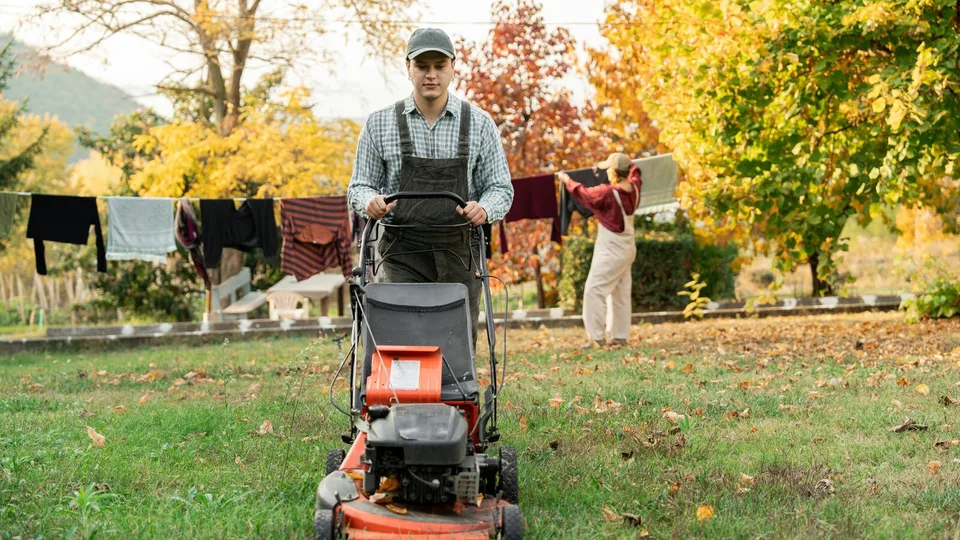
A mulching mower works best, but a regular one will do the job too [1]. Pick up sticks and limbs first, and wear goggles and a dust mask against flying debris [4]. Colorado State University Extension suggests the highest deck setting, the bagger removed and at least two passes to chop the leaves small [2].
Start before every leaf is down: the job is easier when leaves are fairly dry and not piled too thick [1]. Leaves that are too wet strain the engine and do not chop finely [4].
The lawn tends to like it. Research at Michigan State University found no negative effects: grass quality improved, broadleaf weeds were fewer, and soil pH did not change with either oak or maple leaves [1].
The study also saw fewer dandelions and crabgrass after three years, and Purdue University research found no effect on turf quality, color or soil pH even at high rates [2]. Pine needles are the exception: they stay intact for months even when chopped, so use them as bed mulch instead [4].
Step 2 Spread them as mulch on beds
Shredded leaves mat down less than whole ones, and watering the mulch after you spread it helps keep it in place [1]. To shred a pile, rake the leaves together and run the mower over them several times [3].
Penn State Extension suggests 2 to 4 inches (5.08 to 10.16 cm) around trees and shrubs or on perennial beds [1]. University of Delaware Extension splits it: 3 to 4 inches (7.62 to 10.16 cm) around shrubs and trees, 2 to 3 inches (5.08 to 7.62 cm) over perennial beds [3].
Step 3 Dig them into the vegetable garden
Colorado State suggests adding 6 to 8 inches (15.24 to 20.32 cm) of leaves, ideally chopped by the mower, to a vegetable or annual flower garden each year, either as a fall mulch worked in during spring or turned into the soil right away [2].
Moist soil speeds up decomposition [2]. Go easy, though: Colorado State warns against over-amending and suggests a soil test [2]. Extra leaves are also the "brown" half of a compost pile, mixed with nitrogen-rich "green" materials [2].
Step 4 Pile them into leaf mold
Leaf mold is simply decayed leaves: dark brown, earthy-smelling and crumbly [1]. It is not high in nutrients, but it improves soil structure, helps soil hold water and feeds soil life, and it works as mulch or in potting soil [1].
Pile the leaves, pack them down, water them and wait a couple of years [1]. A wood or wire bin 3 to 6 feet (0.91 to 1.83 m) wide and at least 3 feet (0.91 m) high keeps things tidy [1].
Or fill large plastic bags or old trash cans, moisten the leaves and close them loosely so some air gets in [1]; the RHS pokes holes in the bags and leaves them for up to two years [6]. Shredding, turning, watering now and then or covering with a tarp can cut the wait to 6 to 12 months [1].
The RHS rates oak, beech and hornbeam leaves as the best, because they break down with little help [6]. Leaf mold more than two years old goes into seed-sowing mixes; younger batches make mulch or a winter cover for bare soil [6].
How many leaves can the lawn take?
Sources measure this in different ways. Delaware says a layer less than 1 inch (2.54 cm) deep can be mowed and left where it lies, while a thicker one should be recycled another way [3].
Colorado State's rule of thumb: if you can still see some grass through the leaves, the layer is not too thick to mulch [2]. Mulching mowers can chop up to 6 inches (15.24 cm) of leaves at a time [4] [5], while a traditional mower may need several passes [5].
After mowing, Penn State calls a layer up to half an inch (1.27 cm) beneficial [1], and UConn says leaves should cover no more than 20% of the lawn after each mulching [5]. A thick layer shades the grass [4] [5], can encourage snow mold through the winter, and slows green-up in spring [5].
Leaves that need special care
Black walnut makes juglone in all parts of the tree; butternut and shagbark hickory make it too, in lower amounts [9]. Tomato, potato, eggplant, pepper, lilac, peony, rhododendron and azalea are particularly sensitive to it [9].
Other leaves just need more time. The RHS shreds thick leaves such as sycamore maple, walnut and horse chestnut before piling them, or adds them to the compost [6]. Evergreens such as holly and cherry laurel break down faster shredded and composted [6].
Conifer needles can take two to three years, while pine needles in a pile of their own make an acidic leaf mold for rhododendrons, azaleas, camellias and blueberries [6]. Leaves from busy main roads may carry air pollution, so gather them on quieter streets [6].
Frequently asked questions
Will oak leaves make my lawn acidic?
Michigan State research found no change in soil pH from mulching oak or maple leaves into turf [1].
Is leaf mold free of weeds?
The sources differ. Penn State calls it mostly weed-free, unlike compost or manure [1], while the RHS warns that leaf mold heaps can be colonized by weeds and their seeds [6].
Can I compost black walnut leaves?
Here too the sources differ. Oregon State University Extension says compost made with black walnut leaves can go on the vegetable garden, as long as the pile is well managed and heats up, which needs nitrogen; walnut leaves also hold less juglone in fall than in spring [7]. Purdue warns that composted walnut material may still release small amounts of juglone [8].
Sources
- Leaves Are Treasure, Not Trash — Penn State Extension · extension.psu.edu, consulted
- Using Leaves in the Landscape (GardenNotes #655) — Colorado State University Extension · extension.colostate.edu, consulted
- Recycling Leaves — University of Delaware Cooperative Extension · udel.edu, consulted
- "Leave" Them Alone: Lawn Leaf Management (SPES-729) — Virginia Cooperative Extension, Virginia Tech · pubs.ext.vt.edu, consulted
- Leaf Disposal & Mulch Mowing — UConn Extension Integrated Pest Management · ipm.cahnr.uconn.edu, consulted
- Leafmould — Royal Horticultural Society · rhs.org.uk, consulted
- Walnut leaves: Safe for composting? — Oregon State University Extension Service · extension.oregonstate.edu, consulted
- Black Walnut Toxicity (HO-193) — Purdue University Cooperative Extension Service · extension.purdue.edu, consulted
- Black Walnut Toxicity — University of Wisconsin-Madison Extension, Plant Disease Diagnostics Clinic · hort.extension.wisc.edu, consulted
Written by Emilio Marruso · last checked