9 golden houseplants and the light that keeps their leaves bright
Golden and lime-leaved houseplants are trending. Nine picks, from 'Neon' pothos to a gold-striped cast iron plant, with the light that keeps the color and pet safety.
by Emilio MarrusoPublished
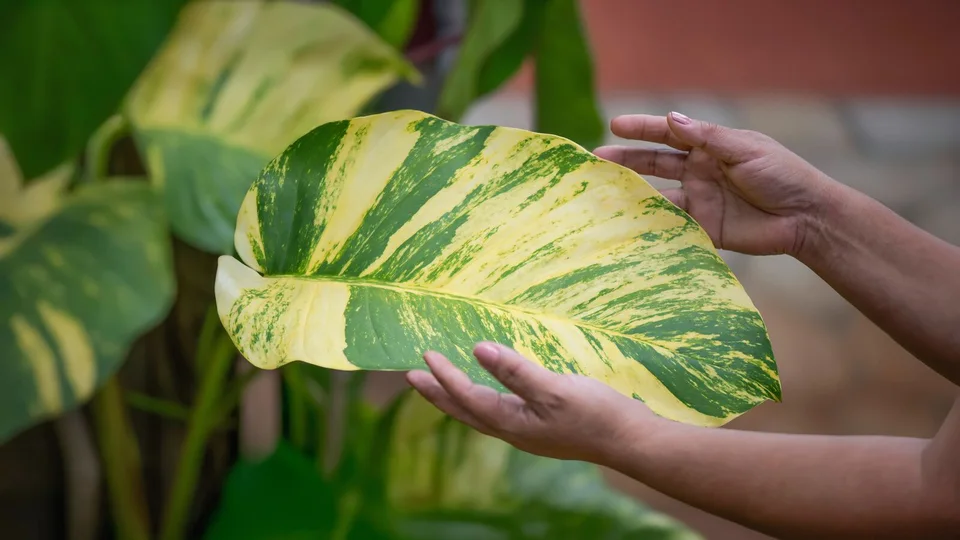
Chartreuse vines, lime stripes, gold flecks: golden leaves are having their moment indoors. Homes & Gardens reports that houseplants with yellow-toned foliage have been steadily gaining popularity, and horticulturist Justin Hancock, who has watched gold plants slowly rise over the past year, expects the trend to keep growing into 2027 [1].
His reasoning is simple: in darker homes, bright golden foliage stands out where deep green leaves fade into the background [1]. Here are nine golden houseplants, each with the light it needs to keep its color and what the ASPCA says about cats and dogs.
Choose golden houseplants
Golden and 'Neon' pothos (Epipremnum aureum)
The species name is Latin for "golden" [3]. NC State lists 'Golden Pothos', with golden, yellow-green variegated leaves, 'Neon', with yellow leaves, and 'Lime', bright yellow-green [3]. Pothos prefers bright, indirect light and survives long periods in low light, but low light can cause loss of variegation [3].
Hancock calls 'Neon' a classic and suggests bright to medium light out of direct sun, which may scorch its leaves, letting the top 2 inches (5.08 cm) of soil dry before watering [1]. Pets: toxic to dogs and cats, because of insoluble calcium oxalates that irritate the mouth [4].
Heartleaf philodendron 'Lemon Lime' (Philodendron hederaceum)
'Lemon Lime' has bright yellow to chartreuse leaves, and 'Brasil' has a central stripe of yellow to light green [5]. This heartleaf philodendron prefers medium light but tolerates low light; keep the soil slightly moist and water less in winter [5].
For something more unusual, Hancock's favorite is Philodendron 'Golden Crocodile', with long, narrow, toothed leaves, introduced within the last 3 years; it does best in bright light, out of direct sun and cold drafts [1]. Pets: the ASPCA lists heartleaf philodendron, and philodendrons in general, as toxic to dogs and cats [6] [7].
Corn plant 'Limelight' (Dracaena fragrans)
Hancock suggests 'Limelight' as a golden indoor tree that reaches 5 to 7 feet (1.524 to 2.1336 m) [1]. NC State describes its glossy yellow-green leaves, which become lighter with age, and also lists 'Lemon Lime', with cream, greenish-yellow and lime stripes [8].
Keep the corn plant in bright to moderate, filtered light: direct sun can burn the leaves, and in light that is too low they grow narrower [8]. It thrives at 70 to 80°F (21.1 to 26.7°C) and should stay above 50°F (10°C) if possible [8]. Pets: toxic to dogs and cats, because of saponins [9].
Gold dust dracaena (Dracaena surculosa)
Its dark green leaves are spotted with cream or yellow, and 'Florida Beauty' is densely spotted with creamy yellow [10].
Light is a balancing act here: gold dust dracaena wants bright but not direct light, because the leaves brown or drop when the light is too high and lose their intense color when it is too low [10]. Its roots like a snug pot [10]. Pets: toxic to dogs and cats [11].
Snake plant 'Laurentii' (Dracaena trifasciata)
'Laurentii' has yellow edges, 'Golden Flame' a yellow-gold pattern of stripes and 'Black Gold' bright gold edging [12]. The snake plant tolerates very low light, but NC State suggests a spot with direct sun for only part of the day, 2 to 6 hours [12].
Let the soil dry between waterings, and in winter water only every 1 to 2 months [12]. Pets: toxic to dogs and cats, because of saponins [13].
Lemon Lime prayer plant (Maranta leuconeura)
The 'Lemon' or Lemon Lime prayer plant has dark green leaves with a yellowish-green center and stripes, and like every prayer plant it folds its leaves at night like praying hands [14].
Give it bright, indirect light: too much sun bleaches the leaf colors, and the leaves also lose color in low light [14]. It needs high humidity, so a tray of wet pebbles helps [14]. Pets: the ASPCA lists maranta as non-toxic to dogs and cats [15].
Baby rubber plant 'Gold Tip' (Peperomia obtusifolia)
'Gold Tip' has marbled leaves with gold at the tips [16]. The baby rubber plant prefers bright, indirect light; it tolerates low light for several months, especially the non-variegated cultivars, and sun that is too strong or direct burns the leaves [16]. Go easy on the water: overwatering yellows the leaves [16].
Pets: non-toxic to dogs and cats [17].
Golden Boston fern 'Rita's Gold' (Nephrolepis exaltata)
NC State lists 'Rita's Gold', with chartreuse fronds, 'Golden Boston', yellowish-green, and 'Tiger Stripe', with gold variegated foliage [18]. The Boston fern wants bright, indirect light, warmth of 60 to 70°F (15.6 to 21.1°C), high humidity and soil that never dries out [18]. Pets: non-toxic to dogs and cats [19].
Cast iron plant 'Lennon's Song' (Aspidistra elatior)
NC State lists 'Lennon's Song', with yellow-variegated leaves, 'Goldfeather', with yellow-gold stripes, and 'Ginga Giant', speckled with yellow flecks [20]. The cast iron plant prefers partial to full shade and does not tolerate direct sun [20].
Pets: the ASPCA lists cast iron plant, including the variegated form, as non-toxic to dogs, cats and horses [21].
Adjust light to keep the color
The pale parts of a variegated leaf make no chlorophyll and produce no food, so variegated plants in shady spots start at a real disadvantage [2]. In those conditions the variegated parts often fade and revert to solid green as the plant tries to make more food [2]. The fix is more light: leaves that have already faded usually stay that way, but new growth should show its pattern again [2]. Too much sun is the opposite problem, and for several plants on this list too much direct sun burns, browns or bleaches the leaves [8] [10] [14] [16]. If your home is on the dim side, our guide to houseplants for low light has more ideas.
Why is gold trending?
According to Homes & Gardens, the trend follows years of enthusiasm for variegated houseplants, and golden leaves are the next foliage look catching the eye of plant lovers [1]. Hancock links it to a growing interest in the ways houseplants can lift our mood: taking a moment to look away from a work screen at a plant's leaves can soothe the eyes, he says, and golden foliage adds a visual lift on top of that [1]. Many golden plants tolerate lower light, though they usually grow best in bright, indirect light [1].
Frequently asked questions
Why is my golden pothos turning green?
Usually it is too little light: NC State notes that low light can cause loss of variegation [3]. More light helps, and new leaves should show the color again, while leaves that have already faded usually do not recover [2].
How do I tell golden leaves from yellowing leaves?
Start with the variety: 'Neon' pothos and 'Lemon Lime' philodendron are described as yellow to chartreuse [3] [5]. Yellowing is a change in the plant instead: overwatering yellows the leaves of the baby rubber plant [16], and older pothos leaves yellow and fall off over time [3]. Our guide to yellow leaves on houseplants helps you read the pattern.
Sources
- Golden Houseplants Are Having a Moment, and This Vibrant Foliage Trend Can Even Boost Your Mood — Homes & Gardens, November 12, 2026 · homesandgardens.com, consulted
- Why is the variegation fading on the leaves of my houseplant? — NYBG Plant Information Service, The New York Botanical Garden · libanswers.nybg.org, consulted
- Epipremnum aureum | North Carolina Extension Gardener Plant Toolbox · plants.ces.ncsu.edu, consulted
- Golden Pothos — ASPCA Toxic and Non-Toxic Plants · aspca.org, consulted
- Philodendron hederaceum | North Carolina Extension Gardener Plant Toolbox · plants.ces.ncsu.edu, consulted
- Heartleaf Philodendron — ASPCA Toxic and Non-Toxic Plants · aspca.org, consulted
- Variegated Philodendron (Philodendron spp.) — ASPCA Toxic and Non-Toxic Plants · aspca.org, consulted
- Dracaena fragrans | North Carolina Extension Gardener Plant Toolbox · plants.ces.ncsu.edu, consulted
- Corn Plant — ASPCA Toxic and Non-Toxic Plants · aspca.org, consulted
- Dracaena surculosa | North Carolina Extension Gardener Plant Toolbox · plants.ces.ncsu.edu, consulted
- Gold Dust Dracaena — ASPCA Toxic and Non-Toxic Plants · aspca.org, consulted
- Dracaena trifasciata | North Carolina Extension Gardener Plant Toolbox · plants.ces.ncsu.edu, consulted
- Snake Plant — ASPCA Toxic and Non-Toxic Plants · aspca.org, consulted
- Maranta leuconeura | North Carolina Extension Gardener Plant Toolbox · plants.ces.ncsu.edu, consulted
- Maranta — ASPCA Toxic and Non-Toxic Plants · aspca.org, consulted
- Peperomia obtusifolia | North Carolina Extension Gardener Plant Toolbox · plants.ces.ncsu.edu, consulted
- Baby Rubber Plant — ASPCA Toxic and Non-Toxic Plants · aspca.org, consulted
- Nephrolepis exaltata | North Carolina Extension Gardener Plant Toolbox · plants.ces.ncsu.edu, consulted
- Boston Fern — ASPCA Toxic and Non-Toxic Plants · aspca.org, consulted
- Aspidistra elatior | North Carolina Extension Gardener Plant Toolbox · plants.ces.ncsu.edu, consulted
- Cast Iron Plant — ASPCA Toxic and Non-Toxic Plants · aspca.org, consulted
Written by Emilio Marruso · last checked