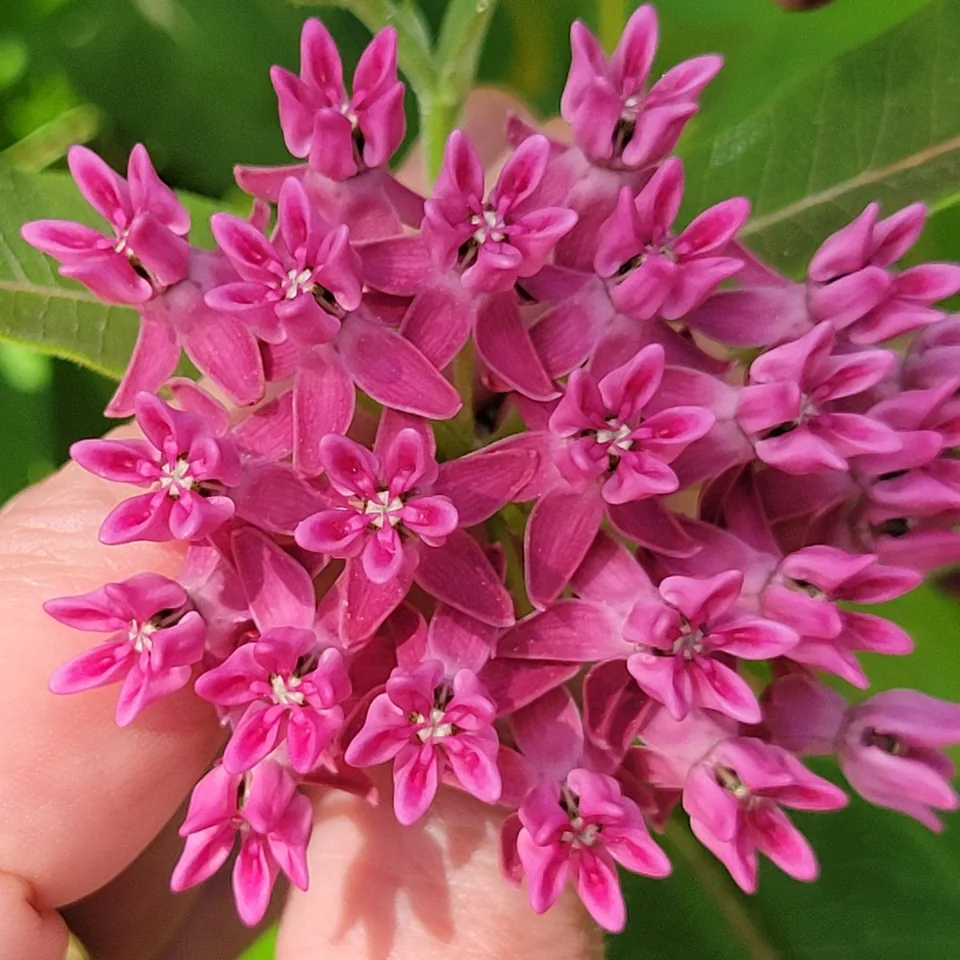
How to Grow and Care for Purple Milkweed
Asclepias purpurascens
Written by Emilio Marruso · last checked
Toxic to: Cats, Dogs, Horses · Why
At a glance
Purple milkweed is a tough perennial that grows in full sun or partial shade and handles dry spells well in well-drained soil. It reaches 2 to 3 feet tall and 1 to 3 feet wide, a tidy size for a sunny corner of the garden. Just keep an eye out for milkweed bugs, which can damage the seed pods.
- Sun
Full sun to partial shade
What the sources say (1)
Light: Full sun to partial shade
The plant grows 2 to 3 feet tall and wide in full sun to partial shade.
— Asclepias purpurascens (Purple Milkweed) | North Carolina Extension Gardener Plant Toolbox [1] - Water
Likes average to dry soil; handles drought well
What the sources say (1)
Watering: Average moist to dry well-drained soils; drought tolerant
It is easy to grow in average moist to dry well-drained soils in full sun. It is drought and deer tolerant.
— Asclepias purpurascens (Purple Milkweed) | North Carolina Extension Gardener Plant Toolbox [1] - Cold
Survives winters down to −40 °F (−40 °C)
Very hardy · USDA 3a · RHS H7 · Z3
What the sources say (2)
Hardiness, coldest zone: 3a [winter low −40 to −37.2 °C (−40 to −35 °F)]
USDA Plant Hardiness Zone: 3a, 3b, 4a, 4b, 5a, 5b, 6a, 6b, 7a, 7b, 8a, 8b
— Asclepias purpurascens (Purple Milkweed) | North Carolina Extension Gardener Plant Toolbox [1] Hardiness, warmest zone: 8b [winter low −9.4 to −6.7 °C (15 to 20 °F)]
USDA Plant Hardiness Zone: 3a, 3b, 4a, 4b, 5a, 5b, 6a, 6b, 7a, 7b, 8a, 8b
— Asclepias purpurascens (Purple Milkweed) | North Carolina Extension Gardener Plant Toolbox [1] - Soil
Well-drained soil
What the sources say (1)
Watering: Average moist to dry well-drained soils; drought tolerant
It is easy to grow in average moist to dry well-drained soils in full sun. It is drought and deer tolerant.
— Asclepias purpurascens (Purple Milkweed) | North Carolina Extension Gardener Plant Toolbox [1] - Pests
Large and small milkweed bugs can badly damage the seed pods
What the sources say (1)
Pests: large milkweed bugs, small milkweed bugs
Most common milkweed pests (aphids, milkweed beetles, Monarch larvae, and milkweed tussock moth larvae) are not problematic, but both large and small milkweed bugs can be very damaging to seed pods.
— Asclepias purpurascens (Purple Milkweed) | North Carolina Extension Gardener Plant Toolbox [1] - Size
2–3 ft tall and 1–3 ft wide
What the sources say (2)
Mature height: 60.96-91.44 cm (2-3 ft)
Height: 2 ft. 0 in. - 3 ft. 0 in. Width: 1 ft. 0 in. - 3 ft. 0 in.
— Asclepias purpurascens (Purple Milkweed) | North Carolina Extension Gardener Plant Toolbox [1] Mature width: 30.48-91.44 cm (1-3 ft)
Height: 2 ft. 0 in. - 3 ft. 0 in. Width: 1 ft. 0 in. - 3 ft. 0 in.
— Asclepias purpurascens (Purple Milkweed) | North Carolina Extension Gardener Plant Toolbox [1] - Safety
Harmful to dogs, cats and horses: keep pets away from it
Overview
Purple milkweed is a perennial wildflower native to eastern and central USA that grows 2 to 3 feet [61–91 cm] tall and wide in full sun to partial shade. [1] It can spread aggressively by seeds and rhizomes and is not appropriate for small gardens. [1] The plant is listed as having low severity poison characteristics and as a problem for dogs, horses and cats. [1]
This record is incomplete: the sources we read do not cover every field yet.
Not yet covered by our sources: Pruning, Propagation
Purple Milkweed care
Measurements in square brackets are our conversion into the other unit system; the quoted text is unchanged.
How to water Purple Milkweed
Average moist to dry well-drained soils; drought tolerant
What the sources say (1)
It is easy to grow in average moist to dry well-drained soils in full sun. It is drought and deer tolerant.How much light Purple Milkweed needs
Full sun to partial shade
What the sources say (1)
The plant grows 2 to 3 feet tall and wide in full sun to partial shade.How much cold Purple Milkweed can take
Hardiness, coldest zone
3a [winter low −40 to −37.2 °C (−40 to −35 °F)]
What the sources say (1)
USDA Plant Hardiness Zone:
3a, 3b, 4a, 4b, 5a, 5b, 6a, 6b, 7a, 7b, 8a, 8bHardiness, warmest zone
8b [winter low −9.4 to −6.7 °C (15 to 20 °F)]
What the sources say (1)
USDA Plant Hardiness Zone:
3a, 3b, 4a, 4b, 5a, 5b, 6a, 6b, 7a, 7b, 8a, 8bHow to propagate Purple Milkweed
Not stated in the sources we read.
How to grow Purple Milkweed
The plant
Life cycle
perennial
What the sources say (1)
Purple Milkweed is a perennial wildflower native to eastern and central USA. It is a rare species in NC but can be found in swampy areas to dry woodlands and meadows of the Piedmont and mountains.Family
Apocynaceae
What the sources say (1)
Genus:
Asclepias
Species:
purpurascens
Family:
Apocynaceae
Life Cycle:
PerennialMature height
60.96-91.44 cm (2-3 ft)
What the sources say (1)
Height: 2 ft. 0 in. - 3 ft. 0 in.
Width: 1 ft. 0 in. - 3 ft. 0 in.Mature width
30.48-91.44 cm (1-3 ft)
What the sources say (1)
Height: 2 ft. 0 in. - 3 ft. 0 in.
Width: 1 ft. 0 in. - 3 ft. 0 in.Pests and diseases
Pests
large milkweed bugs, small milkweed bugs
What the sources say (1)
Most common milkweed pests (aphids, milkweed beetles, Monarch larvae, and milkweed tussock moth larvae) are not problematic, but both large and small milkweed bugs can be very damaging to seed pods.Purple Milkweed pests and problems
Milkweed bugs
Symptom: Large and small milkweed bugs can be very damaging to seed pods.
What the sources say (1)
but both large and small milkweed bugs can be very damaging to seed pods.
— Asclepias purpurascens (Purple Milkweed) | North Carolina Extension Gardener Plant Toolbox [1]
Remedies
Each remedy shows what official sources say about it; traditional remedies without an official source are marked as such. Harmful ones are listed so you know to avoid them.
First aid
First aid: not a substitute for a doctor
sap on skin
washing skin with soap and water Official source, not independently tested
If there is any persistent skin or eye pain, seek medical examination and treatment.
— poison.org [4] How: If your skin comes into contact with milkweed sap, immediately wash the affected area thoroughly with soap and water.
If your skin comes into contact with milkweed sap, you should immediately wash the affected area thoroughly with soap and water.
— poison.org [4]
sap in eyes
rinsing the eye with water Official source, not independently tested
If there is any persistent skin or eye pain, seek medical examination and treatment.
— poison.org [4] How: If someone experiences eye irritation after getting sap in their eye, gently rinse the eye with room-temperature water for 10–15 minutes.
If someone experiences eye irritation after getting sap in their eye, gently rinse the eye with room-temperature water for 10–15 minutes.
— poison.org [4]
Treating the plant
aphids
cutting off infested tips Works
How: Cut the infested tips off; the plant will generally sprout back in a couple of weeks with fresh, new growth.
If you notice aphids on your milkweed, just cut the infested tips off! The plant will generally sprout back in a couple of weeks with fresh, new growth.
— lee.ces.ncsu.edu [5] What the evidence says If you notice aphids on your milkweed, just cut the infested tips off! The plant will generally sprout back in a couple of weeks with fresh, new growth.
— lee.ces.ncsu.edu [5] squishing aphids by hand and hosing them off Not verified
Traditional remedy, not verified by an official source.
Always check for monarch eggs and caterpillars before spraying because you could damage or dislodge them in the process as well.
— saveourmonarchs.org [6] How: Squish the aphids between your fingers (wear gloves) and then use a hose to dislodge them from the plant; check for monarch eggs and caterpillars before spraying.
dish soap, isopropyl alcohol and vinegar spray Not proven
*Use caution with this method because it will also kill monarch larvae if they come in contact with the solution.
— saveourmonarchs.org [6] How: 1 part [nome commerciale], 1 part isopropyl alcohol, 1 part white vinegar and 128 parts water, applied directly on the aphids; rinse the plant when finished.
1 part (e.g. 1 oz) [nome commerciale] • 1 part Isopropyl Alcohol • 1 part white vinegar • 128 parts (e.g. 1 gal) water
— saveourmonarchs.org [6] What the evidence says Mixing your own concoction of dish soap and salts is not recommended ever.
— lee.ces.ncsu.edu [5]
rust
pinching off infected leaves Works
Do not remove more than 1/3 of the plant’s foliage at any one time.
— ask.extension.org [7] How: Pinch off rust-infected leaves and dispose of them in the trash, not compost; do not remove more than 1/3 of the foliage at once.
Helpful control measures include pinching off rust infected leaves and disposing of them in the trash, not compost.
— ask.extension.org [7] What the evidence says Hand removal of infected material is your best option if the infection isn’t severe.
— ask.extension.org [7]
Getting rid of it
spreading milkweed
digging out individual plants Official source, not independently tested
How: Existing plants need to be dug out individually.
Existing plants need to be either dug out individually or, if not immediately next to a desirable plant, covered with a light-blocking material until the roots starve
— ask.extension.org [8] covering with light-blocking material Official source, not independently tested
How: Cover the plants with a light-blocking material until the roots starve, which may be several weeks.
covered with a light-blocking material until the roots starve (which may be several weeks).
— ask.extension.org [8] repeated cutting of top growth Partly works
How: Cut down the top growth, repeating promptly each time the plant resprouts.
The alternative is to cut down the top growth, repeating the process promptly each time the plant resprouts, which will eventually exhaust its root energy reserves.
— ask.extension.org [8] What the evidence says The alternative is to cut down the top growth, repeating the process promptly each time the plant resprouts, which will eventually exhaust its root energy reserves.
— ask.extension.org [8] burying a rhizome barrier Official source, not independently tested
How: Bury a barrier to block the running roots from creeping across the property line, likely at least 6 inches deep.
To prevent rhizome spread (the running roots that may be connecting the original plants to any new sprouts that are not seedlings), you'd need to bury a barrier
— ask.extension.org [8] removing immature seed pods Partly works
How: Remove immature seed pods to prevent further spread; the plant will still emerge again in the same spot next summer.
If you already have common milkweed in the garden, you can prevent further spread by removing immature seed pods.
— extension.unh.edu [9] What the evidence says you can prevent further spread by removing immature seed pods. Since milkweed is a perennial, it will emerge again in the same spot next summer, but its spread will be more limited.
— extension.unh.edu [9] repeated hand-pulling Official source, not independently tested
How: Individual plants can be repeatedly hand-pulled; wait until the butterflies have emerged from their chrysalids or do it in late spring.
Individual plants can also be repeatedly hand-pulled or treated with an herbicide, but don’t be too hasty this season.
— extension.unh.edu [9]
Is Purple Milkweed toxic to pets?
Reported by the source, quoted verbatim. This is not medical or veterinary advice: if a person or an animal may have eaten this plant, contact a poison control centre or a veterinarian.
Calendar
Pruning
Not stated in the sources we read.
Months as given by the sources, which are mostly from the United States (northern hemisphere). In the southern hemisphere they shift by about six months.
Indicative values
Values from a secondary source, not checked word for word like the rest of this page. Use them as a starting point.
- Hours of sun
- 10-12 hoursIndicative value, adapt it to your climate · Secondary source
- Drought tolerant
- yesIndicative value, adapt it to your climate · Secondary source
- Soil
- Clay, SandIndicative value, adapt it to your climate · Secondary source
- Soil pH
- 6-7Indicative value, adapt it to your climate · Secondary source
- Care level
- MediumIndicative value, adapt it to your climate · Secondary source
- Growth rate
- LowIndicative value, adapt it to your climate · Secondary source
- Pruning
- August, February, March, April, May, June, July, August, September, March, April, MayIndicative value, adapt it to your climate · Secondary source
- Propagation
- Seed Propagation, Root Cutting, Division, Layering PropagationIndicative value, adapt it to your climate · Secondary source
Similar plants
- Butterfly Weed Asclepias tuberosa
- Clasping Milkweed Asclepias amplexicaulis
- Few-flower Milkweed Asclepias lanceolata
- Green Antelopehorn Asclepias viridis
- Green Comet Milkweed Asclepias viridiflora
- Poke Milkweed Asclepias exaltata
- Red Milkweed Asclepias rubra
- Sandhill Milkweed Asclepias humistrata
Sources
Every value above is quoted from these documents. Links lead to the original publisher.
- Asclepias purpurascens (Purple Milkweed) | North Carolina Extension Gardener Plant Toolbox · plants.ces.ncsu.edu, consulted
- Find a Plant | North Carolina Extension Gardener Plant Toolbox · plants.ces.ncsu.edu, consulted
- Milkweed | Prairies to Perennials | Illinois Extension | Illinois · extension.illinois.edu, consulted
- poison.org · poison.org
- lee.ces.ncsu.edu · lee.ces.ncsu.edu
- saveourmonarchs.org · saveourmonarchs.org
- ask.extension.org · ask.extension.org
- ask.extension.org · ask.extension.org
- extension.unh.edu · extension.unh.edu
Written by Emilio Marruso · last checked