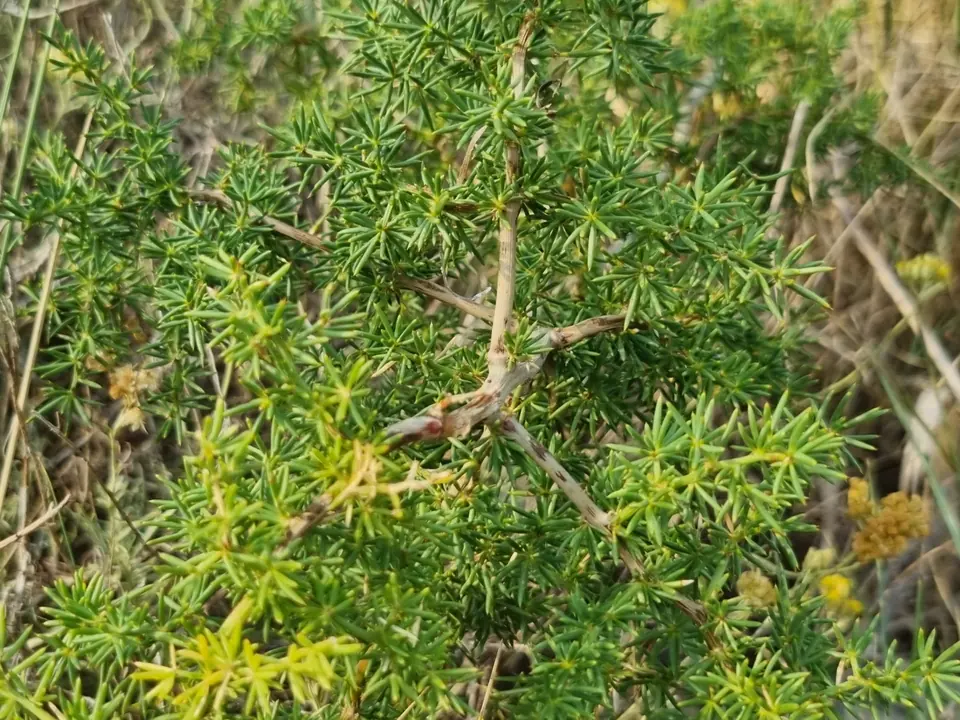
How to Grow and Care for Asparagus acutifolius
Asparagus acutifolius
Written by Emilio Marruso · last checked
Toxic to: People · Why
At a glance
This wild asparagus is a favorite of food lovers: its young shoots, eaten cooked, have a stronger flavor and make a fine asparagus substitute. It grows happily in full sun or light shade and comes back year after year. Plant it in late spring or early summer, then look forward to picking tender shoots from March to May.
- Sun
Full sun to light shade
- Cold
Survives winters down to 10 °F (−12.2 °C)
Hardy in cold winters · USDA 8 · RHS H5 · Z8
What the sources say (1)
Hardiness, coldest zone: 8 [winter low −12.2 to −6.7 °C (10 to 20 °F)]
Light full sun Shade tolerance light shade Water moderate Hardiness Zone 8+
— Asparagus acutifolius — Practical Plants [6] - Spacing
13 in between plants, in rows 3 ft apart
What the sources say (3)
Spacing: 33 cm [13 in] along the row, in rows 1 m [3.3 ft] apart
olive orchard, planted in inter-row area: the wild asparagus can be planted at 33 cm spacing within 1 m rows
— 19 [7] olive orchard, planted only in the tree rows: the wild asparagus plants are typically planted at about 33 cm spacing along the row
— 19 [7] the wild asparagus can be planted at 33 cm spacing within 1 m rows
— 19 [7] - Planting
Plant in late spring or early summer
What the sources say (1)
Planting: Late spring or early summer
Plant them out into their permanent positions in late spring or early summer
— Asparagus acutifolius - Useful Temperate Plants [5] - Harvest
Pick the young shoots from March to May and eat them cooked
What the sources say (1)
Harvest: March to May, depending on local climate
harvestable spears each spring (March to May depending on local climate)
— 19 [7] - Propagation
Grow from seed or divide the plant in early spring
- Sowing
Sow in spring, or in early fall in a greenhouse as soon as the seed is ripe
What the sources say (1)
Sowing: Spring, or as soon as the seed is ripe in early autumn (in a greenhouse)
sow in spring or as soon as the seed is ripe in early autumn in a greenhouse
— Asparagus acutifolius - Useful Temperate Plants [5] - Safety
No known hazards
Overview
Wild asparagus is a perennial native to the Mediterranean region. [5] Its young shoots are eaten cooked as an asparagus substitute. [6] It is propagated from seed or by division and, in olive orchards, spears are harvested in spring. [5][7]
This record is incomplete: the sources we read do not cover every field yet.
Not yet covered by our sources: Watering
Asparagus acutifolius care
Measurements in square brackets are our conversion into the other unit system; the quoted text is unchanged.
How to water Asparagus acutifolius
Not stated in the sources we read.
How much light Asparagus acutifolius needs
How much cold Asparagus acutifolius can take
8 [winter low −12.2 to −6.7 °C (10 to 20 °F)]
What the sources say (1)
Light
full sun
Shade tolerance
light shade
Water
moderate
Hardiness
Zone 8+Where to grow Asparagus acutifolius
33 cm [13 in] along the row, in rows 1 m [3.3 ft] apart
What each source says
olive orchard, planted in inter-row area: 33 cm [13 in] along the row, in rows 1 m [3.3 ft] apart
olive orchard, planted only in the tree rows: 33 cm [13 in] along the row
What the sources say (3)
olive orchard, planted in inter-row area: the wild asparagus can be planted at 33 cm spacing within 1 m rowsolive orchard, planted only in the tree rows: the wild asparagus plants are typically planted at about 33 cm spacing along the rowthe wild asparagus can be planted at 33 cm spacing within 1 m rowsHow to propagate Asparagus acutifolius
How to grow Asparagus acutifolius
The plant
Life cycle
perennial
What the sources say (1)
The native range of this species is Medit. It is a scrambling perennial and grows primarily in the subtropical biome.Family
Asparagaceae
What the sources say (1)
Asparagaceae Asparagus ## Asparagus acutifolius L. First published in Sp. Pl.: 314 (1753) This species is accepted The native range of this species is Medit.Remedies
The sources we checked give no remedies for this plant.
Is Asparagus acutifolius poisonous?
Reported by the source, quoted verbatim. This is not medical or veterinary advice: if a person or an animal may have eaten this plant, contact a poison control centre or a veterinarian.
though others dismiss it as thin, bitter and stringy. ## Known Hazards None known
[5]
Calendar
Spring, or as soon as the seed is ripe in early autumn (in a greenhouse)
What the sources say (1)
sow in spring or as soon as the seed is ripe in early autumn in a greenhouseLate spring or early summer
What the sources say (1)
Plant them out into their permanent positions in late spring or early summerMarch to May, depending on local climate
What the sources say (1)
harvestable spears each spring (March to May depending on local climate)Months as given by the sources, which are mostly from the United States (northern hemisphere). In the southern hemisphere they shift by about six months.
Edibility
Reported by the source, quoted verbatim. Do not eat a plant on the basis of this page alone: identification mistakes can be dangerous.
Young shoots - cooked [7] [9] [10] . An asparagus substitute, it is preferred by gourmets for its stronger flavour
[6]
Similar plants
- Asparagus Asparagus officinalis
- Asparagus Fern Asparagus setaceus
- Asparagus aphyllus Asparagus aphyllus
- Asparagus albus Asparagus albus
- Sprenger's asparagus fern Asparagus densiflorus
- Adam's Needle Yucca flaccida
- American Agave Agave virginica
- Beaked Yucca Yucca rostrata
Sources
Every value above is quoted from these documents. Links lead to the original publisher.
- Urbani, Malvina; Ledda, Marco G.; Becca, Giovanna (2005) Note sulla · iris.uniss.it, consulted
- Asparagus acutifolius L. | Plants of the World Online | Kew Science · powo.science.kew.org, consulted
- Parametri di qualità e attività antiossidante e antimicrobica di piante selvatiche: i casi studio di Foeniculum vulgare e Asparagus acutifolius · thesis.unipd.it, consulted
- Distribution and major morphological traits of wild asparagus (A. acutifolius L. and A. albus L.) in Sicily · iris.unipa.it, consulted
- Asparagus acutifolius - Useful Temperate Plants · temperate.theferns.info, consulted
- Asparagus acutifolius — Practical Plants · practicalplants.org, consulted
- 19 · agroforst.ch, consulted
- AUB - NCC Plants | Details · plants.aub.edu.lb, consulted
Written by Emilio Marruso · last checked