
How to Grow and Care for Asparagus
Asparagus officinalis
Written by Emilio Marruso · last checked
Toxic to: People · Why
At a glance
Asparagus is a perennial that comes back every year, rewarding you with young spears in early spring. Give it full sun and deep watering that wets the soil at least 6 inches down, then simply cut or snap the spears at the soil surface. Choose all-male varieties: male plants give more and better spears.
- Sun
Full sun
What the sources say (2)
Light: Full sun
Asparagus needs full sun; moist, organic, sandy soil with good drainage; and neutral (6.0-8.0) pH levels.
— Asparagus officinalis (Asparagus, Garden Asparagus) | North Carolina Extension Gardener Plant Toolbox [1] Choose a site for a permanent asparagus bed that has good drainage and full sun.
— Asparagus | Home & Garden Information Center [6] - Water
Water deeply to wet the soil 6 inches down; light watering gives shallow roots
What the sources say (1)
Watering: Water sufficiently to moisten the soil to a depth of at least 6 inches [15 cm]; light watering leads to shallow rooted plants
Water sufficiently to moisten the soil to a depth of at least 6 inches. Light watering will lead to shallow rooted plants.
— Asparagus | Home & Garden Information Center [6] - Cold
Survives winters down to −50 °F (−45.6 °C)
Very hardy · USDA 2a · RHS H7 · Z2
What the sources say (2)
Hardiness, coldest zone: 2a [winter low −45.6 to −42.8 °C (−50 to −45 °F)]
USDA Plant Hardiness Zone: 2a, 2b, 3a, 3b, 4a, 4b, 5a, 5b, 6a, 6b, 7a, 7b, 8a, 8b, 9a, 9b
— Asparagus officinalis (Asparagus, Garden Asparagus) | North Carolina Extension Gardener Plant Toolbox [1] Hardiness, warmest zone: 9b [winter low −3.9 to −1.1 °C (25 to 30 °F)]
USDA Plant Hardiness Zone: 2a, 2b, 3a, 3b, 4a, 4b, 5a, 5b, 6a, 6b, 7a, 7b, 8a, 8b, 9a, 9b
— Asparagus officinalis (Asparagus, Garden Asparagus) | North Carolina Extension Gardener Plant Toolbox [1] - Spacing
15–18 in between plants, 4–5 ft between trenches
What the sources say (6)
Spacing: Home garden crowns: 38.1-45.7 cm (15 to 18 inches apart); commercial single rows: 30.5 cm (12 inches) between plants in the row
home garden (crowns): Set the crowns 15 to 18 inches apart and 6 to 8 inches deep.
— Asparagus | Home & Garden Information Center [6] commercial single rows: with 12 inches between plants in the row and 5 to 6 feet between rows
— Asparagus Production [5] Set the crowns 15 to 18 inches apart and 6 to 8 inches deep.
— Asparagus | Home & Garden Information Center [6] with 12 inches between plants in the row and 5 to 6 feet between rows
— Asparagus Production [5] Row spacing: 122-152 cm (4-5 ft) between trenches (home garden)
commercial single rows: 152-183 cm (5-6 ft) between rows: Growers generally plant approximately 12,000 to 14,000 plants per acre in single rows, with 12 inches between plants in the row and 5 to 6 feet between rows.
— Asparagus Production [5] The trench is dug 12 to 18 inches wide, with 4 to 5 feet between trenches.
— Asparagus | Home & Garden Information Center [6] - Planting
Plant crowns 6–8 inches deep; in warm climates, from February to mid-April
What the sources say (6)
Planting: Crowns in South Carolina: Piedmont Mar 1 - Apr 15, Coastal Feb 1 - Mar 15; commercial planting usually in May
South Carolina Piedmont: Planting Dates for Crowns | Area | Dates | Piedmont | Mar 1 – April 15
— Asparagus | Home & Garden Information Center [6] South Carolina Coastal: | Coastal | Feb 1 – March 15
— Asparagus | Home & Garden Information Center [6] commercial planting (fonte: Penn State Extension): Asparagus usually is planted in May so that extensive foliage (fern) develops before winter.
— Asparagus Production [5] Planting Dates for Crowns | Area | Dates | Piedmont | Mar 1 – April 15 | Coastal | Feb 1 – March 15
— Asparagus | Home & Garden Information Center [6] Asparagus usually is planted in May so that extensive foliage (fern) develops before winter.
— Asparagus Production [5] Sowing depth: 15-20 cm (6-8 in) (crowns)
Set the crowns 15 to 18 inches apart and 6 to 8 inches deep.
— Asparagus | Home & Garden Information Center [6] - Feeding
Feed every year in early spring, before spears appear, and again after harvest
What the sources say (7)
When: Very early spring, before the spears emerge, and a side-dressing after harvest; at planting, in the trench
In the absence of a soil test, apply 5 lbs of 5-10-10 per 100 feet of row in the very early spring before spears emerge.
— Asparagus | Home & Garden Information Center [6] Then sidedress with 1½ lbs calcium nitrate (15.5-0-0) per 100 feet of row after harvest.
— Asparagus | Home & Garden Information Center [6] In the absence of soil test results, the recommended N-P-K application rates are 50-100-150 pounds per acre broadcast in the spring of every year before spear emergence.
— Asparagus Production [5] In the absence of a soil test, apply 5 lbs 5-10-10 per 100 feet of row in the trench and cover with at least 2 inches.
— Asparagus | Home & Garden Information Center [6] How often: Every year: once in early spring and once after harvest
In the absence of a soil test, apply 5 lbs of 5-10-10 per 100 feet of row in the very early spring before spears emerge.
— Asparagus | Home & Garden Information Center [6] Then sidedress with 1½ lbs calcium nitrate (15.5-0-0) per 100 feet of row after harvest.
— Asparagus | Home & Garden Information Center [6] In the absence of soil test results, the recommended N-P-K application rates are 50-100-150 pounds per acre broadcast in the spring of every year before spear emergence.
— Asparagus Production [5] - Pruning
Cut back the brown foliage in late winter, before new spears come up
What the sources say (1)
Pruning: Late winter, after the foliage turns brown and before spears emerge in spring
In all asparagus planting, cut the foliage down to 2-inch stubs in late winter after they turn brown, but before the spears emerge in spring.
— Asparagus | Home & Garden Information Center [6] - Harvest
Cut spears at soil level before the tips open; stop when they get pencil-thin
What the sources say (3)
How to harvest: Cut or snap spears off at the soil surface before the tips begin to separate; do not cut too deeply, which injures the crown buds that produce the next spears; stop harvesting when spears are reduced to pencil size and let them grow to full height.
should be cut or snapped off at the soil surface before the tips begin to separate
— Asparagus | Home & Garden Information Center [6] Cutting too deeply can injure the crown buds that produce the next spears.
— Asparagus | Home & Garden Information Center [6] Stop harvesting when the diameter of the spears has been reduced to pencil-size and allow the spear to grow to full height.
— Asparagus | Home & Garden Information Center [6] - Pollination
Male and female plants are separate; all-male varieties give more and better spears
What the sources say (3)
Fruit set: Dioecious: male and female flowers on separate plants
Asparagus is dioecious which means that the male and female flowers form on separate plants.
— Asparagus | Home & Garden Information Center [6] What it needs: Male plants yield more and better spears, so all-male cultivars are preferred; female plants spend energy on seeds and yield less.
Asparagus plants are either male or female – male plants produce more and better spears, so many modern varieties are all-male.
— [7] The female plants expend more energy to produce seeds; therefore, the female plants will have a much lower yield than the males.
— Asparagus | Home & Garden Information Center [6] - Pests
Asparagus beetles, aphids and cutworms; rust and root rot, so don't replant where asparagus grew
What the sources say (5)
Pests: asparagus beetle, spotted asparagus beetle, asparagus aphids, cutworms, Japanese beetles
Common insect problems include asparagus beetle, spotted asparagus beetle, and aphids.
— Asparagus officinalis (Asparagus, Garden Asparagus) | North Carolina Extension Gardener Plant Toolbox [1] Asparagus beetles, asparagus aphids, cutworms, and Japanese beetles can all cause crop losses.
— Asparagus Production [5] Diseases: fusarium root rot, rust, needle blight, phytophthora crown and root rot, cercospora leaf spot
Common disease problems include fusarium, rust, and needle blight.
— Asparagus officinalis (Asparagus, Garden Asparagus) | North Carolina Extension Gardener Plant Toolbox [1] In addition, asparagus is extremely susceptible to Fusarium root rot, a disease caused by a fungus that will weaken the plant.
— Asparagus Production [5] Diseases that may occur in the home garden include rust, phytophthora crown and root rot, and cerospora leaf spot.
— Asparagus | Home & Garden Information Center [6] - Size
1.5–3 ft wide
What the sources say (1)
Mature width: 46-91 cm (1.5-3 ft)
Width: 1 ft. 6 in. - 3 ft. 0 in.
— Asparagus officinalis (Asparagus, Garden Asparagus) | North Carolina Extension Gardener Plant Toolbox [1] - Propagation
By division, crowns or seedlings started in a greenhouse
What the sources say (3)
Propagation: Division; crowns; seed-started greenhouse transplants
Species: officinalis Family: Asparagaceae Life Cycle: Perennial Recommended Propagation Strategy: Division
— Asparagus officinalis (Asparagus, Garden Asparagus) | North Carolina Extension Gardener Plant Toolbox [1] Start asparagus from 1 to 2 – year-old disease-free crowns .
— Asparagus | Home & Garden Information Center [6] Commercially, asparagus can be started in the greenhouse 8 to 10 weeks prior to transplanting in the field
— Asparagus Production [5] - Sowing
Start seeds in a greenhouse 8–10 weeks before planting out
What the sources say (1)
Sowing: Started in the greenhouse 8 to 10 weeks before transplanting in the field
Commercially, asparagus can be started in the greenhouse 8 to 10 weeks prior to transplanting in the field
— Asparagus Production [5] - Safety
Don't eat the berries, they upset the stomach; wear gloves when handling raw young shoots
Overview
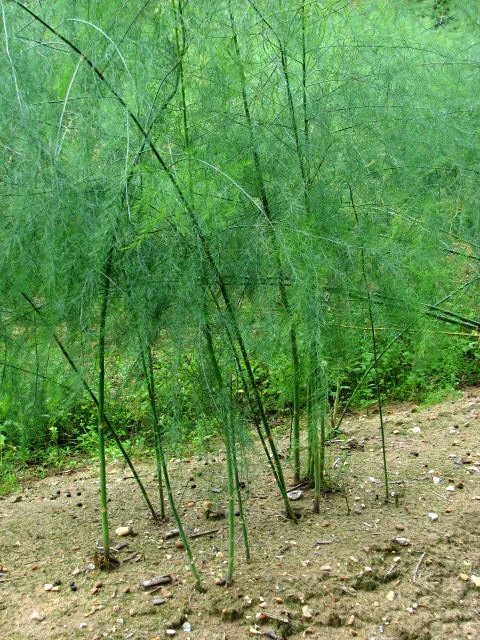
Garden asparagus is a long-lived herbaceous perennial vegetable grown for its young spears. [1] It needs full sun and well-drained soil, and a bed can remain productive for 20-30 years if properly sited. [3] Foliage is cut back in late winter, after it turns brown and before spears emerge. [6]
Asparagus care
Measurements in square brackets are our conversion into the other unit system; the quoted text is unchanged.
How to water Asparagus
Watering
Water sufficiently to moisten the soil to a depth of at least 6 inches [15 cm]; light watering leads to shallow rooted plants
What the sources say (1)
Water sufficiently to moisten the soil to a depth of at least 6 inches. Light watering will lead to shallow rooted plants.Watering notes
During stand establishment plants should not be water-stressed or over-watered; irrigation is highly recommended, and trickle irrigation is preferred over overhead irrigation
What the sources say (2)
During the period of stand establishment , they should not be water-stressed or over-watered.Irrigation is highly recommended and will help ensure a more consistent crop from year to year. Trickle irrigation is preferred over overhead irrigationHow much light Asparagus needs
Full sun
What the sources say (2)
Asparagus needs full sun; moist, organic, sandy soil with good drainage; and neutral (6.0-8.0) pH levels.Choose a site for a permanent asparagus bed that has good drainage and full sun.How much cold Asparagus can take
Hardiness, coldest zone
2a [winter low −45.6 to −42.8 °C (−50 to −45 °F)]
What the sources say (1)
USDA Plant Hardiness Zone:
2a, 2b, 3a, 3b, 4a, 4b, 5a, 5b, 6a, 6b, 7a, 7b, 8a, 8b, 9a, 9bHardiness, warmest zone
9b [winter low −3.9 to −1.1 °C (25 to 30 °F)]
What the sources say (1)
USDA Plant Hardiness Zone:
2a, 2b, 3a, 3b, 4a, 4b, 5a, 5b, 6a, 6b, 7a, 7b, 8a, 8b, 9a, 9bBest soil for Asparagus
Soil pH, minimum
The sources give different values depending on region, zone or growing conditions.
What each source says
According to NC State Extension Plant Toolbox: 6.0
According to Penn State Extension: 6.2
According to Clemson HGIC: 6.0
What the sources say (3)
According to NC State Extension Plant Toolbox: Asparagus needs full sun; moist, organic, sandy soil with good drainage; and neutral (6.0-8.0) pH levels.According to Penn State Extension: Soil pH should be between 6.2 and 7.0.According to Clemson HGIC: Follow the results of a soil test to maintain a soil pH between 6.0 and 6.5 and optimal fertility levels.Soil pH, maximum
The sources give different values depending on region, zone or growing conditions.
What each source says
According to NC State Extension Plant Toolbox: 8.0
According to Penn State Extension: 7.0
According to Clemson HGIC: 6.5
What the sources say (3)
According to NC State Extension Plant Toolbox: Asparagus needs full sun; moist, organic, sandy soil with good drainage; and neutral (6.0-8.0) pH levels.According to Penn State Extension: Soil pH should be between 6.2 and 7.0.According to Clemson HGIC: Follow the results of a soil test to maintain a soil pH between 6.0 and 6.5 and optimal fertility levels.Where to grow Asparagus
Home garden crowns: 38.1-45.7 cm (15 to 18 inches apart); commercial single rows: 30.5 cm (12 inches) between plants in the row
What each source says
home garden (crowns): 38.1-45.7 cm (15 to 18 inches) apart, crowns 15.2-20.3 cm (6 to 8 inches) deep
commercial single rows: 30.5 cm (12 inches) between plants in the row, 152.4-182.9 cm (5 to 6 feet) between rows
What the sources say (4)
home garden (crowns): Set the crowns 15 to 18 inches apart and 6 to 8 inches deep.commercial single rows: with 12 inches between plants in the row and 5 to 6 feet between rowsSet the crowns 15 to 18 inches apart and 6 to 8 inches deep.with 12 inches between plants in the row and 5 to 6 feet between rowsHow to propagate Asparagus
Division; crowns; seed-started greenhouse transplants
What the sources say (3)
Species:
officinalis
Family:
Asparagaceae
Life Cycle:
Perennial
Recommended Propagation Strategy:
DivisionStart asparagus from 1 to 2 – year-old disease-free crowns .Commercially, asparagus can be started in the greenhouse 8 to 10 weeks prior to transplanting in the fieldHow to grow Asparagus
The plant
Life cycle
perennial
What the sources say (2)
Asparagus, in the Asparagaceae family, is a long-lived, herbaceous perennial vegetable that is not a native to the United StatesAsparagus ( Asparagus officinalis ) is a long-lived herbaceous perennial belonging to the newly formed asparagus family.Family
Asparagaceae
What the sources say (2)
Asparagus, in the Asparagaceae family, is a long-lived, herbaceous perennial vegetableAsparagus ( Asparagus officinalis ) is a member of the asparagus family (Asparagaceae) and one of only a few vegetables that are monocotsMature height
Mature width
46-91 cm (1.5-3 ft)
What the sources say (1)
Width: 1 ft. 6 in. - 3 ft. 0 in.Sowing and growth
Sowing depth
15-20 cm (6-8 in) (crowns)
What the sources say (1)
Set the crowns 15 to 18 inches apart and 6 to 8 inches deep.Row spacing
122-152 cm (4-5 ft) between trenches (home garden)
What each source says
commercial single rows: 152-183 cm (5-6 ft) between rows:
What the sources say (2)
commercial single rows: 152-183 cm (5-6 ft) between rows: Growers generally plant approximately 12,000 to 14,000 plants per acre in single rows, with 12 inches between plants in the row and 5 to 6 feet between rows.The trench is dug 12 to 18 inches wide, with 4 to 5 feet between trenches.Harvest and storage
How to harvest
Cut or snap spears off at the soil surface before the tips begin to separate; do not cut too deeply, which injures the crown buds that produce the next spears; stop harvesting when spears are reduced to pencil size and let them grow to full height.
What the sources say (3)
should be cut or snapped off at the soil surface before the tips begin to separateCutting too deeply can injure the crown buds that produce the next spears.Stop harvesting when the diameter of the spears has been reduced to pencil-size and allow the spear to grow to full height.Storage
Cool or refrigerate immediately after harvest; at 0-2 °C (32-36 °F) and 90-95% relative humidity it keeps good quality for 7 to 14 days; it can also be frozen or canned.
What the sources say (2)
Asparagus that is maintained at 32 to 36°F and 90 to 95 percent relative humidity will retain good quality for approximately 7 to 14 days.After harvest, process or refrigerate immediately. Asparagus can be frozen or canned.Pests and diseases
Pests
asparagus beetle, spotted asparagus beetle, asparagus aphids, cutworms, Japanese beetles
What the sources say (2)
Common insect problems include asparagus beetle, spotted asparagus beetle, and aphids.Asparagus beetles, asparagus aphids, cutworms, and Japanese beetles can all cause crop losses.Diseases
fusarium root rot, rust, needle blight, phytophthora crown and root rot, cercospora leaf spot
What the sources say (3)
Common disease problems include fusarium, rust, and needle blight.In addition, asparagus is extremely susceptible to Fusarium root rot, a disease caused by a fungus that will weaken the plant.Diseases that may occur in the home garden include rust, phytophthora crown and root rot, and cerospora leaf spot.Fertilizing
When
Very early spring, before the spears emerge, and a side-dressing after harvest; at planting, in the trench
What the sources say (4)
In the absence of a soil test, apply 5 lbs of 5-10-10 per 100 feet of row in the very early spring before spears emerge.Then sidedress with 1½ lbs calcium nitrate (15.5-0-0) per 100 feet of row after harvest.In the absence of soil test results, the recommended N-P-K application rates are 50-100-150 pounds per acre broadcast in the spring of every year before spear emergence.In the absence of a soil test, apply 5 lbs 5-10-10 per 100 feet of row in the trench and cover with at least 2 inches.How often
Every year: once in early spring and once after harvest
What the sources say (3)
In the absence of a soil test, apply 5 lbs of 5-10-10 per 100 feet of row in the very early spring before spears emerge.Then sidedress with 1½ lbs calcium nitrate (15.5-0-0) per 100 feet of row after harvest.In the absence of soil test results, the recommended N-P-K application rates are 50-100-150 pounds per acre broadcast in the spring of every year before spear emergence.Natural fertilizers
Compost or leaf mold worked into the soil at 20% by volume; yearly top-dressing of compost at 20% by volume
What the sources say (2)
Enrich the soil with additions of compost or leaf mold at the rate of 20% by volume.Asparagus also benefits from yearly top-dressing of compost, again at the rate of 20% by volume.Mineral fertilizers
Without a soil test: 5-10-10 at 2.27 kg [5 lb] per 30.5 m [100 ft] of row, in the trench at planting and every early spring; calcium nitrate 15.5-0-0 at 681 g per 30.5 m [100 ft] of row after harvest
What each source says
commercial fields, without a soil test: Nitrogen, phosphate and potash at 56, 112 and 168 kg [246.9–370.4 lb]/ha, broadcast each spring before spear emergence
What the sources say (4)
commercial fields, without a soil test: In the absence of soil test results, the recommended N-P-K application rates are 50-100-150 pounds per acre broadcast in the spring of every year before spear emergence.In the absence of a soil test, apply 5 lbs 5-10-10 per 100 feet of row in the trench and cover with at least 2 inches.In the absence of a soil test, apply 5 lbs of 5-10-10 per 100 feet of row in the very early spring before spears emerge.Then sidedress with 1½ lbs calcium nitrate (15.5-0-0) per 100 feet of row after harvest.Pollination
Fruit set
Dioecious: male and female flowers on separate plants
What the sources say (1)
Asparagus is dioecious which means that the male and female flowers form on separate plants.What it needs
Male plants yield more and better spears, so all-male cultivars are preferred; female plants spend energy on seeds and yield less.
What the sources say (2)
Asparagus plants are either male or female – male plants produce more and better spears, so many modern varieties are all-male.The female plants expend more energy to produce seeds; therefore, the female plants will have a much lower yield than the males.Asparagus pests and problems
Asparagus beetle
Symptom: Adults and larvae feed on spears and ferns
What to do: Sprays with carbaryl every 10 to 14 days or spinosad every 7 to 10 days
What the sources say (2)
The primary insect pest is the asparagus beetle. Adults and larvae feed on spears and ferns.
— Asparagus | Home & Garden Information Center [6] Asparagus beetles can be controlled by sprays with carbaryl every 10 to 14 days or with spinosad every 7 to 10 days.
— Asparagus | Home & Garden Information Center [6] Fusarium root rot
Symptom: Fungal disease that weakens the plant; the fungus can survive up to seven years in infected soil
What to do: Avoid planting where asparagus grew in previous years; good water and air drainage and disease-resistant cultivars
What the sources say (2)
asparagus is extremely susceptible to Fusarium root rot, a disease caused by a fungus that will weaken the plant.
— Asparagus Production [5] These diseases can be prevented by having good water and air drainage and planting disease-resistant cultivars.
— Asparagus Production [5] Rust
Symptom: Disease that may occur in the home garden
What to do: Sprays of myclobutanil or sulfur; drip rather than overhead irrigation
Remedies
Each remedy shows what official sources say about it; traditional remedies without an official source are marked as such. Harmful ones are listed so you know to avoid them.
Treating the plant
asparagus beetles
hand picking beetles into soapy water Partly works
How: Inspect the spears in the morning and drop beetles and larvae into soapy water; squish eggs.
Handpick daily: Inspect spears in the morning and drop beetles and larvae into soapy water.
— harvesttotable.com [8] What the evidence says In small scale settings (home gardens) diligent scouting combined with squishing of eggs and hand picking of adults (or knocking adults into a container of soapy water) are additional options.
— hort.extension.wisc.edu [9] ducks and chickens Partly works
How: Natural and domestic predators such as ducks and chickens can help slow population buildup during the summer.
Natural and domestic predators (ducks, chickens) can help slow population buildup during the summer.
— yardandgarden.extension.iastate.edu [10] What the evidence says Natural and domestic predators (ducks, chickens) can help slow population buildup during the summer.
— yardandgarden.extension.iastate.edu [10] removing weeds and debris Works
How: Keep weeds and debris out of asparagus plantings to reduce overwintering sites for adult beetles.
Keeping weeds and debris out of asparagus plantings reduces sites for adult beetles to overwinter.
— yardandgarden.extension.iastate.edu [10] What the evidence says Keeping weeds and debris out of asparagus plantings reduces sites for adult beetles to overwinter.
— yardandgarden.extension.iastate.edu [10] floating row covers Partly works
How: Use floating row covers early in spring to prevent damage to spears, and remove them after harvest is complete.
try using floating row covers early in spring to prevent damage to spears, but remove them after harvest is complete.
— hort.extension.wisc.edu [9] What the evidence says try using floating row covers early in spring to prevent damage to spears, but remove them after harvest is complete.
— hort.extension.wisc.edu [9] neem oil and insecticidal soap spray Partly works
Check the label to be sure the product is labeled for use on asparagus to control asparagus beetle.
— yardandgarden.extension.iastate.edu [10] How: In home gardens, organic options include neem and other horticultural oils and insecticidal soap, to target the larvae.
In small-scale settings (e.g., home gardens), organic options include neem and other horticultural oils and insecticidal soap to target the larvae.
— hort.extension.wisc.edu [9] What the evidence says In small-scale settings (e.g., home gardens), organic options include neem and other horticultural oils and insecticidal soap to target the larvae.
— hort.extension.wisc.edu [9]
spotted asparagus beetle
gathering and destroying infested berries Works
How: Gather and destroy infested berries to reduce spotted asparagus beetle larvae.
Populations of the spotted asparagus beetle larvae can be reduced by gathering and destroying infested berries.
— yardandgarden.extension.iastate.edu [10] What the evidence says Populations of the spotted asparagus beetle larvae can be reduced by gathering and destroying infested berries.
— yardandgarden.extension.iastate.edu [10]
cutworms
cardboard collars around plants Works
How: Encircle individual plants with cardboard or metal collars pressed an inch into the soil, to make fences that cutworms cannot cross.
By encircling individual plants with cardboard or metal "collars" pressed an inch into the soil, gardeners can create "fences" that cutworms cannot cross.
— content.ces.ncsu.edu [11] What the evidence says By encircling individual plants with cardboard or metal "collars" pressed an inch into the soil, gardeners can create "fences" that cutworms cannot cross.
— content.ces.ncsu.edu [11]
slugs and snails
beer trap Not verified
Traditional remedy, not verified by an official source.
How: Drown them in a deep container filled with 1/2 inch of beer, or sugar water and yeast, sunk so that the top edge is slightly above ground.
diatomaceous earth barrier Not verified
Traditional remedy, not verified by an official source.
How: Apply a 1-inch-wide strip of food-grade diatomaceous earth as a barrier.
asparagus aphids
removing dead ferns and spring tilling Works
How: Remove dead ferns during the fall or winter and till in spring.
Removing dead ferns during the fall or winter and tilling in spring often control this pest.
— content.ces.ncsu.edu [11] What the evidence says Removing dead ferns during the fall or winter and tilling in spring often control this pest.
— content.ces.ncsu.edu [11]
aphids
strong jet of water Not verified
Traditional remedy, not verified by an official source.
How: Blast aphids off with a strong jet of water.
rust
cutting down and destroying diseased ferns Not verified
Traditional remedy, not verified by an official source.
How: Cut down diseased ferns at the crown and destroy them.
blight and mildew
baking soda, dish detergent and olive oil spray Harmful
The dish detergent label does not provide any directions on how to use it on plants to control insects.
— extension.psu.edu [13] Home remedies often lack specific mix or use rates or identify how often to use them.
— extension.psu.edu [13] How: Mix one tablespoon of baking soda, 1/2 teaspoon of a mild dish detergent, and 2 1/2 tablespoons of olive oil in a gallon of water; shake well before spraying and repeat every week.
Mix one tablespoon of baking soda, 1/2 teaspoon of a mild dish detergent, and 2 1/2 tablespoons of olive oil in a gallon of water to make a solution
— foodgardening.mequoda.com [12] What the evidence says For example, spraying home remedies that contain dish detergent on plants on a sunny day can injure the plant, essentially burning it.
— extension.psu.edu [13]
Is Asparagus poisonous?
Reported by the source, quoted verbatim. This is not medical or veterinary advice: if a person or an animal may have eaten this plant, contact a poison control centre or a veterinarian.
Calendar
Sowing
Started in the greenhouse 8 to 10 weeks before transplanting in the field
What the sources say (1)
Commercially, asparagus can be started in the greenhouse 8 to 10 weeks prior to transplanting in the fieldPlanting
Crowns in South Carolina: Piedmont Mar 1 - Apr 15, Coastal Feb 1 - Mar 15; commercial planting usually in May
What each source says
South Carolina Piedmont: Mar 1 - April 15 (crowns)
South Carolina Coastal: Feb 1 - March 15 (crowns)
commercial planting (fonte: Penn State Extension): Usually May
What the sources say (5)
South Carolina Piedmont: Planting Dates for Crowns | Area | Dates | Piedmont | Mar 1 – April 15South Carolina Coastal: | Coastal | Feb 1 – March 15commercial planting (fonte: Penn State Extension): Asparagus usually is planted in May so that extensive foliage (fern) develops before winter.Planting Dates for Crowns
| Area
| Dates
| Piedmont
| Mar 1 – April 15
| Coastal
| Feb 1 – March 15Asparagus usually is planted in May so that extensive foliage (fern) develops before winter.Harvest
The sources give different values depending on region, zone or growing conditions.
What each source says
According to University of Arkansas Extension: Daily, from early spring to late spring
According to NC State Extension Plant Toolbox: Early spring, while spears are very young
What the sources say (4)
According to University of Arkansas Extension: Harvesting is a daily affair, beginning in early spring and continuing until late spring.According to NC State Extension Plant Toolbox: Harvest time: collect asparagus spears in the early spring, while very young.Harvesting is a daily affair, beginning in early spring
and continuing until late spring.Harvest young shoots in early spring for edibility.Pruning
Late winter, after the foliage turns brown and before spears emerge in spring
What the sources say (1)
In all asparagus planting, cut the foliage down to 2-inch stubs in late winter after they turn brown, but before the spears emerge in spring.Months as given by the sources, which are mostly from the United States (northern hemisphere). In the southern hemisphere they shift by about six months.
Edibility
Reported by the source, quoted verbatim. Do not eat a plant on the basis of this page alone: identification mistakes can be dangerous.
Young spears (shoots). Harvest time: collect asparagus spears in the early spring, while very young.
[1]
Indicative values
Values from a secondary source, not checked word for word like the rest of this page. Use them as a starting point.
- Hours of sun
- 6-8 hoursIndicative value, adapt it to your climate · Secondary source
- Care level
- MediumIndicative value, adapt it to your climate · Secondary source
- Growth rate
- HighIndicative value, adapt it to your climate · Secondary source
Similar plants
- Asparagus acutifolius Asparagus acutifolius
- Asparagus Fern Asparagus setaceus
- Asparagus aphyllus Asparagus aphyllus
- Asparagus albus Asparagus albus
- Sprenger's asparagus fern Asparagus densiflorus
- Adam's Needle Yucca flaccida
- American Agave Agave virginica
- Beaked Yucca Yucca rostrata
Sources
Every value above is quoted from these documents. Links lead to the original publisher.
- Asparagus officinalis (Asparagus, Garden Asparagus) | North Carolina Extension Gardener Plant Toolbox · plants.ces.ncsu.edu, consulted
- Asparagus - Asparagus officinalis | North Carolina Extension Gardener Plant Toolbox · plants.ces.ncsu.edu, consulted
- Asparagus officinalis: Garden Asparagus · uaex.uada.edu, consulted
- Garden Asparagus - Asparagus officinalis | North Carolina Extension Gardener Plant Toolbox · plants.ces.ncsu.edu, consulted
- Asparagus Production · extension.psu.edu, consulted
- Asparagus | Home & Garden Information Center · hgic.clemson.edu, consulted
- rhs.org.uk · rhs.org.uk
- harvesttotable.com · harvesttotable.com
- hort.extension.wisc.edu · hort.extension.wisc.edu
- yardandgarden.extension.iastate.edu · yardandgarden.extension.iastate.edu
- content.ces.ncsu.edu · content.ces.ncsu.edu
- foodgardening.mequoda.com · foodgardening.mequoda.com
- extension.psu.edu · extension.psu.edu
Written by Emilio Marruso · last checked