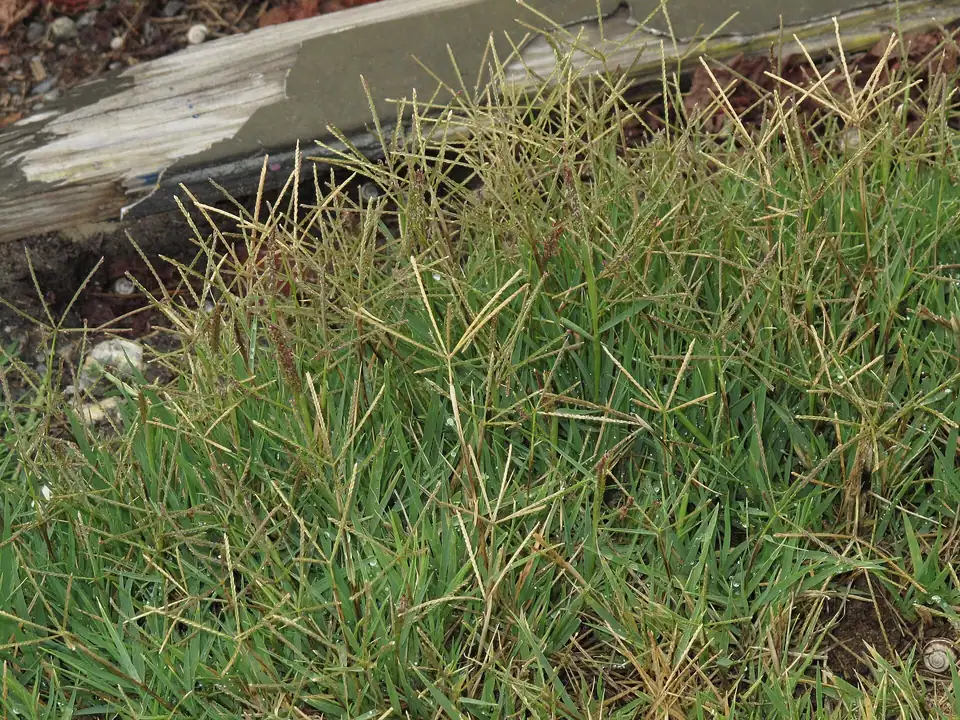

How to Grow and Care for Bermuda grass
Cynodon dactylon
Written by Emilio Marruso · last checked
At a glance
Bermuda grass is a tough perennial lawn grass that loves full sun. In normal years rainfall may be all it needs, with extra water only during drought, and you can start it from seeds, plugs, sprigs or sod. Leave the clippings on the lawn to feed it, and keep it out of flower beds, because it spreads fast.
- Sun
Full sun
What the sources say (2)
- Water
Rain may be enough in normal years; water during drought so it doesn't suffer
What the sources say (2)
Watering: Rainfall may be sufficient in normal years; irrigate during drought to prevent water stress
Naturally occurring rainfall may provide sufficient water for maintaining a healthy turfgrass in normal years, but irrigation may need to be applied to prevent plant water stress during drought periods.
— Bermudagrass [4] Watering notes: After sodding, the grass should be established in three to four weeks, after which irrigation can be as-needed
Three to four weeks after sodding, the grass should be fully established and irrigation can begin on an as-needed basis.
— ENH19 [5] - Soil
Slightly acidic to neutral soil, pH 6.0–7.0
- Spacing
Set plugs 12–24 in apart
What the sources say (3)
Spacing: 30.5-61.0 cm (12-24 in)
According to UF/IFAS Extension (plugs): Spacing of plugs varies from 12 to 24 inches apart, with the closer spacing covering in 3 to 6 months
— ENH19 [5] According to LSU AgCenter (plugs): Purchase plugs or create plugs from sod and plant each piece about 1 foot apart.
— Bermudagrass [4] Spacing of plugs varies from 12 to 24 inches apart, with the closer spacing covering in 3 to 6 months
— ENH19 [5] - Planting
Plant from spring to early summer; in warm climates, any time of year
What the sources say (3)
Planting: Spring to early summer
north Florida: in north Florida, the best time to establish bermudagrass is during the spring or early summer months.
— ENH19 [5] much of Florida: Bermudagrass can be established any time of year in much of Florida
— ENH19 [5] in north Florida, the best time to establish bermudagrass is during the spring or early summer months.
— ENH19 [5] - Feeding
Feed mid-spring to midsummer, never before the last frost; leave clippings on the lawn
What the sources say (7)
When: From mid-spring to midsummer, not before the last frost
newly planted lawns: A newly planted lawn should not be fertilized until 30–60 days after planting.
— ENH19 [5] Fertilizer should be applied from midspring to midsummer.
— Bermudagrass [4] Nitrogen applications made prior to the last frost may result in damaged turfgrass.
— ENH19 [5] Natural fertilizers: Grass clippings left on the lawn
The clippings do not contribute to thatch, and they provide supplemental sources of nutrients.
— ENH19 [5] Avoid: Nitrogen before the last frost; fertilizing a new lawn in its first 30-60 days; more than 4.88 g/m² of nitrogen per application
Nitrogen applications made prior to the last frost may result in damaged turfgrass.
— ENH19 [5] A newly planted lawn should not be fertilized until 30–60 days after planting.
— ENH19 [5] Never apply more than 1 pound of nitrogen per 1,000 square feet per application.
— Bermudagrass [4] - Watch out
Spreads fast above and below ground and is hard to remove; dig it out of beds, roots and all
- Propagation
Start it from seeds, plugs, sprigs or sod
Overview
Bermudagrass is a warm-season perennial that spreads by stolons and rhizomes. [2] It is grown as a lawn turfgrass, but common bermudagrass is often considered a weed. [4]
This record is incomplete: the sources we read do not cover every field yet.
Not yet covered by our sources: Hardiness, coldest zone, Hardiness, warmest zone, Pruning
Bermuda grass care
How to water Bermuda grass
Watering
Rainfall may be sufficient in normal years; irrigate during drought to prevent water stress
What the sources say (1)
Naturally occurring rainfall may provide sufficient water for maintaining a healthy turfgrass in normal years, but irrigation may need to be applied to prevent plant water stress during drought periods.Watering notes
After sodding, the grass should be established in three to four weeks, after which irrigation can be as-needed
What the sources say (1)
Three to four weeks after sodding, the grass should be fully established and irrigation can begin on an as-needed basis.How much light Bermuda grass needs
How much cold Bermuda grass can take
Hardiness, coldest zone
Not stated in the sources we read.
Hardiness, warmest zone
Not stated in the sources we read.
Best soil for Bermuda grass
Soil pH, minimum
6.0
What the sources say (1)
Prefers slightly acidic (< pH 7) soils, but optimal pH is between 6 and 7.Soil pH, maximum
7.0
What the sources say (1)
Prefers slightly acidic (< pH 7) soils, but optimal pH is between 6 and 7.Where to grow Bermuda grass
30.5-61.0 cm (12-24 in)
What each source says
According to UF/IFAS Extension (plugs): 30.5-61.0 cm (12-24 in)
According to LSU AgCenter (plugs): 30.5 cm (1 ft)
What the sources say (3)
According to UF/IFAS Extension (plugs): Spacing of plugs varies from 12 to 24 inches apart, with the closer spacing covering in 3 to 6 monthsAccording to LSU AgCenter (plugs): Purchase plugs or create plugs from sod and plant each piece about 1 foot apart.Spacing of plugs varies from 12 to 24 inches apart, with the closer spacing covering in 3 to 6 monthsHow to propagate Bermuda grass
How to grow Bermuda grass
The plant
Life cycle
perennial
What the sources say (1)
Common bermudagrass ( Cynodon dactylon [L.] Pers.) is a warm-season perennial turfgrassFamily
Poaceae
What the sources say (1)
Scientific Family
Poaceae
Synonyms
Capriola dactylon, Cynodon aristiglumis, Cynodon incompletus, Panicum dactylonFertilizing
When
From mid-spring to midsummer, not before the last frost
What each source says
newly planted lawns: Not until 30-60 days after planting
What the sources say (3)
newly planted lawns: A newly planted lawn should not be fertilized until 30–60 days after planting.Fertilizer should be applied from midspring to midsummer.Nitrogen applications made prior to the last frost may result in damaged turfgrass.Natural fertilizers
Grass clippings left on the lawn
What the sources say (1)
The clippings do not contribute to thatch, and they provide supplemental sources of nutrients.Mineral fertilizers
Nitrogen fertilizer, up to 14.6 g/m² of nitrogen a year and no more than 4.88 g/m² per application
What each source says
Florida lawns, per application: 2.44-4.88 g/m² of nitrogen, with no more than 3.42 g/m² as soluble nitrogen
Florida lawns, per year: 14.6-24.4 g/m² of nitrogen in North Florida, 19.5-29.3 g/m² in Central Florida, 24.4-34.2 g/m² in South Florida
What the sources say (4)
Florida lawns, per application: University of Florida recommendations call for applying ½ pound to 1 pound of nitrogen per 1000 square feet of turfgrass per application with no more than 0.7 lb of soluble N applied during any single application.Florida lawns, per year: Location1 N fertility guideline2 (lb N/1000 sq ft/year) North Florida 3–5 Central Florida 4–6 South Florida 5–7Fertilization: Fertilize with up to 3 pounds of nitrogen per 1,000 square feet per year.Never apply more than 1 pound of nitrogen per 1,000 square feet per application.Micronutrients
Iron and manganese on high-pH soils: soluble or chelated manganese, granular or foliar; iron only as a foliar spray or a granular chelate
What the sources say (3)
On high-pH (>7.0) soils or where high-pH water is applied, yellow leaf blades may be an indication of iron or manga-nese deficiency.Granular or foliar applications of soluble or chelated manganese may provide a green-up in these cases.Iron should only be applied as a foliar spray or as a granular chelate.Avoid
Nitrogen before the last frost; fertilizing a new lawn in its first 30-60 days; more than 4.88 g/m² of nitrogen per application
What the sources say (3)
Nitrogen applications made prior to the last frost may result in damaged turfgrass.A newly planted lawn should not be fertilized until 30–60 days after planting.Never apply more than 1 pound of nitrogen per 1,000 square feet per application.Signs of deficiency
Yellow leaf blades on high-pH soils or with high-pH water: iron or manganese deficiency
What the sources say (1)
On high-pH (>7.0) soils or where high-pH water is applied, yellow leaf blades may be an indication of iron or manga-nese deficiency.Signs of excess
Faster growth with more nitrogen
What the sources say (1)
Nitrogen will result in faster bermudagrass growth so applying lower nitrogen rates may be advisable.Bermuda grass pests and problems
Aggressive spread into lawns and beds
Symptom: Spreads aggressively by stolons and rhizomes and is difficult to eradicate once established
What to do: Maintain dense, healthy turf that competes with weeds; dig out small infestations in beds removing the entire root system and rhizomes
What the sources say (2)
Maintain healthy, dense turf that can compete with weeds and prevent weed germination and establishment.
— Bermudagrass (Wiregrass) | University of Maryland Extension [2] In flower/garden beds, small bermudagrass infestations can be dug out manually. You must remove the entire root system and any rhizomes.
— Bermudagrass (Wiregrass) | University of Maryland Extension [2]
Remedies
Each remedy shows what official sources say about it; traditional remedies without an official source are marked as such. Harmful ones are listed so you know to avoid them.
Treating the plant
spring dead spot
avoiding late-season nitrogen Official source, not independently tested
How: Avoid late-season nitrogen fertilizer; a balanced fertility program in early summer speeds recovery.
Balanced soil fertility programs in early summer will increase the speed of recovery and aid bermudagrass in outcompeting weed encroachment (see Fact Sheet HLA-6420 ). Avoid late season applications of nitrogen fertilizers.
— extension.okstate.edu [6] digging out small patches Official source, not independently tested
How: For small lawns, when patches are identified before they are large, symptomatic areas can be dug and the soil and plant material removed.
For small lawns and when patches are identified before they are large, symptomatic areas can be dug and the soil and plant material removed in and around the dead area.
— extension.okstate.edu [6]
Getting rid of it
bermudagrass in garden beds
clear plastic solarization Works
It is important to highlight that suboptimal solarization treatments applied in early spring during low solar radiation and low soil and air temperature can actually promote bermudagrass growth.
— ipm.ucanr.edu [7] How: Mow closely, remove the clippings and water the area well, then cover with clear UV-protected polyethylene extending about 2 feet beyond the stolons and keep it intact for 4 to 6 weeks during high solar radiation.
The plastic should extend roughly 2 feet beyond the bermudagrass stolons to make sure the infested area is covered; it must be maintained intact for 4 to 6 weeks
— ipm.ucanr.edu [7] What the evidence says Clear plastic mulching (solarization) is effective for eradication of bermudagrass if it is applied during periods of high solar radiation.
— ipm.ucanr.edu [7] black plastic mulch Works
How: Mow and irrigate the grass, place the plastic over the plants and leave it for at least 6 to 8 weeks in summer; it does not work in winter and the plastic must stay intact without holes.
To accomplish this, mow and irrigate the grass, place the plastic over the plants, and leave it for at least 6 to 8 weeks in summer.
— extension.usu.edu [8] What the evidence says Black polyethylene film applied over bermudagrass to prevent sunlight from reaching the plant can effectively control established plants.
— ipm.ucanr.edu [7] digging out Partly works
How: Small infestations in flower or garden beds can be dug out manually, removing the entire root system and any rhizomes.
In flower/garden beds, small bermudagrass infestations can be dug out manually. You must remove the entire root system and any rhizomes.
— Bermudagrass (Wiregrass) | University of Maryland Extension [2] What the evidence says Digging established bermudagrass out of a lawn is usually not practical, and rhizome fragments left behind (even when the infested sod is removed) can regrow, although usually only from pieces left within a few inches of the soil surface.
— Bermudagrass (Wiregrass) | University of Maryland Extension [2]
bermudagrass seedlings around plantings
hoeing or shallow cultivation Official source, not independently tested
How: Seedlings that germinate around ornamental plantings can be controlled with shallow cultivation, hoeing or a thin layer of mulch.
If bermudagrass seeds germinate in areas around ornamental plantings, the seedlings can be controlled with shallow cultivation, hoeing, or a thin layer of mulch.
— ipm.ucanr.edu [7]
bermudagrass seed spread
mowing before seeds mature Official source, not independently tested
How: Mowing within two weeks of seedhead emergence does not let the seed mature and reduces the risk of seed dispersal; a basket collects clippings.
Mowing within two weeks of seedhead emergence does not allow seed to mature and reduces the risk of seed dispersal
— ask.ifas.ufl.edu [9]
Calendar
Planting
Spring to early summer
What each source says
north Florida: Spring to early summer
much of Florida: Any time of year
What the sources say (3)
north Florida: in north Florida, the best time to establish bermudagrass is during the spring or early summer months.much of Florida: Bermudagrass can be established any time of year in much of Floridain north Florida, the best time to establish bermudagrass is during the spring or early summer months.Pruning
Not stated in the sources we read.
Months as given by the sources, which are mostly from the United States (northern hemisphere). In the southern hemisphere they shift by about six months.
Similar plants
- African lovegrass Eragrostis curvula
- Aristida purpurea Aristida purpurea
- Autumn Moor Grass Sesleria autumnalis
- Bamboo Phyllostachys aurea
- Beaked Panicgrass Coleataenia anceps
- Big Bluestem Andropogon gerardi
- Bigtop Lovegrass Eragrostis hirsuta
- Bitter Panicgrass Panicum amarum
Sources
Every value above is quoted from these documents. Links lead to the original publisher.
- Cynodon dactylon - Bermudagrass | Yavapai County Native and Naturalized Plants · yavapaiplants.extension.arizona.edu, consulted
- Bermudagrass (Wiregrass) | University of Maryland Extension · extension.umd.edu, consulted
- Cynodon dactylon (L.) Pers. - Herbari Virtual del Mediterrani Occidental · herbarivirtual.uib.cat, consulted
- Bermudagrass · lsuagcenter.com, consulted
- ENH19 · edis.ifas.ufl.edu, consulted
- extension.okstate.edu · extension.okstate.edu
- ipm.ucanr.edu · ipm.ucanr.edu
- extension.usu.edu · extension.usu.edu
- ask.ifas.ufl.edu · ask.ifas.ufl.edu
Written by Emilio Marruso · last checked