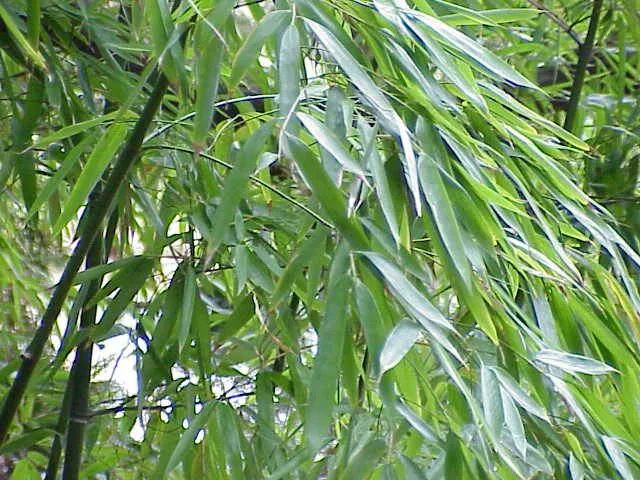


How to Grow and Care for Bamboo
Phyllostachys aurea
Written by Emilio Marruso · last checked
Not toxic to cats and dogs, according to the sources · Sources
At a glance
This bamboo grows tall, reaching 15–20 feet in full sun or partial shade. It asks for very little: a mulch of garden compost after planting, and its own fallen leaves left in place to feed it. Its young shoots are even edible, and it is safe for cats, dogs and horses. Just keep an eye on its spreading roots.
- Sun
Full sun to partial shade
What the sources say (1)
Light: Full sun to partial shade
Light: Full sun (6 or more hours of direct sunlight a day) Partial Shade (Direct sunlight only part of the day, 2-6 hours)
— Phyllostachys aurea (Bamboo, Fish Pole Bamboo, Fishpole Bamboo, Golden Bamboo) | North Carolina Extension Gardener Plant Toolbox [1] - Cold
Survives winters down to −30 °F (−34.4 °C)
Very hardy · USDA 4a · RHS H7 · Z4
What the sources say (2)
Hardiness, coldest zone: 4a [winter low −34.4 to −31.7 °C (−30 to −25 °F)]
USDA Plant Hardiness Zone: 4a, 4b, 5a, 5b, 6a, 6b, 7a, 7b, 8a, 8b, 9a, 9b, 10a, 10b
— Phyllostachys aurea (Bamboo, Fish Pole Bamboo, Fishpole Bamboo, Golden Bamboo) | North Carolina Extension Gardener Plant Toolbox [1] Hardiness, warmest zone: 10b [winter low 1.7 to 4.4 °C (35 to 40 °F)]
USDA Plant Hardiness Zone: 4a, 4b, 5a, 5b, 6a, 6b, 7a, 7b, 8a, 8b, 9a, 9b, 10a, 10b
— Phyllostachys aurea (Bamboo, Fish Pole Bamboo, Fishpole Bamboo, Golden Bamboo) | North Carolina Extension Gardener Plant Toolbox [1] - Feeding
Mulch with garden compost after planting; leave fallen leaves in place
What the sources say (2)
Natural fertilizers: Garden compost as a mulch after planting; fallen leaves left in place, as bamboo reuses their silica
Water thoroughly, then mulch the soil surface with garden compost
— [5] Don’t rake up fallen foliage, as it contains silica, which bamboo can re-use to boost its strength and stability.
— [5] - Harvest
The young shoots are edible
- Watch out
Spreads aggressively underground; cut it to the ground again and again during the growing season
- Size
15–20 ft tall and 12–25 ft wide
What the sources say (2)
Mature height: 457-610 cm (15-20 ft)
Dimensions: Height: 15 ft. 0 in. - 20 ft. 0 in. Width: 12 ft. 0 in. - 25 ft. 0 in.
— Phyllostachys aurea (Bamboo, Fish Pole Bamboo, Fishpole Bamboo, Golden Bamboo) | North Carolina Extension Gardener Plant Toolbox [1] Mature width: 366-762 cm (12-25 ft)
Dimensions: Height: 15 ft. 0 in. - 20 ft. 0 in. Width: 12 ft. 0 in. - 25 ft. 0 in.
— Phyllostachys aurea (Bamboo, Fish Pole Bamboo, Fishpole Bamboo, Golden Bamboo) | North Carolina Extension Gardener Plant Toolbox [1] - Safety
Safe for cats, dogs and horses
Overview
Golden bamboo is an invasive evergreen grass that spreads aggressively by rhizomes. [1] It grows in full sun to partial shade. [1] Young shoots are edible and the plant is tagged non-toxic for cats, dogs and horses. [1]
This record is incomplete: the sources we read do not cover every field yet.
Not yet covered by our sources: Propagation
Bamboo care
How much light Bamboo needs
Full sun to partial shade
What the sources say (1)
Light:
Full sun (6 or more hours of direct sunlight a day)
Partial Shade (Direct sunlight only part of the day, 2-6 hours)How much cold Bamboo can take
Hardiness, coldest zone
4a [winter low −34.4 to −31.7 °C (−30 to −25 °F)]
What the sources say (1)
USDA Plant Hardiness Zone:
4a, 4b, 5a, 5b, 6a, 6b, 7a, 7b, 8a, 8b, 9a, 9b, 10a, 10bHardiness, warmest zone
10b [winter low 1.7 to 4.4 °C (35 to 40 °F)]
What the sources say (1)
USDA Plant Hardiness Zone:
4a, 4b, 5a, 5b, 6a, 6b, 7a, 7b, 8a, 8b, 9a, 9b, 10a, 10bHow to propagate Bamboo
Not stated in the sources we read.
How to grow Bamboo
The plant
Life cycle
perennial
What the sources say (1)
Life Cycle:
Perennial
Country Or Region Of Origin:
China to VietnamFamily
Poaceae
What the sources say (1)
Genus:
Phyllostachys
Species:
aurea
Family:
PoaceaeMature height
457-610 cm (15-20 ft)
What the sources say (1)
Dimensions:
Height: 15 ft. 0 in. - 20 ft. 0 in.
Width: 12 ft. 0 in. - 25 ft. 0 in.Mature width
366-762 cm (12-25 ft)
What the sources say (1)
Dimensions:
Height: 15 ft. 0 in. - 20 ft. 0 in.
Width: 12 ft. 0 in. - 25 ft. 0 in.Fertilizing
When
The sources give different values depending on region, zone or growing conditions.
What each source says
on poor, light soil: Spring
in containers: During the growing season, March to October
after the whole clump has flowered: Spring, after cutting the clump back to ground level
What the sources say (3)
on poor, light soil: If grown on a poor, light soil bamboos will benefit from a general purpose granular feed in spring.in containers: When grown in containers, bamboos will require additional feeding. Apply a general liquid feed during the growing season: March to October.after the whole clump has flowered: Then in spring, cut back the clump to ground level and feed with a high-nitrogen fertiliser , such as a spring lawn feed, to encourage new growth from the base.How often
The sources give different values depending on region, zone or growing conditions.
What each source says
after the whole clump has flowered: Regularly for the rest of the growing season
What the sources say (1)
after the whole clump has flowered: If the whole clump starts flowering, allow it to do so, even if the plant looks terrible. Feed and water it regularly for the rest of the growing season.Natural fertilizers
Garden compost as a mulch after planting; fallen leaves left in place, as bamboo reuses their silica
Mineral fertilizers
The sources give different values depending on region, zone or growing conditions.
What each source says
on poor, light soil: General-purpose granular fertilizer
in containers: General liquid fertilizer
after the whole clump has flowered: High-nitrogen fertilizer to encourage new growth from the base
What the sources say (3)
on poor, light soil: If grown on a poor, light soil bamboos will benefit from a general purpose granular feed in spring.in containers: When grown in containers, bamboos will require additional feeding. Apply a general liquid feed during the growing season: March to October.after the whole clump has flowered: Then in spring, cut back the clump to ground level and feed with a high-nitrogen fertiliser , such as a spring lawn feed, to encourage new growth from the base.Bamboo pests and problems
Invasive spread
Symptom: Spreads aggressively by rhizomes and forms large stands that prevent native plants from growing.
What to do: Cut plants close to the ground repeatedly through the growing season, or replace with native plants.
What the sources say (2)
This plant spreads aggressively by rhizomes and will form large stands preventing native plants to grow.
— Phyllostachys aurea (Bamboo, Fish Pole Bamboo, Fishpole Bamboo, Golden Bamboo) | North Carolina Extension Gardener Plant Toolbox [1] Mechanical Cutting and mowing can be used on small infestations or where herbicides cannot be used. Cut plants as close to the ground as possible. Repeat several times throughout the growing season as plants resprout.
— | Center for Aquatic and Invasive Plants | University of Florida, IFAS [4]
Remedies
Each remedy shows what official sources say about it; traditional remedies without an official source are marked as such. Harmful ones are listed so you know to avoid them.
Treating the plant
invasive spread
buried root barrier Works
How: Trench around the grove and install a barrier, leaving about 2 inches above the soil so rhizomes do not grow over the top.
The easiest way to prevent unwanted bamboo growth is to install a root barrier between the bamboo grove and the bamboo-free zone.
— extension.oregonstate.edu [6] What the evidence says The easiest way to prevent unwanted bamboo growth is to install a root barrier between the bamboo grove and the bamboo-free zone.
— extension.oregonstate.edu [6]
Getting rid of it
invasive spread
repeated cutting or mowing of regrowth Partly works
How: Cut or mow plants as close to the ground as possible and repeat several times throughout the season until the energy reserves in the rhizomes are depleted.
Cut or mow plants as close to the ground as possible. Repeat several times throughout season until energy reserves in the rhizomes are depleted.
— piedmontmastergardeners.org [7] What the evidence says Bamboo can be controlled in a small area by mowing or stepping on the young shoots.
— extension.oregonstate.edu [6] digging out the rhizomes by hand Not verified
Traditional remedy, not verified by an official source.
How: Hand pull or dig up all the rhizomes and seedlings; pull up rhizomes in spring when the soil is moist.
cutting rhizomes with a spade or saw Official source, not independently tested
How: Cut the connecting rhizomes with a spade or a saw every year; on old growth use a mattock or digging bar the first time.
Cutting rhizomes with a spade or a saw will do the trick if you do it every year.
— depts.washington.edu [8] high-strength vinegar-based products Official source, not independently tested
use extreme caution with these, even though they are ‘natural,’ as they are still quite hazardous
— depts.washington.edu [8] How: Mentioned as a possible option together with sheet mulching.
using high-strength vinegar-based products (use extreme caution with these, even though they are ‘natural,’ as they are still quite hazardous) might help.
— depts.washington.edu [8]
Is Bamboo poisonous?
Reported by the source, quoted verbatim. This is not medical or veterinary advice: if a person or an animal may have eaten this plant, contact a poison control centre or a veterinarian.
#non-toxic for cats #non-toxic for horses #non-toxic for dogs
[1]The source flags the risk for this animal but does not explain why.
Edibility
Reported by the source, quoted verbatim. Do not eat a plant on the basis of this page alone: identification mistakes can be dangerous.
Country Or Region Of Origin: China to Vietnam Edibility: Young shoots are edible
[1]
Similar plants
- Yellow Groove Phyllostachys aureosulcata
- Black bamboo Phyllostachys nigra
- Tortoise shell bamboo Phyllostachys edulis
- African lovegrass Eragrostis curvula
- Aristida purpurea Aristida purpurea
- Autumn Moor Grass Sesleria autumnalis
- Beaked Panicgrass Coleataenia anceps
- Bermuda grass Cynodon dactylon
Sources
Every value above is quoted from these documents. Links lead to the original publisher.
- Phyllostachys aurea (Bamboo, Fish Pole Bamboo, Fishpole Bamboo, Golden Bamboo) | North Carolina Extension Gardener Plant Toolbox · plants.ces.ncsu.edu, consulted
- Fish Pole Bamboo - Phyllostachys aurea | North Carolina Extension Gardener Plant Toolbox · plants.ces.ncsu.edu, consulted
- Fishpole Bamboo - Phyllostachys aurea | North Carolina Extension Gardener Plant Toolbox · plants.ces.ncsu.edu, consulted
- | Center for Aquatic and Invasive Plants | University of Florida, IFAS · plant-directory.ifas.ufl.edu, consulted
- rhs.org.uk · rhs.org.uk
- extension.oregonstate.edu · extension.oregonstate.edu
- piedmontmastergardeners.org · piedmontmastergardeners.org
- depts.washington.edu · depts.washington.edu
Written by Emilio Marruso · last checked