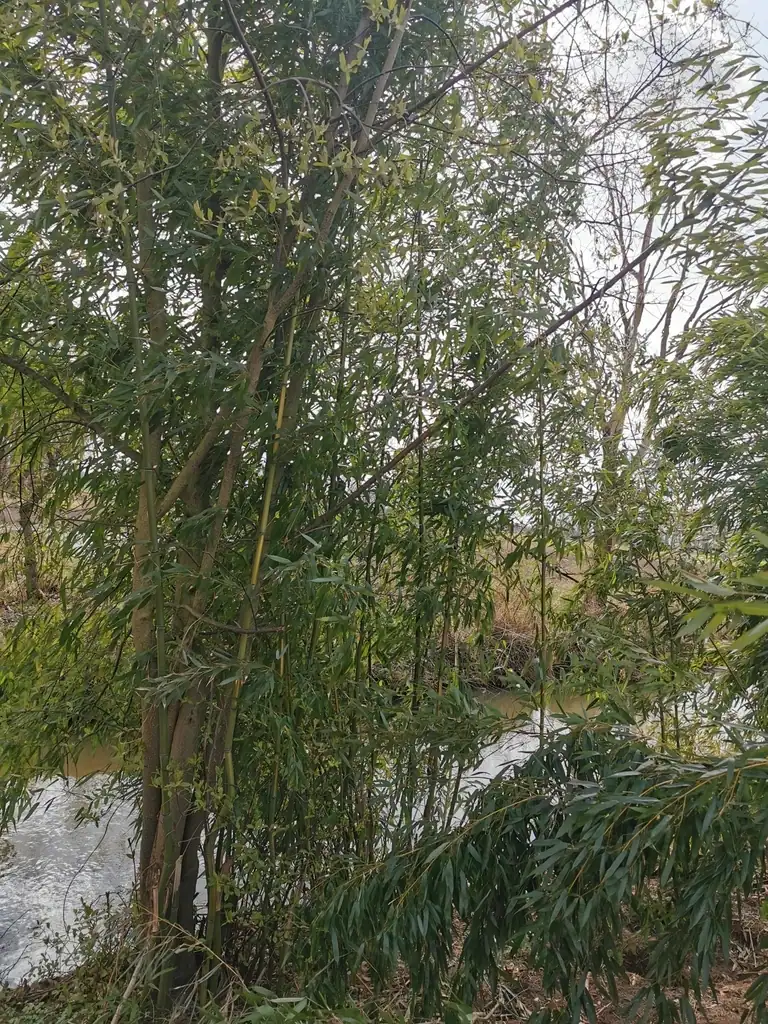
How to Grow and Care for Yellow Groove
Phyllostachys aureosulcata
Written by Emilio Marruso · last checked
At a glance
This bamboo is a tough perennial grass that loves full sun, shrugs off drought and grows 12–18 ft tall. It asks for little: a compost mulch and its own fallen leaves keep it fed. But think twice before planting it: it is a running bamboo that spreads quickly into dense stands, so a clumping bamboo is a much safer choice.
- Sun
Full sun
What the sources say (1)
Light: Full sun
Light: Full sun (6 or more hours of direct sunlight a day) Soil Texture:
— Phyllostachys aureosulcata (Yellow Groove, Yellow Groove Bamboo) | North Carolina Extension Gardener Plant Toolbox [1] - Water
Handles drought well
What the sources say (1)
Watering: Drought tolerant
Resistance To Challenges: Black Walnut Drought Pollution Problems:
— Phyllostachys aureosulcata (Yellow Groove, Yellow Groove Bamboo) | North Carolina Extension Gardener Plant Toolbox [1] - Cold
Survives winters down to −30 °F (−34.4 °C)
Very hardy · USDA 4a · RHS H7 · Z4
What the sources say (2)
Hardiness, coldest zone: 4a [winter low −34.4 to −31.7 °C (−30 to −25 °F)]
USDA Plant Hardiness Zone: 4a, 4b, 5a, 5b, 6a, 6b, 7a, 7b, 8a, 8b, 9a, 9b, 10a, 10b, 11a, 11b
— Phyllostachys aureosulcata (Yellow Groove, Yellow Groove Bamboo) | North Carolina Extension Gardener Plant Toolbox [1] Hardiness, warmest zone: 11b [winter low 7.2 to 10 °C (45 to 50 °F)]
USDA Plant Hardiness Zone: 4a, 4b, 5a, 5b, 6a, 6b, 7a, 7b, 8a, 8b, 9a, 9b, 10a, 10b, 11a, 11b
— Phyllostachys aureosulcata (Yellow Groove, Yellow Groove Bamboo) | North Carolina Extension Gardener Plant Toolbox [1] - Feeding
Spread compost as a mulch after planting and leave fallen leaves in place
What the sources say (2)
Natural fertilizers: Garden compost as a mulch after planting; fallen leaves left in place, as bamboo reuses their silica
Water thoroughly, then mulch the soil surface with garden compost
— [2] Don’t rake up fallen foliage, as it contains silica, which bamboo can re-use to boost its strength and stability.
— [2] - Watch out
Spreads fast and crowds out other plants: better not to plant it; choose a clumping bamboo
- Size
12–18 ft tall and 12–25 ft wide
What the sources say (2)
Mature height: 366-549 cm (12-18 ft)
Height: 12 ft. 0 in. - 18 ft. 0 in. Width: 12 ft. 0 in. - 25 ft. 0 in.
— Phyllostachys aureosulcata (Yellow Groove, Yellow Groove Bamboo) | North Carolina Extension Gardener Plant Toolbox [1] Mature width: 366-762 cm (12-25 ft)
Height: 12 ft. 0 in. - 18 ft. 0 in. Width: 12 ft. 0 in. - 25 ft. 0 in.
— Phyllostachys aureosulcata (Yellow Groove, Yellow Groove Bamboo) | North Carolina Extension Gardener Plant Toolbox [1]
Overview
Yellow groove bamboo is a running type of bamboo with very invasive tendencies. [1] It is listed as invasive in several mid and eastern US states. [1] It is classed as drought tolerant and grows in full sun. [1]
This record is incomplete: the sources we read do not cover every field yet.
Not yet covered by our sources: Propagation
Yellow Groove care
How to water Yellow Groove
Drought tolerant
What the sources say (1)
Resistance To Challenges:
Black Walnut
Drought
Pollution
Problems:How much light Yellow Groove needs
Full sun
What the sources say (1)
Light:
Full sun (6 or more hours of direct sunlight a day)
Soil Texture:How much cold Yellow Groove can take
Hardiness, coldest zone
4a [winter low −34.4 to −31.7 °C (−30 to −25 °F)]
What the sources say (1)
USDA Plant Hardiness Zone:
4a, 4b, 5a, 5b, 6a, 6b, 7a, 7b, 8a, 8b, 9a, 9b, 10a, 10b, 11a, 11bHardiness, warmest zone
11b [winter low 7.2 to 10 °C (45 to 50 °F)]
What the sources say (1)
USDA Plant Hardiness Zone:
4a, 4b, 5a, 5b, 6a, 6b, 7a, 7b, 8a, 8b, 9a, 9b, 10a, 10b, 11a, 11bHow to propagate Yellow Groove
Not stated in the sources we read.
How to grow Yellow Groove
The plant
Life cycle
perennial
What the sources say (1)
Family:
Poaceae
Life Cycle:
Perennial
Country Or Region Of Origin:
Northeastern ChinaFamily
Poaceae
What the sources say (1)
Family:
Poaceae
Life Cycle:
Perennial
Country Or Region Of Origin:
Northeastern ChinaMature height
366-549 cm (12-18 ft)
What the sources say (1)
Height: 12 ft. 0 in. - 18 ft. 0 in.
Width: 12 ft. 0 in. - 25 ft. 0 in.Mature width
366-762 cm (12-25 ft)
What the sources say (1)
Height: 12 ft. 0 in. - 18 ft. 0 in.
Width: 12 ft. 0 in. - 25 ft. 0 in.Fertilizing
When
The sources give different values depending on region, zone or growing conditions.
What each source says
on poor, light soil: Spring
in containers: During the growing season, March to October
after the whole clump has flowered: Spring, after cutting the clump back to ground level
What the sources say (3)
on poor, light soil: If grown on a poor, light soil bamboos will benefit from a general purpose granular feed in spring.in containers: When grown in containers, bamboos will require additional feeding. Apply a general liquid feed during the growing season: March to October.after the whole clump has flowered: Then in spring, cut back the clump to ground level and feed with a high-nitrogen fertiliser , such as a spring lawn feed, to encourage new growth from the base.How often
The sources give different values depending on region, zone or growing conditions.
What each source says
after the whole clump has flowered: Regularly for the rest of the growing season
What the sources say (1)
after the whole clump has flowered: If the whole clump starts flowering, allow it to do so, even if the plant looks terrible. Feed and water it regularly for the rest of the growing season.Natural fertilizers
Garden compost as a mulch after planting; fallen leaves left in place, as bamboo reuses their silica
Mineral fertilizers
The sources give different values depending on region, zone or growing conditions.
What each source says
on poor, light soil: General-purpose granular fertilizer
in containers: General liquid fertilizer
after the whole clump has flowered: High-nitrogen fertilizer to encourage new growth from the base
What the sources say (3)
on poor, light soil: If grown on a poor, light soil bamboos will benefit from a general purpose granular feed in spring.in containers: When grown in containers, bamboos will require additional feeding. Apply a general liquid feed during the growing season: March to October.after the whole clump has flowered: Then in spring, cut back the clump to ground level and feed with a high-nitrogen fertiliser , such as a spring lawn feed, to encourage new growth from the base.Yellow Groove pests and problems
Invasive spread
Symptom: Running bamboo with very invasive tendencies, spreading quickly to form dense stands that prevent native plants from growing.
What to do: Should not be planted; clumping bamboos are described as much safer to plant.
What the sources say (2)
This plant is an invasive species and should not be planted.
— Phyllostachys aureosulcata (Yellow Groove, Yellow Groove Bamboo) | North Carolina Extension Gardener Plant Toolbox [1] There are bamboos that do not have running rhizomes and are called clumping bamboo. These are much safer to plant.
— Phyllostachys aureosulcata (Yellow Groove, Yellow Groove Bamboo) | North Carolina Extension Gardener Plant Toolbox [1]
Remedies
Each remedy shows what official sources say about it; traditional remedies without an official source are marked as such. Harmful ones are listed so you know to avoid them.
Treating the plant
spider mites
hose water spray Not verified
Traditional remedy, not verified by an official source.
How: Spray affected foliage with water using a high, concentrated setting on the garden hose nozzle.
neem oil spray Not verified
Traditional remedy, not verified by an official source.
How: Spray neem oil on the tops and undersides of the leaves every seven to 14 days for light infestation and every five to seven days for heavier populations.
Getting rid of it
running bamboo
repeated cutting of shoots Works
An intensive effort over multiple years will be required to completely eradicate bamboo.
— extension.oregonstate.edu [4] How: Regularly cut bamboo shoots down to ground level to deplete the energy stored in the roots over time.
Regularly cut bamboo shoots down to the ground level. This helps to deplete the energy stored in the roots over time.
— ask.extension.org [3] What the evidence says Regularly cut bamboo shoots down to the ground level. This helps to deplete the energy stored in the roots over time.
— ask.extension.org [3] digging out rhizomes Works
How: Dig up the shoots and as much of the rhizomes as possible, deep and wide.
Dig deep (at least 2 feet) and wide to ensure you remove all the rhizomes, as any remaining parts can regrow.
— ask.extension.org [3] What the evidence says Dig deep (at least 2 feet) and wide to ensure you remove all the rhizomes, as any remaining parts can regrow.
— ask.extension.org [3] mowing young shoots Partly works
How: Regularly mow the area to weaken the bamboo and prevent robust regrowth.
regularly mow the area. This can weaken the bamboo and prevent it from growing back robustly.
— ask.extension.org [3] What the evidence says Bamboo can be controlled in a small area by mowing or stepping on the young shoots.
— extension.oregonstate.edu [4] cutting down, watering and cutting again Official source, not independently tested
How: Cut the grove to the ground, water and fertilize to cause new growth, then cut it down again.
Water and fertilize the area, to cause new growth. - Cut it down again. And again.
— depts.washington.edu [5]
Indicative values
Values from a secondary source, not checked word for word like the rest of this page. Use them as a starting point.
- Hours of sun
- 6-8 hoursIndicative value, adapt it to your climate · Secondary source
- Drought tolerant
- yesIndicative value, adapt it to your climate · Secondary source
- Soil pH
- 6-6.5Indicative value, adapt it to your climate · Secondary source
- Care level
- MediumIndicative value, adapt it to your climate · Secondary source
- Growth rate
- HighIndicative value, adapt it to your climate · Secondary source
- Pruning
- March, April, August, December, January, FebruaryIndicative value, adapt it to your climate · Secondary source
- Propagation
- Division, Cutting, Seed Propagation, Layering PropagationIndicative value, adapt it to your climate · Secondary source
Similar plants
- Bamboo Phyllostachys aurea
- Black bamboo Phyllostachys nigra
- Tortoise shell bamboo Phyllostachys edulis
- African lovegrass Eragrostis curvula
- Aristida purpurea Aristida purpurea
- Autumn Moor Grass Sesleria autumnalis
- Beaked Panicgrass Coleataenia anceps
- Bermuda grass Cynodon dactylon
Sources
Every value above is quoted from these documents. Links lead to the original publisher.
- Phyllostachys aureosulcata (Yellow Groove, Yellow Groove Bamboo) | North Carolina Extension Gardener Plant Toolbox · plants.ces.ncsu.edu, consulted
- rhs.org.uk · rhs.org.uk
- ask.extension.org · ask.extension.org
- extension.oregonstate.edu · extension.oregonstate.edu
- depts.washington.edu · depts.washington.edu
Written by Emilio Marruso · last checked