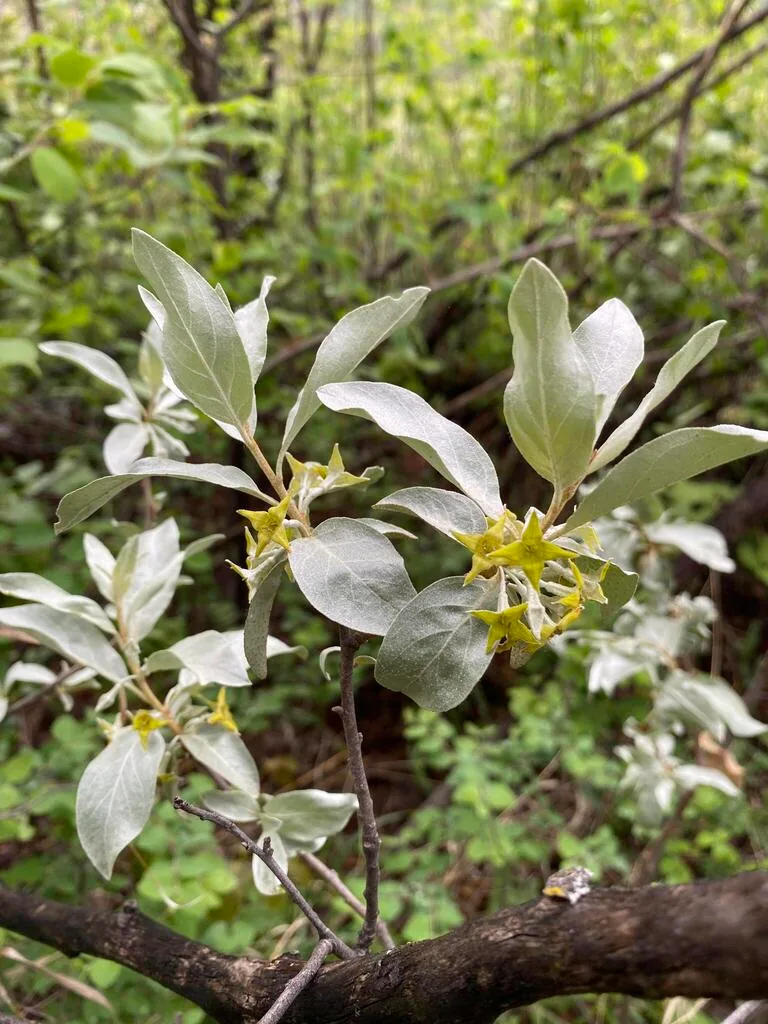
How to Grow and Care for Silverberry
Elaeagnus commutata
Written by Emilio Marruso · last checked
At a glance
Silverberry is an easygoing plant that shrugs off drought and asks only for moisture deep in the soil, never soggy ground. You can start new plants in many ways: from seed, from cuttings, by rooting a stem or by splitting off the shoots that rise from its roots. Its fruit can even be eaten raw or cooked, though it is on the dry, mealy side.
- Water
Handles drought; likes moisture deep down, but never soggy ground
- Cold
Survives winters down to −50 °F (−45.6 °C)
Very hardy · USDA 2 · RHS H7 · Z2
What the sources say (1)
Hardiness, coldest zone: 2 [winter low −45.6 to −40 °C (−50 to −40 °F)]
Hardiness: Zone 2
— Silverberry | NDSU Agriculture [3] - Harvest
The fruit can be eaten raw or cooked, but it is dry and mealy
- Propagation
From seed, cuttings, rooting a bent-down stem, or splitting off shoots that grow from the roots
What the sources say (3)
Propagation: Seed; cuttings; layering; division of suckers
Seed - best sown as soon as it is ripe in a cold frame
— Silverberry (Elaeagnus commutata) — Practical Plants [5] Division of suckers during the dormant season
— Silverberry (Elaeagnus commutata) — Practical Plants [5] Propagation: Seed or occasionally cutting
— Silver Berry (Elaeagnus commutata) [7]
Overview
Silverberry is a deciduous shrub with silvery leaves that spreads by suckers. [3] It is very hardy and drought tolerant, and is sometimes used in windbreaks. [3]
This record is incomplete: the sources we read do not cover every field yet.
Not yet covered by our sources: Light, Hardiness, warmest zone, Pruning
Silverberry care
How to water Silverberry
Watering
Drought tolerant
What the sources say (1)
Drought tolerant.Watering notes
Prefers subsoil moisture as opposed to waterlogged sites
What the sources say (1)
Prefers subsoil moisture as opposed to waterlogged sites.How much light Silverberry needs
Not stated in the sources we read.
How much cold Silverberry can take
Hardiness, coldest zone
2 [winter low −45.6 to −40 °C (−50 to −40 °F)]
What the sources say (1)
Hardiness: Zone 2Hardiness, warmest zone
Not stated in the sources we read.
How to propagate Silverberry
Seed; cuttings; layering; division of suckers
What the sources say (3)
Seed - best sown as soon as it is ripe in a cold frameDivision of suckers during the dormant seasonPropagation: Seed or occasionally cuttingHow to grow Silverberry
The plant
Family
Elaeagnaceae
What the sources say (1)
Scientific Name: Elaeagnus commutata Family: Elaeagnaceae (Oleaster) Hardiness: Zone 2Remedies
The sources we checked give no remedies for this plant.
Calendar
Pruning
Not stated in the sources we read.
Months as given by the sources, which are mostly from the United States (northern hemisphere). In the southern hemisphere they shift by about six months.
Edibility
Reported by the source, quoted verbatim. Do not eat a plant on the basis of this page alone: identification mistakes can be dangerous.
Indicative values
Values from a secondary source, not checked word for word like the rest of this page. Use them as a starting point.
- Life cycle
- PerennialIndicative value, adapt it to your climate · Secondary source
- Light
- Full sun Partial sunIndicative value, adapt it to your climate · Secondary source
- Drought tolerant
- yesIndicative value, adapt it to your climate · Secondary source
- Soil
- Sandy, Loamy, Clay, RockyIndicative value, adapt it to your climate · Secondary source
- Soil pH
- 6-8Indicative value, adapt it to your climate · Secondary source
- Care level
- MediumIndicative value, adapt it to your climate · Secondary source
- Growth rate
- ModerateIndicative value, adapt it to your climate · Secondary source
- Pruning
- February, March, AprilIndicative value, adapt it to your climate · Secondary source
- Pests
- Drought resistantIndicative value, adapt it to your climate · Secondary source
Similar plants
- Autumn Olive Elaeagnus umbellata
- Elaeagnus ebbingei Elaeagnus ebbingei
- Russian Olive Elaeagnus angustifolia
- Thorny Olive Elaeagnus pungens
- Cherry silverberry Elaeagnus multiflora
- Elaeagnus macrophylla Elaeagnus macrophylla
- Russet buffaloberry Shepherdia canadensis
- Seaberry Hippophae rhamnoides
Sources
Every value above is quoted from these documents. Links lead to the original publisher.
- Elaeagnus commutata (Silverberry): Minnesota Wildflowers · minnesotawildflowers.info, consulted
- Elaeagnus commutata - Trees and Shrubs Online · treesandshrubsonline.org, consulted
- Silverberry | NDSU Agriculture · ndsu.edu, consulted
- Virginia Tech Dendrology Fact Sheet · dendro.cnre.vt.edu, consulted
- Silverberry (Elaeagnus commutata) — Practical Plants · practicalplants.org, consulted
- Elaeagnus commutata - Useful Temperate Plants · temperate.theferns.info, consulted
- Silver Berry (Elaeagnus commutata) · desert-tropicals.com, consulted
Written by Emilio Marruso · last checked