
How to Grow and Care for Meadow Crane's-bill
Geranium pratense
Written by Emilio Marruso · last checked
Toxic to: Cats, Dogs, Birds · Why
At a glance
Meadow cranesbill is a perennial that settles happily into almost any soil, as long as it isn't boggy. Plant it anytime from May to September, give it moderate watering, and cut it back between September and November. It's easy to share, too: divide clumps in spring or fall, and relax, since no toxicity to cats or dogs has been reported.
- Water
Moderate watering; avoid boggy, soggy spots
What the sources say (3)
Watering: Moderate
Light full sun Shade tolerance no shade Water moderate Hardiness Zone 5+
— Meadow Crane's Bill (Geranium pratense) — Practical Plants [6] Watering notes: Drought intolerant; thrives in most soils except boggy ones
Soil pH acid, neutral, alkaline Tolerates Nutritionally Poor Soil No Drought intolerant
— Meadow Crane's Bill (Geranium pratense) — Practical Plants [6] Trouble-free, Geranium pratense thrives in most soils, except boggy ones.
— Geranium pratense | BBC Gardeners World Magazine [4] - Cold
Survives winters down to −20 °F (−28.9 °C)
Very hardy · USDA 5 · RHS H7 · Z5
What the sources say (1)
Hardiness, coldest zone: 5 [winter low −28.9 to −23.3 °C (−20 to −10 °F)]
Light full sun Shade tolerance no shade Water moderate Hardiness Zone 5+
— Meadow Crane's Bill (Geranium pratense) — Practical Plants [6] - Soil
Grows in most soils, pH 5.5–7.5, but not in boggy ground
What the sources say (8)
Soil pH, minimum: 5.5
Swedish vascular plants compilation: Tyler et al. (2020) categorise G. pratense as occurring on soils that are subneutral to circumneutral with pH ranging from 5.5 to 7.5.
— Received: 22 March 2023 | Accepted: 2 September 2023 [1] northern England, 13 populations (2020): In a sample of 13 G. pratense populations from sites in northern England from 2020, soil pH ranged from 6.3 to 7.0 with a mean of 6.7
— Received: 22 March 2023 | Accepted: 2 September 2023 [1] Tyler et al. (2020) categorise G. pratense as occurring on soils that are subneutral to circumneutral with pH ranging from 5.5 to 7.5.
— Received: 22 March 2023 | Accepted: 2 September 2023 [1] Soil pH, maximum: 7.5
Swedish vascular plants compilation: Tyler et al. (2020) categorise G. pratense as occurring on soils that are subneutral to circumneutral with pH ranging from 5.5 to 7.5.
— Received: 22 March 2023 | Accepted: 2 September 2023 [1] northern England, 13 populations (2020): In a sample of 13 G. pratense populations from sites in northern England from 2020, soil pH ranged from 6.3 to 7.0 with a mean of 6.7
— Received: 22 March 2023 | Accepted: 2 September 2023 [1] Tyler et al. (2020) categorise G. pratense as occurring on soils that are subneutral to circumneutral with pH ranging from 5.5 to 7.5.
— Received: 22 March 2023 | Accepted: 2 September 2023 [1] Watering notes: Drought intolerant; thrives in most soils except boggy ones
Soil pH acid, neutral, alkaline Tolerates Nutritionally Poor Soil No Drought intolerant
— Meadow Crane's Bill (Geranium pratense) — Practical Plants [6] Trouble-free, Geranium pratense thrives in most soils, except boggy ones.
— Geranium pratense | BBC Gardeners World Magazine [4] - Planting
Plant from May to September
What the sources say (4)
Planting: May-September
According to BBC Gardeners' World Magazine: | | Jan | Feb | Mar | Apr | May | Jun | Jul | Aug | Sep | Oct | Nov | Dec | Plant | | | | | yes | yes | yes | yes | yes | | |
— Geranium pratense | BBC Gardeners World Magazine [4] seedlings raised in a cold frame: Seed - sow spring in a cold frame. When they are large enough to handle, prick the seedlings out into individual pots and plant them out in the summer.
— Meadow Crane's Bill (Geranium pratense) — Practical Plants [6] small divisions grown on in a cold frame: it is best to pot up smaller clumps and grow them on in a cold frame until they are rooting well. Plant them out in the spring.
— Meadow Crane's Bill (Geranium pratense) — Practical Plants [6] | | Jan | Feb | Mar | Apr | May | Jun | Jul | Aug | Sep | Oct | Nov | Dec | Plant | | | | | yes | yes | yes | yes | yes | | |
— Geranium pratense | BBC Gardeners World Magazine [4] - Pruning
Cut back from September to November
What the sources say (1)
Pruning: September-November
| Divide | | | yes | yes | yes | | | | yes | yes | yes | | Prune | | | | | | | | | yes | yes | yes |
— Geranium pratense | BBC Gardeners World Magazine [4] - Pests
Aphids, sawflies and weevils; also downy mildew, rust and powdery mildew
What the sources say (5)
Pests: beetles (incl. the weevil Zacladus geranii), micromoths, butterfly larvae, sawfly, gall midge, aphid
Eleven insect species have been recorded as feeding on G. pratense, including three bee-tles, four micromoths and one species each of butterfly, sawfly, gall midge and aphid.
— Received: 22 March 2023 | Accepted: 2 September 2023 [1] Close up of the flower showing a pair of the weevil Zacladus geranii that is confined to feeding on larger species of Geranium
— Received: 22 March 2023 | Accepted: 2 September 2023 [1] Diseases: downy mildew (Plasmopara pusilla), rust (Uromyces geranii), powdery mildew (Podosphaera fugax)
Plasmopara pusilla (de Bary) Schröter is a downy mildew found on the leaves of G. pratense
— Received: 22 March 2023 | Accepted: 2 September 2023 [1] Uromyces geranii (DC.) Fr. Is an oligophagous rust fungus that occurs on the abaxial surface of the leaves of various Geranium spe-cies including G. pratense
— Received: 22 March 2023 | Accepted: 2 September 2023 [1] also lists the oligophagous powdery mil-dew Podosphaera fugax (Penz. & Sacc.) U. Braun & S. Takam as form-ing hypophyllous colonies on the leaves of G. pratense.
— Received: 22 March 2023 | Accepted: 2 September 2023 [1] - Size
Stems 12–31 inches tall
What the sources say (1)
Mature height: 30–80 cm [12–31 in] stems (range 10–130 cm [4–51 in])
Stem (10)30–80(130) cm, pale green, erect or as-cending
— Received: 22 March 2023 | Accepted: 2 September 2023 [1] - Propagation
From seed, or divide clumps March–May or September–November
What the sources say (4)
Propagation: Seed; division
According to BBC Gardeners' World Magazine (division months): | Divide | | | yes | yes | yes | | | | yes | yes | yes | | Prune | | | | | | | | | yes | yes | yes |
— Geranium pratense | BBC Gardeners World Magazine [4] Division in spring or autumn. Larger clumps can be replanted direct into their permanent positions
— Meadow Crane's Bill (Geranium pratense) — Practical Plants [6] When the clump gets too large, simply lift the plant in spring and divide into smaller pieces.
— Geranium pratense | BBC Gardeners World Magazine [4] Reproduction of G. pratense is principally by seed. Plants grown in gardens often begin to flower and set seed from the second year onward
— Received: 22 March 2023 | Accepted: 2 September 2023 [1] - Sowing
Sow in spring in a cold frame; nick the seed coat and seeds sprout in 2–5 days
What the sources say (5)
Sowing: Spring, in a cold frame
Seed - sow spring in a cold frame. When they are large enough to handle, prick the seedlings out into individual pots and plant them out in the summer.
— Meadow Crane's Bill (Geranium pratense) — Practical Plants [6] Scarification: Fresh seed has physical dormancy, removed at once by mechanically scarifying the seed coat (perforating the testa, for example with a scalpel)
Alleviation of the physical seed dormancy of G. pratense can be instantly achieved by mechanical scarification of the seed coat, that is, by perforating the testa, for example with a scalpel
— Received: 22 March 2023 | Accepted: 2 September 2023 [1] Germination: After scarification half of the germination occurs in 2-5 days; unscarified seed stored dry at 5 °C [41 °F] needs 27-43 days for half of its germination
laboratory study (Grime et al. 1981): In their study, at least 50% of maximum germination was observed for constant tem-peratures ranging from 6°C to 33°C.
— Received: 22 March 2023 | Accepted: 2 September 2023 [1] laboratory study (Van Assche & Vandelook 2006): a constant temperature of 23°C resulted in much more rapid and complete germination of scarified fresh seeds and of seeds scar-ified after 3 months of dry storage, compared with lower constant temperatures of 10°C or 5°C.
— Received: 22 March 2023 | Accepted: 2 September 2023 [1] After seed scarification, 50% of observed germination occurred after just 2 to 5 days, whereas in unscarified seeds that had been stored dry at 5°C, 27 to 43 days were required
— Received: 22 March 2023 | Accepted: 2 September 2023 [1] - Safety
No toxicity reported for cats or dogs
Overview
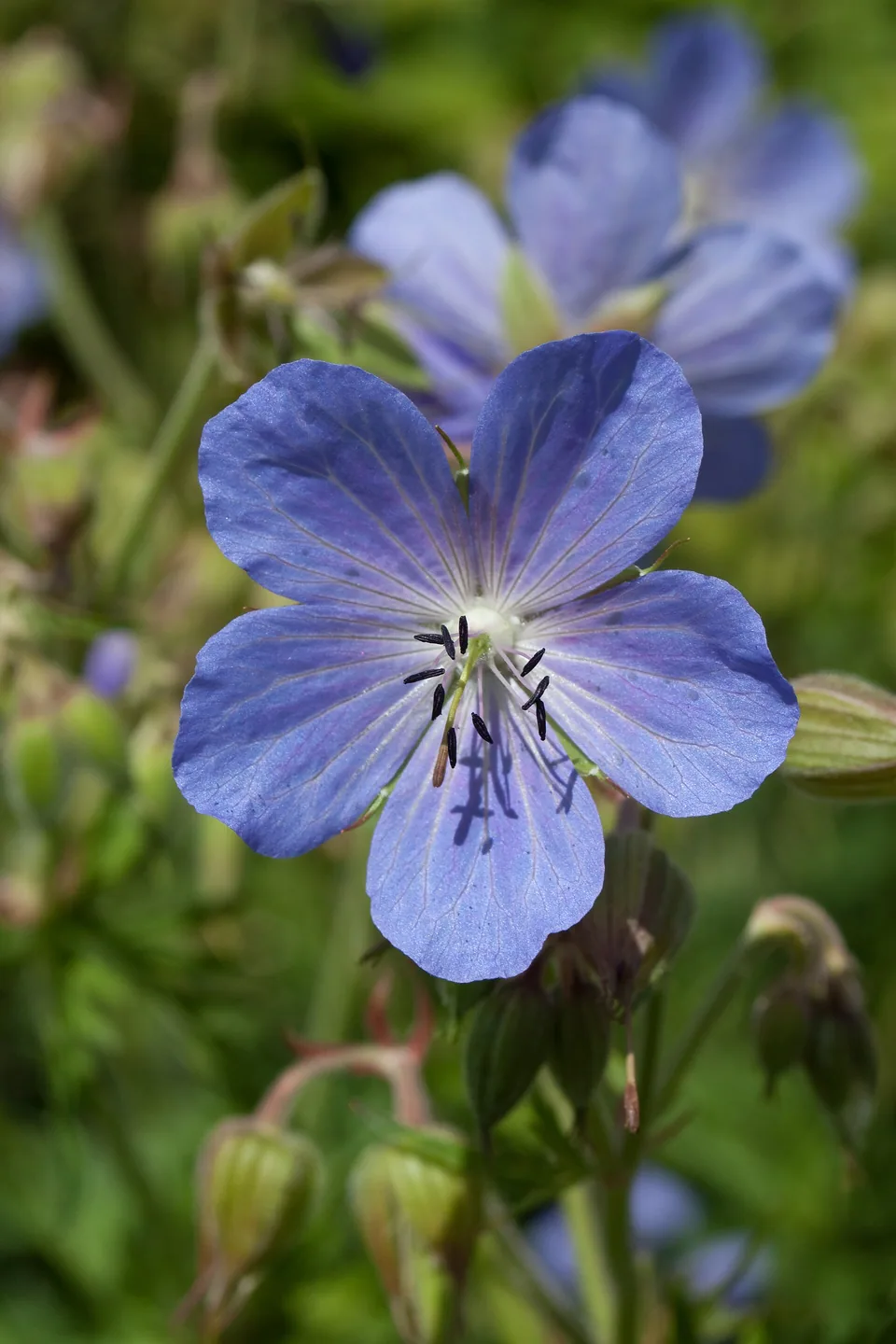
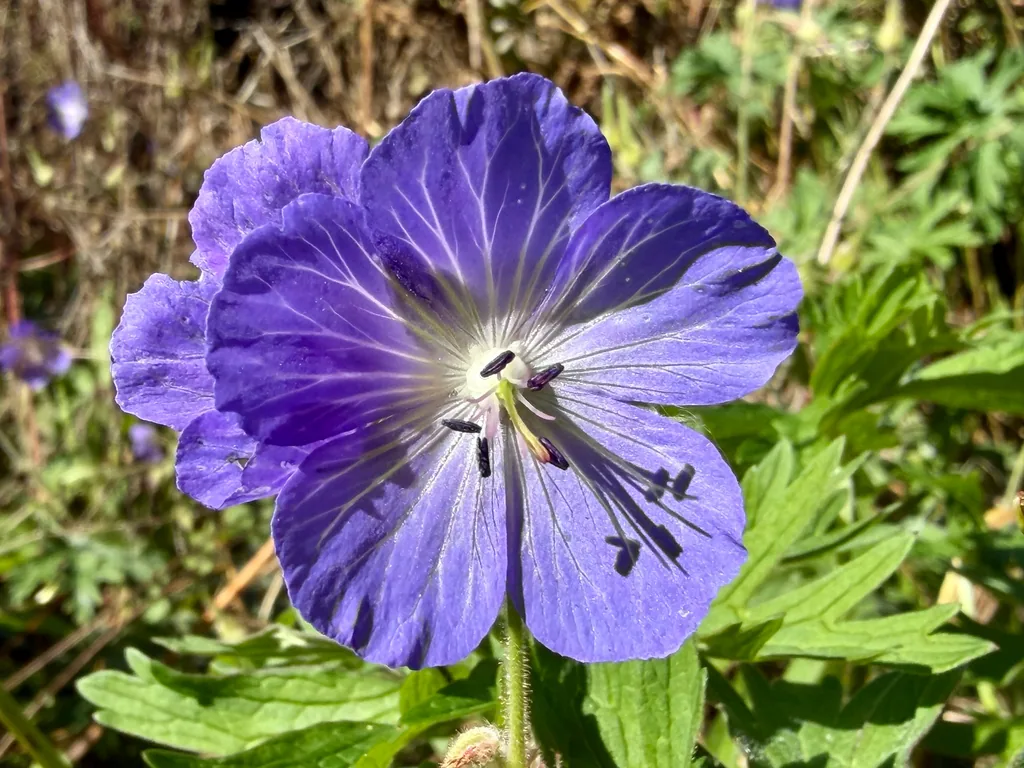
Meadow cranesbill is a perennial forb of neutral grassland native to Europe and Asia, also grown in gardens for its white, blue or violet saucer-shaped flowers. [1][4] It grows in most soils except boggy ones, and large clumps can be lifted and divided in spring. [4] In the wild it usually occurs on free-draining, often nutrient-rich soils that are weakly acidic to weakly alkaline. [1]
This record is incomplete: the sources we read do not cover every field yet.
Not yet covered by our sources: Hardiness, warmest zone
Meadow Crane's-bill care
How to water Meadow Crane's-bill
Watering
Moderate
What the sources say (1)
Light
full sun
Shade tolerance
no shade
Water
moderate
Hardiness
Zone 5+Watering notes
Drought intolerant; thrives in most soils except boggy ones
What the sources say (2)
Soil pH
acid, neutral, alkaline
Tolerates Nutritionally Poor Soil
No
Drought
intolerantTrouble-free, Geranium pratense thrives in most soils, except boggy ones.How much light Meadow Crane's-bill needs
The sources give different values depending on region, zone or growing conditions.
What each source says
According to BBC Gardeners' World Magazine: Dappled shade, full shade, full sun, partial shade
According to Practical Plants (PFAF notes): Full sun, no shade
What the sources say (2)
According to BBC Gardeners' World Magazine: Sun Exposure:
Dappled shade, full shade, full sun, partial shade
|
Aspect:
East facing, north facing, south facing, west facingAccording to Practical Plants (PFAF notes): Light
full sun
Shade tolerance
no shade
Water
moderate
Hardiness
Zone 5+How much cold Meadow Crane's-bill can take
Hardiness, coldest zone
5 [winter low −28.9 to −23.3 °C (−20 to −10 °F)]
What the sources say (1)
Light
full sun
Shade tolerance
no shade
Water
moderate
Hardiness
Zone 5+Hardiness, warmest zone
Not stated in the sources we read.
Best soil for Meadow Crane's-bill
Soil pH, minimum
5.5
What each source says
Swedish vascular plants compilation: 5.5-7.5
northern England, 13 populations (2020): 6.3-7.0
What the sources say (3)
Swedish vascular plants compilation: Tyler et al. (2020) categorise G. pratense as occurring on soils that are subneutral to circumneutral with pH ranging from 5.5 to 7.5.northern England, 13 populations (2020): In a sample of 13 G. pratense populations from sites in northern England from 2020, soil pH ranged from 6.3 to 7.0 with a mean of 6.7Tyler et al. (2020) categorise G. pratense as occurring on soils that are subneutral to circumneutral with pH ranging from 5.5 to 7.5.Soil pH, maximum
7.5
What each source says
Swedish vascular plants compilation: 5.5-7.5
northern England, 13 populations (2020): 6.3-7.0
What the sources say (3)
Swedish vascular plants compilation: Tyler et al. (2020) categorise G. pratense as occurring on soils that are subneutral to circumneutral with pH ranging from 5.5 to 7.5.northern England, 13 populations (2020): In a sample of 13 G. pratense populations from sites in northern England from 2020, soil pH ranged from 6.3 to 7.0 with a mean of 6.7Tyler et al. (2020) categorise G. pratense as occurring on soils that are subneutral to circumneutral with pH ranging from 5.5 to 7.5.How to propagate Meadow Crane's-bill
Seed; division
What each source says
According to BBC Gardeners' World Magazine (division months): Division March-May and September-November
What the sources say (4)
According to BBC Gardeners' World Magazine (division months): | Divide | | | yes | yes | yes | | | | yes | yes | yes |
| Prune | | | | | | | | | yes | yes | yes |Division in spring or autumn. Larger clumps can be replanted direct into their permanent positionsWhen the clump gets too large, simply lift the plant in spring and divide into smaller pieces.Reproduction of G. pratense is principally by seed. Plants grown in gardens often begin to flower and set seed from the second year onwardHow to grow Meadow Crane's-bill
The plant
Life cycle
perennial
What the sources say (1)
Geranium pratense is a perennial gynodioecious forb of neutral grassland.Family
Geraniaceae
What the sources say (1)
Meadow Cranesbill. Geraniaceae. Geranium pratense L. is a leafy, branched, perennial, gynodioecious herb with a compact, stout, oblique rhizome.Mature height
30–80 cm [12–31 in] stems (range 10–130 cm [4–51 in])
What the sources say (1)
Stem (10)30–80(130) cm, pale green, erect or as-cendingPests and diseases
Pests
beetles (incl. the weevil Zacladus geranii), micromoths, butterfly larvae, sawfly, gall midge, aphid
What the sources say (2)
Eleven insect species have been recorded as feeding on G. pratense, including three bee-tles, four micromoths and one species each of butterfly, sawfly, gall midge and aphid.Close up of the flower showing a pair of the weevil Zacladus geranii that is confined to feeding on larger species of GeraniumDiseases
downy mildew (Plasmopara pusilla), rust (Uromyces geranii), powdery mildew (Podosphaera fugax)
What the sources say (3)
Plasmopara pusilla (de Bary) Schröter is a downy mildew found on the leaves of G. pratenseUromyces geranii (DC.) Fr. Is an oligophagous rust fungus that occurs on the abaxial surface of the leaves of various Geranium spe-cies including G. pratensealso lists the oligophagous powdery mil-dew Podosphaera fugax (Penz. & Sacc.) U. Braun & S. Takam as form-ing hypophyllous colonies on the leaves of G. pratense.Roots
Root system
Short rhizome and a root system of a main root with adventitious roots serving as storage organs
What the sources say (1)
and a root system consisting of a main root with adventitious poly-cyclic roots serving as storage organsPropagation
Germination
After scarification half of the germination occurs in 2-5 days; unscarified seed stored dry at 5 °C [41 °F] needs 27-43 days for half of its germination
What each source says
laboratory study (Grime et al. 1981): At least half of maximum germination at constant temperatures from 6 °C [43 °F] to 33 °C [91 °F]
laboratory study (Van Assche & Vandelook 2006): Scarified seed germinated faster and more completely at a constant 23 °C [73 °F] than at 10 °C [50 °F] or 5 °C [41 °F]
What the sources say (3)
laboratory study (Grime et al. 1981): In their study, at least 50% of maximum germination was observed for constant tem-peratures ranging from 6°C to 33°C.laboratory study (Van Assche & Vandelook 2006): a constant temperature of 23°C resulted in much more rapid and complete germination of scarified fresh seeds and of seeds scar-ified after 3 months of dry storage, compared with lower constant temperatures of 10°C or 5°C.After seed scarification, 50% of observed germination occurred after just 2 to 5 days, whereas in unscarified seeds that had been stored dry at 5°C, 27 to 43 days were requiredScarification
Fresh seed has physical dormancy, removed at once by mechanically scarifying the seed coat (perforating the testa, for example with a scalpel)
What the sources say (1)
Alleviation of the physical seed dormancy of G. pratense can be instantly achieved by mechanical scarification of the seed coat, that is, by perforating the testa, for example with a scalpelHeat and drought
Drought
Relatively high drought tolerance: in a five-year experiment drought did not significantly change its abundance in grassland
What the sources say (2)
Drought did not lead to any significant change in abundance in G. pratense in any of the 5 years.appears to be due to the relatively high drought tolerance of this species, compared to that of companion speciesRemedies
The sources we checked give no remedies for this plant.
Is Meadow Crane's-bill toxic to pets?
Reported by the source, quoted verbatim. This is not medical or veterinary advice: if a person or an animal may have eaten this plant, contact a poison control centre or a veterinarian.
Geranium ‘Pratense’ has no toxic effects reported. No reported toxicity to: Is not known to attract Birds
[4]The source flags the risk for this animal but does not explain why.
No reported toxicity to: Is not known to attract Birds Birds Is not known to attract Cats
[4]The source flags the risk for this animal but does not explain why.
No reported toxicity to: Is not known to attract Birds Birds Is not known to attract Cats Cats Is not known to attract Dogs
[4]The source flags the risk for this animal but does not explain why.
Calendar
Spring, in a cold frame
What the sources say (1)
Seed - sow spring in a cold frame. When they are large enough to handle, prick the seedlings out into individual pots and plant them out in the summer.May-September
What each source says
According to BBC Gardeners' World Magazine: May-September
seedlings raised in a cold frame: Summer
small divisions grown on in a cold frame: Spring
What the sources say (4)
According to BBC Gardeners' World Magazine: | | Jan | Feb | Mar | Apr | May | Jun | Jul | Aug | Sep | Oct | Nov | Dec
| Plant | | | | | yes | yes | yes | yes | yes | | |seedlings raised in a cold frame: Seed - sow spring in a cold frame. When they are large enough to handle, prick the seedlings out into individual pots and plant them out in the summer.small divisions grown on in a cold frame: it is best to pot up smaller clumps and grow them on in a cold frame until they are rooting well. Plant them out in the spring.| | Jan | Feb | Mar | Apr | May | Jun | Jul | Aug | Sep | Oct | Nov | Dec
| Plant | | | | | yes | yes | yes | yes | yes | | |September-November
What the sources say (1)
| Divide | | | yes | yes | yes | | | | yes | yes | yes |
| Prune | | | | | | | | | yes | yes | yes |Months as given by the sources, which are mostly from the United States (northern hemisphere). In the southern hemisphere they shift by about six months.
Similar plants
- Bloody Cranesbill Geranium Geranium sanguineum
- Wild Geranium Geranium maculatum
- Wood Crane's-bill Geranium sylvaticum
- Armenian crane's-bill Geranium psilostemon
- Black widow Geranium phaeum
- Endres's cranesbill Geranium endressii
- Geranium macrorrhizum Geranium macrorrhizum
- Geranium renardii Geranium renardii
Sources
Every value above is quoted from these documents. Links lead to the original publisher.
- Received: 22 March 2023 | Accepted: 2 September 2023 · nora.nerc.ac.uk, consulted
- Pagina 215 - Flora of the Southern Carnic Alps · dryades.units.it, consulted
- HortFlora · hortflora.rbg.vic.gov.au, consulted
- Geranium pratense | BBC Gardeners World Magazine · gardenersworld.com, consulted
- Geranium pratense • New Zealand Plant Conservation Network · nzpcn.org.nz, consulted
- Meadow Crane's Bill (Geranium pratense) — Practical Plants · practicalplants.org, consulted
Written by Emilio Marruso · last checked