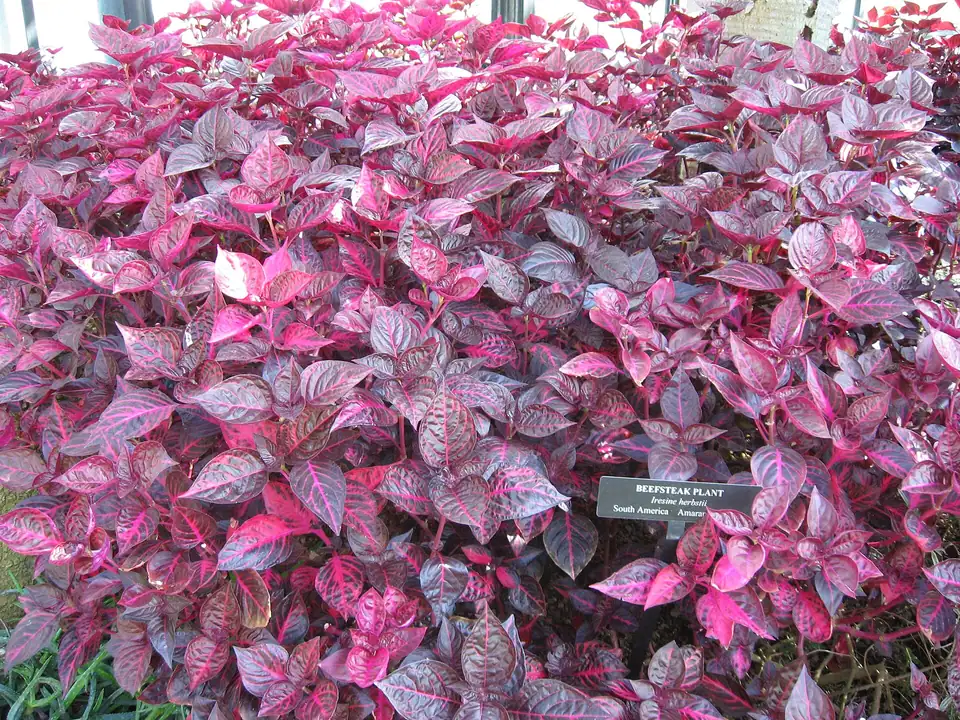

How to Grow and Care for Bloodleaf
Iresine herbstii
Written by Emilio Marruso · last checked
Not toxic to cats and dogs, according to the sources · Sources
At a glance
Iresine is a perennial that grows in full sun or partial shade, and it is just as happy in containers or indoors. Keep the soil evenly moist, pinch the growth tips while the plants are young, and start new plants from stem cuttings. It is non-toxic for cats, dogs and horses, so it is a relaxed choice for homes with pets.
- Sun
Full sun to partial shade
What the sources say (3)
Light: Full sun to partial shade
Plant in full sun in moist but well-drained soil.
— Iresine diffusa f. herbstii (Beefsteak, Bloodleaf, Chicken Gizzard, Chicken-Gizzard, Formosa Bloodleaf, Joseph's Coat, Yellow Bloodleaf) | North Carolina Extension Gardener Plant Toolbox [1] Plant in a location with full sun or partial shade and organically rich soil that drains freely.
— Iresine Plant Info - Learn About Growing Bloodleaf Plants | Gardening Know How [3] Full sun only if soil kept moist, Part sun/part shade
— Iresine herbstii - Kwantlen Polytechnic University, School of Horticulture - Plant Database [2] - Water
Keep the soil evenly moist; indoors, water when the top 1 inch is dry and empty the saucer
What the sources say (4)
Watering: Keep the soil evenly moist
Keep the soil evenly moist but cut back during cooler seasons.
— Iresine diffusa f. herbstii (Beefsteak, Bloodleaf, Chicken Gizzard, Chicken-Gizzard, Formosa Bloodleaf, Joseph's Coat, Yellow Bloodleaf) | North Carolina Extension Gardener Plant Toolbox [1] Keep the soil evenly moist all summer by watering deeply every week in the absence of rain.
— Iresine Plant Info - Learn About Growing Bloodleaf Plants | Gardening Know How [3] Watering notes: Reduce moisture in fall and winter when grown as a perennial; indoors, water when the soil feels dry at about 2.5 cm (1 in) depth and empty the saucer
Reduce the moisture in fall and winter if you are growing bloodleaf plants as perennials.
— Iresine Plant Info - Learn About Growing Bloodleaf Plants | Gardening Know How [3] Keep the potting mix moist in spring and summer by watering when the soil feels dry at a depth of about an inch (2.5 cm.).
— Iresine Plant Info - Learn About Growing Bloodleaf Plants | Gardening Know How [3] - Cold
Survives winters down to 30 °F (−1.1 °C)
Half hardy: mild winters or an unheated greenhouse · USDA 10 · RHS H3 · Z10
What the sources say (2)
Hardiness, coldest zone: 10 [winter low −1.1 to 4.4 °C (30 to 40 °F)]
you can grow them outdoors year-round in USDA plant hardiness zones 10 and 11.
— Iresine Plant Info - Learn About Growing Bloodleaf Plants | Gardening Know How [3] Hardiness, warmest zone: 11 [winter low 4.4 to 10 °C (40 to 50 °F)]
you can grow them outdoors year-round in USDA plant hardiness zones 10 and 11.
— Iresine Plant Info - Learn About Growing Bloodleaf Plants | Gardening Know How [3] - Planting
Plant in spring, once all danger of frost has passed
What the sources say (1)
Planting: Spring, after all danger of frost has passed
Set out the plants in spring after all danger of frost has passed
— Iresine Plant Info - Learn About Growing Bloodleaf Plants | Gardening Know How [3] - Pruning
Pinch out the growth tips while the plants are young
What the sources say (1)
Pruning: Pinch out growth tips while the plants are young
Pinch out the growth tips while the plants are young to promote a dense growth habit and attractive shape.
— Iresine Plant Info - Learn About Growing Bloodleaf Plants | Gardening Know How [3] - Pests
Watch for aphids, spider mites and powdery mildew
What the sources say (2)
Pests: aphids, spider mites
Insects, Diseases, and Other Problems: Susceptible to powdery mildew. Watch for aphids and spider mites.
— Iresine diffusa f. herbstii (Beefsteak, Bloodleaf, Chicken Gizzard, Chicken-Gizzard, Formosa Bloodleaf, Joseph's Coat, Yellow Bloodleaf) | North Carolina Extension Gardener Plant Toolbox [1] Diseases: powdery mildew
Insects, Diseases, and Other Problems: Susceptible to powdery mildew. Watch for aphids and spider mites.
— Iresine diffusa f. herbstii (Beefsteak, Bloodleaf, Chicken Gizzard, Chicken-Gizzard, Formosa Bloodleaf, Joseph's Coat, Yellow Bloodleaf) | North Carolina Extension Gardener Plant Toolbox [1] - Size
In the wild it reaches 5 ft tall and 3 ft wide
What the sources say (2)
Mature height: 152.4 cm (5 ft) in its native habitat
In its native habitat, it can grow 5 feet tall and 3 feet wide.
— Iresine diffusa f. herbstii (Beefsteak, Bloodleaf, Chicken Gizzard, Chicken-Gizzard, Formosa Bloodleaf, Joseph's Coat, Yellow Bloodleaf) | North Carolina Extension Gardener Plant Toolbox [1] Mature width: 91.44 cm (3 ft) in its native habitat
In its native habitat, it can grow 5 feet tall and 3 feet wide.
— Iresine diffusa f. herbstii (Beefsteak, Bloodleaf, Chicken Gizzard, Chicken-Gizzard, Formosa Bloodleaf, Joseph's Coat, Yellow Bloodleaf) | North Carolina Extension Gardener Plant Toolbox [1] - Propagation
Make new plants from stem cuttings
What the sources say (1)
Propagation: Stem cuttings
It is easy to propagate by stem cuttings.
— Iresine diffusa f. herbstii (Beefsteak, Bloodleaf, Chicken Gizzard, Chicken-Gizzard, Formosa Bloodleaf, Joseph's Coat, Yellow Bloodleaf) | North Carolina Extension Gardener Plant Toolbox [1] - Containers
Grows well in containers and indoors
What the sources say (2)
In containers: Yes
Use outdoors to add color to the border or in containers or use as a houseplant.
— Iresine diffusa f. herbstii (Beefsteak, Bloodleaf, Chicken Gizzard, Chicken-Gizzard, Formosa Bloodleaf, Joseph's Coat, Yellow Bloodleaf) | North Carolina Extension Gardener Plant Toolbox [1] Indoors: Yes
In North Carolina, it can be grown as an annual or a houseplant.
— Iresine diffusa f. herbstii (Beefsteak, Bloodleaf, Chicken Gizzard, Chicken-Gizzard, Formosa Bloodleaf, Joseph's Coat, Yellow Bloodleaf) | North Carolina Extension Gardener Plant Toolbox [1] - Safety
Non-toxic for cats, dogs and horses
Overview
Bloodleaf is a short-lived evergreen perennial grown mainly for its reddish-purple foliage. [1] It is grown outdoors as an annual in borders and containers, or as a houseplant, and is easily propagated by stem cuttings. [1]
Bloodleaf care
How to water Bloodleaf
Watering
Keep the soil evenly moist
What the sources say (2)
Keep the soil evenly moist but cut back during cooler seasons.Keep the soil evenly moist all summer by watering deeply every week in the absence of rain.Watering notes
Reduce moisture in fall and winter when grown as a perennial; indoors, water when the soil feels dry at about 2.5 cm (1 in) depth and empty the saucer
What the sources say (2)
Reduce the moisture in fall and winter if you are growing bloodleaf plants as perennials.Keep the potting mix moist in spring and summer by watering when the soil feels dry at a depth of about an inch (2.5 cm.).How much light Bloodleaf needs
Full sun to partial shade
What the sources say (3)
Plant in full sun in moist but well-drained soil.Plant in a location with full sun or partial shade and organically rich soil that drains freely.Full sun only if soil kept moist, Part sun/part shadeHow much cold Bloodleaf can take
Hardiness, coldest zone
10 [winter low −1.1 to 4.4 °C (30 to 40 °F)]
What the sources say (1)
you can grow them outdoors year-round in USDA plant hardiness zones 10 and 11.Hardiness, warmest zone
11 [winter low 4.4 to 10 °C (40 to 50 °F)]
What the sources say (1)
you can grow them outdoors year-round in USDA plant hardiness zones 10 and 11.Where to grow Bloodleaf
Indoors
Yes
What the sources say (1)
In North Carolina, it can be grown as an annual or a houseplant.In containers
Yes
What the sources say (1)
Use outdoors to add color to the border or in containers or use as a houseplant.How to propagate Bloodleaf
Stem cuttings
What the sources say (1)
It is easy to propagate by stem cuttings.How to grow Bloodleaf
The plant
Life cycle
perennial
What the sources say (1)
Bloodleaf is a short-lived evergreen perennial plant in the amaranth family (Amaranthaceae) native to Peru.Family
Amaranthaceae
What the sources say (1)
Bloodleaf is a short-lived evergreen perennial plant in the amaranth family (Amaranthaceae) native to Peru.Mature height
152.4 cm (5 ft) in its native habitat
What the sources say (1)
In its native habitat, it can grow 5 feet tall and 3 feet wide.Mature width
91.44 cm (3 ft) in its native habitat
What the sources say (1)
In its native habitat, it can grow 5 feet tall and 3 feet wide.Pests and diseases
Pests
aphids, spider mites
What the sources say (1)
Insects, Diseases, and Other Problems: Susceptible to powdery mildew. Watch for aphids and spider mites.Diseases
powdery mildew
What the sources say (1)
Insects, Diseases, and Other Problems: Susceptible to powdery mildew. Watch for aphids and spider mites.Bloodleaf pests and problems
Powdery mildew
What the sources say (1)
Susceptible to powdery mildew.
— Iresine diffusa f. herbstii (Beefsteak, Bloodleaf, Chicken Gizzard, Chicken-Gizzard, Formosa Bloodleaf, Joseph's Coat, Yellow Bloodleaf) | North Carolina Extension Gardener Plant Toolbox [1] Aphids and spider mites
What the sources say (1)
Watch for aphids and spider mites.
— Iresine diffusa f. herbstii (Beefsteak, Bloodleaf, Chicken Gizzard, Chicken-Gizzard, Formosa Bloodleaf, Joseph's Coat, Yellow Bloodleaf) | North Carolina Extension Gardener Plant Toolbox [1]
Remedies
Each remedy shows what official sources say about it; traditional remedies without an official source are marked as such. Harmful ones are listed so you know to avoid them.
Treating the plant
spider mites
repeated water sprays Works
How: Spray all plant surfaces with water; repeated water sprays help control spider mites.
Be sure to spray all plant surfaces. Repeated water sprays help control spider mites.
— hgic.clemson.edu [6] What the evidence says Be sure to spray all plant surfaces. Repeated water sprays help control spider mites.
— hgic.clemson.edu [6]
aphids
handpicking, water spray or alcohol swab Partly works
How: With minor infestations, handpick, spray with water, or wipe the insects with a cotton swab dipped in rubbing alcohol.
With minor infestations, handpicking, spraying with water, or wiping the insects with a cotton swab dipped in rubbing alcohol may be practical.
— hgic.clemson.edu [6] What the evidence says With minor infestations, handpicking, spraying with water, or wiping the insects with a cotton swab dipped in rubbing alcohol may be practical.
— hgic.clemson.edu [6]
aphids and spider mites
insecticidal soap spray Partly works
Insecticidal soaps are contact insecticides and are only effective when they make direct contact with insects.
— hgic.clemson.edu [6] How: Spray the plant with insecticidal soap in the early stages of an infestation; more than one treatment is often needed.
Spraying the plant with insecticidal soap can often eliminate a pest infestation in its early stages.
— hgic.clemson.edu [6] What the evidence says Spraying the plant with insecticidal soap can often eliminate a pest infestation in its early stages.
— hgic.clemson.edu [6]
Is Bloodleaf poisonous?
Reported by the source, quoted verbatim. This is not medical or veterinary advice: if a person or an animal may have eaten this plant, contact a poison control centre or a veterinarian.
Calendar
Planting
Spring, after all danger of frost has passed
What the sources say (1)
Set out the plants in spring after all danger of frost has passedPruning
Pinch out growth tips while the plants are young
What the sources say (1)
Pinch out the growth tips while the plants are young to promote a dense growth habit and attractive shape.Months as given by the sources, which are mostly from the United States (northern hemisphere). In the southern hemisphere they shift by about six months.
Indicative values
Values from a secondary source, not checked word for word like the rest of this page. Use them as a starting point.
- Hours of sun
- 4-6 hoursIndicative value, adapt it to your climate · Secondary source
- Soil pH
- 5.5-6.5Indicative value, adapt it to your climate · Secondary source
- Care level
- MediumIndicative value, adapt it to your climate · Secondary source
- Growth rate
- LowIndicative value, adapt it to your climate · Secondary source
Similar plants
- Brazilian joyweed Alternanthera dentata
- Cockscomb Celosia argentea
- Foxtail amaranth Amaranthus caudatus
- Globe Amaranth Gomphrena globosa
- Joseph's Coat Alternanthera ficoidea
- Joseph's Coat Amaranthus tricolor
- Prince's Feather Amaranthus hypochondriacus
- Summer Cypress Bassia scoparia
Sources
Every value above is quoted from these documents. Links lead to the original publisher.
- Iresine diffusa f. herbstii (Beefsteak, Bloodleaf, Chicken Gizzard, Chicken-Gizzard, Formosa Bloodleaf, Joseph's Coat, Yellow Bloodleaf) | North Carolina Extension Gardener Plant Toolbox · plants.ces.ncsu.edu, consulted
- Iresine herbstii - Kwantlen Polytechnic University, School of Horticulture - Plant Database · plantdatabase.kpu.ca, consulted
- Iresine Plant Info - Learn About Growing Bloodleaf Plants | Gardening Know How · gardeningknowhow.com, consulted
- Bloodleaf (Iresine diffusa f. herbstii) - Garden.org · garden.org, consulted
- Iresine diffusa f. herbstii - Botany Brisbane · botanybrisbane.com, consulted
- hgic.clemson.edu · hgic.clemson.edu
Written by Emilio Marruso · last checked