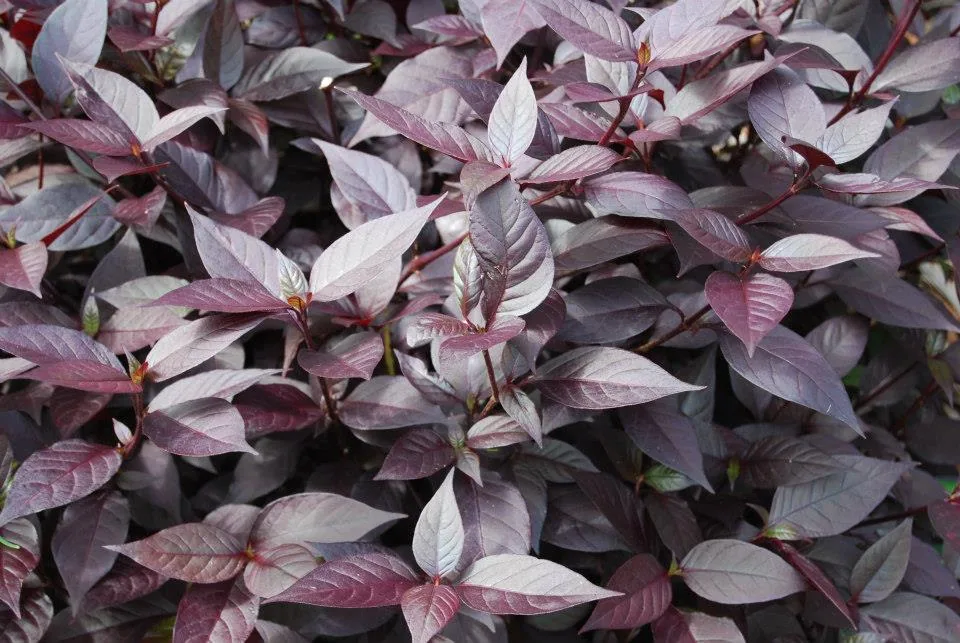
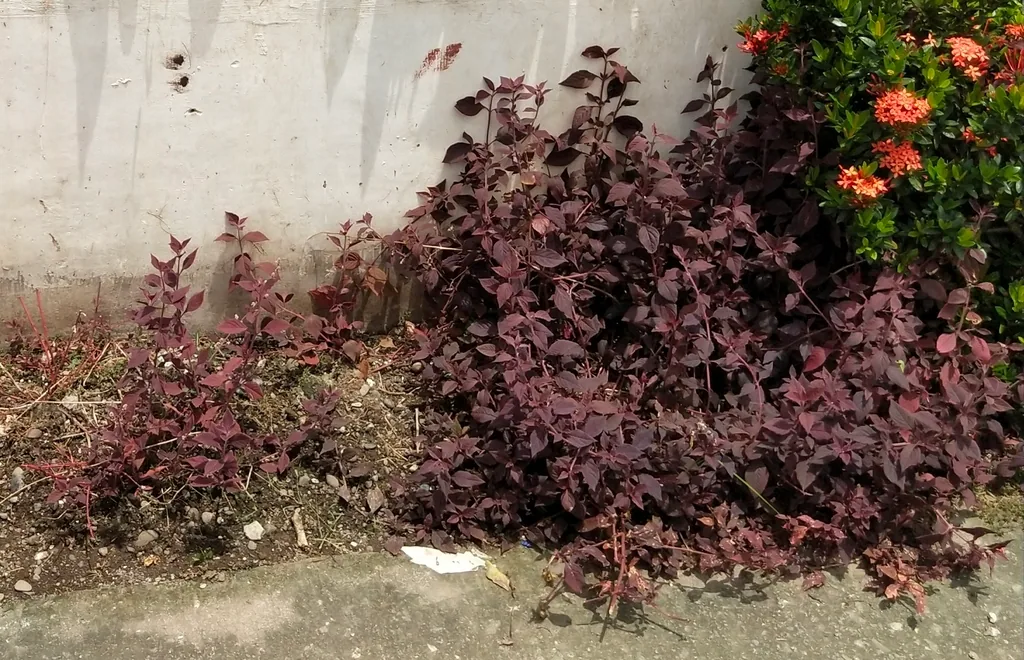

How to Grow and Care for Brazilian joyweed
Alternanthera dentata
Written by Emilio Marruso · last checked
At a glance
This compact plant, a perennial usually grown as an annual, is an easy pick for sunny spots. It stays low, 6 inches to 1 foot tall and 1 to 2 feet wide, so it fits neatly in beds or containers. Give it full sun and rich, well-drained soil that stays evenly moist, and it will settle in happily.
- Sun
Full sun
What the sources say (1)
Light: Full sun
The best leaf color appears when in full sun. It has a spreaching habit so pinch stem ends
— Alternanthera dentata (Joseph's Coat, Upright Calico Plant) | North Carolina Extension Gardener Plant Toolbox [1] - Water
Keep the soil evenly moist, but never soggy
What the sources say (1)
Watering: Rich, consistently moist, well-drained soil
Plant in rich, consistently moist, and well-drained soil and this plant will reach 6 to 12 inches high.
— Alternanthera dentata (Joseph's Coat, Upright Calico Plant) | North Carolina Extension Gardener Plant Toolbox [1] - Cold
Survives winters down to 30 °F (−1.1 °C)
Half hardy: mild winters or an unheated greenhouse · USDA 10a · RHS H3 · Z10
What the sources say (2)
Hardiness, coldest zone: 10a [winter low −1.1 to 1.7 °C (30 to 35 °F)]
Available Space To Plant: 12 inches-3 feet USDA Plant Hardiness Zone: 10a, 10b, 11a, 11b
— Alternanthera dentata (Joseph's Coat, Upright Calico Plant) | North Carolina Extension Gardener Plant Toolbox [1] Hardiness, warmest zone: 11b [winter low 7.2 to 10 °C (45 to 50 °F)]
Available Space To Plant: 12 inches-3 feet USDA Plant Hardiness Zone: 10a, 10b, 11a, 11b
— Alternanthera dentata (Joseph's Coat, Upright Calico Plant) | North Carolina Extension Gardener Plant Toolbox [1] - Soil
Rich soil that drains well
What the sources say (1)
Watering: Rich, consistently moist, well-drained soil
Plant in rich, consistently moist, and well-drained soil and this plant will reach 6 to 12 inches high.
— Alternanthera dentata (Joseph's Coat, Upright Calico Plant) | North Carolina Extension Gardener Plant Toolbox [1] - Size
6 inches to 1 foot tall, 1 to 2 feet wide
What the sources say (2)
Mature height: 15.2-30.5 cm (6 in - 1 ft)
Height: 0 ft. 6 in. - 1 ft. 0 in. Width: 1 ft. 0 in. - 2 ft. 0 in.
— Alternanthera dentata (Joseph's Coat, Upright Calico Plant) | North Carolina Extension Gardener Plant Toolbox [1] Mature width: 30.5-61 cm (1 ft - 2 ft)
Height: 0 ft. 6 in. - 1 ft. 0 in. Width: 1 ft. 0 in. - 2 ft. 0 in.
— Alternanthera dentata (Joseph's Coat, Upright Calico Plant) | North Carolina Extension Gardener Plant Toolbox [1] - Containers
Grows in containers too
What the sources say (1)
In containers: Yes
Excellent choice for containers on a patio, in the front of an annual border or bedding plants in a cottage garden.
— Alternanthera dentata (Joseph's Coat, Upright Calico Plant) | North Carolina Extension Gardener Plant Toolbox [1]
Overview
Joseph's coat is a tropical perennial typically grown as an annual, valued for colorful foliage. [1] It needs rich, consistently moist, well-drained soil and gives its best leaf color in full sun. [1] It is used in containers, annual borders and cottage garden beds. [1]
This record is incomplete: the sources we read do not cover every field yet.
Not yet covered by our sources: Pruning, Propagation
Brazilian joyweed care
How to water Brazilian joyweed
Rich, consistently moist, well-drained soil
What the sources say (1)
Plant in rich, consistently moist, and well-drained soil and this plant will reach 6 to 12 inches high.How much light Brazilian joyweed needs
Full sun
What the sources say (1)
The best leaf color appears when in full sun. It has a spreaching habit so pinch stem endsHow much cold Brazilian joyweed can take
Hardiness, coldest zone
10a [winter low −1.1 to 1.7 °C (30 to 35 °F)]
What the sources say (1)
Available Space To Plant:
12 inches-3 feet
USDA Plant Hardiness Zone:
10a, 10b, 11a, 11bHardiness, warmest zone
11b [winter low 7.2 to 10 °C (45 to 50 °F)]
What the sources say (1)
Available Space To Plant:
12 inches-3 feet
USDA Plant Hardiness Zone:
10a, 10b, 11a, 11bWhere to grow Brazilian joyweed
Yes
What the sources say (1)
Excellent choice for containers on a patio, in the front of an annual border or bedding plants in a cottage garden.How to propagate Brazilian joyweed
Not stated in the sources we read.
How to grow Brazilian joyweed
The plant
Life cycle
perennial (typically grown as an annual)
What the sources say (1)
Joseph's coat is a tropical perennial typically grown as an annual in the Amaranthaceae (buckwheat) family native to the West Indies and South America.Family
Amaranthaceae
What the sources say (1)
Joseph's coat is a tropical perennial typically grown as an annual in the Amaranthaceae (buckwheat) family native to the West Indies and South America.Mature height
15.2-30.5 cm (6 in - 1 ft)
What the sources say (1)
Height: 0 ft. 6 in. - 1 ft. 0 in.
Width: 1 ft. 0 in. - 2 ft. 0 in.Mature width
30.5-61 cm (1 ft - 2 ft)
What the sources say (1)
Height: 0 ft. 6 in. - 1 ft. 0 in.
Width: 1 ft. 0 in. - 2 ft. 0 in.Fertilizing
When
The sources give different values depending on region, zone or growing conditions.
What each source says
cultivar 'Little Ruby': Spring and again in fall
What the sources say (1)
cultivar 'Little Ruby': No special fertilization requirements. A general-purpose fertilizer applied in spring and again in the fall will suffice.How often
The sources give different values depending on region, zone or growing conditions.
What each source says
cultivar 'Little Ruby': Twice a year; no special fertilization requirements
What the sources say (1)
cultivar 'Little Ruby': No special fertilization requirements. A general-purpose fertilizer applied in spring and again in the fall will suffice.Mineral fertilizers
The sources give different values depending on region, zone or growing conditions.
What each source says
cultivar 'Little Ruby': General-purpose fertilizer
What the sources say (1)
cultivar 'Little Ruby': No special fertilization requirements. A general-purpose fertilizer applied in spring and again in the fall will suffice.Remedies
Each remedy shows what official sources say about it; traditional remedies without an official source are marked as such. Harmful ones are listed so you know to avoid them.
Treating the plant
whiteflies
dish soap spray Not verified
Traditional remedy, not verified by an official source.
them three times about once a week when temperatures are below 90 degrees Fahrenheit and be sure to water the plants the day before you spray.
— hunker.com [3] How: Shoot a squirt of dish soap into a gallon of water and spray your plants in the evening when it is cooler outside; spray three times about once a week.
water spray from a hose Not verified
Traditional remedy, not verified by an official source.
How: Spray affected plants with water from your garden hose or from a spray bottle.
handheld vacuum Not verified
Traditional remedy, not verified by an official source.
How: Use a small, handheld vacuum to get rid of adults and nymphs.
Calendar
Pruning
Not stated in the sources we read.
Months as given by the sources, which are mostly from the United States (northern hemisphere). In the southern hemisphere they shift by about six months.
Indicative values
Values from a secondary source, not checked word for word like the rest of this page. Use them as a starting point.
- Drought tolerant
- yesIndicative value, adapt it to your climate · Secondary source
- Soil pH
- 5.5-6.5Indicative value, adapt it to your climate · Secondary source
- Care level
- MediumIndicative value, adapt it to your climate · Secondary source
- Growth rate
- HighIndicative value, adapt it to your climate · Secondary source
- Pruning
- March, April, August, March, April, May, June, July, August, SeptemberIndicative value, adapt it to your climate · Secondary source
- Propagation
- Stem Propagation, Division, Layering Propagation, Seed PropagationIndicative value, adapt it to your climate · Secondary source
Similar plants
- Joseph's Coat Alternanthera ficoidea
- Alligatorweed Alternanthera philoxeroides
- Bloodleaf Iresine herbstii
- Cockscomb Celosia argentea
- Foxtail amaranth Amaranthus caudatus
- Globe Amaranth Gomphrena globosa
- Joseph's Coat Amaranthus tricolor
- Prince's Feather Amaranthus hypochondriacus
Sources
Every value above is quoted from these documents. Links lead to the original publisher.
- Alternanthera dentata (Joseph's Coat, Upright Calico Plant) | North Carolina Extension Gardener Plant Toolbox · plants.ces.ncsu.edu, consulted
- Louisiana Super Plants: Little Ruby Alternanthera · lsuagcenter.com, consulted
- hunker.com · hunker.com
Written by Emilio Marruso · last checked