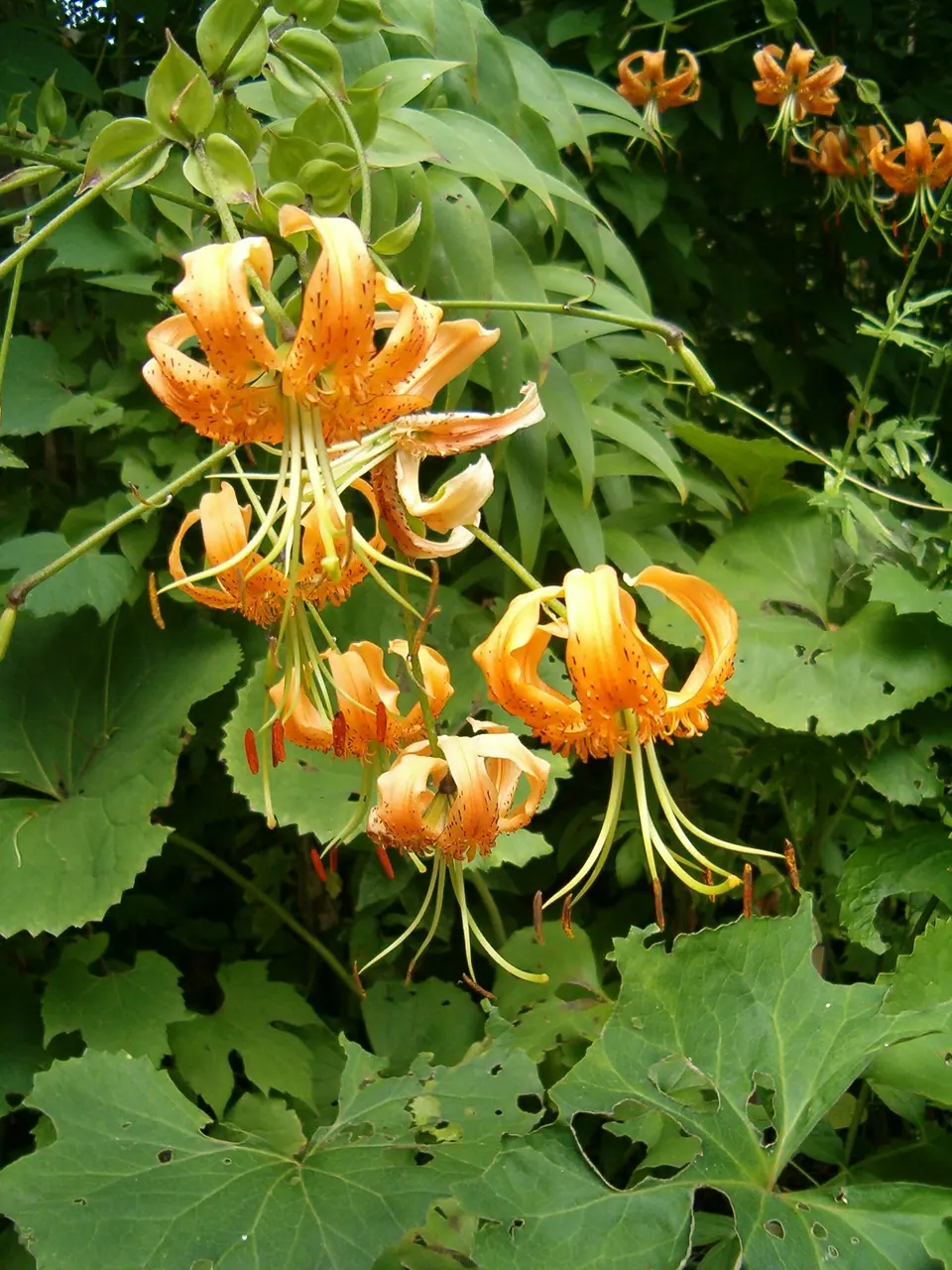

How to Grow and Care for Henry's lily
Lilium henryi
Written by Emilio Marruso · last checked
Toxic to: Cats · Why
At a glance
This lily is happy in full sun or light shade, with its head in the sun and its roots in the shade. Give it open, free-draining, humus-rich soil and moderate water, since it dislikes drought. You can start new plants from seed, division or bulb scales, and a little care in early spring keeps rabbits and slugs off its new shoots.
- Sun
Full sun to light shade: head in the sun, roots in the shade
What the sources say (3)
Light: Full sun to light shade; roots in shade, head in sun
Light full sun Shade tolerance light shade Water moderate
— Lilium henryi — Practical Plants [3] Prefers an open free-draining humus-rich loamy soil with its roots in the shade and its head in the sun [4] .
— Lilium henryi — Practical Plants [3] It is tough and undemanding, needing only sun (with, ideally, a bit of afternoon shade) and a humusy, well-drained soil on the alkaline side of neutral
— Lilium henryi - Horticulture [1] - Water
Moderate water; it does not tolerate drought
What the sources say (2)
- Cold
Survives winters down to −20 °F (−28.9 °C)
Very hardy · USDA 5 · RHS H7 · Z5
What the sources say (1)
Hardiness, coldest zone: 5 [winter low −28.9 to −23.3 °C (−20 to −10 °F)]
Water moderate Hardiness Zone 5+ Soil textures sandy, loamy
— Lilium henryi — Practical Plants [3] - Soil
Open, free-draining soil rich in humus
What the sources say (2)
Watering notes: Prefers an open, free-draining, humus-rich soil
Prefers an open free-draining humus-rich loamy soil with its roots in the shade and its head in the sun [4] .
— Lilium henryi — Practical Plants [3] It is tough and undemanding, needing only sun (with, ideally, a bit of afternoon shade) and a humusy, well-drained soil on the alkaline side of neutral
— Lilium henryi - Horticulture [1] - Harvest
The bulb is edible cooked, a bit bitter, used like potatoes
- Pests
Guard shoots from rabbits and slugs in early spring; squash lily beetle eggs
- Propagation
New plants from seed, division or bulb scales
What the sources say (3)
Propagation: Seed, division, bulb scales
Seed - immediate epigeal germination [2] . Sow thinly in pots from late winter to early spring in a cold frame. Should germinate in 2 - 4 weeks [3] .
— Lilium henryi — Practical Plants [3] Division with care in the autumn once the leaves have died down. Replant immediately [4] .
— Lilium henryi — Practical Plants [3] Bulb scales can be removed from the bulbs in early autumn. If they are kept in a warm dark place in a bag of moist peat, they will produce bulblets.
— Lilium henryi — Practical Plants [3] - Sowing
Sow in pots in a cold frame, late winter to early spring
What the sources say (1)
Sowing: Late winter to early spring (pots in a cold frame)
Seed - immediate epigeal germination [2] . Sow thinly in pots from late winter to early spring in a cold frame. Should germinate in 2 - 4 weeks [3] .
— Lilium henryi — Practical Plants [3] - Safety
Every part is poisonous to cats; the bulbs are a risk to all pets
Overview
Lilium henryi is a herbaceous perennial bulbous plant with a leafy stem, described as very ornamental and easily grown. [2][3] It prefers an open, free-draining, humus-rich soil with its roots in the shade and its head in the sun. [3] Bulbs are best planted in early to mid autumn in cool temperate areas. [3]
This record is incomplete: the sources we read do not cover every field yet.
Not yet covered by our sources: Hardiness, warmest zone, Pruning
Henry's lily care
How to water Henry's lily
Watering
Moderate water; drought intolerant
Watering notes
Prefers an open, free-draining, humus-rich soil
What the sources say (2)
Prefers an open free-draining humus-rich loamy soil with its roots in the shade and its head in the sun [4] .It is tough and undemanding, needing only sun (with, ideally, a bit of afternoon shade) and a humusy, well-drained soil on the alkaline side of neutralHow much light Henry's lily needs
Full sun to light shade; roots in shade, head in sun
What the sources say (3)
Light
full sun
Shade tolerance
light shade
Water
moderatePrefers an open free-draining humus-rich loamy soil with its roots in the shade and its head in the sun [4] .It is tough and undemanding, needing only sun (with, ideally, a bit of afternoon shade) and a humusy, well-drained soil on the alkaline side of neutralHow much cold Henry's lily can take
Hardiness, coldest zone
5 [winter low −28.9 to −23.3 °C (−20 to −10 °F)]
What the sources say (1)
Water
moderate
Hardiness
Zone 5+
Soil textures
sandy, loamyHardiness, warmest zone
Not stated in the sources we read.
How to propagate Henry's lily
Seed, division, bulb scales
What the sources say (3)
Seed - immediate epigeal germination [2] . Sow thinly in pots from late winter to early spring in a cold frame. Should germinate in 2 - 4 weeks [3] .Division with care in the autumn once the leaves have died down. Replant immediately [4] .Bulb scales can be removed from the bulbs in early autumn. If they are kept in a warm dark place in a bag of moist peat, they will produce bulblets.Henry's lily pests and problems
Rabbits and slugs
Symptom: If the shoot tip is eaten out the bulb will not grow in that year and loses vigour.
What to do: Protect the plant against rabbits and slugs in early spring.
What the sources say (1)
The plant should be protected against rabbits and slugs in early spring. If the shoot tip is eaten out the bulb will not grow in that year and will lose vigour [4] .
— Lilium henryi — Practical Plants [3] Scarlet lily beetle
Symptom: Clusters of orange eggs, adults and excrement-covered larvae on the plant.
What to do: Squash egg clusters and spray adults and larvae with insecticidal soap.
What the sources say (1)
I go on lily beetle patrol every morning before breakfast, taking a savage delight in squishing the clusters of orange eggs and squirting the adults and excrement-covered larvae with insecticidal soap.
— Lilium henryi - Horticulture [1]
Remedies
Each remedy shows what official sources say about it; traditional remedies without an official source are marked as such. Harmful ones are listed so you know to avoid them.
Treating the plant
lily beetle
crushing egg clusters by hand Works
How: Patrol the plants every morning and squish the clusters of orange eggs.
I go on lily beetle patrol every morning before breakfast, taking a savage delight in squishing the clusters of orange eggs
— Lilium henryi - Horticulture [1] What the evidence says Hand-picking adults, eggs, and larvae is an effective means of reducing damage.
— extension.umaine.edu [5] insecticidal soap spray Works
Be aware that conventional and organic insecticides can pose risks to pollinators, so avoid spraying near plants that are in bloom
— hort.extension.wisc.edu [6] How: Squirt the adults and the excrement-covered larvae with insecticidal soap.
squishing the clusters of orange eggs and squirting the adults and excrement-covered larvae with insecticidal soap
— Lilium henryi - Horticulture [1] What the evidence says Organic insecticides containing azadirachtin, pyrethrins, or spinosad can also be used, as well as horticultural oils and insecticidal soap.
— hort.extension.wisc.edu [6]
Is Henry's lily toxic to pets?
Reported by the source, quoted verbatim. This is not medical or veterinary advice: if a person or an animal may have eaten this plant, contact a poison control centre or a veterinarian.
All parts of lilies are poisonous to cats and bulbs are a potential risk to all pets
[4]Genus-level warning: refers to the whole genus, not documented for this species
The source flags the risk for this animal but does not explain why.
Calendar
Sowing
Late winter to early spring (pots in a cold frame)
What the sources say (1)
Seed - immediate epigeal germination [2] . Sow thinly in pots from late winter to early spring in a cold frame. Should germinate in 2 - 4 weeks [3] .Planting
The sources give different values depending on region, zone or growing conditions.
What each source says
cool temperate areas: Early to mid autumn
warmer areas: As late as late autumn
According to Horticulture magazine: Fall or spring
What the sources say (5)
cool temperate areas: Early to mid autumn is the best time to plant out the bulbs in cool temperate areas, in warmer areas they can be planted out as late as late autumn [4] .warmer areas: Early to mid autumn is the best time to plant out the bulbs in cool temperate areas, in warmer areas they can be planted out as late as late autumn [4] .According to Horticulture magazine: The purple-tinged, fist-size bulbs can be planted in either fall or spring. There should be about eight inches of soil above the bulbEarly to mid autumn is the best time to plant out the bulbs in cool temperate areas, in warmer areas they can be planted out as late as late autumn [4] .The purple-tinged, fist-size bulbs can be planted in either fall or spring. There should be about eight inches of soil above the bulbPruning
Not stated in the sources we read.
Months as given by the sources, which are mostly from the United States (northern hemisphere). In the southern hemisphere they shift by about six months.
Edibility
Reported by the source, quoted verbatim. Do not eat a plant on the basis of this page alone: identification mistakes can be dangerous.
Bulb - cooked [3] . The bulb is about 7cm in diameter [6] . A rather bitter flavour[K]. Rich in starch, it can be used as a vegetable in similar ways to potatoes (Solanum tuberosum).
[3]
Indicative values
Values from a secondary source, not checked word for word like the rest of this page. Use them as a starting point.
- Life cycle
- PerennialIndicative value, adapt it to your climate · Secondary source
- Mature height
- 121.9-243.8 cm (4-8 ft)Indicative value, adapt it to your climate · Secondary source
- Drought tolerant
- yesIndicative value, adapt it to your climate · Secondary source
- Soil pH
- 6-7Indicative value, adapt it to your climate · Secondary source
- Care level
- MediumIndicative value, adapt it to your climate · Secondary source
- Growth rate
- HighIndicative value, adapt it to your climate · Secondary source
- Pruning
- March, April, MayIndicative value, adapt it to your climate · Secondary source
Similar plants
- Easter Lily Lilium longiflorum
- Formosan Lily Lilium formosanum
- Gold rayed lily Lilium auratum
- Gray's Lily Lilium grayi
- Lilium carniolicum Lilium carniolicum
- Lilium pomponium Lilium pomponium
- Lilium pumilum Lilium pumilum
- Michigan lily Lilium michiganense
Sources
Every value above is quoted from these documents. Links lead to the original publisher.
- Lilium henryi - Horticulture · hortmag.com, consulted
- Lilium henryi - Useful Temperate Plants · temperate.theferns.info, consulted
- Lilium henryi — Practical Plants · practicalplants.org, consulted
- How to grow lilies | RHS Growing Guide · rhs.org.uk, consulted
- extension.umaine.edu · extension.umaine.edu
- hort.extension.wisc.edu · hort.extension.wisc.edu
Written by Emilio Marruso · last checked