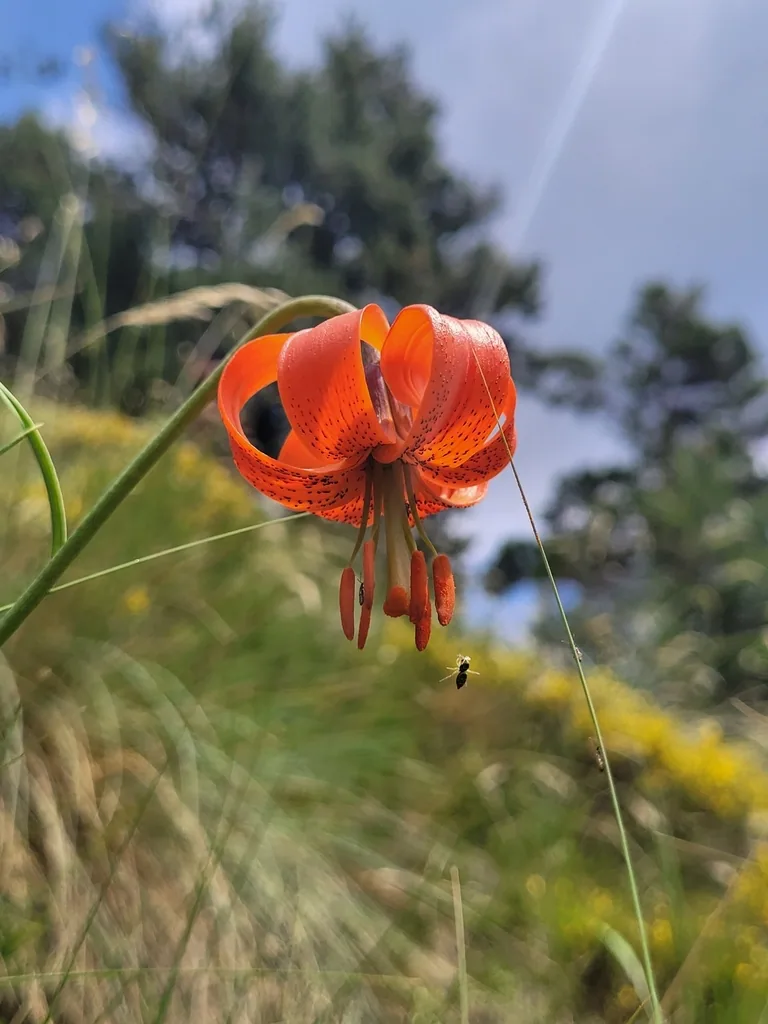
How to Grow and Care for Lilium pomponium
Lilium pomponium
Written by Emilio Marruso · last checked
Toxic to: People · Why
At a glance
This lily likes its head in the sun and its roots in the shade, in open, free-draining soil rich in humus. Plant the bulbs in early to mid fall, water moderately while it grows in spring, then let it rest almost dry through its summer dormancy. Even its bulb is edible when cooked.
- Sun
Full sun to partial shade; flowers in the sun, roots in the shade
What the sources say (3)
Light: Full sun to partial shade
Full sun to partial shade.
— Lilium pomponium - TURBAN LILY [3] Light: Full sun.
— Lilium pomponium – Lilium Species Foundation [2] Watering notes: Prefers an open free-draining humus-rich loamy soil, roots in the shade and head in the sun
Prefers an open free-draining humus-rich loamy soil with its roots in the shade and its head in the sun
— Lilium pomponium - Useful Temperate Plants [1] - Water
Moderate water while it grows in spring; very little during its summer rest
What the sources say (1)
Watering: Minimal in summer dormancy; moderate during spring growth
Water: Minimal in summer dormancy; moderate during spring growth.
— Lilium pomponium – Lilium Species Foundation [2] - Cold
Survives winters down to −20 °F (−28.9 °C)
Very hardy · USDA 5 · RHS H7 · Z5
- Soil
Open, loamy, free-draining soil rich in humus
What the sources say (1)
Watering notes: Prefers an open free-draining humus-rich loamy soil, roots in the shade and head in the sun
Prefers an open free-draining humus-rich loamy soil with its roots in the shade and its head in the sun
— Lilium pomponium - Useful Temperate Plants [1] - Planting
Plant early to mid fall in cool areas; up to late fall in warm climates
What the sources say (1)
Planting: Early to mid autumn in cool temperate areas; as late as late autumn in warmer areas
Early to mid autumn is the best time to plant out the bulbs in cool temperate areas, in warmer areas they can be planted out as late as late autumn
— Lilium pomponium - Useful Temperate Plants [1] - Harvest
The bulb is edible, but only cooked
- Propagation
By seed, by dividing the bulbs in fall, or from bulb scales
What the sources say (3)
Propagation: Seed, division of bulbs in autumn, bulb scales
Division in autumn once the leaves have died down.
— Lilium pomponium - Useful Temperate Plants [1] Bulb scales can be removed from the bulbs in early autumn.
— Lilium pomponium - Useful Temperate Plants [1] Sow seed in fall.
— Lilium pomponium - TURBAN LILY [3] - Sowing
Sow the seeds in fall
What the sources say (1)
Sowing: Autumn
Sow seed in fall.
— Lilium pomponium - TURBAN LILY [3] - Safety
No known hazards for people
Overview
Turban lily is a bulbous perennial of rocky, calcareous hillsides in the southern Alps. [1] It prefers a sunny position in free-draining soil and is propagated by seed, bulb division or bulb scales. [1]
This record is incomplete: the sources we read do not cover every field yet.
Not yet covered by our sources: Pruning
Lilium pomponium care
How to water Lilium pomponium
Watering
Minimal in summer dormancy; moderate during spring growth
What the sources say (1)
Water: Minimal in summer dormancy; moderate during spring growth.Watering notes
Prefers an open free-draining humus-rich loamy soil, roots in the shade and head in the sun
What the sources say (1)
Prefers an open free-draining humus-rich loamy soil with its roots in the shade and its head in the sunHow much light Lilium pomponium needs
How much cold Lilium pomponium can take
Hardiness, coldest zone
5 [winter low −28.9 to −23.3 °C (−20 to −10 °F)]
What the sources say (1)
USDA zones: 5-8.Hardiness, warmest zone
8 [winter low −12.2 to −6.7 °C (10 to 20 °F)]
What the sources say (1)
USDA zones: 5-8.How to propagate Lilium pomponium
Seed, division of bulbs in autumn, bulb scales
How to grow Lilium pomponium
Fertilizing
When
The sources give different values depending on region, zone or growing conditions.
What each source says
LA hybrid lilies grown for cut flowers: After shoot emergence, or at the visible bud stage if the soil already holds nutrient reserves
What the sources say (1)
LA hybrid lilies grown for cut flowers: If growing lilies in field soil, perform a soil test to determine nutrient reserves. For optimal shoot height, do not fertilize until after shoot emergence, or at the visible bud stage of development if the media has nutrient reserves.Avoid
The sources give different values depending on region, zone or growing conditions.
What each source says
LA hybrid lilies grown for cut flowers: Excessive nutrient levels at shoot emergence
What the sources say (1)
LA hybrid lilies grown for cut flowers: Excessive nutrient levels at shoot emergence can be detrimental for lilies grown for cut flower production.Remedies
Each remedy shows what official sources say about it; traditional remedies without an official source are marked as such. Harmful ones are listed so you know to avoid them.
Treating the plant
lily leaf beetle
hand-picking adults, eggs and larvae Works
How: Begin scouting for adults in April and destroy any that you see; check the undersides of leaves for orange egg masses and destroy them; remove young larvae as they develop.
Hand-picking adults, eggs, and larvae is an effective means of reducing damage. It’s important to begin scouting for the emergence of adults in April and destroy any that you see.
— extension.umaine.edu [5] What the evidence says Hand-picking adults, eggs, and larvae is an effective means of reducing damage. It’s important to begin scouting for the emergence of adults in April and destroy any that you see.
— extension.umaine.edu [5] soapy water Official source, not independently tested
How: Hand-pick and crush adults and larvae or knock them into a container of soapy water; crush eggs by hand; repeat regularly throughout the growing season.
consider hand-picking and crushing adults and larvae or knocking them into a container of soapy water. Also, crush eggs by hand if you see them.
— hort.extension.wisc.edu [6] neem Partly works
How: Applied every five to seven days after eggs begin to hatch.
Neem is most effective on first-stage, very young LLB larvae, and should be applied every five to seven days after eggs begin to hatch.
— extension.umaine.edu [5] What the evidence says Neem is most effective on first-stage, very young LLB larvae, and should be applied every five to seven days after eggs begin to hatch.
— extension.umaine.edu [5]
Is Lilium pomponium poisonous?
Reported by the source, quoted verbatim. This is not medical or veterinary advice: if a person or an animal may have eaten this plant, contact a poison control centre or a veterinarian.
Known Hazards None known
[1]
Calendar
Planting
Early to mid autumn in cool temperate areas; as late as late autumn in warmer areas
What the sources say (1)
Early to mid autumn is the best time to plant out the bulbs in cool temperate areas, in warmer areas they can be planted out as late as late autumnPruning
Not stated in the sources we read.
Months as given by the sources, which are mostly from the United States (northern hemisphere). In the southern hemisphere they shift by about six months.
Edibility
Reported by the source, quoted verbatim. Do not eat a plant on the basis of this page alone: identification mistakes can be dangerous.
Bulb - cooked[ 2 Title Sturtevant's Edible Plants of the World. Publication Author Hedrick. U. P. Publisher Dover Publications Year 1972 ISBN 0-486-20459-6 Description Lots of entries, quite a lot of information in most entries and references. , 4 Title A Modern Herbal. Publication Author Grieve. Publisher Penguin Year 1984 ISBN 0-14-046-440-9 Description Not so modern (1930's?) but lots of information, mainly temperate plants. , 61 Title A Dictionary of Plants Used by Man. Publication Author Usher. G. Publisher Constable Year 1974 ISBN 0094579202 Description Forget the sexist title, this is one of the best books on the subject. Lists a very extensive range of useful plants from around the world with very brief details of the uses. Not for the casual reader. , 163 Title Lilies and Related Plants. Publication Author RHS Lily Group. Publisher Year ISBN Description Lots of interesting snippets about plants in the family Liliaceae (in the old, broad sense) ]. Rich in starch, it can be used as a vegetable in similar ways to potatoes (Solanum tuberosum).
[1]
Similar plants
- Carolina Lily Lilium michauxii
- Easter Lily Lilium longiflorum
- Formosan Lily Lilium formosanum
- Gold rayed lily Lilium auratum
- Gray's Lily Lilium grayi
- Henry's lily Lilium henryi
- Lilium carniolicum Lilium carniolicum
- Lilium pumilum Lilium pumilum
Sources
Every value above is quoted from these documents. Links lead to the original publisher.
- Lilium pomponium - Useful Temperate Plants · temperate.theferns.info, consulted
- Lilium pomponium – Lilium Species Foundation · liliumspeciesfoundation.org, consulted
- Lilium pomponium - TURBAN LILY · rainyside.com, consulted
- extension.msstate.edu · extension.msstate.edu
- extension.umaine.edu · extension.umaine.edu
- hort.extension.wisc.edu · hort.extension.wisc.edu
Written by Emilio Marruso · last checked