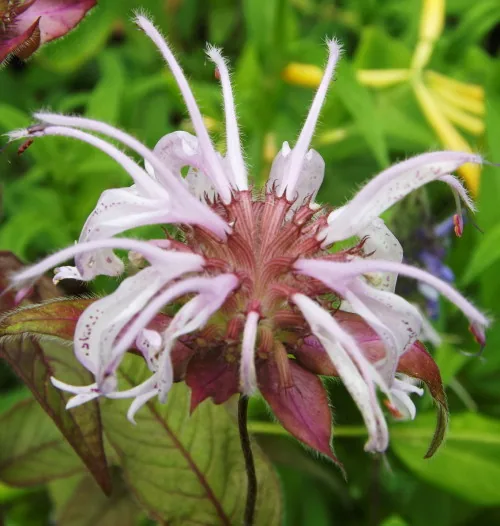

How to Grow and Care for Eastern Beebalm
Monarda bradburiana
Written by Emilio Marruso · last checked
At a glance
This perennial grows happily in full sun to partial shade, forming a clump 1–2 feet tall and 2–3 feet wide. It self-seeds, so it can spread on its own, and you can steep its leaves into a homemade tea. Give it well-drained soil and room for air to move around it, and it will come back year after year.
- Sun
Full sun to partial shade
What the sources say (1)
Light: Full sun to partial shade
Light: Full sun (6 or more hours of direct sunlight a day) Partial Shade (Direct sunlight only part of the day, 2-6 hours)
— Monarda bradburyana (Bee Balm, Bradbury Beebalm, Eastern Beebalm, Sessile-leaved Monarda) | North Carolina Extension Gardener Plant Toolbox [1] - Cold
Survives winters down to −20 °F (−28.9 °C)
Very hardy · USDA 5a · RHS H7 · Z5
What the sources say (2)
Hardiness, coldest zone: 5a [winter low −28.9 to −26.1 °C (−20 to −15 °F)]
USDA Plant Hardiness Zone: 5a, 5b, 6a, 6b, 7a, 7b, 8a, 8b
— Monarda bradburyana (Bee Balm, Bradbury Beebalm, Eastern Beebalm, Sessile-leaved Monarda) | North Carolina Extension Gardener Plant Toolbox [1] Hardiness, warmest zone: 8b [winter low −9.4 to −6.7 °C (15 to 20 °F)]
USDA Plant Hardiness Zone: 5a, 5b, 6a, 6b, 7a, 7b, 8a, 8b
— Monarda bradburyana (Bee Balm, Bradbury Beebalm, Eastern Beebalm, Sessile-leaved Monarda) | North Carolina Extension Gardener Plant Toolbox [1] - Soil
Needs well-drained soil
What the sources say (1)
Watering notes: Needs well-drained soil
Soil Drainage: Good Drainage
— Monarda bradburyana (Bee Balm, Bradbury Beebalm, Eastern Beebalm, Sessile-leaved Monarda) | North Carolina Extension Gardener Plant Toolbox [1] - Harvest
The leaves can be used to make tea
- Pests
Powdery mildew and rust; don't crowd plants so air can move between them
What the sources say (1)
Diseases: powdery mildew, rust
Powdery mildew can be a significant problem with the monardas, particularly in crowded gardens with poor air circulation. This species, however, has some mildew resistance. Rust can also be a problem.
— Monarda bradburyana (Bee Balm, Bradbury Beebalm, Eastern Beebalm, Sessile-leaved Monarda) | North Carolina Extension Gardener Plant Toolbox [1] - Size
1–2 ft tall and 2–3 ft wide
What the sources say (2)
Mature height: 30-61 cm (1-2 ft)
Eastern beebalm grows 1 to 2 feet tall and 2 to 3 feet wide in a neat mound.
— Monarda bradburyana (Bee Balm, Bradbury Beebalm, Eastern Beebalm, Sessile-leaved Monarda) | North Carolina Extension Gardener Plant Toolbox [1] Mature width: 61-91 cm (2-3 ft)
Eastern beebalm grows 1 to 2 feet tall and 2 to 3 feet wide in a neat mound.
— Monarda bradburyana (Bee Balm, Bradbury Beebalm, Eastern Beebalm, Sessile-leaved Monarda) | North Carolina Extension Gardener Plant Toolbox [1] - Propagation
Grows from seed and self-seeds on its own
What the sources say (2)
Propagation: Seed; self-seeds
Recommended Propagation Strategy: Seed
— Monarda bradburyana (Bee Balm, Bradbury Beebalm, Eastern Beebalm, Sessile-leaved Monarda) | North Carolina Extension Gardener Plant Toolbox [1] It needs good air circulation and naturalizes well by self-seeding.
— Monarda bradburyana (Bee Balm, Bradbury Beebalm, Eastern Beebalm, Sessile-leaved Monarda) | North Carolina Extension Gardener Plant Toolbox [1]
Overview
Eastern beebalm is a herbaceous perennial in the mint family native to the southern and central US, forming a neat mound 1 to 2 feet [30–61 cm] tall. [1] It grows in full sun to part shade on medium to dry, well-drained soils and blooms in spring, earlier than other beebalms. [1] The aromatic leaves are used to make tea. [2]
This record is incomplete: the sources we read do not cover every field yet.
Not yet covered by our sources: Pruning
Eastern Beebalm care
Measurements in square brackets are our conversion into the other unit system; the quoted text is unchanged.
How to water Eastern Beebalm
Watering
The sources give different values depending on region, zone or growing conditions.
What each source says
According to NC State Extension: Medium to dry soils
According to Friends of the Wildflower Garden: Moist to somewhat dry; best with moderate moisture
What the sources say (4)
According to NC State Extension: It tolerates full sun to part shade and medium to dry, even rocky, well-drained soils.According to Friends of the Wildflower Garden: This monarda likes full sun with moist to somewhat dry conditions. Best plant appearance will be with average soil and moderate moisture.It tolerates full sun to part shade and medium to dry, even rocky, well-drained soils.Still others appreciate its tolerance for rather poor, dry soils.Watering notes
Needs well-drained soil
What the sources say (1)
Soil Drainage:
Good DrainageHow much light Eastern Beebalm needs
Full sun to partial shade
What the sources say (1)
Light:
Full sun (6 or more hours of direct sunlight a day)
Partial Shade (Direct sunlight only part of the day, 2-6 hours)How much cold Eastern Beebalm can take
Hardiness, coldest zone
5a [winter low −28.9 to −26.1 °C (−20 to −15 °F)]
What the sources say (1)
USDA Plant Hardiness Zone:
5a, 5b, 6a, 6b, 7a, 7b, 8a, 8bHardiness, warmest zone
8b [winter low −9.4 to −6.7 °C (15 to 20 °F)]
What the sources say (1)
USDA Plant Hardiness Zone:
5a, 5b, 6a, 6b, 7a, 7b, 8a, 8bHow to propagate Eastern Beebalm
Seed; self-seeds
What the sources say (2)
Recommended Propagation Strategy:
SeedIt needs good air circulation and naturalizes well by self-seeding.How to grow Eastern Beebalm
The plant
Life cycle
perennial
What the sources say (1)
Eastern beebalm is an herbaceous perennial in the mint family (Lamiaceae) native to the southern and central US.Family
Lamiaceae
What the sources say (1)
Eastern beebalm is an herbaceous perennial in the mint family (Lamiaceae) native to the southern and central US.Mature height
30-61 cm (1-2 ft)
What the sources say (1)
Eastern beebalm grows 1 to 2 feet tall and 2 to 3 feet wide in a neat mound.Mature width
61-91 cm (2-3 ft)
What the sources say (1)
Eastern beebalm grows 1 to 2 feet tall and 2 to 3 feet wide in a neat mound.Pests and diseases
Diseases
powdery mildew, rust
What the sources say (1)
Powdery mildew can be a significant problem with the monardas, particularly in crowded gardens with poor air circulation. This species, however, has some mildew resistance. Rust can also be a problem.Eastern Beebalm pests and problems
Powdery mildew
Symptom: Mildew on foliage, worse in crowded plantings with poor air circulation
What to do: Ensure good air circulation; this species has some mildew resistance
What the sources say (1)
Powdery mildew can be a significant problem with the monardas, particularly in crowded gardens with poor air circulation. This species, however, has some mildew resistance.
— Monarda bradburyana (Bee Balm, Bradbury Beebalm, Eastern Beebalm, Sessile-leaved Monarda) | North Carolina Extension Gardener Plant Toolbox [1] Rust
What the sources say (1)
Rust can also be a problem.
— Monarda bradburyana (Bee Balm, Bradbury Beebalm, Eastern Beebalm, Sessile-leaved Monarda) | North Carolina Extension Gardener Plant Toolbox [1]
Remedies
Each remedy shows what official sources say about it; traditional remedies without an official source are marked as such. Harmful ones are listed so you know to avoid them.
Treating the plant
powdery mildew
good air circulation Official source, not independently tested
How: Avoid crowded plantings and grow the plant where air circulates well; this species has some mildew resistance.
Powdery mildew can be a significant problem with the monardas, particularly in crowded gardens with poor air circulation. This species, however, has some mildew resistance.
— Monarda bradburyana (Bee Balm, Bradbury Beebalm, Eastern Beebalm, Sessile-leaved Monarda) | North Carolina Extension Gardener Plant Toolbox [1]
Calendar
Pruning
Not stated in the sources we read.
Months as given by the sources, which are mostly from the United States (northern hemisphere). In the southern hemisphere they shift by about six months.
Edibility
Reported by the source, quoted verbatim. Do not eat a plant on the basis of this page alone: identification mistakes can be dangerous.
Indicative values
Values from a secondary source, not checked word for word like the rest of this page. Use them as a starting point.
- Hours of sun
- 6-8 hoursIndicative value, adapt it to your climate · Secondary source
- Drought tolerant
- yesIndicative value, adapt it to your climate · Secondary source
- Soil pH
- 6-7Indicative value, adapt it to your climate · Secondary source
- Care level
- MediumIndicative value, adapt it to your climate · Secondary source
- Growth rate
- LowIndicative value, adapt it to your climate · Secondary source
- Pruning
- June, JulyIndicative value, adapt it to your climate · Secondary source
Similar plants
- Beebalm Monarda didyma
- Lemon Beebalm Monarda citriodora
- Spotted Beebalm Monarda punctata
- Wild Bergamot Monarda fistulosa
- Anise Sage Salvia guaranitica
- Apple mint Mentha suaveolens
- Arrowleaf Sage Salvia sagittata
- Autumn Sage Salvia greggii
Sources
Every value above is quoted from these documents. Links lead to the original publisher.
- Monarda bradburyana (Bee Balm, Bradbury Beebalm, Eastern Beebalm, Sessile-leaved Monarda) | North Carolina Extension Gardener Plant Toolbox · plants.ces.ncsu.edu, consulted
- Bradbury Beebalm | Missouri Department of Conservation · mdc.mo.gov, consulted
- Discovering the Beauty and Benefits of Beebalm, Part 2: Floral Traits and Nectar Content | CAES Field Report · fieldreport.caes.uga.edu, consulted
- Eastern beebalm | Kansas Wildflowers · kswildflower.org, consulted
- Bradbury's monarda, Monarda bradburiana · friendsofeloisebutler.org, consulted
- Illinois Natural History Survey Plantdb · wwv.inhs.illinois.edu, consulted
Written by Emilio Marruso · last checked