
How to Grow and Care for White Gaura
Oenothera lindheimeri
Written by Emilio Marruso · last checked
At a glance
This tough perennial shrugs off heat and drought thanks to its taproot, and it grows happily in full sun or partial shade. It reaches 3 to 5 feet tall, grows in a container too, and asks only for well-drained soil. Cut back the flower spikes in fall, clear the dead leaves in spring, and it will come back year after year.
- Sun
Full sun to partial shade
What the sources say (2)
Light: Full sun to partial shade
It prefers full sun and will tolerate heat and humidity.
— Oenothera lindheimeri (Appleblossom Grass, Bee Blossom, Butterfly Gaura, Indian feather, Lindheimer's Beeblossom, Lindheimer's clockweed, Lindheimer's Gaura, Pink Gaura, Wand Flower, Whirling butterflies, White Gaura) | North Carolina Extension Gardener Plant Toolbox [1] Partial Shade (Direct sunlight only part of the day, 2-6 hours)
— Oenothera lindheimeri (Appleblossom Grass, Bee Blossom, Butterfly Gaura, Indian feather, Lindheimer's Beeblossom, Lindheimer's clockweed, Lindheimer's Gaura, Pink Gaura, Wand Flower, Whirling butterflies, White Gaura) | North Carolina Extension Gardener Plant Toolbox [1] - Water
Handles drought and heat; likes moist soil that drains well
What the sources say (3)
Watering: Drought and heat tolerant (taproot)
The taproot helps make it drought and heat tolerant.
— Oenothera lindheimeri (Appleblossom Grass, Bee Blossom, Butterfly Gaura, Indian feather, Lindheimer's Beeblossom, Lindheimer's clockweed, Lindheimer's Gaura, Pink Gaura, Wand Flower, Whirling butterflies, White Gaura) | North Carolina Extension Gardener Plant Toolbox [1] Watering notes: Best in moist, well-drained soils; root rot may occur in poorly drained soils
White Gaura is best grown in sandy, loamy, acidic, moist, well-drained soils.
— Oenothera lindheimeri (Appleblossom Grass, Bee Blossom, Butterfly Gaura, Indian feather, Lindheimer's Beeblossom, Lindheimer's clockweed, Lindheimer's Gaura, Pink Gaura, Wand Flower, Whirling butterflies, White Gaura) | North Carolina Extension Gardener Plant Toolbox [1] In poorly drained soils, root rot may occur.
— Oenothera lindheimeri (Appleblossom Grass, Bee Blossom, Butterfly Gaura, Indian feather, Lindheimer's Beeblossom, Lindheimer's clockweed, Lindheimer's Gaura, Pink Gaura, Wand Flower, Whirling butterflies, White Gaura) | North Carolina Extension Gardener Plant Toolbox [1] - Cold
Survives winters down to −20 °F (−28.9 °C)
Very hardy · USDA 5a · RHS H7 · Z5
What the sources say (2)
Hardiness, coldest zone: 5a [winter low −28.9 to −26.1 °C (−20 to −15 °F)]
USDA Plant Hardiness Zone: 5a, 5b, 6a, 6b, 7a, 7b, 8a, 8b, 9a, 9b
— Oenothera lindheimeri (Appleblossom Grass, Bee Blossom, Butterfly Gaura, Indian feather, Lindheimer's Beeblossom, Lindheimer's clockweed, Lindheimer's Gaura, Pink Gaura, Wand Flower, Whirling butterflies, White Gaura) | North Carolina Extension Gardener Plant Toolbox [1] Hardiness, warmest zone: 9b [winter low −3.9 to −1.1 °C (25 to 30 °F)]
USDA Plant Hardiness Zone: 5a, 5b, 6a, 6b, 7a, 7b, 8a, 8b, 9a, 9b
— Oenothera lindheimeri (Appleblossom Grass, Bee Blossom, Butterfly Gaura, Indian feather, Lindheimer's Beeblossom, Lindheimer's clockweed, Lindheimer's Gaura, Pink Gaura, Wand Flower, Whirling butterflies, White Gaura) | North Carolina Extension Gardener Plant Toolbox [1] - Soil
Moist, well-drained soil with pH up to 6.0; soggy soil rots the roots
What the sources say (3)
Watering notes: Best in moist, well-drained soils; root rot may occur in poorly drained soils
White Gaura is best grown in sandy, loamy, acidic, moist, well-drained soils.
— Oenothera lindheimeri (Appleblossom Grass, Bee Blossom, Butterfly Gaura, Indian feather, Lindheimer's Beeblossom, Lindheimer's clockweed, Lindheimer's Gaura, Pink Gaura, Wand Flower, Whirling butterflies, White Gaura) | North Carolina Extension Gardener Plant Toolbox [1] In poorly drained soils, root rot may occur.
— Oenothera lindheimeri (Appleblossom Grass, Bee Blossom, Butterfly Gaura, Indian feather, Lindheimer's Beeblossom, Lindheimer's clockweed, Lindheimer's Gaura, Pink Gaura, Wand Flower, Whirling butterflies, White Gaura) | North Carolina Extension Gardener Plant Toolbox [1] Soil pH, maximum: 6.0
Soil pH: Acid (<6.0)
— Oenothera lindheimeri (Appleblossom Grass, Bee Blossom, Butterfly Gaura, Indian feather, Lindheimer's Beeblossom, Lindheimer's clockweed, Lindheimer's Gaura, Pink Gaura, Wand Flower, Whirling butterflies, White Gaura) | North Carolina Extension Gardener Plant Toolbox [1] - Pruning
Cut back flower spikes in fall; remove dead leaves in spring
What the sources say (1)
Pruning: Cut back flower spikes in fall; remove dead foliage in spring
The flower spikes should be cut back in the fall, and all the dead foliage removed in the spring.
— Oenothera lindheimeri (Appleblossom Grass, Bee Blossom, Butterfly Gaura, Indian feather, Lindheimer's Beeblossom, Lindheimer's clockweed, Lindheimer's Gaura, Pink Gaura, Wand Flower, Whirling butterflies, White Gaura) | North Carolina Extension Gardener Plant Toolbox [1] - Pests
Aphids, whiteflies and flea beetles; root rot, rust and powdery mildew
What the sources say (2)
Pests: aphids, whiteflies, flea beetles
Other diseases include rust and powdery mildew. Potential insect pests include aphids, whiteflies, and flea beetles.
— Oenothera lindheimeri (Appleblossom Grass, Bee Blossom, Butterfly Gaura, Indian feather, Lindheimer's Beeblossom, Lindheimer's clockweed, Lindheimer's Gaura, Pink Gaura, Wand Flower, Whirling butterflies, White Gaura) | North Carolina Extension Gardener Plant Toolbox [1] Diseases: root rot, rust, powdery mildew
In poorly drained soils, root rot may occur. Other diseases include rust and powdery mildew.
— Oenothera lindheimeri (Appleblossom Grass, Bee Blossom, Butterfly Gaura, Indian feather, Lindheimer's Beeblossom, Lindheimer's clockweed, Lindheimer's Gaura, Pink Gaura, Wand Flower, Whirling butterflies, White Gaura) | North Carolina Extension Gardener Plant Toolbox [1] - Size
3 to 5 ft tall and 1 to 2 ft wide
What the sources say (2)
Mature height: 91-152 cm (3 to 5 feet)
White Gaura is a native clump-forming herbaceous perennial. It grows 3 to 5 feet tall and 1 to 2 feet wide.
— Oenothera lindheimeri (Appleblossom Grass, Bee Blossom, Butterfly Gaura, Indian feather, Lindheimer's Beeblossom, Lindheimer's clockweed, Lindheimer's Gaura, Pink Gaura, Wand Flower, Whirling butterflies, White Gaura) | North Carolina Extension Gardener Plant Toolbox [1] Mature width: 30-61 cm (1 to 2 feet)
White Gaura is a native clump-forming herbaceous perennial. It grows 3 to 5 feet tall and 1 to 2 feet wide.
— Oenothera lindheimeri (Appleblossom Grass, Bee Blossom, Butterfly Gaura, Indian feather, Lindheimer's Beeblossom, Lindheimer's clockweed, Lindheimer's Gaura, Pink Gaura, Wand Flower, Whirling butterflies, White Gaura) | North Carolina Extension Gardener Plant Toolbox [1] - Propagation
From seed, by dividing the clump, or from cuttings taken at the base
What the sources say (1)
Propagation: Seed, division, basal cuttings
The plant may be propagated by seeds, division, or basal cuttings.
— Oenothera lindheimeri (Appleblossom Grass, Bee Blossom, Butterfly Gaura, Indian feather, Lindheimer's Beeblossom, Lindheimer's clockweed, Lindheimer's Gaura, Pink Gaura, Wand Flower, Whirling butterflies, White Gaura) | North Carolina Extension Gardener Plant Toolbox [1] - Containers
Grows in containers too
What the sources say (1)
In containers: Yes
It may be used along sunny borders or has a container planting.
— Oenothera lindheimeri (Appleblossom Grass, Bee Blossom, Butterfly Gaura, Indian feather, Lindheimer's Beeblossom, Lindheimer's clockweed, Lindheimer's Gaura, Pink Gaura, Wand Flower, Whirling butterflies, White Gaura) | North Carolina Extension Gardener Plant Toolbox [1]
Overview
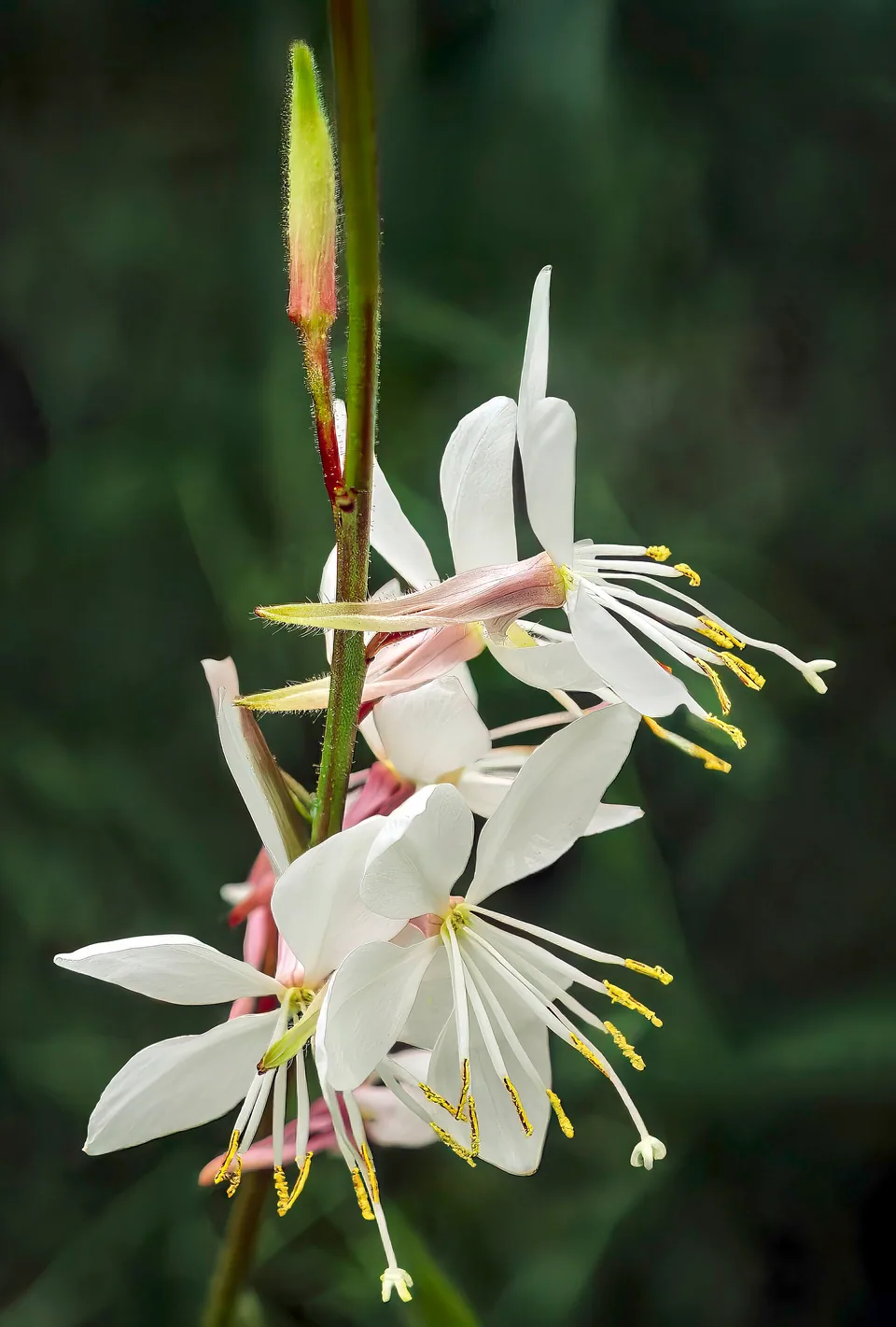
White gaura is a clump-forming herbaceous perennial that grows 3 to 5 feet [0.9–1.5 m] tall and 1 to 2 feet [30–61 cm] wide. [1] It prefers full sun and well-drained soil, and its taproot makes it drought and heat tolerant. [1]
White Gaura care
Measurements in square brackets are our conversion into the other unit system; the quoted text is unchanged.
How to water White Gaura
Watering
Drought and heat tolerant (taproot)
What the sources say (1)
The taproot helps make it drought and heat tolerant.Watering notes
Best in moist, well-drained soils; root rot may occur in poorly drained soils
What the sources say (2)
White Gaura is best grown in sandy, loamy, acidic, moist, well-drained soils.In poorly drained soils, root rot may occur.How much light White Gaura needs
Full sun to partial shade
What the sources say (2)
It prefers full sun and will tolerate heat and humidity.Partial Shade (Direct sunlight only part of the day, 2-6 hours)How much cold White Gaura can take
Hardiness, coldest zone
5a [winter low −28.9 to −26.1 °C (−20 to −15 °F)]
What the sources say (1)
USDA Plant Hardiness Zone:
5a, 5b, 6a, 6b, 7a, 7b, 8a, 8b, 9a, 9bHardiness, warmest zone
9b [winter low −3.9 to −1.1 °C (25 to 30 °F)]
What the sources say (1)
USDA Plant Hardiness Zone:
5a, 5b, 6a, 6b, 7a, 7b, 8a, 8b, 9a, 9bBest soil for White Gaura
6.0
What the sources say (1)
Soil pH:
Acid (<6.0)Where to grow White Gaura
Yes
What the sources say (1)
It may be used along sunny borders or has a container planting.How to propagate White Gaura
Seed, division, basal cuttings
What the sources say (1)
The plant may be propagated by seeds, division, or basal cuttings.How to grow White Gaura
The plant
Life cycle
perennial
What the sources say (1)
White Gaura is a native clump-forming herbaceous perennial. It grows 3 to 5 feet tall and 1 to 2 feet wide.Mature height
91-152 cm (3 to 5 feet)
What the sources say (1)
White Gaura is a native clump-forming herbaceous perennial. It grows 3 to 5 feet tall and 1 to 2 feet wide.Mature width
30-61 cm (1 to 2 feet)
What the sources say (1)
White Gaura is a native clump-forming herbaceous perennial. It grows 3 to 5 feet tall and 1 to 2 feet wide.Pests and diseases
Pests
aphids, whiteflies, flea beetles
What the sources say (1)
Other diseases include rust and powdery mildew. Potential insect pests include aphids, whiteflies, and flea beetles.Diseases
root rot, rust, powdery mildew
What the sources say (1)
In poorly drained soils, root rot may occur. Other diseases include rust and powdery mildew.White Gaura pests and problems
Root rot, rust, powdery mildew
Symptom: Root rot may occur in poorly drained soils; other diseases include rust and powdery mildew
What the sources say (1)
In poorly drained soils, root rot may occur. Other diseases include rust and powdery mildew.
— Oenothera lindheimeri (Appleblossom Grass, Bee Blossom, Butterfly Gaura, Indian feather, Lindheimer's Beeblossom, Lindheimer's clockweed, Lindheimer's Gaura, Pink Gaura, Wand Flower, Whirling butterflies, White Gaura) | North Carolina Extension Gardener Plant Toolbox [1] Aphids, whiteflies, flea beetles
Symptom: Potential insect pests
What the sources say (1)
Potential insect pests include aphids, whiteflies, and flea beetles.
— Oenothera lindheimeri (Appleblossom Grass, Bee Blossom, Butterfly Gaura, Indian feather, Lindheimer's Beeblossom, Lindheimer's clockweed, Lindheimer's Gaura, Pink Gaura, Wand Flower, Whirling butterflies, White Gaura) | North Carolina Extension Gardener Plant Toolbox [1]
Remedies
The sources we checked give no remedies for this plant.
Calendar
Pruning
Cut back flower spikes in fall; remove dead foliage in spring
What the sources say (1)
The flower spikes should be cut back in the fall, and all the dead foliage removed in the spring.Months as given by the sources, which are mostly from the United States (northern hemisphere). In the southern hemisphere they shift by about six months.
Indicative values
Values from a secondary source, not checked word for word like the rest of this page. Use them as a starting point.
- Hours of sun
- 6-8 hoursIndicative value, adapt it to your climate · Secondary source
- Soil
- Rocky, gravelly, dry, Well-drainedIndicative value, adapt it to your climate · Secondary source
- Care level
- MediumIndicative value, adapt it to your climate · Secondary source
- Growth rate
- ModerateIndicative value, adapt it to your climate · Secondary source
Similar plants
- Bigfruit evening primrose Oenothera macrocarpa
- Evening Primrose Oenothera biennis
- Showy Evening Primrose Oenothera speciosa
- Sundrops Oenothera fruticosa
- Abies grandis Abies grandis
- Abraham Trachystemon orientalis
- Abyssinian banana Ensete ventricosum
- Acacia longifolia Acacia longifolia
Sources
Every value above is quoted from these documents. Links lead to the original publisher.
- Oenothera lindheimeri (Appleblossom Grass, Bee Blossom, Butterfly Gaura, Indian feather, Lindheimer's Beeblossom, Lindheimer's clockweed, Lindheimer's Gaura, Pink Gaura, Wand Flower, Whirling butterflies, White Gaura) | North Carolina Extension Gardener Plant Toolbox · plants.ces.ncsu.edu, consulted
Written by Emilio Marruso · last checked