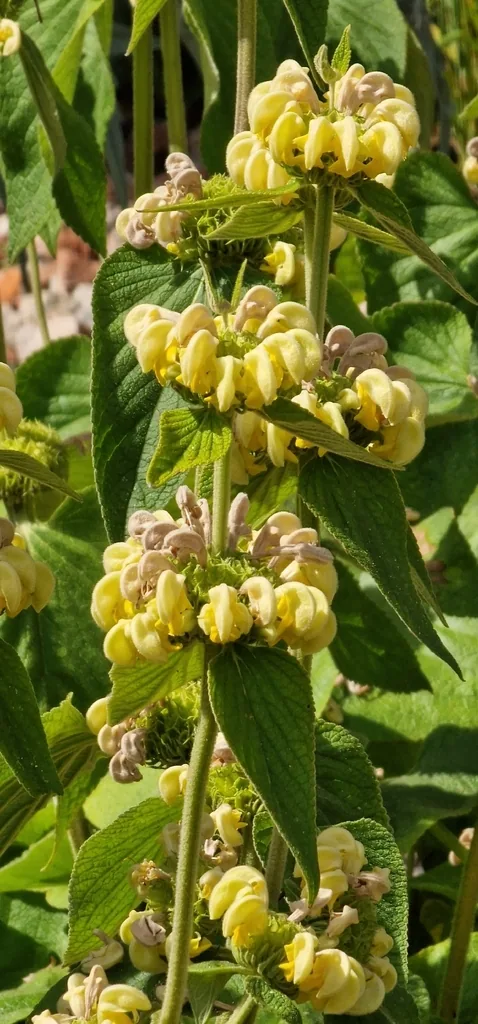
How to Grow and Care for Phlomis russeliana
Phlomis russeliana
Written by Emilio Marruso · last checked
Toxic to: People · Why
At a glance
This perennial from the mint family grows happily in full sun or partial shade and reaches 3 ft tall. Plant it in late spring or early summer, once the last frosts are over, and give it 2 ft of room each way. Each late autumn or winter, simply cut it back to near the ground and let it grow again.
- Sun
Full sun to partial shade
What the sources say (2)
- Spacing
2 ft between plants each way
What the sources say (1)
Spacing: 60 cm (about 60cm [24 in] apart each way)
should be spaced about 60cm apart each way
— Phlomis russeliana - Useful Temperate Plants [5] - Planting
Plant in late spring or early summer, after the last frosts
What the sources say (1)
Planting: Late spring or early summer, after the last expected frosts
Plant them out into their permanent positions in late spring or early summer, after the last expected frosts.
— Phlomis russeliana - Useful Temperate Plants [5] - Pruning
In late autumn or winter, cut it back to near the ground
What the sources say (1)
Pruning: Late autumn or winter: cut back to near ground level
Cut back to near ground-level in late autumn, winter, or any time you no longer want the seedheads.
— About Garden Design - Phlomis russeliana [4] - Pests
Watch for leafhoppers
- Size
Grows 3 ft tall
What the sources say (1)
Mature height: 90 cm [35 in]
Turkish sage is a herbaceous perennial, growing to about 90 cm tall, spreading above and below ground, with softly wrinkled, ovate leaves
— Phlomis russeliana (Sims) Lag. ex Benth. | Plants of the World Online | Kew Science [6] - Propagation
By seed, division in spring or fall, layering or cuttings
What the sources say (3)
Propagation: Seed, division in spring or fall, layering, soft or semi-ripe cuttings
or divide in spring or fall
— Sticky Jerusalem sage - Fine Gardening [1] Propagation is by layering or soft-/semi-ripe cuttings.
— Plant Profile: Phlomis russeliana • AIPH [2] Propagation can be carried out by division of the clumps.
— Phlomis russeliana (Sims) Lag. ex Benth. | Plants of the World Online | Kew Science [6] - Sowing
Sow in spring, indoors or in a greenhouse
- Safety
No known hazards to people
Overview
Turkish sage is a herbaceous perennial about 90 cm [35 in] tall with hooded yellow flowers in whorls, native to Turkey. [6] It grows in any good, well-drained soil in sun or partial shade and is drought tolerant when established. [6] It is cultivated as an ornamental, holds the RHS Award of Garden Merit and suppresses weeds as ground cover. [6]
Phlomis russeliana care
Measurements in square brackets are our conversion into the other unit system; the quoted text is unchanged.
How to water Phlomis russeliana
The sources disagree:
Moisture : Medium Moisture
[1]
How much light Phlomis russeliana needs
Full sun to partial shade
How much cold Phlomis russeliana can take
Hardiness, coldest zone
The sources give different values depending on region, zone or growing conditions.
What each source says
According to Fine Gardening: 3 [winter low −40 to −34.4 °C (−40 to −30 °F)]
According to About Garden Design: 4 [winter low −34.4 to −28.9 °C (−30 to −20 °F)]
Where to grow Phlomis russeliana
60 cm (about 60cm [24 in] apart each way)
What the sources say (1)
should be spaced about 60cm apart each wayHow to propagate Phlomis russeliana
Seed, division in spring or fall, layering, soft or semi-ripe cuttings
What the sources say (3)
or divide in spring or fallPropagation is by layering or soft-/semi-ripe cuttings.Propagation can be carried out by division of the clumps.How to grow Phlomis russeliana
The plant
Life cycle
perennial
What the sources say (1)
The native range of this species is N. Türkiye. It is a perennial and grows primarily in the subtropical biome.Family
Lamiaceae
What the sources say (1)
Lamiaceae
Phlomis
## Phlomis russeliana (Sims) Lag. ex Benth.Mature height
90 cm [35 in]
What the sources say (1)
Turkish sage is a herbaceous perennial, growing to about 90 cm tall, spreading above and below ground, with softly wrinkled, ovate leavesPhlomis russeliana pests and problems
Leafhoppers
Symptom: Leafhopper damage
What the sources say (1)
Usually problem-free except for leaf hoppers.
— Sticky Jerusalem sage - Fine Gardening [1]
Remedies
The sources we checked give no remedies for this plant.
Is Phlomis russeliana poisonous?
Reported by the source, quoted verbatim. This is not medical or veterinary advice: if a person or an animal may have eaten this plant, contact a poison control centre or a veterinarian.
Hazards None known.
[6]
Calendar
Planting
Late spring or early summer, after the last expected frosts
What the sources say (1)
Plant them out into their permanent positions in late spring or early summer, after the last expected frosts.Pruning
Late autumn or winter: cut back to near ground level
What the sources say (1)
Cut back to near ground-level in late autumn, winter, or any time you no longer want the seedheads.Months as given by the sources, which are mostly from the United States (northern hemisphere). In the southern hemisphere they shift by about six months.
Indicative values
Values from a secondary source, not checked word for word like the rest of this page. Use them as a starting point.
- Hours of sun
- 6-8 hoursIndicative value, adapt it to your climate · Secondary source
- Drought tolerant
- yesIndicative value, adapt it to your climate · Secondary source
- Soil
- Well-drainedIndicative value, adapt it to your climate · Secondary source
- Soil pH
- 6-7.5Indicative value, adapt it to your climate · Secondary source
- Care level
- MediumIndicative value, adapt it to your climate · Secondary source
- Growth rate
- HighIndicative value, adapt it to your climate · Secondary source
- Pests
- Deer resistantIndicative value, adapt it to your climate · Secondary source
Similar plants
- Jerusalem Sage Phlomis fruticosa
- Tuberous Jerusalem sage Phlomis tuberosa
- Anise Sage Salvia guaranitica
- Apple mint Mentha suaveolens
- Arrowleaf Sage Salvia sagittata
- Autumn Sage Salvia greggii
- Beach Vitex Vitex rotundifolia
- Beautyberry Callicarpa acuminata
Sources
Every value above is quoted from these documents. Links lead to the original publisher.
- Sticky Jerusalem sage - Fine Gardening · finegardening.com, consulted
- Plant Profile: Phlomis russeliana • AIPH · aiph.org, consulted
- Phlomis russeliana — Friends of the Botanical Gardens Sheffield · fobssheffield.co.uk, consulted
- About Garden Design - Phlomis russeliana · aboutgardendesign.com, consulted
- Phlomis russeliana - Useful Temperate Plants · temperate.theferns.info, consulted
- Phlomis russeliana (Sims) Lag. ex Benth. | Plants of the World Online | Kew Science · powo.science.kew.org, consulted
Written by Emilio Marruso · last checked