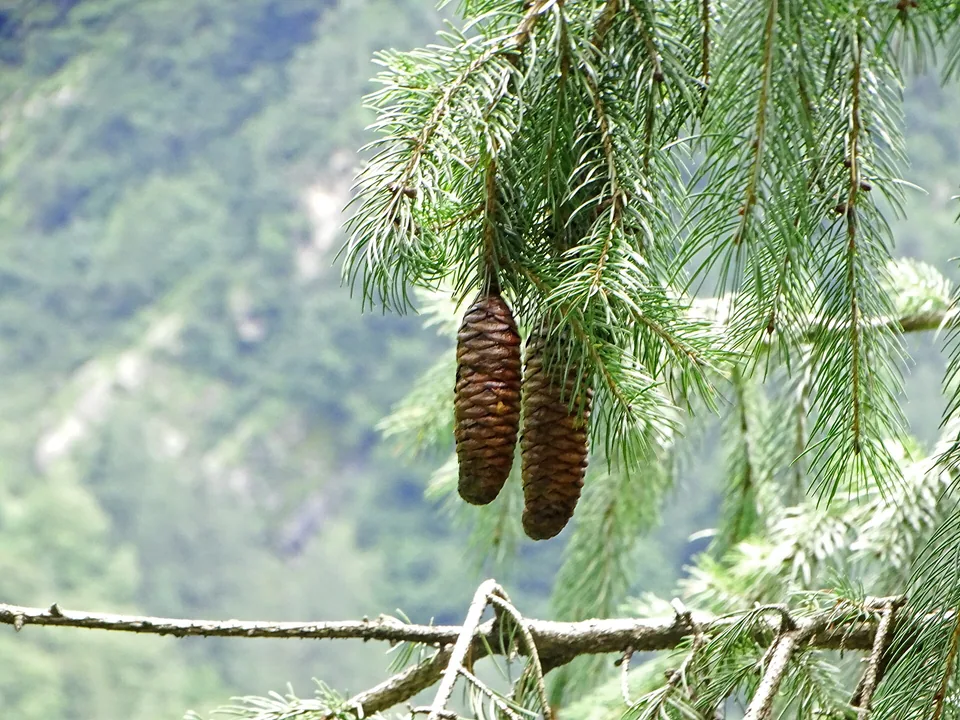


How to Grow and Care for Himalayan Spruce
Picea smithiana
Written by Emilio Marruso · last checked
At a glance
This spruce is a conifer that asks for little: a spot in full sun, well-drained soil and average, steady moisture. It feels best away from high heat and humidity, where it can struggle. Keep an eye out for spider mites, the most common pest on spruces, and you'll have a handsome tree to watch grow year after year.
- Sun
Full sun
What the sources say (2)
Light: Full sun
It is grown in average, medium moisture, well-drained soils in full sun.
— Picea smithiana (Himalayan Spruce, Morinda Spruce, Western Himalayan spruce) | North Carolina Extension Gardener Plant Toolbox [1] Light: Full sun (6 or more hours of direct sunlight a day)
— Picea smithiana (Himalayan Spruce, Morinda Spruce, Western Himalayan spruce) | North Carolina Extension Gardener Plant Toolbox [1] - Water
Average water: keep the soil moderately moist
What the sources say (1)
Watering: Average, medium moisture
It is grown in average, medium moisture, well-drained soils in full sun.
— Picea smithiana (Himalayan Spruce, Morinda Spruce, Western Himalayan spruce) | North Carolina Extension Gardener Plant Toolbox [1] - Cold
Survives winters down to −10 °F (−23.3 °C)
Very hardy · USDA 6a · RHS H7 · Z6
What the sources say (2)
Hardiness, coldest zone: 6a [winter low −23.3 to −20.6 °C (−10 to −5 °F)]
Soil Drainage: Good Drainage USDA Plant Hardiness Zone: 6a, 6b, 7a, 7b
— Picea smithiana (Himalayan Spruce, Morinda Spruce, Western Himalayan spruce) | North Carolina Extension Gardener Plant Toolbox [1] Hardiness, warmest zone: 7b [winter low −15 to −12.2 °C (5 to 10 °F)]
Soil Drainage: Good Drainage USDA Plant Hardiness Zone: 6a, 6b, 7a, 7b
— Picea smithiana (Himalayan Spruce, Morinda Spruce, Western Himalayan spruce) | North Carolina Extension Gardener Plant Toolbox [1] - Soil
Well-drained soil
What the sources say (2)
Watering notes: Grown in well-drained soils; may struggle in locations with high heat and humidity
Plants may struggle in locations that experience high heat and humidity.
— Picea smithiana (Himalayan Spruce, Morinda Spruce, Western Himalayan spruce) | North Carolina Extension Gardener Plant Toolbox [1] Soil Drainage: Good Drainage USDA Plant Hardiness Zone:
— Picea smithiana (Himalayan Spruce, Morinda Spruce, Western Himalayan spruce) | North Carolina Extension Gardener Plant Toolbox [1] - Pests
Spider mites, sawflies, budworms and beetles; rust, canker and rot
What the sources say (2)
Pests: yellow-headed spruce sawfly, spruce budworm, eastern spruce beetle, spider mites
Yellow-headed spruce sawfly, spruce budworm, and eastern spruce beetle are problems in some areas. Spider mites are common.
— Picea smithiana (Himalayan Spruce, Morinda Spruce, Western Himalayan spruce) | North Carolina Extension Gardener Plant Toolbox [1] Diseases: needle and stem rust, canker, trunk and root rot
Although there are no serious insect or disease problems, spruces are generally susceptible to needle and stem rust, canker, trunk and root rot.
— Picea smithiana (Himalayan Spruce, Morinda Spruce, Western Himalayan spruce) | North Carolina Extension Gardener Plant Toolbox [1] - Watch out
May struggle where it is very hot and humid; a conifer native to your area may suit better
What the sources say (2)
Watering notes: Grown in well-drained soils; may struggle in locations with high heat and humidity
Plants may struggle in locations that experience high heat and humidity.
— Picea smithiana (Himalayan Spruce, Morinda Spruce, Western Himalayan spruce) | North Carolina Extension Gardener Plant Toolbox [1] Soil Drainage: Good Drainage USDA Plant Hardiness Zone:
— Picea smithiana (Himalayan Spruce, Morinda Spruce, Western Himalayan spruce) | North Carolina Extension Gardener Plant Toolbox [1]
Overview
Himalayan spruce is an evergreen conifer native to the western Himalayas, with a tall pyramidal form and the longest needles of any spruce. [1] It grows in full sun and well-drained soils and performs best in climates with somewhat cool summers. [1]
This record is incomplete: the sources we read do not cover every field yet.
Not yet covered by our sources: Pruning, Propagation
Himalayan Spruce care
How to water Himalayan Spruce
Watering
Average, medium moisture
What the sources say (1)
It is grown in average, medium moisture, well-drained soils in full sun.Watering notes
Grown in well-drained soils; may struggle in locations with high heat and humidity
What the sources say (2)
Plants may struggle in locations that experience high heat and humidity.Soil Drainage:
Good Drainage
USDA Plant Hardiness Zone:How much light Himalayan Spruce needs
Full sun
What the sources say (2)
It is grown in average, medium moisture, well-drained soils in full sun.Light:
Full sun (6 or more hours of direct sunlight a day)How much cold Himalayan Spruce can take
Hardiness, coldest zone
6a [winter low −23.3 to −20.6 °C (−10 to −5 °F)]
What the sources say (1)
Soil Drainage:
Good Drainage
USDA Plant Hardiness Zone:
6a, 6b, 7a, 7bHardiness, warmest zone
7b [winter low −15 to −12.2 °C (5 to 10 °F)]
What the sources say (1)
Soil Drainage:
Good Drainage
USDA Plant Hardiness Zone:
6a, 6b, 7a, 7bHow to propagate Himalayan Spruce
Not stated in the sources we read.
How to grow Himalayan Spruce
The plant
Family
Pinaceae
What the sources say (1)
Family: Pinaceae Life Cycle: Woody Country Or Region Of Origin: Western Himalayas from Afghanistan to Nepal and Tibet.Pests and diseases
Pests
yellow-headed spruce sawfly, spruce budworm, eastern spruce beetle, spider mites
What the sources say (1)
Yellow-headed spruce sawfly, spruce budworm, and eastern spruce beetle are problems in some areas. Spider mites are common.Diseases
needle and stem rust, canker, trunk and root rot
What the sources say (1)
Although there are no serious insect or disease problems, spruces are generally susceptible to needle and stem rust, canker, trunk and root rot.Fertilizing
When
The sources give different values depending on region, zone or growing conditions.
What each source says
Picea in general: In fall, at a low nitrogen rate
What the sources say (1)
Picea in general: Otherwise, fertilizing at a low rate of N using a slow release fertilizer in the Fall will be fine.How often
The sources give different values depending on region, zone or growing conditions.
What each source says
Picea in general: Only when a soil test shows the need; test the soil every 5 years
What the sources say (1)
Picea in general: Evergreen trees require even less fertilization than deciduous trees- test your soil every 5 years to determine needMineral fertilizers
The sources give different values depending on region, zone or growing conditions.
What each source says
Picea in general: Slow-release fertilizer, since all fertilizers are salts
Picea in general: Nitrogen at the lowest recommended rate
Micronutrients
The sources give different values depending on region, zone or growing conditions.
What each source says
Picea in general: Iron applied to the soil or sprayed on the foliage for iron chlorosis on high-pH soils, often only a temporary fix
What the sources say (1)
Picea in general: Adding iron to the soil or spraying on the foliage may provide a solution but it may be only temporary.Avoid
The sources give different values depending on region, zone or growing conditions.
What each source says
Picea in general: Fertilizing newly planted trees
Picea in general: Fertilizing stressed trees or trees infested by insects or diseases
Picea in general: Fertilizing after new growth emerges in spring or before the trees harden off in fall
Picea in general: Fertilizer in the backfill, which can burn the needles
What the sources say (4)
Picea in general: Never fertilize newly planted trees, only established treesPicea in general: Never fertilize insect or disease infested or stressed treesPicea in general: Never fertilize after new leaves have emerged in spring or before hardening in fallPicea in general: Use the lowest rate of recommended Nitrogen and never put in the back fill or leaves may burnSigns of deficiency
The sources give different values depending on region, zone or growing conditions.
What each source says
Picea in general: Chlorotic needles from iron deficiency on high-pH soils
What the sources say (1)
Picea in general: Sometimes with a high pH such as yours, iron gets tied up in the soil and cant be taken up by plants. This makes the leaves (needles in this case) chlorotic.Signs of excess
The sources give different values depending on region, zone or growing conditions.
What each source says
Picea in general: Top growth at the expense of root growth
What the sources say (1)
Picea in general: Fertilizing results in top growth at the expense of root growthHimalayan Spruce pests and problems
Needle and stem rust, canker, trunk and root rot, spider mites
Symptom: Spruces are generally susceptible to needle and stem rust, canker, trunk and root rot; spider mites are common.
What to do: The source gives no control measure; it advises choosing a conifer native to your area.
What the sources say (2)
Although there are no serious insect or disease problems, spruces are generally susceptible to needle and stem rust, canker, trunk and root rot.
— Picea smithiana (Himalayan Spruce, Morinda Spruce, Western Himalayan spruce) | North Carolina Extension Gardener Plant Toolbox [1] Best grown in cool summer locations. Choose a conifer native to your area.
— Picea smithiana (Himalayan Spruce, Morinda Spruce, Western Himalayan spruce) | North Carolina Extension Gardener Plant Toolbox [1]
Remedies
Each remedy shows what official sources say about it; traditional remedies without an official source are marked as such. Harmful ones are listed so you know to avoid them.
Treating the plant
spider mites
strong water spray from a garden hose Partly works
How: Use the garden hose to apply a forceful stream of water to dislodge mites from an infested plant. Repeat 3 or 4 times on consecutive days.
Use the garden hose to apply a forceful stream of water to dislodge mites from an infested plant. Repeat 3 or 4 times on consecutive days.
— yardandgarden.extension.iastate.edu [3] What the evidence says Hose plants with strong stream of water to wash off spider mites (where practical).
— hortsense.cahnrs.wsu.edu [4] insecticidal soap spray Partly works
Horticultural oils, soap-based products and some other products may cause discoloration of spruce needles, particularly on Colorado blue spruce.
— hortsense.cahnrs.wsu.edu [4] Read labels carefully and test on a small area before application.
— hortsense.cahnrs.wsu.edu [4] How: Spray thoroughly; soap sprays only control mites that are contacted directly.
Soap and oil sprays have no residual activity and only control mites and insects that are contacted directly. Thorough spraying is important for control.
— yardandgarden.extension.iastate.edu [3] What the evidence says Soap and oil sprays have no residual activity and only control mites and insects that are contacted directly. Thorough spraying is important for control.
— yardandgarden.extension.iastate.edu [3] ultrafine horticultural oil spray Works
Oil, however, will cause the waxy bloom on blue or white spruces to permanently darken.
— portal.ct.gov [5] How: Sprayed during the dormant season it controls the overwintering eggs; at a low rate in the growing season it suppresses spider mites.
Ultrafine horticultural oil, which is among the compounds registered for use against this pest in Connecticut, sprayed during the dormant season will control the overwintering eggs.
— portal.ct.gov [5] What the evidence says Ultrafine horticultural oil, which is among the compounds registered for use against this pest in Connecticut, sprayed during the dormant season will control the overwintering eggs.
— portal.ct.gov [5]
aphids
strong water spray from a garden hose Works
How: Regular hosing of small trees with a strong stream of water.
Regular hosing of small trees with a strong stream of water will help wash off aphids.
— hortsense.cahnrs.wsu.edu [6] What the evidence says Regular hosing of small trees with a strong stream of water will help wash off aphids.
— hortsense.cahnrs.wsu.edu [6] insecticidal soap or horticultural oil spray Works
Oil products should not be used if there is any danger of freezing.
— hortsense.cahnrs.wsu.edu [6] How: Spray when aphids occur in great numbers.
Should they occur in great numbers, spraying with insecticidal soap or horticultural oil, which are among the compounds registered for use against this pest in Connecticut, will control them.
— portal.ct.gov [5] What the evidence says Should they occur in great numbers, spraying with insecticidal soap or horticultural oil, which are among the compounds registered for use against this pest in Connecticut, will control them.
— portal.ct.gov [5]
cytospora canker
pruning out infected branches Partly works
How: Prune and remove symptomatic twigs and branches as soon as they are evident and when the bark is dry; cut 8-10 inches below visible symptoms.
Helpful practices to manage this diseases include pruning and removing symptomatic twigs and branches as soon as they are evident and when the bark is dry.
— portal.ct.gov [5] What the evidence says Helpful practices to manage this diseases include pruning and removing symptomatic twigs and branches as soon as they are evident and when the bark is dry.
— portal.ct.gov [5]
Calendar
Pruning
Not stated in the sources we read.
Months as given by the sources, which are mostly from the United States (northern hemisphere). In the southern hemisphere they shift by about six months.
Indicative values
Values from a secondary source, not checked word for word like the rest of this page. Use them as a starting point.
- Life cycle
- PerennialIndicative value, adapt it to your climate · Secondary source
- Mature height
- 2133.6-3048 cm (70-100 ft)Indicative value, adapt it to your climate · Secondary source
- Hours of sun
- 4-5 hoursIndicative value, adapt it to your climate · Secondary source
- Drought tolerant
- yesIndicative value, adapt it to your climate · Secondary source
- Soil pH
- 5.5-6.5Indicative value, adapt it to your climate · Secondary source
- Care level
- MediumIndicative value, adapt it to your climate · Secondary source
- Growth rate
- LowIndicative value, adapt it to your climate · Secondary source
- Pruning
- March, AprilIndicative value, adapt it to your climate · Secondary source
- Propagation
- Cutting, Grafting Propagation, Layering Propagation, Air Layering Propagation, Seed PropagationIndicative value, adapt it to your climate · Secondary source
Similar plants
- Black Spruce Picea mariana
- Blue spruce Picea pungens
- Dragon Spruce Picea asperata
- Norway Spruce Picea abies
- Oriental Spruce Picea orientalis
- Serbian Spruce Picea omorika
- Sitka Spruce Picea sitchensis
- White Spruce Picea laxa
Sources
Every value above is quoted from these documents. Links lead to the original publisher.
- Picea smithiana (Himalayan Spruce, Morinda Spruce, Western Himalayan spruce) | North Carolina Extension Gardener Plant Toolbox · plants.ces.ncsu.edu, consulted
- ask.extension.org · ask.extension.org
- yardandgarden.extension.iastate.edu · yardandgarden.extension.iastate.edu
- hortsense.cahnrs.wsu.edu · hortsense.cahnrs.wsu.edu
- portal.ct.gov · portal.ct.gov
- hortsense.cahnrs.wsu.edu · hortsense.cahnrs.wsu.edu
Written by Emilio Marruso · last checked