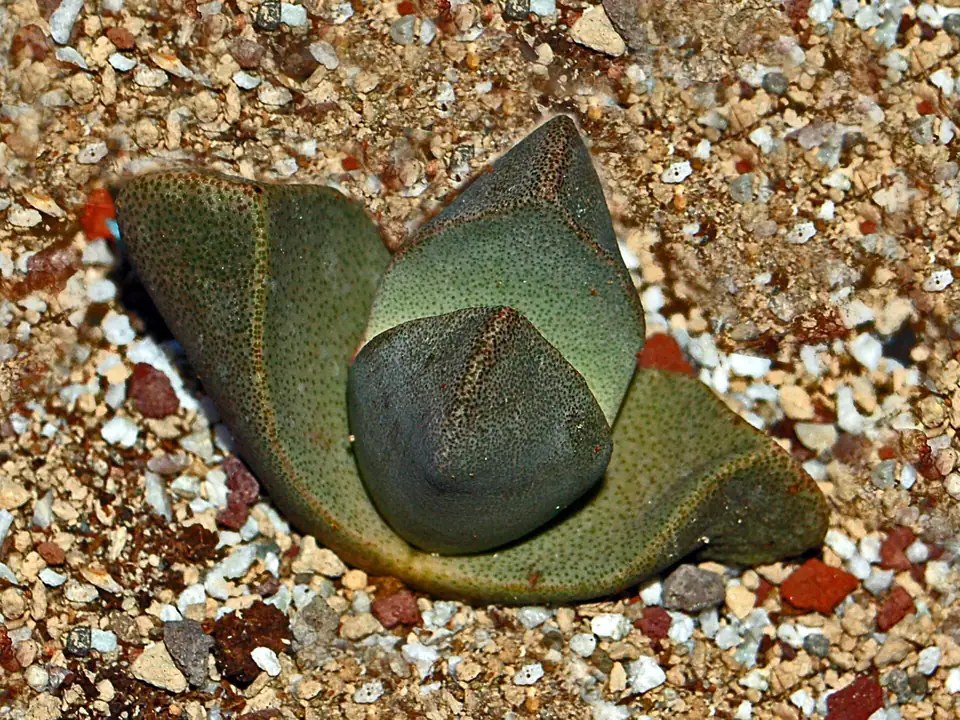


How to Grow and Care for African Living Rock
Pleiospilos bolusii
Written by Emilio Marruso · last checked
Not toxic to cats and dogs, according to the sources · Sources
At a glance
This little succulent stays just 3 inches tall and 6 inches wide, perfect for a bright spot indoors or a small pot. It rests in summer without any water, then wakes up in fall, when you water it thoroughly and let the mix dry out in between. It is safe around cats, dogs and horses, and only aphids tend to bother it.
- Sun
Bright, indirect light; morning sun is fine, but give it afternoon shade
What the sources say (1)
Light: Bright, indirect sunlight; tolerates direct morning sun; partial shade in the afternoon
This plant prefers bright, indirect sunlight. It can tolerate direct morning sun but prefers partial shade in the afternoon.
— Pleiospilos bolusii (African Living Rock, Living Rock Cactus, Mimicry Plant) | North Carolina Extension Gardener Plant Toolbox [1] - Water
No water in summer; in fall water deeply and let the mix dry out between waterings
What the sources say (2)
Watering: Dormant in summer and needs no water; in fall, water thoroughly during the growing cycle and let the potting mix dry out between waterings
The plant is dormant during the summer and does not require water. During the fall, it is best to water thoroughly during its growing cycle but allow the potting mix to dry out between waterings.
— Pleiospilos bolusii (African Living Rock, Living Rock Cactus, Mimicry Plant) | North Carolina Extension Gardener Plant Toolbox [1] Watering notes: Well-draining potting mix; avoid overwatering
Insects, Diseases, and Other Plant Problems: This plant is generally disease free. Monitor for aphids and avoid overwatering.
— Pleiospilos bolusii (African Living Rock, Living Rock Cactus, Mimicry Plant) | North Carolina Extension Gardener Plant Toolbox [1] - Cold
Survives winters down to 25 °F (−3.9 °C)
Half hardy: mild winters or an unheated greenhouse · USDA 9b · RHS H3 · Z9
What the sources say (2)
Hardiness, coldest zone: 9b [winter low −3.9 to −1.1 °C (25 to 30 °F)]
USDA Plant Hardiness Zone: 9b, 10a, 10b, 11a
— Pleiospilos bolusii (African Living Rock, Living Rock Cactus, Mimicry Plant) | North Carolina Extension Gardener Plant Toolbox [1] They are not cold weather tolerant and are hardy in USDA Plant Hardiness Zones of 9b to 11b.
— Pleiospilos bolusii (African Living Rock, Living Rock Cactus, Mimicry Plant) | North Carolina Extension Gardener Plant Toolbox [1] - Soil
A potting mix that drains well; too much water harms it
What the sources say (1)
Watering notes: Well-draining potting mix; avoid overwatering
Insects, Diseases, and Other Plant Problems: This plant is generally disease free. Monitor for aphids and avoid overwatering.
— Pleiospilos bolusii (African Living Rock, Living Rock Cactus, Mimicry Plant) | North Carolina Extension Gardener Plant Toolbox [1] - Pests
Watch out for aphids
What the sources say (1)
Pests: aphids
Insects, Diseases, and Other Plant Problems: This plant is generally disease free. Monitor for aphids and avoid overwatering.
— Pleiospilos bolusii (African Living Rock, Living Rock Cactus, Mimicry Plant) | North Carolina Extension Gardener Plant Toolbox [1] - Size
3 in tall and 6 in wide
What the sources say (2)
Mature height: 7.62 cm (3 in)
The plant has a clump-forming habit, stemless, and grows about 3 inches tall and 6 inches wide with a split in the middle where new growth occurs.
— Pleiospilos bolusii (African Living Rock, Living Rock Cactus, Mimicry Plant) | North Carolina Extension Gardener Plant Toolbox [1] Mature width: 15.24 cm (6 in)
The plant has a clump-forming habit, stemless, and grows about 3 inches tall and 6 inches wide with a split in the middle where new growth occurs.
— Pleiospilos bolusii (African Living Rock, Living Rock Cactus, Mimicry Plant) | North Carolina Extension Gardener Plant Toolbox [1] - Propagation
Grow new plants from seed or by dividing the plant
What the sources say (1)
Propagation: Seed, division
Repotting may be required every 2 years. It may be propagated by seeds or division.
— Pleiospilos bolusii (African Living Rock, Living Rock Cactus, Mimicry Plant) | North Carolina Extension Gardener Plant Toolbox [1] - Containers
Grows well in pots and indoors
What the sources say (2)
In containers: Yes
Landscape Location: Container Houseplants Small Space Landscape Theme: Rock Garden
— Pleiospilos bolusii (African Living Rock, Living Rock Cactus, Mimicry Plant) | North Carolina Extension Gardener Plant Toolbox [1] Indoors: Yes
This small plant is easy to grow, and it can be used as a houseplant or in warmer climates planted in a rock garden.
— Pleiospilos bolusii (African Living Rock, Living Rock Cactus, Mimicry Plant) | North Carolina Extension Gardener Plant Toolbox [1] - Safety
Not toxic to cats, dogs or horses
Overview
Pleiospilos bolusii is a small stemless succulent from South Africa, about 3 inches [7.6 cm] tall and 6 inches [15 cm] wide. [1] It needs a well-draining potting mix and no water while dormant in summer. [1]
African Living Rock care
Measurements in square brackets are our conversion into the other unit system; the quoted text is unchanged.
How to water African Living Rock
Watering
Dormant in summer and needs no water; in fall, water thoroughly during the growing cycle and let the potting mix dry out between waterings
What the sources say (1)
The plant is dormant during the summer and does not require water. During the fall, it is best to water thoroughly during its growing cycle but allow the potting mix to dry out between waterings.Watering notes
Well-draining potting mix; avoid overwatering
What the sources say (1)
Insects, Diseases, and Other Plant Problems: This plant is generally disease free. Monitor for aphids and avoid overwatering.How much light African Living Rock needs
Bright, indirect sunlight; tolerates direct morning sun; partial shade in the afternoon
What the sources say (1)
This plant prefers bright, indirect sunlight. It can tolerate direct morning sun but prefers partial shade in the afternoon.How much cold African Living Rock can take
Hardiness, coldest zone
9b [winter low −3.9 to −1.1 °C (25 to 30 °F)]
What the sources say (2)
USDA Plant Hardiness Zone:
9b, 10a, 10b, 11aThey are not cold weather tolerant and are hardy in USDA Plant Hardiness Zones of 9b to 11b.Hardiness, warmest zone
The sources disagree:
What the sources say (2)
USDA Plant Hardiness Zone:
9b, 10a, 10b, 11aThey are not cold weather tolerant and are hardy in USDA Plant Hardiness Zones of 9b to 11b.Where to grow African Living Rock
Indoors
Yes
What the sources say (1)
This small plant is easy to grow, and it can be used as a houseplant or in warmer climates planted in a rock garden.In containers
Yes
What the sources say (1)
Landscape Location:
Container
Houseplants
Small Space
Landscape Theme:
Rock GardenHow to propagate African Living Rock
Seed, division
What the sources say (1)
Repotting may be required every 2 years. It may be propagated by seeds or division.How to grow African Living Rock
The plant
Life cycle
perennial
What the sources say (1)
The African Living Rock is a small succulent herbaceous perennial that has a stone-like or pebble-like appearance and is native to South Africa.Family
Aizoaceae
What the sources say (1)
It is a member of the ice plant family (Aizoaceae).Mature height
7.62 cm (3 in)
What the sources say (1)
The plant has a clump-forming habit, stemless, and grows about 3 inches tall and 6 inches wide with a split in the middle where new growth occurs.Mature width
15.24 cm (6 in)
What the sources say (1)
The plant has a clump-forming habit, stemless, and grows about 3 inches tall and 6 inches wide with a split in the middle where new growth occurs.Pests and diseases
Pests
aphids
What the sources say (1)
Insects, Diseases, and Other Plant Problems: This plant is generally disease free. Monitor for aphids and avoid overwatering.Remedies
Each remedy shows what official sources say about it; traditional remedies without an official source are marked as such. Harmful ones are listed so you know to avoid them.
Treating the plant
mealybugs
rubbing alcohol swab Official source, not independently tested
Make sure to test the soap and alcohol mixtures on a small portion of the plant prior to full application because some plants may be sensitive to soap or alcohol.
— planttalk.colostate.edu [2] How: Dab the insects with a cotton swab dipped in rubbing alcohol and repeat every week until the bugs are gone.
For smaller infestations, dab the insects with a cotton swab dipped in rubbing alcohol. Repeat this procedure every week until the bugs are gone.
— planttalk.colostate.edu [2] insecticidal soap Official source, not independently tested
Make sure to test the soap and alcohol mixtures on a small portion of the plant prior to full application because some plants may be sensitive to soap or alcohol.
— planttalk.colostate.edu [2] How: Prune infested branches, destroy heavily infested plants; the pests may also be controlled with insecticidal soap.
Control mealy bugs by pruning infested branches and removing and destroying heavily infested plants. These pests may also be controlled with insecticidal soap.
— planttalk.colostate.edu [2]
root rot
removing affected parts and changing the substrate Not verified
Traditional remedy, not verified by an official source.
How: Remove the affected parts and change the substrate.
Is African Living Rock poisonous?
Reported by the source, quoted verbatim. This is not medical or veterinary advice: if a person or an animal may have eaten this plant, contact a poison control centre or a veterinarian.
#succulent #non-toxic for cats #non-toxic for horses #non-toxic for dogs
[1]The source flags the risk for this animal but does not explain why.
Edibility
Reported by the source, quoted verbatim. Do not eat a plant on the basis of this page alone: identification mistakes can be dangerous.
Wildlife Value: In South Africa, sheep and goats feed on this plant.
[1]
Similar plants
- Hardy Ice Plant Delosperma nubigenum
- Delosperma sutherlandii Delosperma sutherlandii
- Hardy Ice Plant Delosperma cooperi
- Mesembryanthemum cordifolium Mesembryanthemum cordifolium
- Sour fig Carpobrotus edulis
- Abies grandis Abies grandis
- Acanthus hungaricus Acanthus hungaricus
- Achlys triphylla Achlys triphylla
Sources
Every value above is quoted from these documents. Links lead to the original publisher.
- Pleiospilos bolusii (African Living Rock, Living Rock Cactus, Mimicry Plant) | North Carolina Extension Gardener Plant Toolbox · plants.ces.ncsu.edu, consulted
- planttalk.colostate.edu · planttalk.colostate.edu
Written by Emilio Marruso · last checked