How to Grow and Care for Pyrus salicifolia
Pyrus salicifolia
Written by Emilio Marruso · last checked
At a glance
The willow-leaved pear is an easygoing tree that grows 15–25 ft tall and just as wide. It is happy in full sun or partial shade, accepts soils from pH 5.5 to 7.5, and once established it shrugs off drought. Just keep an eye out for fireblight, the one disease it is very vulnerable to.
- Sun
Full sun to partial shade
- Water
Once established, it handles drought well
What the sources say (1)
Watering: Established plants are drought tolerant
Established plants are drought tolerant[ 200 Title The
— Pyrus salicifolia - Useful Temperate Plants [5] - Cold
Survives winters down to −30 °F (−34.4 °C)
Very hardy · USDA 4 · RHS H7 · Z4
What the sources say (3)
Hardiness, coldest zone: 4 [winter low −34.4 to −28.9 °C (−30 to −20 °F)]
USDA Hardiness Zone: 4 to 7 AHS Heat
— Pyrus salicifolia ( Willowleaf Pear ) - Professional Gardening Tips [2] Hardiness: - USDA Zone 4 552 Deciduous /
— Pyrus salicifolia (Willowleaf Pear) – Purdue Arboretum Explorer [3] Hardiness, warmest zone: 7 [winter low −17.8 to −12.2 °C (0 to 10 °F)]
USDA Hardiness Zone: 4 to 7 AHS Heat
— Pyrus salicifolia ( Willowleaf Pear ) - Professional Gardening Tips [2] - Soil
Soil from slightly acidic to slightly alkaline, pH 5.5–7.5
- Harvest
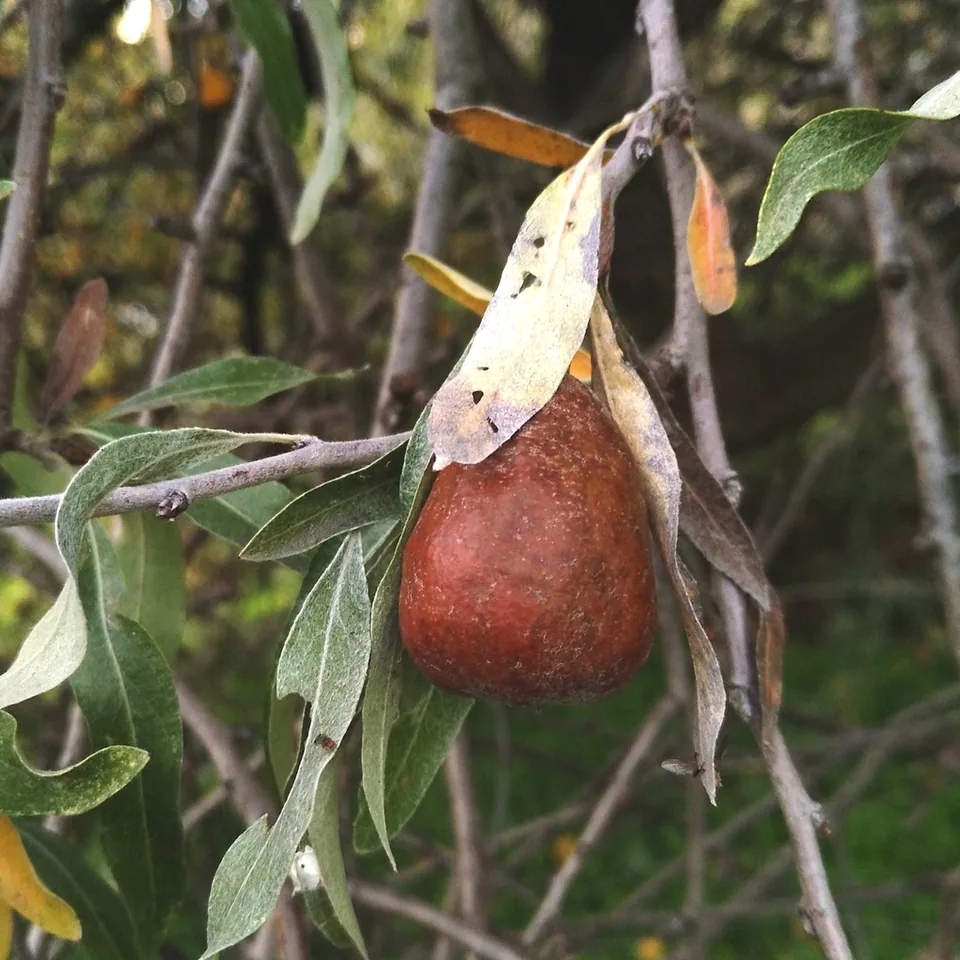
Green, pear-like fruit in summer, but sour, astringent and hardly edible
- Pests
Very vulnerable to fireblight
What the sources say (1)
Diseases: fireblight
Attractive clusters of white flowers appear in the spring. Severe fireblight susceptibility.
— Pyrus salicifolia (Willowleaf Pear) – Purdue Arboretum Explorer [3] - Size
15–25 ft tall and just as wide
What the sources say (2)
Mature height: 457.2-762 cm (15-25 ft)
Fruit Notes: Brown (Sparsely produced and not ornamentally important) Ultimate Height: 15-25 feet Ultimate Spread: 15-25 feet
— Pyrus salicifolia (Willowleaf Pear) – Purdue Arboretum Explorer [3] Mature width: 457.2-762 cm (15-25 ft)
Fruit Notes: Brown (Sparsely produced and not ornamentally important) Ultimate Height: 15-25 feet Ultimate Spread: 15-25 feet
— Pyrus salicifolia (Willowleaf Pear) – Purdue Arboretum Explorer [3] - Propagation
From seed, sown in a cold frame as soon as it ripens in autumn
What the sources say (1)
Propagation: Seed, sown in a cold frame as soon as ripe in autumn
Seed - best sown in a cold frame as soon as it is ripe in the autumn
— Pyrus salicifolia - Useful Temperate Plants [5]
Overview
Pyrus salicifolia is a deciduous pear tree with silvery, willow-like foliage, grown as an ornamental. [5][3] It is susceptible to fireblight. [3][4] It does best in full sun and tolerates a wide range of soils and established drought. [3][5]
This record is incomplete: the sources we read do not cover every field yet.
Not yet covered by our sources: Pruning
Pyrus salicifolia care
How to water Pyrus salicifolia
Established plants are drought tolerant
What the sources say (1)
Established plants are drought tolerant[ 200 Title
TheHow much light Pyrus salicifolia needs
How much cold Pyrus salicifolia can take
Hardiness, coldest zone
4 [winter low −34.4 to −28.9 °C (−30 to −20 °F)]
Hardiness, warmest zone
7 [winter low −17.8 to −12.2 °C (0 to 10 °F)]
What the sources say (1)
USDA Hardiness Zone:
4 to 7
AHS HeatBest soil for Pyrus salicifolia
Soil pH, minimum
5.5
What the sources say (1)
pH Range:
5.5 to 7.5
Soil Range:
SomeSoil pH, maximum
7.5
What the sources say (1)
pH Range:
5.5 to 7.5
Soil Range:
SomeHow to propagate Pyrus salicifolia
Seed, sown in a cold frame as soon as ripe in autumn
What the sources say (1)
Seed - best sown in a cold frame as soon as it is ripe in the autumnHow to grow Pyrus salicifolia
The plant
Family
Rosaceae
What the sources say (1)
Family:
- Rosaceae (Rose Family) 217
Genus:
- Pyrus (Pear Callery Pear)Mature height
457.2-762 cm (15-25 ft)
What the sources say (1)
Fruit Notes:
Brown (Sparsely produced and not ornamentally important)
Ultimate Height:
15-25 feet
Ultimate Spread:
15-25 feetMature width
457.2-762 cm (15-25 ft)
What the sources say (1)
Fruit Notes:
Brown (Sparsely produced and not ornamentally important)
Ultimate Height:
15-25 feet
Ultimate Spread:
15-25 feetPests and diseases
Diseases
fireblight
What the sources say (1)
Attractive clusters of white flowers appear in the spring. Severe fireblight susceptibility.Pyrus salicifolia pests and problems
Fireblight
Symptom: The tree is very vulnerable to fireblight.
Remedies
Each remedy shows what official sources say about it; traditional remedies without an official source are marked as such. Harmful ones are listed so you know to avoid them.
Treating the plant
fire blight
pruning out and destroying infected tissue Official source, not independently tested
To reduce chances of spreading bacteria, do not perform blight removal during regular pruning.
— hortsense.cahnrs.wsu.edu [6] How: Prune out and destroy infected tissues when noticed; cut below infected areas and sterilize pruning tools between cuts.
Prune out and destroy infected tissues when noticed. Make cuts at least 6″ below infected areas and sterilize pruning tools between cuts.
— hortsense.cahnrs.wsu.edu [6]
aphids
washing off with a strong stream of water Official source, not independently tested
How: Wash aphids and honeydew from trees with a strong stream of water.
Wash aphids and honeydew from trees with a strong stream of water.
— hortsense.cahnrs.wsu.edu [7] insecticidal soap Partly works
Homeowners should not make foliar applications to trees over 10 ft tall.
— hortsense.cahnrs.wsu.edu [7] How: Use insecticidal soap as needed during the summer; soaps may require several applications.
Use insecticidal soap or azadirachtin as needed during the summer. - Soaps may require several applications.
— hortsense.cahnrs.wsu.edu [7] What the evidence says Use insecticidal soap or azadirachtin as needed during the summer. - Soaps may require several applications.
— hortsense.cahnrs.wsu.edu [7] horticultural spray oil Official source, not independently tested
superior-type oil-Do not apply after delayed-dormant. Apply with enough water to cover the entire tree thoroughly.
— pnwhandbooks.org [8] How: Apply superior spray oils to manage overwintering aphid eggs.
Apply superior spray oils to manage overwintering aphid eggs.
— hortsense.cahnrs.wsu.edu [7]
Calendar
Pruning
Not stated in the sources we read.
Months as given by the sources, which are mostly from the United States (northern hemisphere). In the southern hemisphere they shift by about six months.
Edibility
Reported by the source, quoted verbatim. Do not eat a plant on the basis of this page alone: identification mistakes can be dangerous.
Indicative values
Values from a secondary source, not checked word for word like the rest of this page. Use them as a starting point.
- Life cycle
- PerennialIndicative value, adapt it to your climate · Secondary source
- Care level
- MediumIndicative value, adapt it to your climate · Secondary source
- Growth rate
- ModerateIndicative value, adapt it to your climate · Secondary source
- Pruning
- February, March, AprilIndicative value, adapt it to your climate · Secondary source
- Pests
- Fungal leaf spot, Pest resistantIndicative value, adapt it to your climate · Secondary source
Similar plants
- Asian Pear Pyrus pyrifolia
- Pear Pyrus communis
- Callery Pear Pyrus calleryana
- Pyrus spinosa Pyrus spinosa
- Afghan Cherry Prunus jacquemontii
- Alabama Snow Wreath Neviusia alabamensis
- American Plum Prunus americana
- Amur chokecherry Prunus maackii
Sources
Every value above is quoted from these documents. Links lead to the original publisher.
- How to Grow Pyrus - Flowering Pear · harvesttotable.com, consulted
- Pyrus salicifolia ( Willowleaf Pear ) - Professional Gardening Tips · backyardgardener.com, consulted
- Pyrus salicifolia (Willowleaf Pear) – Purdue Arboretum Explorer · arboretum.purdue.edu, consulted
- Weeping Willow-leafed Pear | Yale Nature Walk · naturewalk.yale.edu, consulted
- Pyrus salicifolia - Useful Temperate Plants · temperate.theferns.info, consulted
- hortsense.cahnrs.wsu.edu · hortsense.cahnrs.wsu.edu
- hortsense.cahnrs.wsu.edu · hortsense.cahnrs.wsu.edu
- pnwhandbooks.org · pnwhandbooks.org
Written by Emilio Marruso · last checked