
How to Grow and Care for Arrowroot
Tacca leontopetaloides
Written by Emilio Marruso · last checked
Toxic to: Livestock · Why
At a glance
Polynesian arrowroot hides a treasure underground: once properly cooked, its tubers are a good source of starch. Plant small tubers at the start of the rainy season in partial shade, give them moderate water and well-drained soil, and the plant even shrugs off salty soil and sea spray. Dig up your harvest when the leaves begin to wither.
- Sun
Partial shade
- Water
Moderate water
What the sources say (1)
Watering: Moderate water
Light Preference | Semi-Shade | Water Preference | Moderate Water
— NParks | Tacca leontopetaloides [1] - Soil
Well-drained soil; it handles salty soil and sea spray
What the sources say (1)
Watering notes: Well-drained soils; tolerates saline soils and salt spray
Rootzone Tolerance | Well-Drained Soils, Saline Soils / Salt Spray
— NParks | Tacca leontopetaloides [1] - Spacing
2–3 ft by 18 in apart; plant small tubers 6 in deep
What the sources say (1)
Spacing: 60-90 cm [24–35 in] x 45 cm [18 in] (small secondary tubers planted 15 cm [5.9 in] deep)
Usually, small secondary tubers are planted 15 cm deep, in rows at a spacing of 60—90 cm 45 cm, preferably at the beginning of the rainy season.
— PROSEA - Plant Resources of South East Asia [2] - Planting
Plant at the beginning of the rainy season
What the sources say (1)
Planting: Beginning of the rainy season
Usually, small secondary tubers are planted 15 cm deep, in rows at a spacing of 60—90 cm 45 cm, preferably at the beginning of the rainy season.
— PROSEA - Plant Resources of South East Asia [2] - Harvest
Dig when the leaves wither; never eat the tubers raw, only after thorough cooking
What the sources say (2)
Harvest: When the leaves begin to wither
When the leaves begin to wither the tubers can be harvested by digging them up.
— PROSEA - Plant Resources of South East Asia [2] Tubers are harvested when the aerial parts have died.
— Gau-gau, Tacca pinnatifida, EAST INDIAN ARROWROOT : Philippine Medicinal Herbs / Alternative Medicine [4] - Propagation
From seed or tubers
- Safety
The peels are poisonous to livestock and other animals: keep them away
Overview
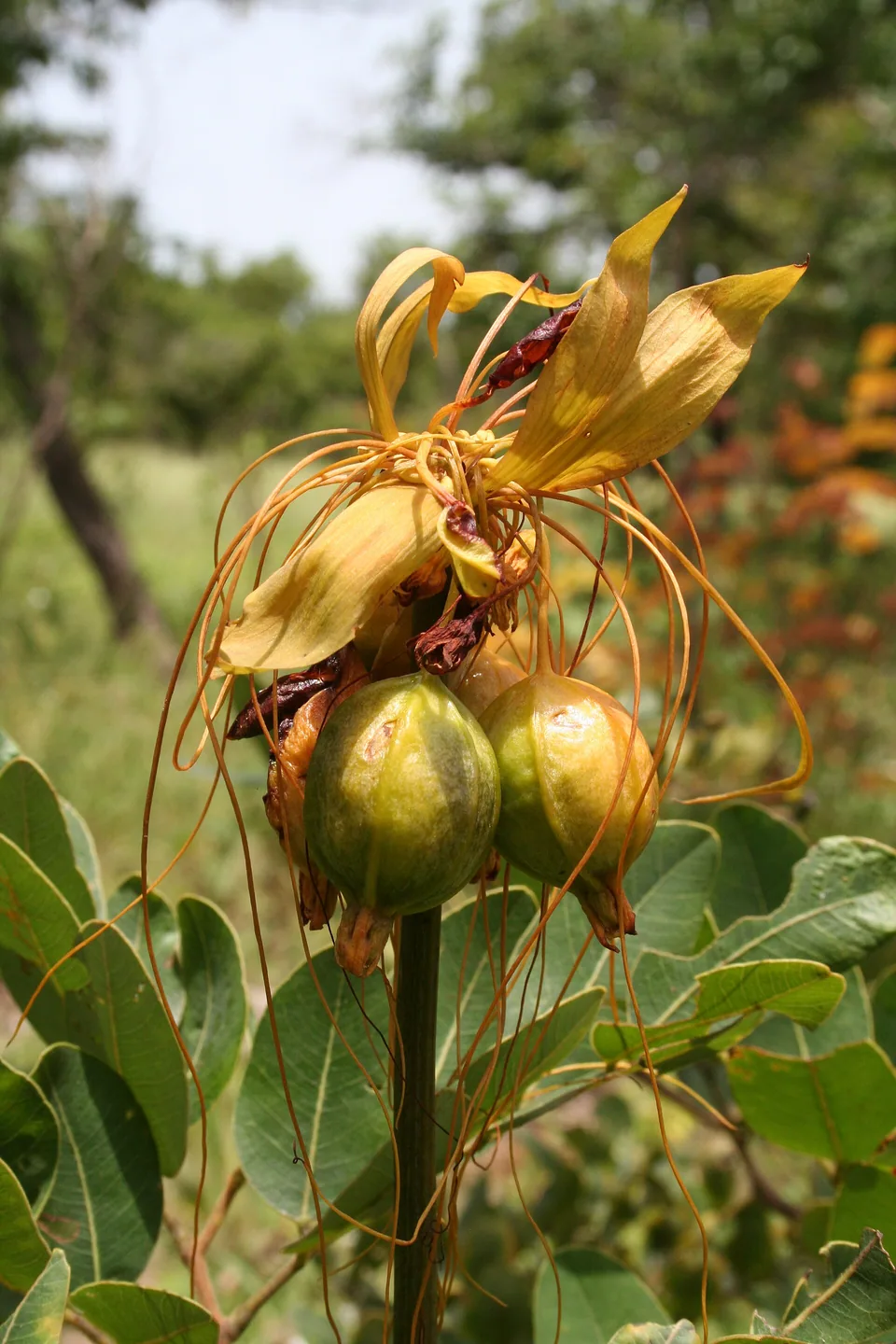
East Indian arrowroot is a perennial tuberous herb of tropical coasts whose tubers are edible after proper cooking and yield starch. [1][2] It is also cultivated as an ornamental for its leaves and flowering shoot, in semi-shade with moderate water and well-drained soil. [1] It is propagated by seed or tubers. [1]
Arrowroot care
Measurements in square brackets are our conversion into the other unit system; the quoted text is unchanged.
How to water Arrowroot
Watering
Moderate water
What the sources say (1)
Light Preference
| Semi-Shade
| Water Preference
| Moderate WaterWatering notes
Well-drained soils; tolerates saline soils and salt spray
What the sources say (1)
Rootzone Tolerance
| Well-Drained Soils, Saline Soils / Salt SprayHow much light Arrowroot needs
Where to grow Arrowroot
60-90 cm [24–35 in] x 45 cm [18 in] (small secondary tubers planted 15 cm [5.9 in] deep)
What the sources say (1)
Usually, small secondary tubers are planted 15 cm deep, in rows at a spacing of 60—90 cm 45 cm, preferably at the beginning of the rainy season.How to propagate Arrowroot
How to grow Arrowroot
The plant
Family
Dioscoreaceae
What the sources say (1)
Order Dioscoreales ( 1DIOO ) Family Dioscoreaceae ( 1DIOF ) Genus Tacca ( 1TCCG ) Species Tacca leontopetaloides ( TCCLE )Remedies
Each remedy shows what official sources say about it; traditional remedies without an official source are marked as such. Harmful ones are listed so you know to avoid them.
Treating the plant
leaf spot
remove infected leaves and burn them Not verified
Traditional remedy, not verified by an official source.
How: Remove infected leaves when the disease is first seen, and burn them; this applies only to newly planted patches of the same age.
destroy crop remains after harvest Not verified
Traditional remedy, not verified by an official source.
How: After harvest, collect the remains of the crop and destroy them by burning or burying.
Is Arrowroot toxic to pets?
Reported by the source, quoted verbatim. This is not medical or veterinary advice: if a person or an animal may have eaten this plant, contact a poison control centre or a veterinarian.
Calendar
Planting
Beginning of the rainy season
What the sources say (1)
Usually, small secondary tubers are planted 15 cm deep, in rows at a spacing of 60—90 cm 45 cm, preferably at the beginning of the rainy season.Harvest
When the leaves begin to wither
What the sources say (2)
When the leaves begin to wither the tubers can be harvested by digging them up.Tubers are harvested when the aerial parts have died.Months as given by the sources, which are mostly from the United States (northern hemisphere). In the southern hemisphere they shift by about six months.
Edibility
Reported by the source, quoted verbatim. Do not eat a plant on the basis of this page alone: identification mistakes can be dangerous.
The tubers are edible after proper cooking, and are a good source of starch.
[1]Although fresh tubers are inedible because of the presence of bitter toxic substances, they can be eaten after thorough preparation or, more important, an edible starch can be extracted from them.
[2]Sometimes the leaves are used as a vegetable.
[2]In Gabon, the fruit pulp is eaten by children.
[2]
Indicative values
Values from a secondary source, not checked word for word like the rest of this page. Use them as a starting point.
- Life cycle
- Herbaceous PerennialIndicative value, adapt it to your climate · Secondary source
- Mature height
- 45.7-61 cm (1.5-2 ft)Indicative value, adapt it to your climate · Secondary source
- Hours of sun
- 4-6 hoursIndicative value, adapt it to your climate · Secondary source
- Soil pH
- 6.1-7.5Indicative value, adapt it to your climate · Secondary source
- USDA hardiness zones
- 8-11 [winter low −12.2 to 10 °C (10 to 50 °F)]Indicative value, adapt it to your climate · Secondary source
- Indoors
- yesIndicative value, adapt it to your climate · Secondary source
- Care level
- MediumIndicative value, adapt it to your climate · Secondary source
- Growth rate
- LowIndicative value, adapt it to your climate · Secondary source
- Pruning
- June, July, August, May, December, January, FebruaryIndicative value, adapt it to your climate · Secondary source
Similar plants
- Tacca integrifolia Tacca integrifolia
- Chinese yam Dioscorea polystachya
- Wild Yam Dioscorea villosa
- Air Potato Dioscorea bulbifera
- Abies grandis Abies grandis
- Acanthus hungaricus Acanthus hungaricus
- Achlys triphylla Achlys triphylla
- Aconite Aconitum napellus
Sources
Every value above is quoted from these documents. Links lead to the original publisher.
- NParks | Tacca leontopetaloides · nparks.gov.sg, consulted
- PROSEA - Plant Resources of South East Asia · prosea.prota4u.org, consulted
- Tacca leontopetaloides - Some Magnetic Island Plants · somemagneticislandplants.com.au, consulted
- Gau-gau, Tacca pinnatifida, EAST INDIAN ARROWROOT : Philippine Medicinal Herbs / Alternative Medicine · stuartxchange.org, consulted
- Tacca leontopetaloides (TCCLE)[Overview]| EPPO Global Database · gd.eppo.int, consulted
Written by Emilio Marruso · last checked