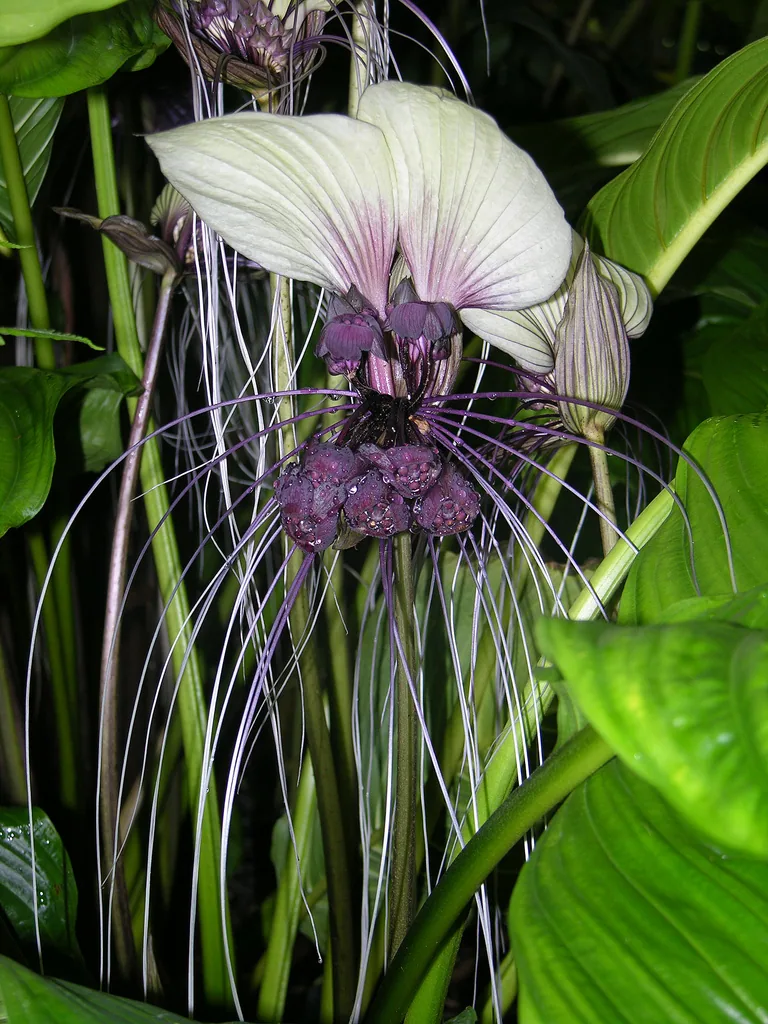
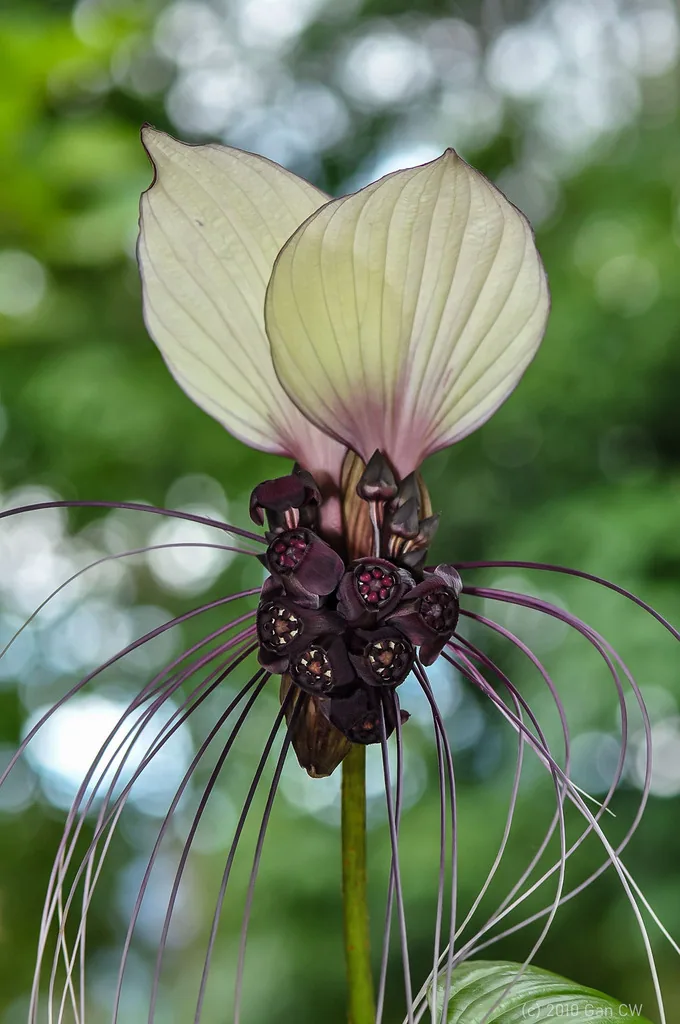

How to Grow and Care for Tacca integrifolia
Tacca integrifolia
Written by Emilio Marruso · last checked
At a glance
This shade lover is happy indoors or in a pot, growing in light shade or filtered light away from direct sun. Keep its soil evenly moist from spring to fall, then water less in winter and let it dry slightly. Feed it every two weeks with an orchid fertilizer, and divide its rhizomes to share new plants with friends.
- Sun
Light shade or filtered light; no direct sun
What the sources say (2)
Light: Light shade or filtered light, no direct sun
They need bright light to flower but keep them from direct sun.
— Tacca integrifolia (White Bat Flower) – The Belmont Rooster [2] Select a spot in your landscape for the white bat plant that is in the shade or has filtered light.
— How To Grow A White Bat Plant [3] - Water
Keep the soil evenly moist spring to fall; water less in winter, never soggy
What the sources say (3)
Watering: Water regularly, keeping the soil evenly moist during the spring-fall growing season
Water regularly, keeping the soil evenly moist during the growing season of spring through fall.
— How To Grow A White Bat Plant [3] Watering notes: Reduce watering in winter, letting the soil dry slightly; soil must not be soggy
During the winter, decrease your watering where the soil slightly dries before watering.
— How To Grow A White Bat Plant [3] Although they like their soil consistently moist, they do not like soggy soil.
— Tacca integrifolia (White Bat Flower) – The Belmont Rooster [2] - Cold
Survives winters down to 30 °F (−1.1 °C)
Half hardy: mild winters or an unheated greenhouse · USDA 10a · RHS H3 · Z10
What the sources say (4)
Hardiness, coldest zone: 10a [winter low −1.1 to 1.7 °C (30 to 35 °F)]
According to Gardenguides: In zones 10 and 11, the white bat plant can be grown outdoors, in the shade, if you have high humidity and temperatures never fall below 40 degrees F.
— How To Grow A White Bat Plant [3] Zones: USDA Zone 10A-12 (30 to 45° F).
— Tacca integrifolia (White Bat Flower) – The Belmont Rooster [2] Hardiness, warmest zone:
According to The Belmont Rooster: Zones: USDA Zone 10A-12 (30 to 45° F).
— Tacca integrifolia (White Bat Flower) – The Belmont Rooster [2] According to Gardenguides: In zones 10 and 11, the white bat plant can be grown outdoors, in the shade, if you have high humidity and temperatures never fall below 40 degrees F.
— How To Grow A White Bat Plant [3] - Feeding
Every two weeks with a water-soluble orchid fertilizer, or use a slow-release one
What the sources say (2)
How often: Every two weeks with soluble fertilizer, or slow-release fertilizer as needed
Keep the bat flower’s soil consistently moist; a saucer beneath it will help insure this. Fertilize with a soluable orchid fertilizer bi-weekly or with a slow release fertilizer as needed.
— Bat Flower – Gardening Solutions [1] Mineral fertilizers: Water-soluble orchid fertilizer, or a slow-release fertilizer
Keep the bat flower’s soil consistently moist; a saucer beneath it will help insure this. Fertilize with a soluable orchid fertilizer bi-weekly or with a slow release fertilizer as needed.
— Bat Flower – Gardening Solutions [1] - Pests
Watch out for snails and slugs
What the sources say (1)
Pests: snails, slugs
Bat flower seems to be mostly pest and disease free; although snails and slugs do occasionally bother it.
— Bat Flower – Gardening Solutions [1] - Propagation
Make new plants by dividing the rhizomes
What the sources say (1)
Propagation: Division of rhizomes
Divide rhizomes when repotting and give them their own pot.
— Tacca integrifolia (White Bat Flower) – The Belmont Rooster [2] - Containers
Grows well in a pot, indoors too
What the sources say (3)
In containers: Yes
Plant your white bat plant in a pot that is slightly larger than the root ball of the plant.
— How To Grow A White Bat Plant [3] Indoors: Yes
As an indoor plant, under the correct conditions, your white bat plant will be a conversation topic.
— How To Grow A White Bat Plant [3] Tacca needs a lot of humidity, especially if grown as a houseplant, and especially over the winter.
— Tacca integrifolia (White Bat Flower) – The Belmont Rooster [2]
Overview
White bat plant can be grown outdoors in shade in warm, humid zones, or as an indoor plant. [3] It needs well-drained, consistently moist but not soggy soil and a lot of humidity. [2]
This record is incomplete: the sources we read do not cover every field yet.
Not yet covered by our sources: Pruning
Tacca integrifolia care
How to water Tacca integrifolia
Watering
Water regularly, keeping the soil evenly moist during the spring-fall growing season
What the sources say (1)
Water regularly, keeping the soil evenly moist during the growing season of spring through fall.Watering notes
Reduce watering in winter, letting the soil dry slightly; soil must not be soggy
How much light Tacca integrifolia needs
Light shade or filtered light, no direct sun
How much cold Tacca integrifolia can take
Hardiness, coldest zone
10a [winter low −1.1 to 1.7 °C (30 to 35 °F)]
What each source says
According to Gardenguides: 10 [winter low −1.1 to 4.4 °C (30 to 40 °F)]
What the sources say (2)
According to Gardenguides: In zones 10 and 11, the white bat plant can be grown outdoors, in the shade, if you have high humidity and temperatures never fall below 40 degrees F.Zones: USDA Zone 10A-12 (30 to 45° F).Hardiness, warmest zone
The sources give different values depending on region, zone or growing conditions.
What each source says
According to The Belmont Rooster: 12 [winter low 10 to 15.6 °C (50 to 60 °F)]
According to Gardenguides: 11 [winter low 4.4 to 10 °C (40 to 50 °F)]
What the sources say (2)
According to The Belmont Rooster: Zones: USDA Zone 10A-12 (30 to 45° F).According to Gardenguides: In zones 10 and 11, the white bat plant can be grown outdoors, in the shade, if you have high humidity and temperatures never fall below 40 degrees F.Where to grow Tacca integrifolia
Indoors
Yes
What the sources say (2)
As an indoor plant, under the correct conditions, your white bat plant will be a conversation topic.Tacca needs a lot of humidity, especially if grown as a houseplant, and especially over the winter.In containers
Yes
What the sources say (1)
Plant your white bat plant in a pot that is slightly larger than the root ball of the plant.How to propagate Tacca integrifolia
Division of rhizomes
What the sources say (1)
Divide rhizomes when repotting and give them their own pot.How to grow Tacca integrifolia
Pests and diseases
Pests
snails, slugs
What the sources say (1)
Bat flower seems to be mostly pest and disease free; although snails and slugs do occasionally bother it.Fertilizing
How often
Every two weeks with soluble fertilizer, or slow-release fertilizer as needed
What the sources say (1)
Keep the bat flower’s soil consistently moist; a saucer beneath it will help insure this. Fertilize with a soluable orchid fertilizer bi-weekly or with a slow release fertilizer as needed.Mineral fertilizers
Water-soluble orchid fertilizer, or a slow-release fertilizer
What the sources say (1)
Keep the bat flower’s soil consistently moist; a saucer beneath it will help insure this. Fertilize with a soluable orchid fertilizer bi-weekly or with a slow release fertilizer as needed.Remedies
Each remedy shows what official sources say about it; traditional remedies without an official source are marked as such. Harmful ones are listed so you know to avoid them.
Treating the plant
slugs and snails
hand-picking Works
How: Look for them daily at night with a flashlight, pick them up and dispose of them; weekly once the population has declined.
Hand-picking can be very effective if done thoroughly on a regular basis. At first you should look for snails and slugs daily, paying careful attention to potential hiding places.
— ipm.ucanr.edu [4] What the evidence says Hand-picking can be very effective if done thoroughly on a regular basis.
— ipm.ucanr.edu [4] copper tape barrier Partly works
How: Copper foil or tape wrapped around planting boxes repels snails until it tarnishes; clean it with a vinegar solution.
Copper foil or tape wrapped around planting boxes, headers, or trunks will repel snails until it becomes tarnished. If the bands do tarnish, you can clean them with a vinegar solution.
— ipm.ucanr.edu [4] What the evidence says Copper foil or tape wrapped around planting boxes, headers, or trunks will repel snails until it becomes tarnished.
— ipm.ucanr.edu [4] beer traps Partly works
How: Beer-baited traps buried at ground level catch and drown slugs and snails; replenish the bait every few days.
Some people use beer-baited traps buried at ground level to catch and drown slugs and snails that fall into them.
— ipm.ucanr.edu [4] What the evidence says Beer/yeast traps attract slugs and snails within an area of only a few feet, and you must replenish the bait every few days to keep the level deep enough to drown the mollusks.
— ipm.ucanr.edu [4] diatomaceous earth barrier Partly works
How: Dry diatomaceous earth heaped in a band 1 inch high and 3 inches wide around the garden.
Barriers of dry diatomaceous earth , heaped in a band 1 inch high and 3 inches wide around the garden, can also be effective.
— ipm.ucanr.edu [4] What the evidence says However, these barriers lose their effectiveness after becoming damp, making them difficult to maintain and not very useful in most garden situations.
— ipm.ucanr.edu [4] crushed egg shells or coffee grounds Not proven
How: Crushed egg shells or coffee grounds as deterrent.
Crushed egg shells or coffee grounds have not been shown to be effective deterrents.
— ipm.ucanr.edu [4] What the evidence says Crushed egg shells or coffee grounds have not been shown to be effective deterrents.
— ipm.ucanr.edu [4] salt Harmful
How: Salt used to destroy snails and slugs.
Do not use salt to destroy snails and slugs, as it will increase soil salinity.
— ipm.ucanr.edu [4] What the evidence says Do not use salt to destroy snails and slugs, as it will increase soil salinity.
— ipm.ucanr.edu [4]
Calendar
Pruning
Not stated in the sources we read.
Months as given by the sources, which are mostly from the United States (northern hemisphere). In the southern hemisphere they shift by about six months.
Indicative values
Values from a secondary source, not checked word for word like the rest of this page. Use them as a starting point.
- Life cycle
- Herbaceous PerennialIndicative value, adapt it to your climate · Secondary source
- Mature height
- 61-121.9 cm (2-4 ft)Indicative value, adapt it to your climate · Secondary source
- Hours of sun
- 3-4 hoursIndicative value, adapt it to your climate · Secondary source
- Drought tolerant
- yesIndicative value, adapt it to your climate · Secondary source
- Soil pH
- 6.1-7.5Indicative value, adapt it to your climate · Secondary source
- Care level
- MediumIndicative value, adapt it to your climate · Secondary source
- Growth rate
- LowIndicative value, adapt it to your climate · Secondary source
- Pruning
- March, April, MayIndicative value, adapt it to your climate · Secondary source
Similar plants
- Arrowroot Tacca leontopetaloides
- Aaron's Beard Hypericum calycinum
- Abies grandis Abies grandis
- Abraham Trachystemon orientalis
- Abyssinian banana Ensete ventricosum
- Acacia longifolia Acacia longifolia
- Acacia retinodes Acacia retinodes
- Acanthus hungaricus Acanthus hungaricus
Sources
Every value above is quoted from these documents. Links lead to the original publisher.
- Bat Flower – Gardening Solutions · gardeningsolutions.ifas.ufl.edu, consulted
- Tacca integrifolia (White Bat Flower) – The Belmont Rooster · thebelmontrooster.com, consulted
- How To Grow A White Bat Plant · gardenguides.com, consulted
- ipm.ucanr.edu · ipm.ucanr.edu
Written by Emilio Marruso · last checked