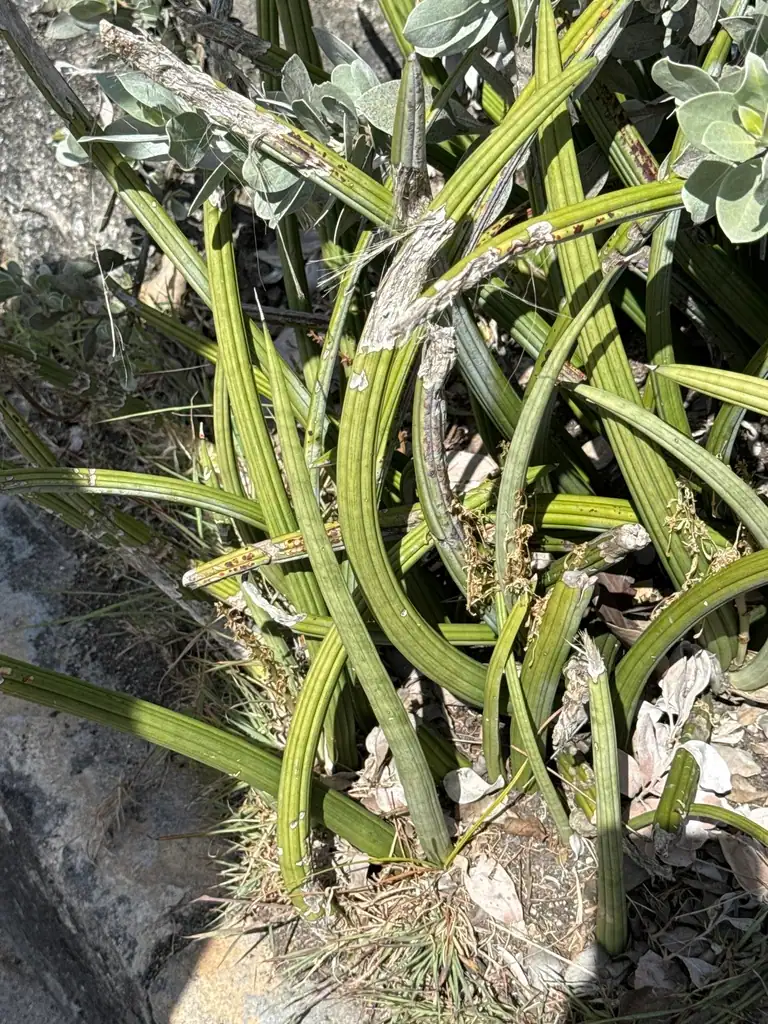
Cómo cultivar y cuidar African Spear
Dracaena angolensis
Escrito por Emilio Marruso · última revisión
Tóxica para: Gatos, Perros, Personas · Por qué
De un vistazo
Esta planta crece a gusto en interior y en maceta, y llega hasta 2,1 m de alto con solo 15–61 cm de ancho. Pide muy poco: riego cada 2 semanas en verano y solo una vez al mes en invierno, en un sustrato bien drenado para cactus. Además, puedes sacar plantas nuevas de esquejes de hoja enraizados, que brotan desde su base.
- Sol
Fuera en verano, dale solo sol de mañana para que no se quemen las hojas
- Riego
Riega cada 2 semanas en verano y una vez al mes en invierno
Qué dicen las fuentes (1)
Riego: Riega aproximadamente cada 2 semanas en verano y mensualmente en invierno
Grow this plant in a well-drained potting mix (one specific for cacti and succulents is good) and water only about every 2 weeks in summer and monthly in winter.
— Dracaena angolensis (African Spear, Brazil Saint Bárbara Sword, Cylindrical Snake Plant, Spear Sansevieria) | North Carolina Extension Gardener Plant Toolbox [1] - Frío
Mételo en casa cuando la temperatura baje de 13 °C
- Suelo
Sustrato bien drenado, como uno para cactus y suculentas
Qué dicen las fuentes (1)
Notas sobre el riego: Usa una mezcla para macetas con buen drenaje, como una específica para cactus y suculentas
Grow this plant in a well-drained potting mix (one specific for cacti and succulents is good) and water only about every 2 weeks in summer and monthly in winter.
— Dracaena angolensis (African Spear, Brazil Saint Bárbara Sword, Cylindrical Snake Plant, Spear Sansevieria) | North Carolina Extension Gardener Plant Toolbox [1] - Abonado
Una vez al mes en primavera y verano, abono universal a mitad de dosis
Qué dicen las fuentes (6)
Cuándo: Durante la temporada de crecimiento (primavera y verano)
For a more robust plant, fertilize monthly during their growing season (spring and summer) with an all-purpose fertilizer at half strength.
— Snake Plant: A Forgiving, Low-maintenance Houseplant — Allegheny County — Master Gardener [6] For a more robust plant, fertilize monthly during the growing season with an all-purpose fertilizer at half strength.
— Snake Plant: A Forgiving, Low-maintenance Houseplant [2] Frecuencia: Mensualmente durante la temporada de crecimiento
For a more robust plant, fertilize monthly during the growing season with an all-purpose fertilizer at half strength.
— Snake Plant: A Forgiving, Low-maintenance Houseplant [2] For a more robust plant, fertilize monthly during their growing season (spring and summer) with an all-purpose fertilizer at half strength.
— Snake Plant: A Forgiving, Low-maintenance Houseplant — Allegheny County — Master Gardener [6] Abonos minerales: Fertilizante de uso general a la mitad de la concentración
For a more robust plant, fertilize monthly during the growing season with an all-purpose fertilizer at half strength.
— Snake Plant: A Forgiving, Low-maintenance Houseplant [2] For a more robust plant, fertilize monthly during their growing season (spring and summer) with an all-purpose fertilizer at half strength.
— Snake Plant: A Forgiving, Low-maintenance Houseplant — Allegheny County — Master Gardener [6] - Plagas
Vigila las cochinillas algodonosas, la araña roja y la podredumbre de raíz
Qué dicen las fuentes (2)
Plagas: cochinillas harinosas, arañitas rojas
Few pests and diseases bother this hardy plant. Due to overwatering, root rot is a common affliction of snake plants. Mealybugs and spider mites occasionally bother this plant.
— Snake Plant: A Forgiving, Low-maintenance Houseplant [2] Enfermedades: pudrición de la raíz
Few pests and diseases bother this hardy plant. Due to overwatering, root rot is a common affliction of snake plants. Mealybugs and spider mites occasionally bother this plant.
— Snake Plant: A Forgiving, Low-maintenance Houseplant [2] - Tamaño
Hasta 2,1 m de alto y 15–61 cm de ancho
Qué dicen las fuentes (2)
Altura adulta: hasta 213 cm (7 pies)
The leaves grow from a rosette and are 1 inch wide and up to 7 feet tall with longitudinal stripes.
— Dracaena angolensis (African Spear, Brazil Saint Bárbara Sword, Cylindrical Snake Plant, Spear Sansevieria) | North Carolina Extension Gardener Plant Toolbox [1] Anchura adulta: 15-61 cm (6 pulg - 2 pies)
Dimensions: Height: 0 ft. 6 in. - 7 ft. 0 in. Width: 0 ft. 6 in. - 2 ft. 0 in.
— Dracaena angolensis (African Spear, Brazil Saint Bárbara Sword, Cylindrical Snake Plant, Spear Sansevieria) | North Carolina Extension Gardener Plant Toolbox [1] - Multiplicación
Enraíza esquejes de hoja: de su base salen plantas nuevas
Qué dicen las fuentes (2)
Propagación: Esquejes de hoja enraizados, de cuya base surgen nuevas plantas
The plants are often sold as rooted leaf cuttings, sometimes with three or more leaves braided together or sometimes with their tips dipped in paint.
— Dracaena angolensis (African Spear, Brazil Saint Bárbara Sword, Cylindrical Snake Plant, Spear Sansevieria) | North Carolina Extension Gardener Plant Toolbox [1] Eventually, new plants will arise for the base of the leaf cuttings.
— Dracaena angolensis (African Spear, Brazil Saint Bárbara Sword, Cylindrical Snake Plant, Spear Sansevieria) | North Carolina Extension Gardener Plant Toolbox [1] - Maceta
Crece bien en maceta y en interior
Qué dicen las fuentes (2)
En maceta: Sí
The leaves grow from a rosette and are 1 inch wide and up to 7 feet tall with longitudinal stripes. It will occasionally bloom in a container.
— Dracaena angolensis (African Spear, Brazil Saint Bárbara Sword, Cylindrical Snake Plant, Spear Sansevieria) | North Carolina Extension Gardener Plant Toolbox [1] En interior: Sí
#houseplant #easy to grow #interiorscape #problem for dogs #problem for cats #succulent #drought tolerant
— Dracaena angolensis (African Spear, Brazil Saint Bárbara Sword, Cylindrical Snake Plant, Spear Sansevieria) | North Carolina Extension Gardener Plant Toolbox [1] - Seguridad
Tóxica para gatos, perros y personas; la savia puede irritar la piel
Resumen
La lanza africana es una suculenta perenne fácil de cultivar, nativa de África, que se vende como planta de interior. [1] Necesita una mezcla para macetas con buen drenaje, una ventana con mucha luz y poca agua. [1] Tiene características de toxicidad de baja gravedad: la ingestión es tóxica para gatos y perros. [1]
Citado en inglés, como en la fuente.
Cuidados
Riego
Riego
Riega aproximadamente cada 2 semanas en verano y mensualmente en invierno
Qué dicen las fuentes (1)
Grow this plant in a well-drained potting mix (one specific for cacti and succulents is good) and water only about every 2 weeks in summer and monthly in winter.Notas sobre el riego
Usa una mezcla para macetas con buen drenaje, como una específica para cactus y suculentas
Qué dicen las fuentes (1)
Grow this plant in a well-drained potting mix (one specific for cacti and succulents is good) and water only about every 2 weeks in summer and monthly in winter.Luz
Las fuentes dan valores distintos según la región, la zona o las condiciones de cultivo.
Lo que dice cada fuente
Según NC State Extension (Dracaena angolensis page): Ventana bien iluminada; al aire libre en verano solo sol de la mañana
Según Penn State Extension (snake plants): Luz indirecta brillante; mantén fuera del sol directo
Qué dicen las fuentes (3)
Según NC State Extension (Dracaena angolensis page): Place it in a brightly lit window. If taken outdoors in the summer, only give it morning sun to avoid sunburn.Según Penn State Extension (snake plants): Snake plant enjoys bright indirect light but tolerates low-light areas very well. Keep it out of the direct sun, as it can burn.Place it in a brightly lit window. If taken outdoors in the summer, only give it morning sun to avoid sunburn.Dónde cultivarla
En interior
Sí
Qué dicen las fuentes (1)
#houseplant #easy to grow #interiorscape #problem for dogs #problem for cats #succulent #drought tolerantEn maceta
Sí
Qué dicen las fuentes (1)
The leaves grow from a rosette and are 1 inch wide and up to 7 feet tall with longitudinal stripes. It will occasionally bloom in a container.Propagación
Esquejes de hoja enraizados, de cuya base surgen nuevas plantas
Qué dicen las fuentes (2)
The plants are often sold as rooted leaf cuttings, sometimes with three or more leaves braided together or sometimes with their tips dipped in paint.Eventually, new plants will arise for the base of the leaf cuttings.Cultivo
La planta
Ciclo de vida
perenne
Qué dicen las fuentes (1)
African spear is an easy-to-grow, succulent herbaceous perennial native to Africa.Familia
Asparagáceas
Qué dicen las fuentes (1)
It is a member of the asparagus family (Asparagaceae).Altura adulta
hasta 213 cm (7 pies)
Qué dicen las fuentes (1)
The leaves grow from a rosette and are 1 inch wide and up to 7 feet tall with longitudinal stripes.Anchura adulta
15-61 cm (6 pulg - 2 pies)
Qué dicen las fuentes (1)
Dimensions:
Height: 0 ft. 6 in. - 7 ft. 0 in.
Width: 0 ft. 6 in. - 2 ft. 0 in.Plagas y enfermedades
Plagas
cochinillas harinosas, arañitas rojas
Qué dicen las fuentes (1)
Few pests and diseases bother this hardy plant. Due to overwatering, root rot is a common affliction of snake plants. Mealybugs and spider mites occasionally bother this plant.Enfermedades
pudrición de la raíz
Qué dicen las fuentes (1)
Few pests and diseases bother this hardy plant. Due to overwatering, root rot is a common affliction of snake plants. Mealybugs and spider mites occasionally bother this plant.Abonado
Cuándo
Durante la temporada de crecimiento (primavera y verano)
Qué dicen las fuentes (2)
For a more robust plant, fertilize monthly during their growing season (spring and summer) with an all-purpose fertilizer at half strength.For a more robust plant, fertilize monthly during the growing season with an all-purpose fertilizer at half strength.Frecuencia
Mensualmente durante la temporada de crecimiento
Qué dicen las fuentes (2)
For a more robust plant, fertilize monthly during the growing season with an all-purpose fertilizer at half strength.For a more robust plant, fertilize monthly during their growing season (spring and summer) with an all-purpose fertilizer at half strength.Abonos minerales
Fertilizante de uso general a la mitad de la concentración
Qué dicen las fuentes (2)
For a more robust plant, fertilize monthly during the growing season with an all-purpose fertilizer at half strength.For a more robust plant, fertilize monthly during their growing season (spring and summer) with an all-purpose fertilizer at half strength.Problemas
Quemadura por sol al aire libre
Síntoma: Quemadura de hojas por sol cuando se saca al aire libre en verano
Qué hacer: Dale solo sol de la mañana cuando esté al aire libre en verano
Qué dicen las fuentes (1)
If taken outdoors in the summer, only give it morning sun to avoid sunburn.
— Dracaena angolensis (African Spear, Brazil Saint Bárbara Sword, Cylindrical Snake Plant, Spear Sansevieria) | North Carolina Extension Gardener Plant Toolbox [1] Frío
Síntoma: No puede permanecer al aire libre en clima fresco
Qué hacer: Métela al interior cuando la temperatura baje de los 55 grados Fahrenheit
Qué dicen las fuentes (1)
Bring it indoors when the temperature falls below 55 degrees Fahrenheit.
— Dracaena angolensis (African Spear, Brazil Saint Bárbara Sword, Cylindrical Snake Plant, Spear Sansevieria) | North Carolina Extension Gardener Plant Toolbox [1]
Remedios
Cada remedio indica qué dicen las fuentes oficiales; los remedios tradicionales sin fuente oficial aparecen marcados. Los perjudiciales están para que sepas evitarlos.
Cuidar la planta
cochinillas harinosas
jabón insecticida Funciona
Cómo: aplica para reducir las poblaciones expuestas
On ornamentals, insecticidal soap , narrow-range oil , or a forceful stream of water can be applied to reduce exposed populations with minimal harm to natural enemies that may migrate in later.
— ipm.ucanr.edu [7] Qué dicen las pruebas On ornamentals, insecticidal soap , narrow-range oil , or a forceful stream of water can be applied to reduce exposed populations with minimal harm to natural enemies that may migrate in later.
— ipm.ucanr.edu [7] chorro de agua fuerte Funciona
Cómo: aplica un chorro de agua fuerte para reducir las poblaciones expuestas
On ornamentals, insecticidal soap , narrow-range oil , or a forceful stream of water can be applied to reduce exposed populations with minimal harm to natural enemies that may migrate in later.
— ipm.ucanr.edu [7] Qué dicen las pruebas On ornamentals, insecticidal soap , narrow-range oil , or a forceful stream of water can be applied to reduce exposed populations with minimal harm to natural enemies that may migrate in later.
— ipm.ucanr.edu [7]
Venenosa para los animales
Según la fuente, citada textualmente. No es un consejo médico ni veterinario: si una persona o un animal pudo haber ingerido esta planta, contacta con un centro de toxicología o con un veterinario.
Animales
Toxic if ingested by cats and dogs: dilated pupils, vomiting, stomach upset, abdominal pain, drooling, weakness, depression.
[1]
Personas
Keep this plant away from pets and children. Humans should not ingest this plant. Skin irritation can occur from the plant sap.
[1]
Valores orientativos
Valores de una fuente secundaria, no comprobados palabra por palabra como el resto de esta página. Úselos como punto de partida.
- Resiste la sequía
- SíValor orientativo, adáptalo a tu clima · Fuente secundaria
- pH del suelo
- 6-7.5Valor orientativo, adáptalo a tu clima · Fuente secundaria
- Zonas de rusticidad USDA
- 10-11 [mínima invernal de −1,1 a 10 °C (de 30 a 50 °F)]Valor orientativo, adáptalo a tu clima · Fuente secundaria
- Nivel de cuidado
- BajoValor orientativo, adáptalo a tu clima · Fuente secundaria
- Crecimiento
- BajoValor orientativo, adáptalo a tu clima · Fuente secundaria
- Poda
- junio, julio, agostoValor orientativo, adáptalo a tu clima · Fuente secundaria
Plantas similares
- Corn Plant Dracaena fragrans
- Dracaena Dracaena marginata
- Gold Dust Dracaena surculosa
- Lucky Bamboo Dracaena sanderiana
- Queen of Dracaenas Dracaena goldieana
- Snake Plant Dracaena trifasciata
- Whale Fin Dracaena Dracaena masoniana
- Drago de Canarias Dracaena draco
Fuentes
Cada valor anterior se cita de estos documentos. Los enlaces llevan al editor original.
- Dracaena angolensis (African Spear, Brazil Saint Bárbara Sword, Cylindrical Snake Plant, Spear Sansevieria) | North Carolina Extension Gardener Plant Toolbox · plants.ces.ncsu.edu, consultado
- Snake Plant: A Forgiving, Low-maintenance Houseplant · extension.psu.edu, consultado
- African Spear - Dracaena angolensis | North Carolina Extension Gardener Plant Toolbox · plants.ces.ncsu.edu, consultado
- Cylindrical Snake Plant - Dracaena angolensis | North Carolina Extension Gardener Plant Toolbox · plants.ces.ncsu.edu, consultado
- Dracaena | North Carolina Extension Gardener Plant Toolbox · plants.ces.ncsu.edu, consultado
- Snake Plant: A Forgiving, Low-maintenance Houseplant — Allegheny County — Master Gardener · extension.psu.edu, consultado
- ipm.ucanr.edu · ipm.ucanr.edu
Escrito por Emilio Marruso · última revisión