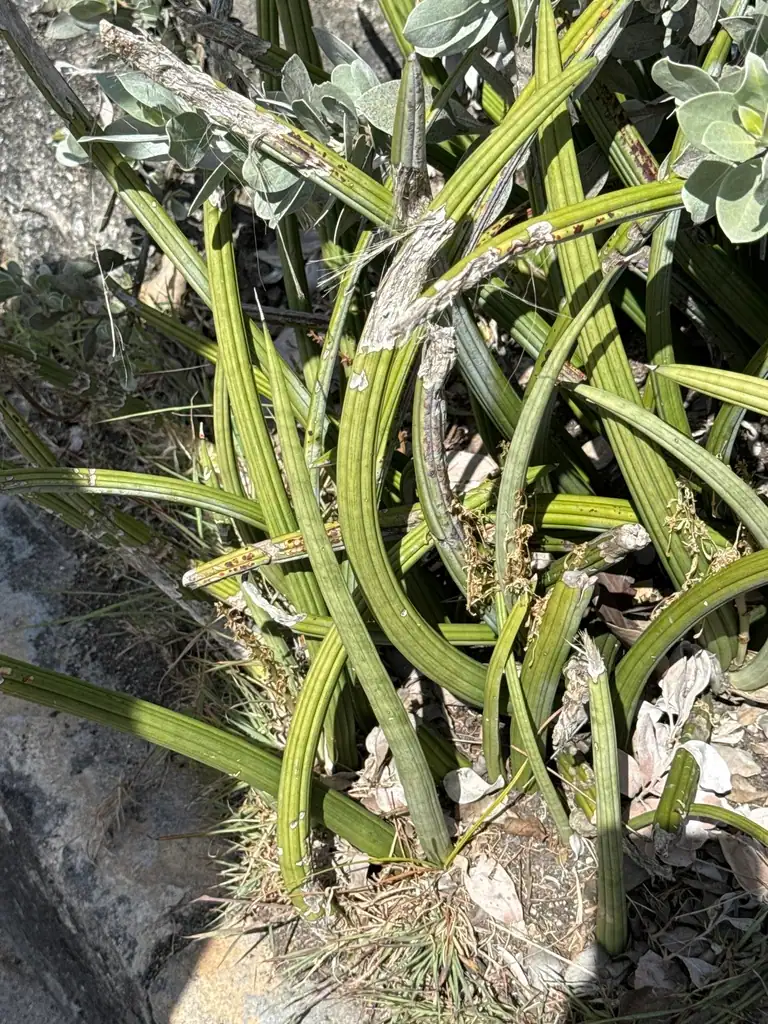
How to Grow and Care for African Spear
Dracaena angolensis
Written by Emilio Marruso · last checked
Toxic to: Cats, Dogs, People · Why
At a glance
This plant grows happily indoors and in pots, reaching up to 7 feet tall while staying just 6 inches to 2 feet wide. It asks for very little: water every 2 weeks in summer and only once a month in winter, in a well-drained cactus mix. You can even grow new plants from rooted leaf cuttings, which sprout fresh shoots from their base.
- Sun
Outdoors in summer, give it only morning sun to avoid scorched leaves
- Water
Water every 2 weeks in summer and once a month in winter
What the sources say (1)
Watering: Water about every 2 weeks in summer and monthly in winter
Grow this plant in a well-drained potting mix (one specific for cacti and succulents is good) and water only about every 2 weeks in summer and monthly in winter.
— Dracaena angolensis (African Spear, Brazil Saint Bárbara Sword, Cylindrical Snake Plant, Spear Sansevieria) | North Carolina Extension Gardener Plant Toolbox [1] - Cold
Bring it indoors when it drops below 55 °F (13 °C)
- Soil
Well-drained potting mix, like one for cacti and succulents
What the sources say (1)
Watering notes: Use a well-drained potting mix, such as one specific for cacti and succulents
Grow this plant in a well-drained potting mix (one specific for cacti and succulents is good) and water only about every 2 weeks in summer and monthly in winter.
— Dracaena angolensis (African Spear, Brazil Saint Bárbara Sword, Cylindrical Snake Plant, Spear Sansevieria) | North Carolina Extension Gardener Plant Toolbox [1] - Feeding
Once a month in spring and summer, all-purpose fertilizer at half strength
What the sources say (6)
When: During the growing season (spring and summer)
For a more robust plant, fertilize monthly during their growing season (spring and summer) with an all-purpose fertilizer at half strength.
— Snake Plant: A Forgiving, Low-maintenance Houseplant — Allegheny County — Master Gardener [6] For a more robust plant, fertilize monthly during the growing season with an all-purpose fertilizer at half strength.
— Snake Plant: A Forgiving, Low-maintenance Houseplant [2] How often: Monthly during the growing season
For a more robust plant, fertilize monthly during the growing season with an all-purpose fertilizer at half strength.
— Snake Plant: A Forgiving, Low-maintenance Houseplant [2] For a more robust plant, fertilize monthly during their growing season (spring and summer) with an all-purpose fertilizer at half strength.
— Snake Plant: A Forgiving, Low-maintenance Houseplant — Allegheny County — Master Gardener [6] Mineral fertilizers: All-purpose fertilizer at half strength
For a more robust plant, fertilize monthly during the growing season with an all-purpose fertilizer at half strength.
— Snake Plant: A Forgiving, Low-maintenance Houseplant [2] For a more robust plant, fertilize monthly during their growing season (spring and summer) with an all-purpose fertilizer at half strength.
— Snake Plant: A Forgiving, Low-maintenance Houseplant — Allegheny County — Master Gardener [6] - Pests
Watch for mealybugs, spider mites and root rot
What the sources say (2)
Pests: mealybugs, spider mites
Few pests and diseases bother this hardy plant. Due to overwatering, root rot is a common affliction of snake plants. Mealybugs and spider mites occasionally bother this plant.
— Snake Plant: A Forgiving, Low-maintenance Houseplant [2] Diseases: root rot
Few pests and diseases bother this hardy plant. Due to overwatering, root rot is a common affliction of snake plants. Mealybugs and spider mites occasionally bother this plant.
— Snake Plant: A Forgiving, Low-maintenance Houseplant [2] - Size
Up to 7 ft tall and 6 in to 2 ft wide
What the sources say (2)
Mature height: up to 213 cm (7 ft)
The leaves grow from a rosette and are 1 inch wide and up to 7 feet tall with longitudinal stripes.
— Dracaena angolensis (African Spear, Brazil Saint Bárbara Sword, Cylindrical Snake Plant, Spear Sansevieria) | North Carolina Extension Gardener Plant Toolbox [1] Mature width: 15-61 cm (6 in - 2 ft)
Dimensions: Height: 0 ft. 6 in. - 7 ft. 0 in. Width: 0 ft. 6 in. - 2 ft. 0 in.
— Dracaena angolensis (African Spear, Brazil Saint Bárbara Sword, Cylindrical Snake Plant, Spear Sansevieria) | North Carolina Extension Gardener Plant Toolbox [1] - Propagation
Root leaf cuttings: new plants grow from their base
What the sources say (2)
Propagation: Rooted leaf cuttings, from whose base new plants arise
The plants are often sold as rooted leaf cuttings, sometimes with three or more leaves braided together or sometimes with their tips dipped in paint.
— Dracaena angolensis (African Spear, Brazil Saint Bárbara Sword, Cylindrical Snake Plant, Spear Sansevieria) | North Carolina Extension Gardener Plant Toolbox [1] Eventually, new plants will arise for the base of the leaf cuttings.
— Dracaena angolensis (African Spear, Brazil Saint Bárbara Sword, Cylindrical Snake Plant, Spear Sansevieria) | North Carolina Extension Gardener Plant Toolbox [1] - Containers
Grows well in pots and indoors
What the sources say (2)
In containers: Yes
The leaves grow from a rosette and are 1 inch wide and up to 7 feet tall with longitudinal stripes. It will occasionally bloom in a container.
— Dracaena angolensis (African Spear, Brazil Saint Bárbara Sword, Cylindrical Snake Plant, Spear Sansevieria) | North Carolina Extension Gardener Plant Toolbox [1] Indoors: Yes
#houseplant #easy to grow #interiorscape #problem for dogs #problem for cats #succulent #drought tolerant
— Dracaena angolensis (African Spear, Brazil Saint Bárbara Sword, Cylindrical Snake Plant, Spear Sansevieria) | North Carolina Extension Gardener Plant Toolbox [1] - Safety
Toxic to cats, dogs and people; the sap can irritate skin
Overview
African spear is an easy-to-grow succulent perennial native to Africa, sold as a houseplant. [1] It needs a well-drained potting mix, a brightly lit window and little water. [1] It has low-severity poison characteristics: ingestion is toxic to cats and dogs. [1]
African Spear care
How to water African Spear
Watering
Water about every 2 weeks in summer and monthly in winter
What the sources say (1)
Grow this plant in a well-drained potting mix (one specific for cacti and succulents is good) and water only about every 2 weeks in summer and monthly in winter.Watering notes
Use a well-drained potting mix, such as one specific for cacti and succulents
What the sources say (1)
Grow this plant in a well-drained potting mix (one specific for cacti and succulents is good) and water only about every 2 weeks in summer and monthly in winter.How much light African Spear needs
The sources give different values depending on region, zone or growing conditions.
What each source says
According to NC State Extension (Dracaena angolensis page): Brightly lit window; outdoors in summer only morning sun
According to Penn State Extension (snake plants): Bright indirect light; keep out of direct sun
What the sources say (3)
According to NC State Extension (Dracaena angolensis page): Place it in a brightly lit window. If taken outdoors in the summer, only give it morning sun to avoid sunburn.According to Penn State Extension (snake plants): Snake plant enjoys bright indirect light but tolerates low-light areas very well. Keep it out of the direct sun, as it can burn.Place it in a brightly lit window. If taken outdoors in the summer, only give it morning sun to avoid sunburn.Where to grow African Spear
Indoors
Yes
What the sources say (1)
#houseplant #easy to grow #interiorscape #problem for dogs #problem for cats #succulent #drought tolerantIn containers
Yes
What the sources say (1)
The leaves grow from a rosette and are 1 inch wide and up to 7 feet tall with longitudinal stripes. It will occasionally bloom in a container.How to propagate African Spear
Rooted leaf cuttings, from whose base new plants arise
What the sources say (2)
The plants are often sold as rooted leaf cuttings, sometimes with three or more leaves braided together or sometimes with their tips dipped in paint.Eventually, new plants will arise for the base of the leaf cuttings.How to grow African Spear
The plant
Life cycle
perennial
What the sources say (1)
African spear is an easy-to-grow, succulent herbaceous perennial native to Africa.Family
Asparagaceae
What the sources say (1)
It is a member of the asparagus family (Asparagaceae).Mature height
up to 213 cm (7 ft)
What the sources say (1)
The leaves grow from a rosette and are 1 inch wide and up to 7 feet tall with longitudinal stripes.Mature width
15-61 cm (6 in - 2 ft)
What the sources say (1)
Dimensions:
Height: 0 ft. 6 in. - 7 ft. 0 in.
Width: 0 ft. 6 in. - 2 ft. 0 in.Pests and diseases
Pests
mealybugs, spider mites
What the sources say (1)
Few pests and diseases bother this hardy plant. Due to overwatering, root rot is a common affliction of snake plants. Mealybugs and spider mites occasionally bother this plant.Diseases
root rot
What the sources say (1)
Few pests and diseases bother this hardy plant. Due to overwatering, root rot is a common affliction of snake plants. Mealybugs and spider mites occasionally bother this plant.Fertilizing
When
During the growing season (spring and summer)
What the sources say (2)
For a more robust plant, fertilize monthly during their growing season (spring and summer) with an all-purpose fertilizer at half strength.For a more robust plant, fertilize monthly during the growing season with an all-purpose fertilizer at half strength.How often
Monthly during the growing season
What the sources say (2)
For a more robust plant, fertilize monthly during the growing season with an all-purpose fertilizer at half strength.For a more robust plant, fertilize monthly during their growing season (spring and summer) with an all-purpose fertilizer at half strength.Mineral fertilizers
All-purpose fertilizer at half strength
What the sources say (2)
For a more robust plant, fertilize monthly during the growing season with an all-purpose fertilizer at half strength.For a more robust plant, fertilize monthly during their growing season (spring and summer) with an all-purpose fertilizer at half strength.African Spear pests and problems
Sunburn outdoors
Symptom: Leaf sunburn when taken outdoors in summer
What to do: Give it only morning sun when outdoors in summer
What the sources say (1)
If taken outdoors in the summer, only give it morning sun to avoid sunburn.
— Dracaena angolensis (African Spear, Brazil Saint Bárbara Sword, Cylindrical Snake Plant, Spear Sansevieria) | North Carolina Extension Gardener Plant Toolbox [1] Cold
Symptom: Cannot stay outdoors in cool weather
What to do: Bring it indoors when the temperature falls below 55 degrees Fahrenheit
What the sources say (1)
Bring it indoors when the temperature falls below 55 degrees Fahrenheit.
— Dracaena angolensis (African Spear, Brazil Saint Bárbara Sword, Cylindrical Snake Plant, Spear Sansevieria) | North Carolina Extension Gardener Plant Toolbox [1]
Remedies
Each remedy shows what official sources say about it; traditional remedies without an official source are marked as such. Harmful ones are listed so you know to avoid them.
Treating the plant
mealybugs
insecticidal soap Works
How: apply to reduce exposed populations
On ornamentals, insecticidal soap , narrow-range oil , or a forceful stream of water can be applied to reduce exposed populations with minimal harm to natural enemies that may migrate in later.
— ipm.ucanr.edu [7] What the evidence says On ornamentals, insecticidal soap , narrow-range oil , or a forceful stream of water can be applied to reduce exposed populations with minimal harm to natural enemies that may migrate in later.
— ipm.ucanr.edu [7] forceful water stream Works
How: apply a forceful stream of water to reduce exposed populations
On ornamentals, insecticidal soap , narrow-range oil , or a forceful stream of water can be applied to reduce exposed populations with minimal harm to natural enemies that may migrate in later.
— ipm.ucanr.edu [7] What the evidence says On ornamentals, insecticidal soap , narrow-range oil , or a forceful stream of water can be applied to reduce exposed populations with minimal harm to natural enemies that may migrate in later.
— ipm.ucanr.edu [7]
Is African Spear toxic to pets?
Reported by the source, quoted verbatim. This is not medical or veterinary advice: if a person or an animal may have eaten this plant, contact a poison control centre or a veterinarian.
Animals
Toxic if ingested by cats and dogs: dilated pupils, vomiting, stomach upset, abdominal pain, drooling, weakness, depression.
[1]
People
Keep this plant away from pets and children. Humans should not ingest this plant. Skin irritation can occur from the plant sap.
[1]
Indicative values
Values from a secondary source, not checked word for word like the rest of this page. Use them as a starting point.
- Drought tolerant
- yesIndicative value, adapt it to your climate · Secondary source
- Soil pH
- 6-7.5Indicative value, adapt it to your climate · Secondary source
- USDA hardiness zones
- 10-11 [winter low −1.1 to 10 °C (30 to 50 °F)]Indicative value, adapt it to your climate · Secondary source
- Care level
- LowIndicative value, adapt it to your climate · Secondary source
- Growth rate
- LowIndicative value, adapt it to your climate · Secondary source
- Pruning
- June, July, AugustIndicative value, adapt it to your climate · Secondary source
Similar plants
- Corn Plant Dracaena fragrans
- Dracaena Dracaena marginata
- Gold Dust Dracaena surculosa
- Lucky Bamboo Dracaena sanderiana
- Queen of Dracaenas Dracaena goldieana
- Snake Plant Dracaena trifasciata
- Whale Fin Dracaena Dracaena masoniana
- Dragon tree Dracaena draco
Sources
Every value above is quoted from these documents. Links lead to the original publisher.
- Dracaena angolensis (African Spear, Brazil Saint Bárbara Sword, Cylindrical Snake Plant, Spear Sansevieria) | North Carolina Extension Gardener Plant Toolbox · plants.ces.ncsu.edu, consulted
- Snake Plant: A Forgiving, Low-maintenance Houseplant · extension.psu.edu, consulted
- African Spear - Dracaena angolensis | North Carolina Extension Gardener Plant Toolbox · plants.ces.ncsu.edu, consulted
- Cylindrical Snake Plant - Dracaena angolensis | North Carolina Extension Gardener Plant Toolbox · plants.ces.ncsu.edu, consulted
- Dracaena | North Carolina Extension Gardener Plant Toolbox · plants.ces.ncsu.edu, consulted
- Snake Plant: A Forgiving, Low-maintenance Houseplant — Allegheny County — Master Gardener · extension.psu.edu, consulted
- ipm.ucanr.edu · ipm.ucanr.edu
Written by Emilio Marruso · last checked