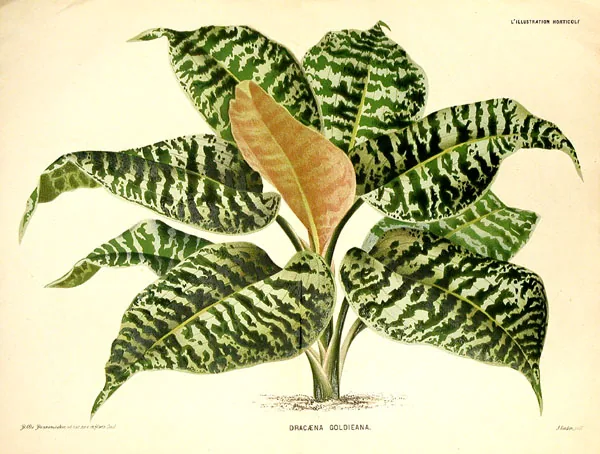

How to Grow and Care for Queen of Dracaenas
Dracaena goldieana
Written by Emilio Marruso · last checked
Toxic to: Cats, Dogs, People · Why
At a glance
This dracaena is a houseplant that grows happily indoors in bright, indirect light and stays a tidy 2–3 feet tall. Water it only when the top inch of potting mix feels dry, using rainwater or filtered water. Feed it every 2 weeks in spring and summer, and you can even grow new plants from stem cuttings.
- Sun
Bright, indirect light or partial shade
What the sources say (2)
Light: Bright, indirect light; partial shade
This plant prefers bright, indirect light, and moist, well-drained potting mix.
— Dracaena goldieana (Green Zebra, Green Zebra Plant, Queen of Dracaenas, Zebra Striped Dragon Tree) | North Carolina Extension Gardener Plant Toolbox [1] Light: Partial Shade (Direct sunlight only part of the day, 2-6 hours)
— Dracaena goldieana (Green Zebra, Green Zebra Plant, Queen of Dracaenas, Zebra Striped Dragon Tree) | North Carolina Extension Gardener Plant Toolbox [1] - Water
Water when the top inch of mix is dry; use rainwater, filtered water or tap water left out for 24 hours
What the sources say (2)
Watering: Water when the top inch of the potting mix is dry to the touch
Water the plant when the top inch of the potting mix is dry to the touch.
— Dracaena goldieana (Green Zebra, Green Zebra Plant, Queen of Dracaenas, Zebra Striped Dragon Tree) | North Carolina Extension Gardener Plant Toolbox [1] Watering notes: Tap water with salt, chlorine, or fluoride can damage the plant; use filtered water, rainwater, or tap water left to stand for 24 hours in an open container
Tap water with salt, chlorine, or fluoride can damage this plant. Consider using filtered water, rainwater, or tap water that has been allowed to stand for 24 hours in an open container.
— Dracaena goldieana (Green Zebra, Green Zebra Plant, Queen of Dracaenas, Zebra Striped Dragon Tree) | North Carolina Extension Gardener Plant Toolbox [1] - Cold
Survives winters down to 40 °F (4.4 °C)
Tender: needs a frost-free greenhouse · USDA 11a · RHS H2 · Z11
What the sources say (2)
Hardiness, coldest zone: 11a [winter low 4.4 to 7.2 °C (40 to 45 °F)]
USDA Plant Hardiness Zone: 11a, 11b, 12a, 12b
— Dracaena goldieana (Green Zebra, Green Zebra Plant, Queen of Dracaenas, Zebra Striped Dragon Tree) | North Carolina Extension Gardener Plant Toolbox [1] Hardiness, warmest zone: 12b [winter low 12.8 to 15.6 °C (55 to 60 °F)]
USDA Plant Hardiness Zone: 11a, 11b, 12a, 12b
— Dracaena goldieana (Green Zebra, Green Zebra Plant, Queen of Dracaenas, Zebra Striped Dragon Tree) | North Carolina Extension Gardener Plant Toolbox [1] - Feeding
Balanced fertilizer every 2 weeks in spring and summer, once a month in fall
What the sources say (4)
When: Spring and summer, with lighter monthly feeding in fall
Dracaena needs moderate to bright indirect light, temperatures of 65-75 degrees, and fertilizing every 2 weeks in spring and summer (balanced fertilizer), monthly feeds in the fall.
— [3] How often: Every 2 weeks in spring and summer; monthly in fall
indoor office conditions: In some office situations, plants may need fertilizer every 2 weeks year-round.
— [3] Dracaena needs moderate to bright indirect light, temperatures of 65-75 degrees, and fertilizing every 2 weeks in spring and summer (balanced fertilizer), monthly feeds in the fall.
— [3] Mineral fertilizers: Balanced fertilizer
Dracaena needs moderate to bright indirect light, temperatures of 65-75 degrees, and fertilizing every 2 weeks in spring and summer (balanced fertilizer), monthly feeds in the fall.
— [3] - Pests
Watch for mealybugs and spider mites; too much water rots the roots
What the sources say (2)
Pests: mealybugs, spider mites
Insects, Diseases, and Other Plant Problems: Monitor for mealybugs and spider mites. Overwatering can result in root rot.
— Dracaena goldieana (Green Zebra, Green Zebra Plant, Queen of Dracaenas, Zebra Striped Dragon Tree) | North Carolina Extension Gardener Plant Toolbox [1] Diseases: root rot
Insects, Diseases, and Other Plant Problems: Monitor for mealybugs and spider mites. Overwatering can result in root rot.
— Dracaena goldieana (Green Zebra, Green Zebra Plant, Queen of Dracaenas, Zebra Striped Dragon Tree) | North Carolina Extension Gardener Plant Toolbox [1] - Watch out
Keep it out of full sun: the leaves scorch
- Size
Indoors 2–3 ft tall and 2–3 ft wide
What the sources say (2)
Mature height: 60.96-91.44 cm (2-3 ft) indoors; up to 396.24 (13 ft) in its native habitat
It may grow up to 2 to 3 feet tall indoors, and up to 13 feet in its native habitat.
— Dracaena goldieana (Green Zebra, Green Zebra Plant, Queen of Dracaenas, Zebra Striped Dragon Tree) | North Carolina Extension Gardener Plant Toolbox [1] Mature width: 60.96-91.44 cm (2-3 ft)
Height: 2 ft. 0 in. - 3 ft. 0 in. Width: 2 ft. 0 in. - 3 ft. 0 in.
— Dracaena goldieana (Green Zebra, Green Zebra Plant, Queen of Dracaenas, Zebra Striped Dragon Tree) | North Carolina Extension Gardener Plant Toolbox [1] - Propagation
Grow new plants from stem cuttings
What the sources say (1)
Propagation: Stem cuttings
It does not tolerate frost or cold drafts. The plant is propagated by stem cuttings.
— Dracaena goldieana (Green Zebra, Green Zebra Plant, Queen of Dracaenas, Zebra Striped Dragon Tree) | North Carolina Extension Gardener Plant Toolbox [1] - Containers
Grows well in a pot, indoors too
What the sources say (2)
In containers: Yes
Landscape Location: Container Houseplants Resistance To Challenges: Drought Humidity
— Dracaena goldieana (Green Zebra, Green Zebra Plant, Queen of Dracaenas, Zebra Striped Dragon Tree) | North Carolina Extension Gardener Plant Toolbox [1] Indoors: Yes
attractive ornamental foliage that is strikingly beautiful as an indoor houseplant.
— Dracaena goldieana (Green Zebra, Green Zebra Plant, Queen of Dracaenas, Zebra Striped Dragon Tree) | North Carolina Extension Gardener Plant Toolbox [1] - Safety
Poisonous to people and a problem for cats: keep it away from children and pets
Overview
Dracaena goldieana is a semi-woody tropical perennial grown for its zebra-striped ornamental foliage, mainly as an indoor houseplant. [1] It prefers bright, indirect light and moist, well-drained potting mix, with watering when the top inch of mix is dry. [1] The plant has low severity poison characteristics and is listed as a problem for cats, dogs and humans. [1]
Queen of Dracaenas care
How to water Queen of Dracaenas
Watering
Water when the top inch of the potting mix is dry to the touch
What the sources say (1)
Water the plant when the top inch of the potting mix is dry to the touch.Watering notes
Tap water with salt, chlorine, or fluoride can damage the plant; use filtered water, rainwater, or tap water left to stand for 24 hours in an open container
What the sources say (1)
Tap water with salt, chlorine, or fluoride can damage this plant. Consider using filtered water, rainwater, or tap water that has been allowed to stand for 24 hours in an open container.How much light Queen of Dracaenas needs
Bright, indirect light; partial shade
What the sources say (2)
This plant prefers bright, indirect light, and moist, well-drained potting mix.Light:
Partial Shade (Direct sunlight only part of the day, 2-6 hours)How much cold Queen of Dracaenas can take
Hardiness, coldest zone
11a [winter low 4.4 to 7.2 °C (40 to 45 °F)]
What the sources say (1)
USDA Plant Hardiness Zone:
11a, 11b, 12a, 12bHardiness, warmest zone
12b [winter low 12.8 to 15.6 °C (55 to 60 °F)]
What the sources say (1)
USDA Plant Hardiness Zone:
11a, 11b, 12a, 12bWhere to grow Queen of Dracaenas
Indoors
Yes
What the sources say (1)
attractive ornamental foliage that is strikingly beautiful as an indoor houseplant.In containers
Yes
What the sources say (1)
Landscape Location:
Container
Houseplants
Resistance To Challenges:
Drought
HumidityHow to propagate Queen of Dracaenas
Stem cuttings
What the sources say (1)
It does not tolerate frost or cold drafts. The plant is propagated by stem cuttings.How to grow Queen of Dracaenas
The plant
Life cycle
perennial
What the sources say (1)
Queen of dracaenas is a semi-woody perennial from tropical West Africa.Family
Asparagaceae
What the sources say (1)
It is a member of the asparagus family (Asparagaceae).Mature height
60.96-91.44 cm (2-3 ft) indoors; up to 396.24 (13 ft) in its native habitat
What the sources say (1)
It may grow up to 2 to 3 feet tall indoors, and up to 13 feet in its native habitat.Mature width
60.96-91.44 cm (2-3 ft)
What the sources say (1)
Height: 2 ft. 0 in. - 3 ft. 0 in.
Width: 2 ft. 0 in. - 3 ft. 0 in.Pests and diseases
Pests
mealybugs, spider mites
What the sources say (1)
Insects, Diseases, and Other Plant Problems: Monitor for mealybugs and spider mites. Overwatering can result in root rot.Diseases
root rot
What the sources say (1)
Insects, Diseases, and Other Plant Problems: Monitor for mealybugs and spider mites. Overwatering can result in root rot.Fertilizing
When
Spring and summer, with lighter monthly feeding in fall
What the sources say (1)
Dracaena needs moderate to bright indirect light, temperatures of 65-75 degrees, and fertilizing every 2 weeks in spring and summer (balanced fertilizer), monthly feeds in the fall.How often
Every 2 weeks in spring and summer; monthly in fall
What each source says
indoor office conditions: Every 2 weeks year-round
What the sources say (2)
indoor office conditions: In some office situations, plants may need fertilizer every 2 weeks year-round.Dracaena needs moderate to bright indirect light, temperatures of 65-75 degrees, and fertilizing every 2 weeks in spring and summer (balanced fertilizer), monthly feeds in the fall.Mineral fertilizers
Balanced fertilizer
What the sources say (1)
Dracaena needs moderate to bright indirect light, temperatures of 65-75 degrees, and fertilizing every 2 weeks in spring and summer (balanced fertilizer), monthly feeds in the fall.Signs of deficiency
Pale leaves with faded variegation (also a sign of too little light)
What the sources say (1)
pale leaves with faded variegation patterns signify too little light or not enough fertilizer.Queen of Dracaenas pests and problems
Mealybugs and spider mites
Symptom: Pest infestation
What to do: Monitor the plant for mealybugs and spider mites
What the sources say (1)
Monitor for mealybugs and spider mites. Overwatering can result in root rot.
— Dracaena goldieana (Green Zebra, Green Zebra Plant, Queen of Dracaenas, Zebra Striped Dragon Tree) | North Carolina Extension Gardener Plant Toolbox [1] Root rot from overwatering
Symptom: Root rot
What to do: Avoid overwatering
What the sources say (1)
Monitor for mealybugs and spider mites. Overwatering can result in root rot.
— Dracaena goldieana (Green Zebra, Green Zebra Plant, Queen of Dracaenas, Zebra Striped Dragon Tree) | North Carolina Extension Gardener Plant Toolbox [1] Leaf scorch and tap water damage
Symptom: Leaves scorch in full sun; intolerant of tap water containing salt, chlorine, or fluoride
What to do: Keep out of full sun; use filtered water or rainwater
What the sources say (1)
This plant is intolerant of tap water containing salt, chlorine, or fluoride. The leaves will scorch when placed in full sun.
— Dracaena goldieana (Green Zebra, Green Zebra Plant, Queen of Dracaenas, Zebra Striped Dragon Tree) | North Carolina Extension Gardener Plant Toolbox [1]
Remedies
Each remedy shows what official sources say about it; traditional remedies without an official source are marked as such. Harmful ones are listed so you know to avoid them.
First aid
First aid: not a substitute for a doctor
plant ingestion
wipe out and rinse the mouth with water Official source, not independently tested
Do not induce vomiting and do not give them anything to drink.
— missouripoisoncenter.org [4] Call 911 if the person is unconscious, having seizures, or has trouble breathing.
— missouripoisoncenter.org [4] How: Wipe out the mouth with a damp cloth or let the person rinse their mouth out with water.
Wipe out their mouth with a damp cloth and or let them rinse their mouth out with water.
— missouripoisoncenter.org [4]
Treating the plant
mealybugs
cotton swab and household alcohol Partly works
Be careful not to get the alcohol on the leaves of the plants as they may be damaged.
— extension.umd.edu [5] How: Dip a cotton swab in household alcohol and dab it on the individual mealybugs.
Dipping a cotton swab in household alcohol and dabbing it on the individual mealybugs can control light infestations.
— extension.umd.edu [5] What the evidence says Dipping a cotton swab in household alcohol and dabbing it on the individual mealybugs can control light infestations. Mealybugs treated with alcohol will turn light brown in color.
— extension.umd.edu [5] insecticidal soap spray Official source, not independently tested
How: Spray the plants thoroughly with insecticidal soap for indoor plants.
For heavy infestations, spray the plants thoroughly with insecticidal soap for indoor plants
— extension.umd.edu [5]
Is Queen of Dracaenas toxic to pets?
Reported by the source, quoted verbatim. This is not medical or veterinary advice: if a person or an animal may have eaten this plant, contact a poison control centre or a veterinarian.
Problems: Poisonous to Humans Problem for Cats Problem for Children
[1]- Poisonous parts
Poison Part: Flowers Fruits Leaves Roots Sap/Juice Stems
[1]- Toxic principle
Poison Toxic Principle: saponin Causes Contact Dermatitis: No
[1]- Symptoms
If ingested by pets, symptoms include weakness, drooling, vomiting, loss of appetite, stomach irritation, diarrhea, depression, increases salivation, and ataxia. Cats may have dilated pupils.
[1]- Symptoms
If ingested by pets, symptoms include weakness, drooling, vomiting, loss of appetite, stomach irritation, diarrhea, depression, increases salivation, and ataxia.
[1]- Symptoms
Some types of dracaena can be toxic to humans also. If ingested, mouth and throat irritation, nausea, vomiting, and diarrhea. Skin irritation can occur when handling some species of this plant.
[1]- Severity
This plant has low severity poison characteristics. See below
[1]
Similar plants
- Lucky Bamboo Dracaena sanderiana
- Whale Fin Dracaena Dracaena masoniana
- African Spear Dracaena angolensis
- Corn Plant Dracaena fragrans
- Dracaena Dracaena marginata
- Gold Dust Dracaena surculosa
- Snake Plant Dracaena trifasciata
- Dragon tree Dracaena draco
Sources
Every value above is quoted from these documents. Links lead to the original publisher.
- Dracaena goldieana (Green Zebra, Green Zebra Plant, Queen of Dracaenas, Zebra Striped Dragon Tree) | North Carolina Extension Gardener Plant Toolbox · plants.ces.ncsu.edu, consulted
- Dracaena | North Carolina Extension Gardener Plant Toolbox · plants.ces.ncsu.edu, consulted
- depts.washington.edu · depts.washington.edu
- missouripoisoncenter.org · missouripoisoncenter.org
- extension.umd.edu · extension.umd.edu
Written by Emilio Marruso · last checked