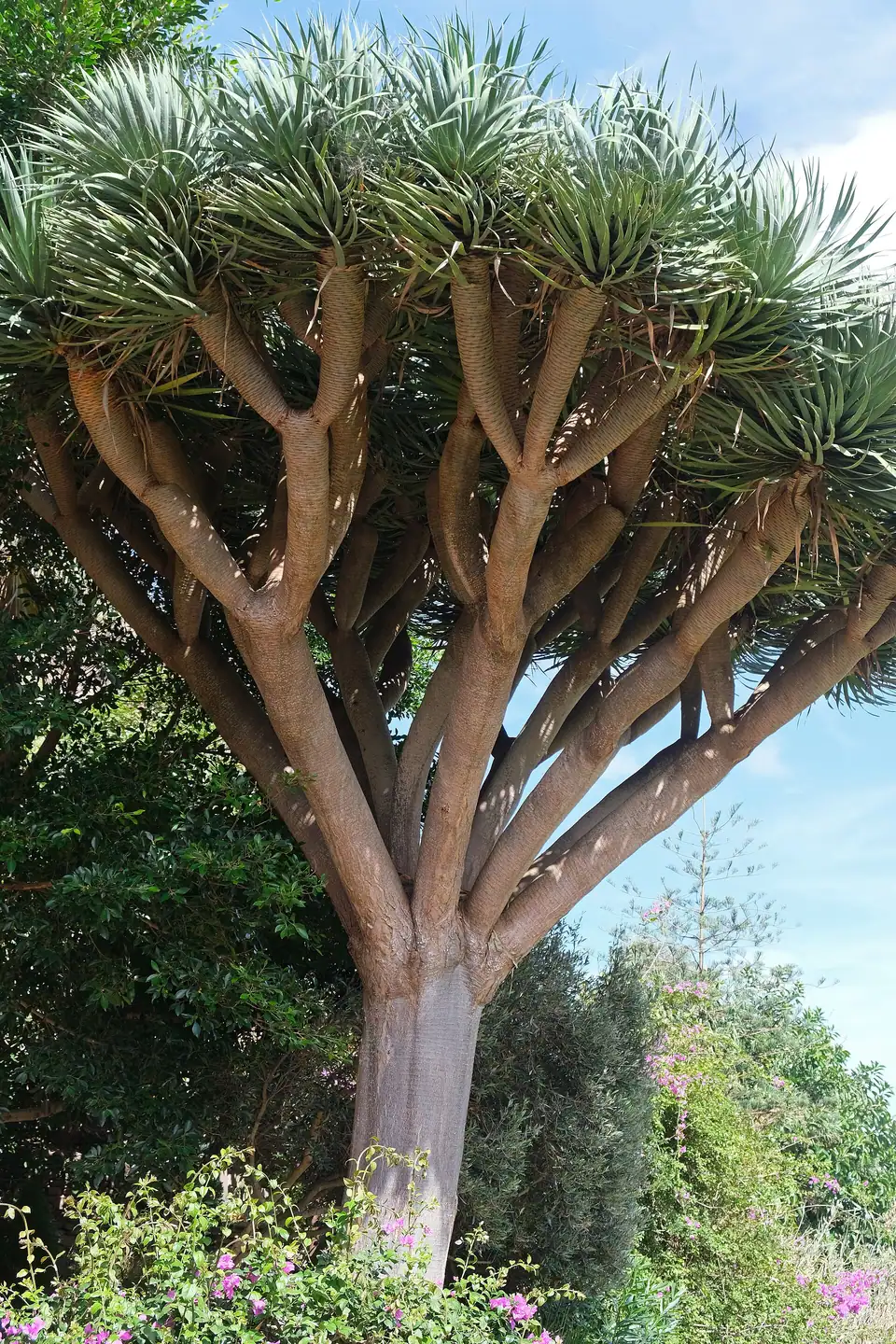
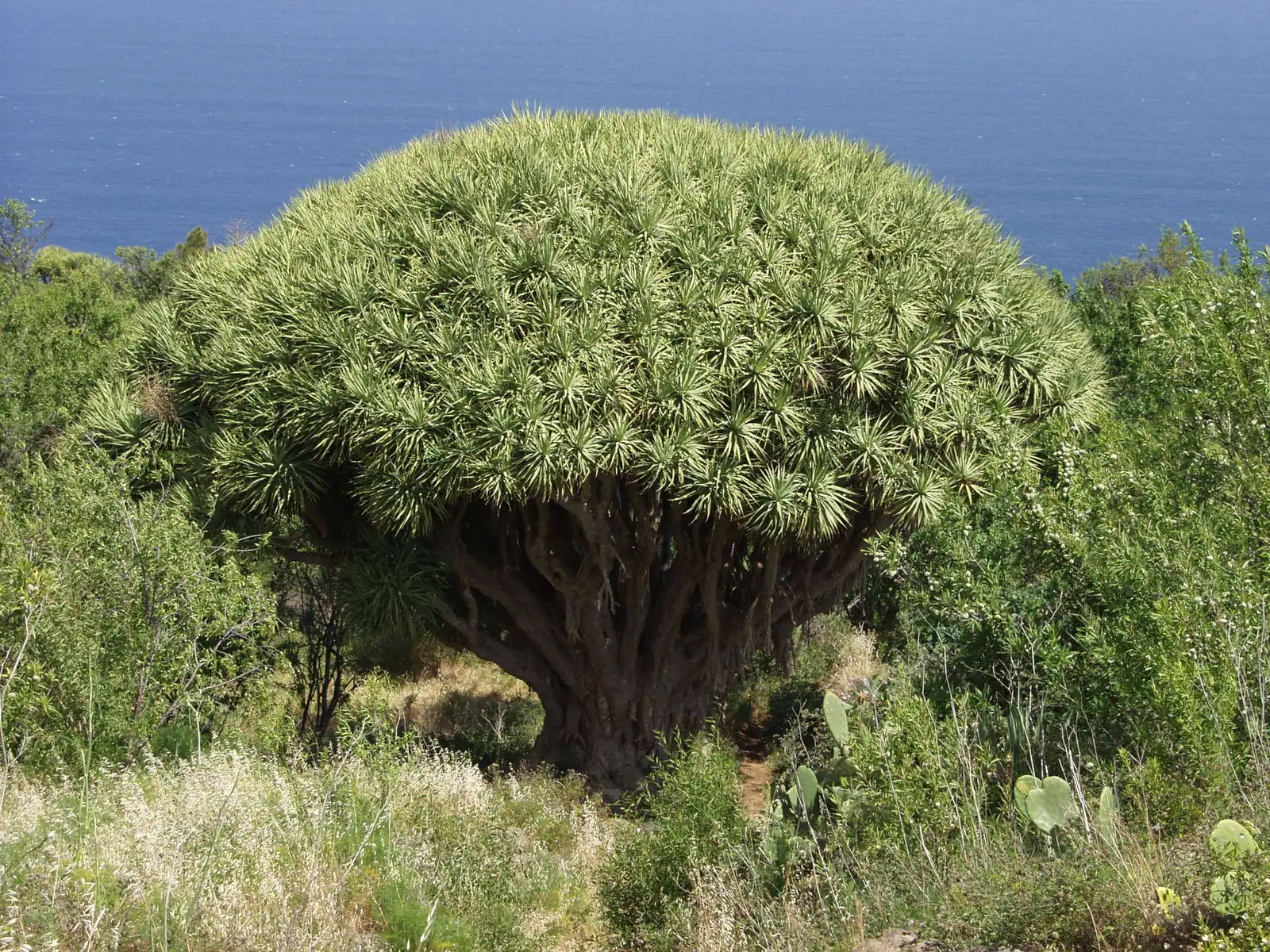

How to Grow and Care for Dragon tree
Dracaena draco
Written by Emilio Marruso · last checked
At a glance
The dragon tree can grow up to 50 feet tall, yet it is happy in a container too. Give it full sun or part shade, water it with rainwater if you can, and plant it any time of year as long as you water it well in dry spells. You can even grow new plants from seed or cuttings.
- Sun
Full sun to part shade
- Water
Very sensitive to fluoride: water with rainwater if you can
What the sources say (1)
Watering notes: Very sensitive to fluoride; water with rainwater if possible
Dracaena are very sensitive to fluoride, so water with rainwater if possible.
— Dracaena draco [4] - Cold
Survives winters down to 25 °F (−3.9 °C)
Half hardy: mild winters or an unheated greenhouse · USDA 9b · RHS H3 · Z9
What the sources say (2)
Hardiness, coldest zone: 9b [winter low −3.9 to −1.1 °C (25 to 30 °F)]
USDA: 9b-12 Frost Tolerance: Hardy to 22°F (-5°C)
— Dragon Tree, Dragon's Blood Tree (Dracaena draco) [3] Hardiness, warmest zone: 12 [winter low 10 to 15.6 °C (50 to 60 °F)]
USDA: 9b-12 Frost Tolerance: Hardy to 22°F (-5°C)
— Dragon Tree, Dragon's Blood Tree (Dracaena draco) [3] - Planting
Plant any time of year, watering well in dry spells; move it to a new spot in spring
What the sources say (2)
Planting: Any time of year, provided the plants are well watered during dry periods
transplanting (fonte: Lifeder): Trasplante. La mejor época para realizar el trasplante es primavera
— Drago: qué es, características, hábitat, propiedades, cultivo y cuidados [6] Dracaena may be planted at any time throughout the year, provided they are well wate red during dry periods.
— Dracaena draco [4] - Harvest
Wild birds and hens eat its fruit; its leaves have been fed to cattle and goats
- Size
Up to 50 ft tall
What the sources say (1)
Mature height: up to 1500 cm (15 m; up to 20 m [65.6 ft])
Árbol hasta de 15(20) m, con raíces aéreas, al menos en ejemplares más viejos en ambientes húmedos, con tallo grueso, cilíndrico, ramifica-ción dicótoma, que se produce después de la floración; ejemplares jó-venes con tronco no ramificado.
—  [1] - Propagation
From seed or from stem, branch, tip or root cuttings
What the sources say (3)
Propagation: Seed; stem or branch cuttings; tip cuttings; root cuttings
Propagation: Tip cuttings, root cuttings, seeds The name
— Dragon Tree, Dragon's Blood Tree (Dracaena draco) [3] Se reproduce por semillas y por esquejes de ramas.
—  [1] El drago se propaga a partir de semillas cultivadas en sustratos húmedos o por medio de esquejes obtenidos del tronco o ramificaciones.
— Drago: qué es, características, hábitat, propiedades, cultivo y cuidados [6] - Containers
Grows in containers too
What the sources say (1)
In containers: Yes
It thrives as well in pots as in garden beds.
— Dracaena draco [4]
Overview
Dracaena draco is a slow-growing evergreen tree native to the Canary Islands, classed as endangered in the wild. [4][2] It is grown in full sun to part shade and, once established, needs little water. [4] Cut or wounded, the trunk exudes a red resin known as dragon's blood. [2]
This record is incomplete: the sources we read do not cover every field yet.
Not yet covered by our sources: Pruning
Dragon tree care
How to water Dragon tree
Watering
The sources give different values depending on region, zone or growing conditions.
What each source says
According to Auckland Botanic Gardens (established plants): No regular watering needed once established
garden-grown trees (fonte: Better Homes & Gardens Australia): Natural rainfall is sufficient once established
plants in large pots (fonte: Better Homes & Gardens Australia): Water occasionally when soil is dry to touch
According to Desert-Tropicals: Moderate water
According to Lifeder (cultivation): Moderate, letting the substrate dry between waterings; once a week outside the hot summer
What the sources say (5)
According to Auckland Botanic Gardens (established plants): Once established, dracaena don't need regular watering, asgarden-grown trees (fonte: Better Homes & Gardens Australia): For garden-grown trees, natural rainfall is sufficient –plants in large pots (fonte: Better Homes & Gardens Australia): For plants in large pots, you’ll need to water occasionally when soil is dry to touch.According to Desert-Tropicals: Watering Needs: Moderate water
Propagation: Tip cuttings, rootAccording to Lifeder (cultivation): Riego. Se debe aplicar de forma moderada, procurando esperar que el sustrato esté seco hasta aplicar un nuevo riego.Watering notes
Very sensitive to fluoride; water with rainwater if possible
What the sources say (1)
Dracaena are very sensitive to fluoride, so water with rainwater if possible.How much light Dragon tree needs
How much cold Dragon tree can take
Hardiness, coldest zone
9b [winter low −3.9 to −1.1 °C (25 to 30 °F)]
What the sources say (1)
USDA: 9b-12
Frost Tolerance: Hardy to 22°F (-5°C)Hardiness, warmest zone
12 [winter low 10 to 15.6 °C (50 to 60 °F)]
What the sources say (1)
USDA: 9b-12
Frost Tolerance: Hardy to 22°F (-5°C)Where to grow Dragon tree
Yes
What the sources say (1)
It thrives as well in pots as in garden beds.How to propagate Dragon tree
Seed; stem or branch cuttings; tip cuttings; root cuttings
What the sources say (3)
Propagation: Tip cuttings, root cuttings, seeds
The nameSe reproduce por semillas y por esquejes de ramas.El drago se propaga a partir de semillas cultivadas en sustratos húmedos o por medio de esquejes obtenidos del tronco o ramificaciones.How to grow Dragon tree
The plant
Mature height
up to 1500 cm (15 m; up to 20 m [65.6 ft])
What the sources say (1)
Árbol hasta de 15(20) m, con raíces aéreas, al menos en ejemplares más viejos en ambientes húmedos, con tallo grueso, cilíndrico, ramifica-ción dicótoma, que se produce después de la floración; ejemplares jó-venes con tronco no ramificado.Fertilizing
When
The sources give different values depending on region, zone or growing conditions.
What each source says
Dracaena in general (as houseplants): Spring and summer, with lighter monthly feeding in fall
What the sources say (1)
Dracaena in general (as houseplants): Dracaena needs moderate to bright indirect light, temperatures of 65-75 degrees, and fertilizing every 2 weeks in spring and summer (balanced fertilizer), monthly feeds in the fall.How often
The sources give different values depending on region, zone or growing conditions.
What each source says
Dracaena in general (as houseplants): Every 2 weeks in spring and summer; monthly in fall
What the sources say (1)
Dracaena in general (as houseplants): Dracaena needs moderate to bright indirect light, temperatures of 65-75 degrees, and fertilizing every 2 weeks in spring and summer (balanced fertilizer), monthly feeds in the fall.Mineral fertilizers
The sources give different values depending on region, zone or growing conditions.
What each source says
Dracaena in general (as houseplants): Balanced fertilizer
What the sources say (1)
Dracaena in general (as houseplants): Dracaena needs moderate to bright indirect light, temperatures of 65-75 degrees, and fertilizing every 2 weeks in spring and summer (balanced fertilizer), monthly feeds in the fall.Signs of deficiency
The sources give different values depending on region, zone or growing conditions.
What each source says
Dracaena in general (as houseplants): Pale leaves with faded variegation (also a sign of too little light)
What the sources say (1)
Dracaena in general (as houseplants): pale leaves with faded variegation patterns signify too little light or not enough fertilizer.Remedies
The sources we checked give no remedies for this plant.
Calendar
Planting
Any time of year, provided the plants are well watered during dry periods
What each source says
transplanting (fonte: Lifeder): Spring
What the sources say (2)
transplanting (fonte: Lifeder): Trasplante. La mejor época para realizar el trasplante es primaveraDracaena may be planted at any time throughout the year, provided they are well wate red during dry periods.Pruning
Not stated in the sources we read.
Months as given by the sources, which are mostly from the United States (northern hemisphere). In the southern hemisphere they shift by about six months.
Edibility
Reported by the source, quoted verbatim. Do not eat a plant on the basis of this page alone: identification mistakes can be dangerous.
En Canarias, el consumo de sus frutos solo ha sido citado por Ber-thelot
[1]La savia o “sangre de drago” se ha usado en Tenerife como in-grediente edulcorante
[1]Sus hojas han sido utilizadas como forraje para el ganado bovino y caprino
[1]Sus hojas han sido utilizadas como forraje para el ganado bovino y caprino
[1]Sus frutos son consumidos por aves silvestres, gallinas y cochinos
[1]
Similar plants
- Queen of Dracaenas Dracaena goldieana
- Corn Plant Dracaena fragrans
- Dracaena Dracaena marginata
- Lucky Bamboo Dracaena sanderiana
- Whale Fin Dracaena Dracaena masoniana
- African Spear Dracaena angolensis
- Gold Dust Dracaena surculosa
- Snake Plant Dracaena trifasciata
Sources
Every value above is quoted from these documents. Links lead to the original publisher.
-  · miteco.gob.es, consulted
- Canary Islands Dragon tree | UNIPA Heritage · musei.unipa.it, consulted
- Dragon Tree, Dragon's Blood Tree (Dracaena draco) · desert-tropicals.com, consulted
- Dracaena draco · aucklandbotanicgardens.co.nz, consulted
- How to grow dragon trees | Better Homes & Gardens Australia · bhg.com.au, consulted
- Drago: qué es, características, hábitat, propiedades, cultivo y cuidados · lifeder.com, consulted
- depts.washington.edu · depts.washington.edu
Written by Emilio Marruso · last checked