

Cómo cultivar y cuidar Lilyturf
Liriope muscari
Escrito por Emilio Marruso · última revisión
Tóxica para: Personas · Por qué
De un vistazo
La liriope es una vivaz agradecida que crece a pleno sol o en semisombra, e incluso tolera una sombra casi total. Riégala con regularidad el primer año; una vez establecida, necesita muy poco riego extra. Se mantiene compacta, de 30 a 46 cm de alto y de ancho, pide poco abono y no es tóxica para gatos, perros ni caballos.
- Sol
Pleno sol o semisombra; tolera una sombra casi total, aunque crece más despacio
Qué dicen las fuentes (1)
Luz: Pleno sol a semisombra; tolera casi plena sombra, con crecimiento más lento
Lily turf requires acidic to neutral, well-drained soils in full sun to partial shade. It will tolerate almost full shade but growth is slower and leaves are elongated.
— Liriope muscari (Big Blue, Big Blue Lilyturf, Big Blue Liriope, Giant Lilyturf, Lilyturf, Lily Turf, Liriope) | North Carolina Extension Gardener Plant Toolbox [1] - Riego
Riega con regularidad el primer año; después, una vez por semana solo en las sequías de verano
Qué dicen las fuentes (4)
Riego: Riega regularmente durante el primer año; una vez establecido, casi no necesita riego suplementario; riega semanalmente según sea necesario durante las sequías de verano
Según NC State Extension: In their first year, they will need regular watering to keep soils moist but once they are established they require very little supplemental irrigation.
— Liriope muscari (Big Blue, Big Blue Lilyturf, Big Blue Liriope, Giant Lilyturf, Lilyturf, Lily Turf, Liriope) | North Carolina Extension Gardener Plant Toolbox [1] Según Clemson HGIC: Keep liriope healthy by watering weekly as needed during summer droughts, don’t over-apply mulch next to plants, and don’t over-fertilize.
— Liriope | Home & Garden Information Center [4] In their first year, they will need regular watering to keep soils moist but once they are established they require very little supplemental irrigation.
— Liriope muscari (Big Blue, Big Blue Lilyturf, Big Blue Liriope, Giant Lilyturf, Lilyturf, Lily Turf, Liriope) | North Carolina Extension Gardener Plant Toolbox [1] Keep liriope healthy by watering weekly as needed during summer droughts, don’t over-apply mulch next to plants, and don’t over-fertilize.
— Liriope | Home & Garden Information Center [4] - Frío
Aguanta inviernos de hasta −28,9 °C (−20 °F)
Muy rústica · USDA 5a · RHS H7 · Z5
Qué dicen las fuentes (2)
Rusticidad, zona más fría: 5a [mínima invernal de −28,9 a −26,1 °C (de −20 a −15 °F)]
USDA Plant Hardiness Zone: 5a, 5b, 6a, 6b, 7a, 7b, 8a, 8b, 9a, 9b, 10a, 10b
— Liriope muscari (Big Blue, Big Blue Lilyturf, Big Blue Liriope, Giant Lilyturf, Lilyturf, Lily Turf, Liriope) | North Carolina Extension Gardener Plant Toolbox [1] Rusticidad, zona más cálida: 10b [mínima invernal de 1,7 a 4,4 °C (de 35 a 40 °F)]
USDA Plant Hardiness Zone: 5a, 5b, 6a, 6b, 7a, 7b, 8a, 8b, 9a, 9b, 10a, 10b
— Liriope muscari (Big Blue, Big Blue Lilyturf, Big Blue Liriope, Giant Lilyturf, Lilyturf, Lily Turf, Liriope) | North Carolina Extension Gardener Plant Toolbox [1] - Suelo
Suelo húmedo y bien drenado; el encharcamiento o el exceso de riego pudren las raíces
Qué dicen las fuentes (1)
Notas sobre el riego: Requiere suelo húmedo y bien drenado; la pudrición de raíces puede ocurrir en sitios con mal drenaje o riego excesivo
Root rot may occur in sites that have poor drainage or are over-watered.
— Liriope | Home & Garden Information Center [4] - Distancia
30 cm entre plantas
Qué dicen las fuentes (1)
Distancia de plantación: 30.5 cm (1 pie)
Space the plants about 1 foot apart when planting.
— Liriope | Home & Garden Information Center [4] - Abonado
Un poco de abono de liberación lenta a principios de primavera, junto a las plantas, no sobre las hojas
Qué dicen las fuentes (6)
Cuándo: Principios de primavera
They are light feeders and benefit from a slow-release or organic fertilizer applied in the early spring.
— Liriope muscari (Big Blue, Big Blue Lilyturf, Big Blue Liriope, Giant Lilyturf, Lilyturf, Lily Turf, Liriope) | North Carolina Extension Gardener Plant Toolbox [1] They are light feeders and benefit from a slow-release or organic fertilizer applied in the early spring.
— Liriope - Liriope muscari | North Carolina Extension Gardener Plant Toolbox [2] Abonos minerales: Abono de liberación lenta; las plantas son de alimentación ligera
They are light feeders and benefit from a slow-release or organic fertilizer applied in the early spring.
— Liriope muscari (Big Blue, Big Blue Lilyturf, Big Blue Liriope, Giant Lilyturf, Lilyturf, Lily Turf, Liriope) | North Carolina Extension Gardener Plant Toolbox [1] They are light feeders and benefit from a slow-release or organic fertilizer applied in the early spring.
— Giant Lilyturf - Liriope muscari | North Carolina Extension Gardener Plant Toolbox [3] Evitar: Exceso de abono y gránulos que quedan entre las hojas: esparce el abono junto a las plantas
When fertilizing, scatter fertilizer around plants but don’t let fertilizer granules become wedged between leaves.
— Liriope | Home & Garden Information Center [4] Keep liriope healthy by watering weekly as needed during summer droughts, don’t over-apply mulch next to plants, and don’t over-fertilize.
— Liriope | Home & Garden Information Center [4] - Poda
Corta las hojas del año anterior en febrero, antes de que empiece a brotar
Qué dicen las fuentes (5)
Poda: Febrero, antes de que comience el nuevo crecimiento (finales de invierno; finales de enero en la parte baja costera de Carolina del Sur, a mediados de febrero en la parte alta de Carolina del Sur)
Según NC State Extension: To maintain an attractive appearance, cut back tops each February before new growth begins.
— Liriope muscari (Big Blue, Big Blue Lilyturf, Big Blue Liriope, Giant Lilyturf, Lilyturf, Lily Turf, Liriope) | North Carolina Extension Gardener Plant Toolbox [1] parte baja costera de Carolina del Sur: It is important to prune liriope before spring growth begins – late January in lower coastal South Carolina and by mid-February in upstate South Carolina.
— Liriope | Home & Garden Information Center [4] el norte del estado de Carolina del Sur: It is important to prune liriope before spring growth begins – late January in lower coastal South Carolina and by mid-February in upstate South Carolina.
— Liriope | Home & Garden Information Center [4] To maintain an attractive appearance, cut back tops each February before new growth begins.
— Liriope muscari (Big Blue, Big Blue Lilyturf, Big Blue Liriope, Giant Lilyturf, Lilyturf, Lily Turf, Liriope) | North Carolina Extension Gardener Plant Toolbox [1] It is important to prune liriope before spring growth begins – late January in lower coastal South Carolina and by mid-February in upstate South Carolina.
— Liriope | Home & Garden Information Center [4] - Plagas
Babosas, caracoles y cochinillas; vigila la antracnosis y la podredumbre de hojas, cuello y raíces
Qué dicen las fuentes (4)
Plagas: babosas, caracoles, cochinilla de liriope, cochinilla de helecho
This plant has no serious insect or disease problems. Monitor for slugs and snails.
— Liriope muscari (Big Blue, Big Blue Lilyturf, Big Blue Liriope, Giant Lilyturf, Lilyturf, Lily Turf, Liriope) | North Carolina Extension Gardener Plant Toolbox [1] Liriope scale ( Pinnaspis caricis ) or fern scale ( P. aspidistrae ) may infest liriope and causes chlorotic spotting
— Liriope | Home & Garden Information Center [4] Enfermedades: pudrición de la hoja, pudrición de la corona, antracnosis, pudrición de la raíz
Leaf rot, crown rot, and anthracnose may occur.
— Liriope muscari (Big Blue, Big Blue Lilyturf, Big Blue Liriope, Giant Lilyturf, Lilyturf, Lily Turf, Liriope) | North Carolina Extension Gardener Plant Toolbox [1] Liriope is also prone to root rot caused by Phytophthora , Fusarium oxysporum, or Rhizoctonia solani.
— Liriope | Home & Garden Information Center [4] - Atención
No la plantes muy honda ni te pases con el acolchado o el abono: la base de la planta puede pudrirse
- Tamaño
30–46 cm de alto y de ancho
Qué dicen las fuentes (3)
Altura adulta: 30-46 cm (1 a 1.5 pies)
Dimensions: Height: 1 ft. 0 in. - 1 ft. 6 in. Width: 1 ft. 0 in. - 1 ft. 6 in.
— Liriope muscari (Big Blue, Big Blue Lilyturf, Big Blue Liriope, Giant Lilyturf, Lilyturf, Lily Turf, Liriope) | North Carolina Extension Gardener Plant Toolbox [1] Anchura adulta: 30-46 cm (1 a 1.5 pies)
Dimensions: Height: 1 ft. 0 in. - 1 ft. 6 in. Width: 1 ft. 0 in. - 1 ft. 6 in.
— Liriope muscari (Big Blue, Big Blue Lilyturf, Big Blue Liriope, Giant Lilyturf, Lilyturf, Lily Turf, Liriope) | North Carolina Extension Gardener Plant Toolbox [1] Liriope muscari generally grows in a clump form and will spread to about 12 to 18 inches wide.
— Liriope | Home & Garden Information Center [4] - Multiplicación
Por división de mata o por semilla
Qué dicen las fuentes (2)
Propagación: División; semilla
Recommended Propagation Strategy: Division Seed Country Or Region Of Origin:
— Liriope muscari (Big Blue, Big Blue Lilyturf, Big Blue Liriope, Giant Lilyturf, Lilyturf, Lily Turf, Liriope) | North Carolina Extension Gardener Plant Toolbox [1] As the plants grow and mature, they can be dug and separated
— Liriope | Home & Garden Information Center [4] - Maceta
Crece también en maceta
Qué dicen las fuentes (1)
En maceta: Sí
Use lilyturf for edging, rock gardens, containers, woodland settings, or as a ground cover.
— Liriope muscari (Big Blue, Big Blue Lilyturf, Big Blue Liriope, Giant Lilyturf, Lilyturf, Lily Turf, Liriope) | North Carolina Extension Gardener Plant Toolbox [1] - Seguridad
No es tóxica para gatos, perros ni caballos; no hay casos conocidos en personas, pero no la comas
Resumen
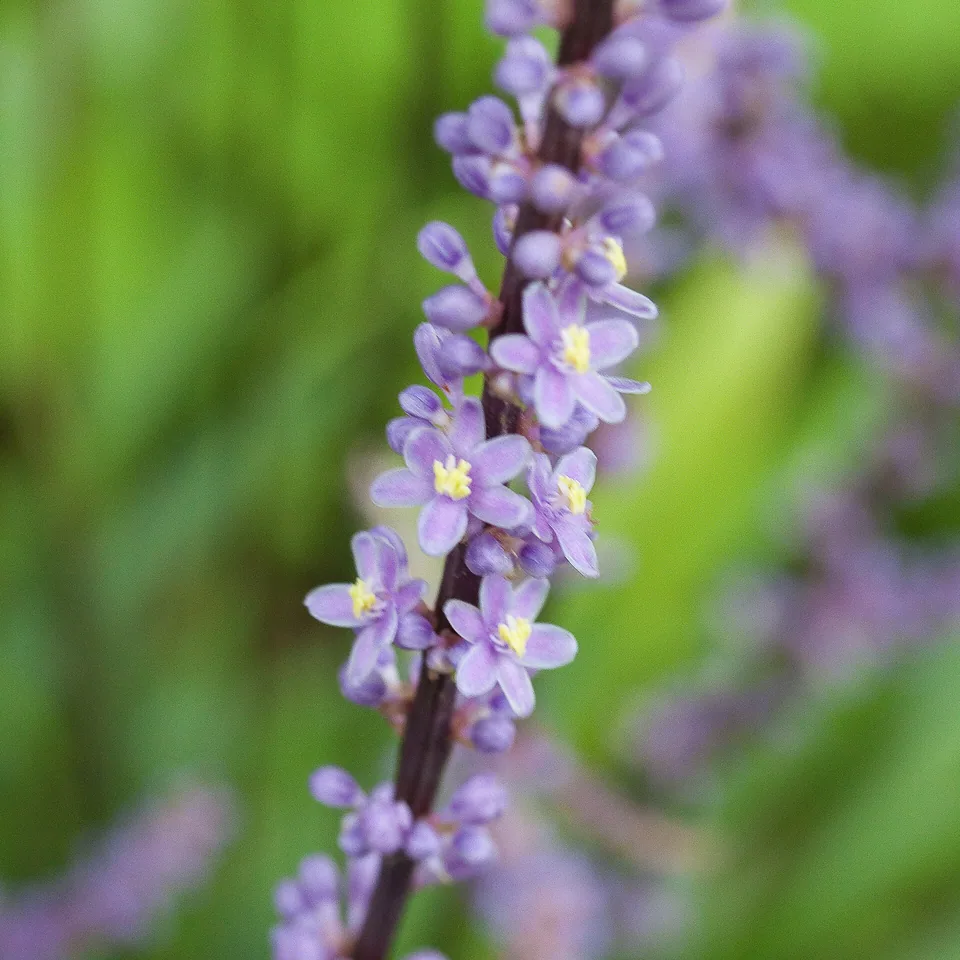
El liriope azul grande es una herbácea perenne de hoja ancha, siempre verde, que forma matas y se usa como cubresuelo o borde. [1] Tolera pleno sol a semisombra y, una vez establecido, necesita muy poco riego suplementario. [1] Tiene espigas de flores moradas seguidas de bayas negras. [1]
Citado en inglés, como en la fuente.
Cuidados
Riego
Riego
Riega regularmente durante el primer año; una vez establecido, casi no necesita riego suplementario; riega semanalmente según sea necesario durante las sequías de verano
Lo que dice cada fuente
Según NC State Extension: Riego regular durante el primer año; una vez establecido, muy poco riego suplementario
Según Clemson HGIC: Riega semanalmente según sea necesario durante las sequías de verano
Qué dicen las fuentes (4)
Según NC State Extension: In their first year, they will need regular watering to keep soils moist but once they are established they require very little supplemental irrigation.Según Clemson HGIC: Keep liriope healthy by watering weekly as needed during summer droughts, don’t over-apply mulch next to plants, and don’t over-fertilize.In their first year, they will need regular watering to keep soils moist but once they are established they require very little supplemental irrigation.Keep liriope healthy by watering weekly as needed during summer droughts, don’t over-apply mulch next to plants, and don’t over-fertilize.Notas sobre el riego
Requiere suelo húmedo y bien drenado; la pudrición de raíces puede ocurrir en sitios con mal drenaje o riego excesivo
Qué dicen las fuentes (1)
Root rot may occur in sites that have poor drainage or are over-watered.Luz
Pleno sol a semisombra; tolera casi plena sombra, con crecimiento más lento
Qué dicen las fuentes (1)
Lily turf requires acidic to neutral, well-drained soils in full sun to partial shade. It will tolerate almost full shade but growth is slower and leaves are elongated.Clima y frío
Rusticidad, zona más fría
5a [mínima invernal de −28,9 a −26,1 °C (de −20 a −15 °F)]
Qué dicen las fuentes (1)
USDA Plant Hardiness Zone:
5a, 5b, 6a, 6b, 7a, 7b, 8a, 8b, 9a, 9b, 10a, 10bRusticidad, zona más cálida
10b [mínima invernal de 1,7 a 4,4 °C (de 35 a 40 °F)]
Qué dicen las fuentes (1)
USDA Plant Hardiness Zone:
5a, 5b, 6a, 6b, 7a, 7b, 8a, 8b, 9a, 9b, 10a, 10bDónde cultivarla
En maceta
Sí
Qué dicen las fuentes (1)
Use lilyturf for edging, rock gardens, containers, woodland settings, or as a ground cover.Distancia de plantación
30.5 cm (1 pie)
Qué dicen las fuentes (1)
Space the plants about 1 foot apart when planting.Propagación
División; semilla
Qué dicen las fuentes (2)
Recommended Propagation Strategy:
Division
Seed
Country Or Region Of Origin:As the plants grow and mature, they can be dug and separatedCultivo
La planta
Ciclo de vida
perenne
Qué dicen las fuentes (1)
Genus: Liriope Species: muscari Family: Asparagaceae Life Cycle: Perennial Recommended Propagation Strategy: Division SeedFamilia
Asparagáceas
Qué dicen las fuentes (1)
Genus: Liriope Species: muscari Family: Asparagaceae Life Cycle: Perennial Recommended Propagation Strategy: Division SeedAltura adulta
30-46 cm (1 a 1.5 pies)
Qué dicen las fuentes (1)
Dimensions: Height: 1 ft. 0 in. - 1 ft. 6 in. Width: 1 ft. 0 in. - 1 ft. 6 in.Anchura adulta
30-46 cm (1 a 1.5 pies)
Qué dicen las fuentes (2)
Dimensions: Height: 1 ft. 0 in. - 1 ft. 6 in. Width: 1 ft. 0 in. - 1 ft. 6 in.Liriope muscari generally grows in a clump form and will spread to about 12 to 18 inches wide.Plagas y enfermedades
Plagas
babosas, caracoles, cochinilla de liriope, cochinilla de helecho
Qué dicen las fuentes (2)
This plant has no serious insect or disease problems. Monitor for slugs and snails.Liriope scale ( Pinnaspis caricis ) or fern scale ( P. aspidistrae ) may infest liriope and causes chlorotic spottingEnfermedades
pudrición de la hoja, pudrición de la corona, antracnosis, pudrición de la raíz
Qué dicen las fuentes (2)
Leaf rot, crown rot, and anthracnose may occur.Liriope is also prone to root rot caused by Phytophthora , Fusarium oxysporum, or Rhizoctonia solani.Abonado
Cuándo
Principios de primavera
Qué dicen las fuentes (2)
They are light feeders and benefit from a slow-release or organic fertilizer applied in the early spring.They are light feeders and benefit from a slow-release or organic fertilizer applied in the early spring.Abonos naturales
Abono orgánico a principios de primavera
Qué dicen las fuentes (1)
They are light feeders and benefit from a slow-release or organic fertilizer applied in the early spring.Abonos minerales
Abono de liberación lenta; las plantas son de alimentación ligera
Qué dicen las fuentes (2)
They are light feeders and benefit from a slow-release or organic fertilizer applied in the early spring.They are light feeders and benefit from a slow-release or organic fertilizer applied in the early spring.Evitar
Exceso de abono y gránulos que quedan entre las hojas: esparce el abono junto a las plantas
Qué dicen las fuentes (2)
When fertilizing, scatter fertilizer around plants but don’t let fertilizer granules become wedged between leaves.Keep liriope healthy by watering weekly as needed during summer droughts, don’t over-apply mulch next to plants, and don’t over-fertilize.Problemas
Antracnosis
Síntoma: Manchas de color marrón rojizo a lo largo de los bordes y puntas de las hojas, muerte regresiva rápida del follaje; más frecuente con lluvias frecuentes o riego por aspersión.
Qué hacer: Siega o recorta las hojas del año pasado a fines del invierno y retira los residuos; evita regar en exceso o regar tarde en el día
Qué dicen las fuentes (2)
Reddish-brown spots that appear along leaf margins and leaf tips are caused by a fungal disease known as anthracnose, which is caused by Colletotrichum species.
— Liriope | Home & Garden Information Center [4] Avoid over-watering or watering late in the day.
— Liriope | Home & Garden Information Center [4] Pudrición de la hoja y de la corona
Síntoma: Amarillamiento del follaje interior, luego las secciones basales de las hojas se vuelven marrones.
Qué hacer: No plantes demasiado profundo, no apliques demasiado mantillo o fertilizante, y evita sitios con mal drenaje; las plantas afectadas deben retirarse y desecharse.
Babosas y caracoles
Síntoma: Se deben monitorear babosas y caracoles; pueden ocurrir pudrición de la hoja, pudrición de la corona y antracnosis.
Qué hacer: Monitorea.
Qué dicen las fuentes (1)
Monitor for slugs and snails. Leaf rot, crown rot, and anthracnose may occur.
— Liriope muscari (Big Blue, Big Blue Lilyturf, Big Blue Liriope, Giant Lilyturf, Lilyturf, Lily Turf, Liriope) | North Carolina Extension Gardener Plant Toolbox [1]
Remedios
Cada remedio indica qué dicen las fuentes oficiales; los remedios tradicionales sin fuente oficial aparecen marcados. Los perjudiciales están para que sepas evitarlos.
Cuidar la planta
babosas
Retira el mantillo. No verificado
Remedio tradicional, no verificado por una fuente oficial.
Cómo: Si tienes problemas de babosas, retira el mantillo durante unos días soleados.
trampas de babosas con cerveza No verificado
Remedio tradicional, no verificado por una fuente oficial.
Cómo: Prueba trampas de babosas con cerveza.
antracnosis
Recorta las hojas viejas y limpia los restos. Funciona en parte
Cómo: Siega o recorta las hojas del año pasado a fines del invierno a una altura de aproximadamente 3 pulgadas y retira la mayor cantidad de restos posible.
Mow or trim off last year’s leaves in late winter to a height of about 3 inches and remove as much of the debris as possible.
— Liriope | Home & Garden Information Center [4] Qué dicen las pruebas remove as much of the debris as possible. Avoid over-watering or watering late in the day. This may be all that is needed to stop disease.
— Liriope | Home & Garden Information Center [4]
cochinillas
Recorta el follaje y limpia los restos de poda Funciona
Cómo: Recorta el follaje a fines del invierno y limpia los restos.
Cut back the foliage in the late winter and clean up the clippings to significantly help in scale control.
— Liriope | Home & Garden Information Center [4] Qué dicen las pruebas Cut back the foliage in the late winter and clean up the clippings to significantly help in scale control.
— Liriope | Home & Garden Information Center [4]
pudrición de la hoja y la corona
eliminando las plantas afectadas Fuente oficial, sin prueba independiente
Cómo: Las plantas que muestren síntomas deben eliminarse y desecharse de inmediato.
Plants that are showing symptoms should be removed and disposed of immediately before there can be further spread of the disease.
— Liriope | Home & Garden Information Center [4]
Toxicidad
Según la fuente, citada textualmente. No es un consejo médico ni veterinario: si una persona o un animal pudo haber ingerido esta planta, contacta con un centro de toxicología o con un veterinario.
Animales
#non-toxic for cats #non-toxic for horses #non-toxic for dogs
[1]La fuente señala el riesgo para este animal pero no explica por qué.
Personas
No cases are known, but caution due to a relationship with known toxic plants
[1]
Calendario
Poda
Febrero, antes de que comience el nuevo crecimiento (finales de invierno; finales de enero en la parte baja costera de Carolina del Sur, a mediados de febrero en la parte alta de Carolina del Sur)
Lo que dice cada fuente
Según NC State Extension: Febrero, antes de que comience el nuevo crecimiento
parte baja costera de Carolina del Sur: Finales de enero, antes de que comience el crecimiento de primavera
el norte del estado de Carolina del Sur: A mediados de febrero, antes de que comience el crecimiento de primavera
Qué dicen las fuentes (5)
Según NC State Extension: To maintain an attractive appearance, cut back tops each February before new growth begins.parte baja costera de Carolina del Sur: It is important to prune liriope before spring growth begins – late January in lower coastal South Carolina and by mid-February in upstate South Carolina.el norte del estado de Carolina del Sur: It is important to prune liriope before spring growth begins – late January in lower coastal South Carolina and by mid-February in upstate South Carolina.To maintain an attractive appearance, cut back tops each February before new growth begins.It is important to prune liriope before spring growth begins – late January in lower coastal South Carolina and by mid-February in upstate South Carolina.Meses tal como los dan las fuentes, en su mayoría de Estados Unidos (hemisferio norte). En el hemisferio sur se desplazan unos seis meses.
Valores orientativos
Valores de una fuente secundaria, no comprobados palabra por palabra como el resto de esta página. Úselos como punto de partida.
- Resiste la sequía
- SíValor orientativo, adáptalo a tu clima · Fuente secundaria
- Suelo
- Ácido, Bien drenadoValor orientativo, adáptalo a tu clima · Fuente secundaria
- pH del suelo
- 6-7Valor orientativo, adáptalo a tu clima · Fuente secundaria
- Nivel de cuidado
- BajoValor orientativo, adáptalo a tu clima · Fuente secundaria
- Crecimiento
- ModeradoValor orientativo, adáptalo a tu clima · Fuente secundaria
Plantas similares
- Lilyturf Liriope spicata
- Palma de aguja Yucca flaccida
- American Agave Agave virginica
- Esparraguera Asparagus officinalis
- Helecho plumoso Asparagus setaceus
- Beaked Yucca Yucca rostrata
- Beschorneria Beschorneria yuccoides
- Brodiaea Triteleia laxa
Fuentes
Cada valor anterior se cita de estos documentos. Los enlaces llevan al editor original.
- Liriope muscari (Big Blue, Big Blue Lilyturf, Big Blue Liriope, Giant Lilyturf, Lilyturf, Lily Turf, Liriope) | North Carolina Extension Gardener Plant Toolbox · plants.ces.ncsu.edu, consultado
- Liriope - Liriope muscari | North Carolina Extension Gardener Plant Toolbox · plants.ces.ncsu.edu, consultado
- Giant Lilyturf - Liriope muscari | North Carolina Extension Gardener Plant Toolbox · plants.ces.ncsu.edu, consultado
- Liriope | Home & Garden Information Center · hgic.clemson.edu, consultado
Escrito por Emilio Marruso · última revisión