

How to Grow and Care for Lilyturf
Liriope muscari
Written by Emilio Marruso · last checked
Toxic to: People · Why
At a glance
Liriope is an easygoing perennial that grows in full sun to partial shade and even tolerates almost full shade. Water it regularly the first year; once established, it needs very little extra water. It stays a tidy 1 to 1.5 feet tall and wide, needs little feeding, and is non-toxic to cats, dogs and horses.
- Sun
Full sun to partial shade; tolerates almost full shade but grows slower
What the sources say (1)
Light: Full sun to partial shade; tolerates almost full shade, with slower growth
Lily turf requires acidic to neutral, well-drained soils in full sun to partial shade. It will tolerate almost full shade but growth is slower and leaves are elongated.
— Liriope muscari (Big Blue, Big Blue Lilyturf, Big Blue Liriope, Giant Lilyturf, Lilyturf, Lily Turf, Liriope) | North Carolina Extension Gardener Plant Toolbox [1] - Water
Water regularly the first year; after that, weekly only during summer droughts
What the sources say (4)
Watering: Regular watering in the first year; once established very little supplemental irrigation, watered weekly as needed during summer droughts
According to NC State Extension: In their first year, they will need regular watering to keep soils moist but once they are established they require very little supplemental irrigation.
— Liriope muscari (Big Blue, Big Blue Lilyturf, Big Blue Liriope, Giant Lilyturf, Lilyturf, Lily Turf, Liriope) | North Carolina Extension Gardener Plant Toolbox [1] According to Clemson HGIC: Keep liriope healthy by watering weekly as needed during summer droughts, don’t over-apply mulch next to plants, and don’t over-fertilize.
— Liriope | Home & Garden Information Center [4] In their first year, they will need regular watering to keep soils moist but once they are established they require very little supplemental irrigation.
— Liriope muscari (Big Blue, Big Blue Lilyturf, Big Blue Liriope, Giant Lilyturf, Lilyturf, Lily Turf, Liriope) | North Carolina Extension Gardener Plant Toolbox [1] Keep liriope healthy by watering weekly as needed during summer droughts, don’t over-apply mulch next to plants, and don’t over-fertilize.
— Liriope | Home & Garden Information Center [4] - Cold
Survives winters down to −20 °F (−28.9 °C)
Very hardy · USDA 5a · RHS H7 · Z5
What the sources say (2)
Hardiness, coldest zone: 5a [winter low −28.9 to −26.1 °C (−20 to −15 °F)]
USDA Plant Hardiness Zone: 5a, 5b, 6a, 6b, 7a, 7b, 8a, 8b, 9a, 9b, 10a, 10b
— Liriope muscari (Big Blue, Big Blue Lilyturf, Big Blue Liriope, Giant Lilyturf, Lilyturf, Lily Turf, Liriope) | North Carolina Extension Gardener Plant Toolbox [1] Hardiness, warmest zone: 10b [winter low 1.7 to 4.4 °C (35 to 40 °F)]
USDA Plant Hardiness Zone: 5a, 5b, 6a, 6b, 7a, 7b, 8a, 8b, 9a, 9b, 10a, 10b
— Liriope muscari (Big Blue, Big Blue Lilyturf, Big Blue Liriope, Giant Lilyturf, Lilyturf, Lily Turf, Liriope) | North Carolina Extension Gardener Plant Toolbox [1] - Soil
Moist, well-drained soil; soggy or overwatered spots cause root rot
What the sources say (1)
Watering notes: Requires moist, well-drained soil; root rot may occur in poorly drained or over-watered sites
Root rot may occur in sites that have poor drainage or are over-watered.
— Liriope | Home & Garden Information Center [4] - Spacing
1 ft between plants
What the sources say (1)
Spacing: 30.5 cm (1 ft)
Space the plants about 1 foot apart when planting.
— Liriope | Home & Garden Information Center [4] - Feeding
A little slow-release fertilizer in early spring, scattered beside the plants, not on the leaves
What the sources say (6)
When: Early spring
They are light feeders and benefit from a slow-release or organic fertilizer applied in the early spring.
— Liriope muscari (Big Blue, Big Blue Lilyturf, Big Blue Liriope, Giant Lilyturf, Lilyturf, Lily Turf, Liriope) | North Carolina Extension Gardener Plant Toolbox [1] They are light feeders and benefit from a slow-release or organic fertilizer applied in the early spring.
— Liriope - Liriope muscari | North Carolina Extension Gardener Plant Toolbox [2] Mineral fertilizers: Slow-release fertilizer; the plants are light feeders
They are light feeders and benefit from a slow-release or organic fertilizer applied in the early spring.
— Liriope muscari (Big Blue, Big Blue Lilyturf, Big Blue Liriope, Giant Lilyturf, Lilyturf, Lily Turf, Liriope) | North Carolina Extension Gardener Plant Toolbox [1] They are light feeders and benefit from a slow-release or organic fertilizer applied in the early spring.
— Giant Lilyturf - Liriope muscari | North Carolina Extension Gardener Plant Toolbox [3] Avoid: Over-fertilizing, and granules lodged between the leaves: scatter the fertilizer beside the plants
When fertilizing, scatter fertilizer around plants but don’t let fertilizer granules become wedged between leaves.
— Liriope | Home & Garden Information Center [4] Keep liriope healthy by watering weekly as needed during summer droughts, don’t over-apply mulch next to plants, and don’t over-fertilize.
— Liriope | Home & Garden Information Center [4] - Pruning
Cut back last year's leaves in February, before new growth starts
What the sources say (5)
Pruning: February, before new growth begins (late winter; late January in lower coastal South Carolina, by mid-February in upstate South Carolina)
According to NC State Extension: To maintain an attractive appearance, cut back tops each February before new growth begins.
— Liriope muscari (Big Blue, Big Blue Lilyturf, Big Blue Liriope, Giant Lilyturf, Lilyturf, Lily Turf, Liriope) | North Carolina Extension Gardener Plant Toolbox [1] lower coastal South Carolina: It is important to prune liriope before spring growth begins – late January in lower coastal South Carolina and by mid-February in upstate South Carolina.
— Liriope | Home & Garden Information Center [4] upstate South Carolina: It is important to prune liriope before spring growth begins – late January in lower coastal South Carolina and by mid-February in upstate South Carolina.
— Liriope | Home & Garden Information Center [4] To maintain an attractive appearance, cut back tops each February before new growth begins.
— Liriope muscari (Big Blue, Big Blue Lilyturf, Big Blue Liriope, Giant Lilyturf, Lilyturf, Lily Turf, Liriope) | North Carolina Extension Gardener Plant Toolbox [1] It is important to prune liriope before spring growth begins – late January in lower coastal South Carolina and by mid-February in upstate South Carolina.
— Liriope | Home & Garden Information Center [4] - Pests
Slugs, snails and scale; watch for anthracnose and leaf, crown and root rot
What the sources say (4)
Pests: slugs, snails, liriope scale, fern scale
This plant has no serious insect or disease problems. Monitor for slugs and snails.
— Liriope muscari (Big Blue, Big Blue Lilyturf, Big Blue Liriope, Giant Lilyturf, Lilyturf, Lily Turf, Liriope) | North Carolina Extension Gardener Plant Toolbox [1] Liriope scale ( Pinnaspis caricis ) or fern scale ( P. aspidistrae ) may infest liriope and causes chlorotic spotting
— Liriope | Home & Garden Information Center [4] Diseases: leaf rot, crown rot, anthracnose, root rot
Leaf rot, crown rot, and anthracnose may occur.
— Liriope muscari (Big Blue, Big Blue Lilyturf, Big Blue Liriope, Giant Lilyturf, Lilyturf, Lily Turf, Liriope) | North Carolina Extension Gardener Plant Toolbox [1] Liriope is also prone to root rot caused by Phytophthora , Fusarium oxysporum, or Rhizoctonia solani.
— Liriope | Home & Garden Information Center [4] - Watch out
Don't plant too deep or overdo mulch and fertilizer: the base of the plant can rot
- Size
1 to 1.5 ft tall and wide
What the sources say (3)
Mature height: 30-46 cm (1 to 1.5 feet)
Dimensions: Height: 1 ft. 0 in. - 1 ft. 6 in. Width: 1 ft. 0 in. - 1 ft. 6 in.
— Liriope muscari (Big Blue, Big Blue Lilyturf, Big Blue Liriope, Giant Lilyturf, Lilyturf, Lily Turf, Liriope) | North Carolina Extension Gardener Plant Toolbox [1] Mature width: 30-46 cm (1 to 1.5 feet)
Dimensions: Height: 1 ft. 0 in. - 1 ft. 6 in. Width: 1 ft. 0 in. - 1 ft. 6 in.
— Liriope muscari (Big Blue, Big Blue Lilyturf, Big Blue Liriope, Giant Lilyturf, Lilyturf, Lily Turf, Liriope) | North Carolina Extension Gardener Plant Toolbox [1] Liriope muscari generally grows in a clump form and will spread to about 12 to 18 inches wide.
— Liriope | Home & Garden Information Center [4] - Propagation
By dividing clumps or from seed
What the sources say (2)
Propagation: Division; seed
Recommended Propagation Strategy: Division Seed Country Or Region Of Origin:
— Liriope muscari (Big Blue, Big Blue Lilyturf, Big Blue Liriope, Giant Lilyturf, Lilyturf, Lily Turf, Liriope) | North Carolina Extension Gardener Plant Toolbox [1] As the plants grow and mature, they can be dug and separated
— Liriope | Home & Garden Information Center [4] - Containers
Grows in containers too
What the sources say (1)
In containers: Yes
Use lilyturf for edging, rock gardens, containers, woodland settings, or as a ground cover.
— Liriope muscari (Big Blue, Big Blue Lilyturf, Big Blue Liriope, Giant Lilyturf, Lilyturf, Lily Turf, Liriope) | North Carolina Extension Gardener Plant Toolbox [1] - Safety
Non-toxic to cats, dogs and horses; no human cases known, but don't eat it
Overview
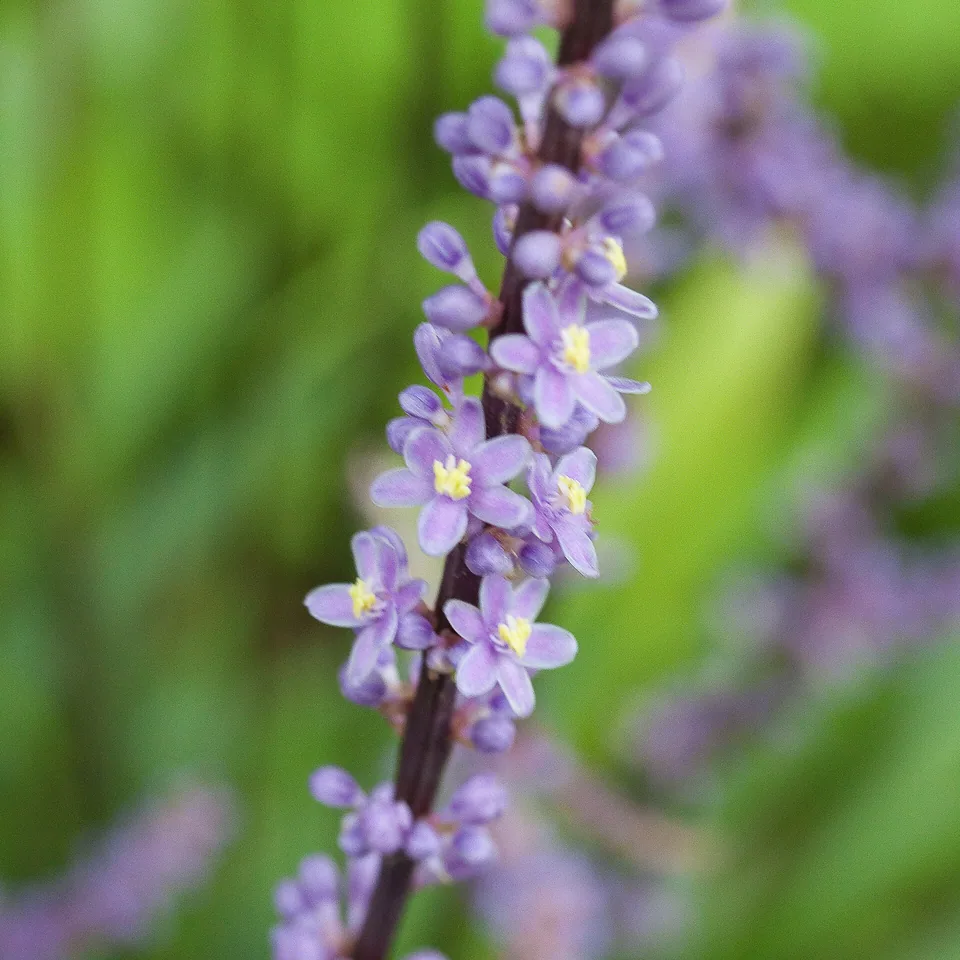
Big blue lilyturf is a broadleaf evergreen, clump-forming herbaceous perennial used as a groundcover or edging. [1] It tolerates full sun to partial shade and, once established, needs very little supplemental irrigation. [1] It has purple flower spikes followed by black berries. [1]
Lilyturf care
How to water Lilyturf
Watering
Regular watering in the first year; once established very little supplemental irrigation, watered weekly as needed during summer droughts
What each source says
According to NC State Extension: Regular watering in the first year; once established very little supplemental irrigation
According to Clemson HGIC: Watering weekly as needed during summer droughts
What the sources say (4)
According to NC State Extension: In their first year, they will need regular watering to keep soils moist but once they are established they require very little supplemental irrigation.According to Clemson HGIC: Keep liriope healthy by watering weekly as needed during summer droughts, don’t over-apply mulch next to plants, and don’t over-fertilize.In their first year, they will need regular watering to keep soils moist but once they are established they require very little supplemental irrigation.Keep liriope healthy by watering weekly as needed during summer droughts, don’t over-apply mulch next to plants, and don’t over-fertilize.Watering notes
Requires moist, well-drained soil; root rot may occur in poorly drained or over-watered sites
What the sources say (1)
Root rot may occur in sites that have poor drainage or are over-watered.How much light Lilyturf needs
Full sun to partial shade; tolerates almost full shade, with slower growth
What the sources say (1)
Lily turf requires acidic to neutral, well-drained soils in full sun to partial shade. It will tolerate almost full shade but growth is slower and leaves are elongated.How much cold Lilyturf can take
Hardiness, coldest zone
5a [winter low −28.9 to −26.1 °C (−20 to −15 °F)]
What the sources say (1)
USDA Plant Hardiness Zone:
5a, 5b, 6a, 6b, 7a, 7b, 8a, 8b, 9a, 9b, 10a, 10bHardiness, warmest zone
10b [winter low 1.7 to 4.4 °C (35 to 40 °F)]
What the sources say (1)
USDA Plant Hardiness Zone:
5a, 5b, 6a, 6b, 7a, 7b, 8a, 8b, 9a, 9b, 10a, 10bWhere to grow Lilyturf
In containers
Yes
What the sources say (1)
Use lilyturf for edging, rock gardens, containers, woodland settings, or as a ground cover.Spacing
30.5 cm (1 ft)
What the sources say (1)
Space the plants about 1 foot apart when planting.How to propagate Lilyturf
Division; seed
What the sources say (2)
Recommended Propagation Strategy:
Division
Seed
Country Or Region Of Origin:As the plants grow and mature, they can be dug and separatedHow to grow Lilyturf
The plant
Life cycle
perennial
What the sources say (1)
Genus: Liriope Species: muscari Family: Asparagaceae Life Cycle: Perennial Recommended Propagation Strategy: Division SeedFamily
Asparagaceae
What the sources say (1)
Genus: Liriope Species: muscari Family: Asparagaceae Life Cycle: Perennial Recommended Propagation Strategy: Division SeedMature height
30-46 cm (1 to 1.5 feet)
What the sources say (1)
Dimensions: Height: 1 ft. 0 in. - 1 ft. 6 in. Width: 1 ft. 0 in. - 1 ft. 6 in.Mature width
30-46 cm (1 to 1.5 feet)
What the sources say (2)
Dimensions: Height: 1 ft. 0 in. - 1 ft. 6 in. Width: 1 ft. 0 in. - 1 ft. 6 in.Liriope muscari generally grows in a clump form and will spread to about 12 to 18 inches wide.Pests and diseases
Pests
slugs, snails, liriope scale, fern scale
What the sources say (2)
This plant has no serious insect or disease problems. Monitor for slugs and snails.Liriope scale ( Pinnaspis caricis ) or fern scale ( P. aspidistrae ) may infest liriope and causes chlorotic spottingDiseases
leaf rot, crown rot, anthracnose, root rot
What the sources say (2)
Leaf rot, crown rot, and anthracnose may occur.Liriope is also prone to root rot caused by Phytophthora , Fusarium oxysporum, or Rhizoctonia solani.Fertilizing
When
Early spring
What the sources say (2)
They are light feeders and benefit from a slow-release or organic fertilizer applied in the early spring.They are light feeders and benefit from a slow-release or organic fertilizer applied in the early spring.Natural fertilizers
Organic fertilizer in early spring
What the sources say (1)
They are light feeders and benefit from a slow-release or organic fertilizer applied in the early spring.Mineral fertilizers
Slow-release fertilizer; the plants are light feeders
What the sources say (2)
They are light feeders and benefit from a slow-release or organic fertilizer applied in the early spring.They are light feeders and benefit from a slow-release or organic fertilizer applied in the early spring.Avoid
Over-fertilizing, and granules lodged between the leaves: scatter the fertilizer beside the plants
What the sources say (2)
When fertilizing, scatter fertilizer around plants but don’t let fertilizer granules become wedged between leaves.Keep liriope healthy by watering weekly as needed during summer droughts, don’t over-apply mulch next to plants, and don’t over-fertilize.Lilyturf pests and problems
Anthracnose
Symptom: Reddish-brown spots along leaf margins and tips, rapid dieback of foliage; more prevalent with frequent rainfall or overhead irrigation.
What to do: Mow or trim off last year’s leaves in late winter and remove debris; avoid over-watering or watering late in the day.
What the sources say (2)
Reddish-brown spots that appear along leaf margins and leaf tips are caused by a fungal disease known as anthracnose, which is caused by Colletotrichum species.
— Liriope | Home & Garden Information Center [4] Avoid over-watering or watering late in the day.
— Liriope | Home & Garden Information Center [4] Leaf and crown rot
Symptom: Yellowing of interior foliage, then basal leaf sections turn brown.
What to do: Do not plant too deeply, do not over-apply mulch or fertilizer, and avoid poorly drained sites; affected plants should be removed and disposed of.
Slugs and snails
Symptom: Slugs and snails should be monitored; leaf rot, crown rot, and anthracnose may occur.
What to do: Monitor.
What the sources say (1)
Monitor for slugs and snails. Leaf rot, crown rot, and anthracnose may occur.
— Liriope muscari (Big Blue, Big Blue Lilyturf, Big Blue Liriope, Giant Lilyturf, Lilyturf, Lily Turf, Liriope) | North Carolina Extension Gardener Plant Toolbox [1]
Remedies
Each remedy shows what official sources say about it; traditional remedies without an official source are marked as such. Harmful ones are listed so you know to avoid them.
Treating the plant
slugs
removing mulch Not verified
Traditional remedy, not verified by an official source.
How: If you have slug problems, remove the mulch for a few sunny days.
beer slug traps Not verified
Traditional remedy, not verified by an official source.
How: Try beer slug traps.
anthracnose
trimming off old leaves and clearing debris Partly works
How: Mow or trim off last year’s leaves in late winter to a height of about 3 inches and remove as much of the debris as possible.
Mow or trim off last year’s leaves in late winter to a height of about 3 inches and remove as much of the debris as possible.
— Liriope | Home & Garden Information Center [4] What the evidence says remove as much of the debris as possible. Avoid over-watering or watering late in the day. This may be all that is needed to stop disease.
— Liriope | Home & Garden Information Center [4]
scale insects
cutting back foliage and cleaning up clippings Works
How: Cut back the foliage in the late winter and clean up the clippings.
Cut back the foliage in the late winter and clean up the clippings to significantly help in scale control.
— Liriope | Home & Garden Information Center [4] What the evidence says Cut back the foliage in the late winter and clean up the clippings to significantly help in scale control.
— Liriope | Home & Garden Information Center [4]
leaf and crown rot
removing affected plants Official source, not independently tested
How: Plants that are showing symptoms should be removed and disposed of immediately.
Plants that are showing symptoms should be removed and disposed of immediately before there can be further spread of the disease.
— Liriope | Home & Garden Information Center [4]
Is Lilyturf poisonous?
Reported by the source, quoted verbatim. This is not medical or veterinary advice: if a person or an animal may have eaten this plant, contact a poison control centre or a veterinarian.
Animals
#non-toxic for cats #non-toxic for horses #non-toxic for dogs
[1]The source flags the risk for this animal but does not explain why.
People
No cases are known, but caution due to a relationship with known toxic plants
[1]
Calendar
Pruning
February, before new growth begins (late winter; late January in lower coastal South Carolina, by mid-February in upstate South Carolina)
What each source says
According to NC State Extension: February, before new growth begins
lower coastal South Carolina: Late January, before spring growth begins
upstate South Carolina: By mid-February, before spring growth begins
What the sources say (5)
According to NC State Extension: To maintain an attractive appearance, cut back tops each February before new growth begins.lower coastal South Carolina: It is important to prune liriope before spring growth begins – late January in lower coastal South Carolina and by mid-February in upstate South Carolina.upstate South Carolina: It is important to prune liriope before spring growth begins – late January in lower coastal South Carolina and by mid-February in upstate South Carolina.To maintain an attractive appearance, cut back tops each February before new growth begins.It is important to prune liriope before spring growth begins – late January in lower coastal South Carolina and by mid-February in upstate South Carolina.Months as given by the sources, which are mostly from the United States (northern hemisphere). In the southern hemisphere they shift by about six months.
Indicative values
Values from a secondary source, not checked word for word like the rest of this page. Use them as a starting point.
- Drought tolerant
- yesIndicative value, adapt it to your climate · Secondary source
- Soil
- Acidic, Well-drainedIndicative value, adapt it to your climate · Secondary source
- Soil pH
- 6-7Indicative value, adapt it to your climate · Secondary source
- Care level
- LowIndicative value, adapt it to your climate · Secondary source
- Growth rate
- ModerateIndicative value, adapt it to your climate · Secondary source
Similar plants
- Lilyturf Liriope spicata
- Adam's Needle Yucca flaccida
- American Agave Agave virginica
- Asparagus Asparagus officinalis
- Asparagus Fern Asparagus setaceus
- Beaked Yucca Yucca rostrata
- Beschorneria Beschorneria yuccoides
- Brodiaea Triteleia laxa
Sources
Every value above is quoted from these documents. Links lead to the original publisher.
- Liriope muscari (Big Blue, Big Blue Lilyturf, Big Blue Liriope, Giant Lilyturf, Lilyturf, Lily Turf, Liriope) | North Carolina Extension Gardener Plant Toolbox · plants.ces.ncsu.edu, consulted
- Liriope - Liriope muscari | North Carolina Extension Gardener Plant Toolbox · plants.ces.ncsu.edu, consulted
- Giant Lilyturf - Liriope muscari | North Carolina Extension Gardener Plant Toolbox · plants.ces.ncsu.edu, consulted
- Liriope | Home & Garden Information Center · hgic.clemson.edu, consulted
Written by Emilio Marruso · last checked