Compost Thanksgiving scraps in 5 steps, and what to leave out
Peels, pumpkins, eggshells and coffee grounds go in; turkey bones, gravy and butter stay out. How to balance the holiday load with fall leaves and keep the pile working into winter.
by Emilio MarrusoPublished
The table is cleared and the counter is covered in peels, cobs and a pumpkin that has been on duty since October. Much of that pile can feed next year's garden.
Composting turns food scraps and dry leaves into a soil amendment that builds soil health and provides nutrients to plants [1], and a few simple rules keep the bin sweet-smelling and free of uninvited guests. Here is what to add, what to set aside, and how to tuck a holiday load into a pile heading into winter.
What goes in the bin
Vegetable peels and fruit scraps
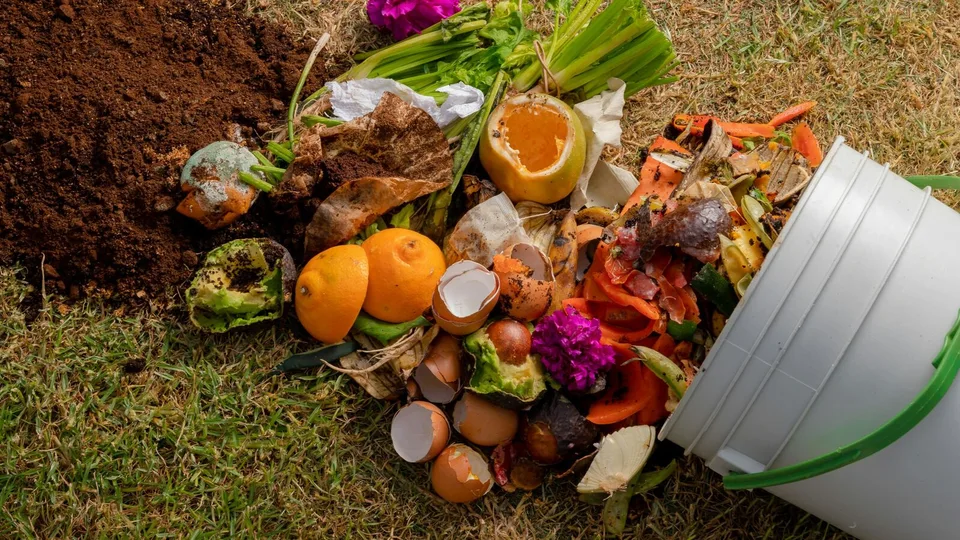
Fruit and vegetable scraps are the classic greens [1]: potato and sweet potato peels, green bean ends, apple cores from the pie, tired cranberries. Old herbs and spices can go in too [3].
Pumpkins and decorative gourds
Pumpkins are a natural for the compost pile [5]. Remove any candles, wax or decorative paint first, then cut the pumpkin into smaller pieces and mix them into the pile with browns such as dried leaves or straw [5].
Decorative gourds are fruit scraps too [1], so break them up the same way. No pile yet? Bury the pumpkin chunks directly in your garden beds, where they decompose over the winter [5].
Keep pumpkins out of the trash and out of the woods. In a landfill they are buried and rot without oxygen, which creates methane, a potent greenhouse gas [7]. Pumpkins dumped in parks and natural areas are not truly composting: they smother plants and take a long time to break down [7].
Eggshells, coffee grounds and tea bags
Coffee grounds and paper filters, paper tea bags without staples and crushed eggshells all belong in the bin [1]. NC State Extension suggests rinsing the shells; the eggs themselves stay out [3]. Eggshells are slow to break down, so the EPA suggests sifting finished compost and returning shells, fruit pits and twigs to the active pile [1].
Napkins, paper and party leftovers
Here the sources part ways. NC State lists paper napkins among the compostable browns [3], and Cornell includes napkins among the kitchen materials that can be composted [2].
The University of Maryland's guide limits backyard piles to non-glossy paper, shredded newspaper and cardboard, and puts paper towels and napkins in the column for commercial facilities [4]. If you add napkins at home, leave out the ones soaked in butter or gravy: fats and grease are on every list of things to keep out [1] [3].
The rest of the party offers fun extras. NC State's list of compostable materials includes corn cobs, flowers and dead blossoms from the centerpiece, paper baking cups, bamboo skewers, toothpicks and even the dregs of juice or wine [3]. Glossy paper and produce stickers stay out [1].
What stays out
The no list is short and the sources agree on it. Meat, fish and bones, cheese and other dairy products, and fats, oils and grease all stay out of a backyard pile [1] [3].
That means the turkey carcass, the gravy, the buttery mashed potatoes and the cheese board. NC State adds eggs and butter [3]. These foods can attract animals [1], and they may create odors and draw rodents and flies [3].
Backyard piles also generally do not get hot enough to fully decompose these materials [1] or to remove possible pathogens [4]. Cooked food is a gray area: the EPA says small amounts are fine, while noting that it can attract animals [1].
Balance greens and browns
A compost pile needs nitrogen-rich greens, carbon-rich browns, water and air in the right balance [1]. Kitchen scraps are greens; dry leaves, plant stalks, shredded paper and shredded cardboard are browns [1]. Browns give the microbes their energy, soak up extra moisture and keep the pile porous so air can move through it [2] [3].
A holiday kitchen turns out a lot of greens at once, so your fall leaves are the perfect partner. Cornell suggests keeping raked leaves in a loose pile, up off the ground and under cover, so you have browns on hand all year [2].
Maple leaves break down quickly, while oak leaves have less nitrogen and plenty of decay-resistant tannins; mixing oak leaves with nitrogen-rich materials speeds them up [3]. Before you rake every last leaf, though, read what a Maryland study found on leaves and spring moths.
How to add a holiday load
What you’ll need
Tools
- A closed container for the counter, or space in the fridge or freezer
- A knife, or a bucket and a square-end shovel for chopping
- A garden fork
Materials
- A stockpile of dry leaves, straw or shredded paper
- Shredded cardboard without wax coating, tape or glue
- 1/4-inch (0.635 cm) hardware cloth, if animals come calling
Step 1 Collect the scraps while you cook
Keep a closed container on the counter or under the sink, or stash the scraps in the fridge or freezer until you head outside [1]. Layering scraps with crumpled newspaper helps absorb moisture and keeps odors down [2].
Step 2 Chop the big pieces
Cutting materials into pieces smaller than 2 inches (5.08 cm) creates more surface area, so they decompose faster [3]. Corn cobs, broccoli stalks and other tough scraps benefit most [1]. Just do not go too fine, or air cannot flow into the pile [3].
Step 3 Bury the scraps in the middle
Make a well in the browns, put the greens into it and keep food away from the outside edges, so only browns are visible [2]. Cover the scraps with 4 to 8 inches (10.16 to 20.32 cm) of dry leaves or other browns [1]. Burying food scraps inside the pile helps avoid attracting rodents [3].
Step 4 Add browns generously
Add at least 2 to 3 times as much browns as greens, by volume [1]. The mix should feel like a wrung-out sponge [1]. If the pile smells bad, it may be too wet or short of air: add more browns [1].
Step 5 Close it up
Well-built, well-maintained piles should not attract pests [1]. Give a bin a lid and possibly a floor, with no gaps larger than 1/4 inch (0.635 cm) [1].
Composting into the cold months
A late November pile is slowing down, and that is fine. Decomposition only stops when the materials are completely frozen, and the interior of a large pile or bin can stay warm enough to keep working [6].
University of New Hampshire Extension suggests harvesting finished compost now, to make room for winter additions [6]. Keep layering greens with browns: piling on kitchen scraps alone all winter can leave a stinky, wet mess at the spring thaw [6].
To keep the pile from freezing solid, surround the bin with bags of leaves or straw bales, or line the inside with 6 to 12 inches (15.24 to 30.48 cm) of leaves, sawdust or wood chips [6]. Skip turning until spring: it only lets out the heat inside the pile [6].
With a well-balanced mix, compost can be ready within 6 months; in less ideal conditions it takes 6 months to a year or more [2]. You will know it is done when it looks dark, loose and crumbly and smells like fresh soil [1].
Frequently asked questions
Can I compost the turkey carcass?
Not in a backyard pile: meat and bones are on the EPA's list of things to avoid [1]. Commercial composting facilities accept them in many cases [4], so check with yours first [1].
Can the centerpiece flowers go in too?
Yes: flowers and dead blossoms are on NC State's list of compostable materials [3].
Should I turn the pile after adding all those scraps?
Not in winter. Turning releases the heat inside the pile; wait until it has thawed completely in spring [6].
Sources
- Composting At Home — US Environmental Protection Agency · epa.gov, consulted
- Composting at Home: The Green and Brown Alternative — Cornell Waste Management Institute · ecommons.cornell.edu, consulted
- 2. Composting — Extension Gardener Handbook, NC State Extension · content.ces.ncsu.edu, consulted
- Composting (FS-2023-0687) — University of Maryland Extension · extension.umd.edu, consulted
- Pumpkins Beyond Halloween — N.C. Cooperative Extension, Beaufort County Center · beaufort.ces.ncsu.edu, consulted
- Can you compost in the winter? — UNH Extension · extension.unh.edu, consulted
- What can you do with pumpkins after Halloween? — University of Illinois Extension · extension.illinois.edu, consulted
Written by Emilio Marruso · last checked