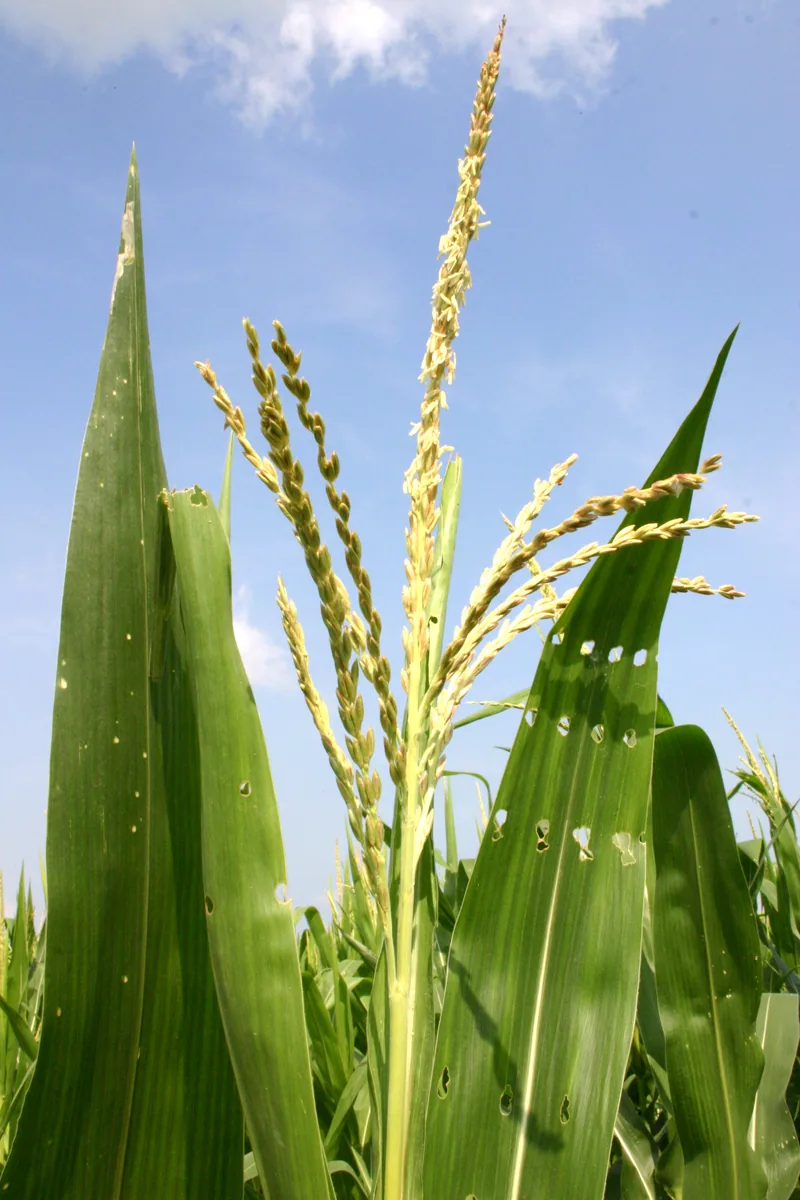


How to Grow and Care for Corn
Zea mays
Written by Emilio Marruso · last checked
At a glance
Corn loves full sun and generous water, and it pays you back with sweet ears that taste far better fresh from your own garden. Feed it nitrogen when the plants reach 1 to 1.5 feet tall. With successive plantings, you can keep picking from early summer until frost and enjoy every ear right away.
- Sun
Full sun
What the sources say (2)
Light: Full sun
Plant in full sun, in fertile, well-drained soil.
— Zea mays (Corn, Indian corn, Maize) | North Carolina Extension Gardener Plant Toolbox [1] Soil Conditions Moist, Well-Drained Exposure/Light Requirements Full Sun
— Sweet corn (Zea mays L. var. rugosa )-Hort Answers - University of Illinois Extension [2] - Water
Plenty of water at the soil, most of all when tassels and silks appear and ears ripen
What the sources say (4)
Watering: Ample water at all times, applied to the soil rather than the plant; if rainfall is deficient, irrigate thoroughly during emergence of the tassels, silking and maturation of the ears
Corn is a heavy feeder and must have ample nitrogen and water at all times, but water the soil, not the plant or pollination could suffer.
— Zea mays (Corn, Indian corn, Maize) | North Carolina Extension Gardener Plant Toolbox [1] If rainfall is deficient, irrigate thoroughly during emergence of the tassels, silking and maturation of the ears.
— Sweet corn (Zea mays L. var. rugosa )-Hort Answers - University of Illinois Extension [2] Watering notes: Lack of water at critical periods can seriously reduce quality and yield; hot, droughty conditions during pollination result in missing kernels, small ears and poor development of the tips of the ears
Although corn is a warm-weather crop, lack of water at critical periods can seriously reduce quality and yield.
— Sweet corn (Zea mays L. var. rugosa )-Hort Answers - University of Illinois Extension [2] Hot, droughty conditions during pollination result in missing kernels, small ears and poor development of the tips of the ears.
— Sweet corn (Zea mays L. var. rugosa )-Hort Answers - University of Illinois Extension [2] - Cold
Survives winters down to −50 °F (−45.6 °C)
Very hardy · USDA 2a · RHS H7 · Z2
What the sources say (2)
Hardiness, coldest zone: 2a [winter low −45.6 to −42.8 °C (−50 to −45 °F)]
USDA Plant Hardiness Zone: 2a, 2b, 3a, 3b, 4a, 4b, 5a, 5b, 6a, 6b, 7a, 7b, 8a, 8b, 9a, 9b, 10a, 10b, 11a, 11b
— Zea mays (Corn, Indian corn, Maize) | North Carolina Extension Gardener Plant Toolbox [1] Hardiness, warmest zone: 11b [winter low 7.2 to 10 °C (45 to 50 °F)]
USDA Plant Hardiness Zone: 2a, 2b, 3a, 3b, 4a, 4b, 5a, 5b, 6a, 6b, 7a, 7b, 8a, 8b, 9a, 9b, 10a, 10b, 11a, 11b
— Zea mays (Corn, Indian corn, Maize) | North Carolina Extension Gardener Plant Toolbox [1] - Spacing
9–12 inches apart in the row, 30–36 inches between rows
What the sources say (3)
Spacing: 22.9-30.5 cm (9 to 12 inches) between kernels in the row; 76.2-91.4 cm (30 to 36 inches) between rows
Space the kernels 9 to 12 inches apart in the row.
— Sweet corn (Zea mays L. var. rugosa )-Hort Answers - University of Illinois Extension [2] Plant two or more rows of each variety side by side to ensure good pollination and ear development. Allow 30 to 36 inches between rows.
— Sweet corn (Zea mays L. var. rugosa )-Hort Answers - University of Illinois Extension [2] Row spacing: 76-91 cm (30 to 36 in)
Plant two or more rows of each variety side by side to ensure good pollination and ear development. Allow 30 to 36 inches between rows.
— Sweet corn (Zea mays L. var. rugosa )-Hort Answers - University of Illinois Extension [2] - Sowing
Sow 1/2 inch deep in cool, moist soil; 1–1.5 inches deep in warm, dry soil
What the sources say (1)
Sowing depth: 1.3 cm (1/2 in) in cool, moist soils; 2.5-3.8 cm (1 to 1.5 in) in warm, dry soils
Plant the kernels (seeds) 1/2 inch deep in cool, moist soils and one to one and a half inches deep in warm, dry soils.
— Sweet corn (Zea mays L. var. rugosa )-Hort Answers - University of Illinois Extension [2] - Feeding
Feed with nitrogen beside the plants when they are 1–1.5 feet tall
What the sources say (3)
When: Side-dress when plants are 30.5 to 45.7 cm [12–18 in] tall
Side-dress nitrogen fertilizer when the plants are 12 to 18 inches tall.
— Sweet corn (Zea mays L. var. rugosa )-Hort Answers - University of Illinois Extension [2] Mineral fertilizers: Nitrogen fertilizer, side-dressed when plants are 30.5 to 45.7 cm [12–18 in] tall; corn is a heavy feeder and needs ample nitrogen at all times
Side-dress nitrogen fertilizer when the plants are 12 to 18 inches tall.
— Sweet corn (Zea mays L. var. rugosa )-Hort Answers - University of Illinois Extension [2] Corn is a heavy feeder and must have ample nitrogen and water at all times, but water the soil, not the plant or pollination could suffer.
— Zea mays (Corn, Indian corn, Maize) | North Carolina Extension Gardener Plant Toolbox [1] - Harvest
Pick sweet corn as your variety's directions say; leave hard corn to dry on the stalk
What the sources say (1)
How to harvest: Sweet corn: harvest time is important, so follow the harvest directions for the cultivar being grown. Hard corns are left to dry on the stalk, so harvest time is not a particular issue for them.
Time of harvest is important for some sweet corns, so follow harvest directions carefully for the particular variety you are growing. Hard corns need to dry on the stalk, so harvest time is not a particular issue for them.
— Zea mays (Corn, Indian corn, Maize) | North Carolina Extension Gardener Plant Toolbox [1] - Pests
Watch for corn earworm, corn borers, aphids and rusts
What the sources say (4)
Pests: aphids, bean leaf beetle, black cutworm, corn earworm, corn rootworm, European corn borer, fall armyworm, flea beetles, seed corn maggot, wireworm
- Aphids [Vegetables] ( Aphididae ) - Bean Leaf Beetle ( Certoma trifurcata ) - Black Cutworm ( Agrotis ipsilon ) - Corn Earworm ( Helicoverpa zea )
— Sweet corn (Zea mays L. var. rugosa )-Hort Answers - University of Illinois Extension [2] Insect pests : - Seed corn maggot - Wireworm - Flea beetle - European corn borer - Corn ear worm - Fall armyworm - Corn root worm
— Sweet corn (Zea mays L. var. rugosa )-Hort Answers - University of Illinois Extension [2] Diseases: anthracnose, Helminthosporium leaf blights, rusts, crazy top, gray leaf spot, Stewart's bacterial wilt, smut, maize dwarf mosaic, maize chlorotic dwarf, wheat streak mosaic, maize streak
Fungal Disease - Anthracnose [Vegetables] ( Colletotrichum spp. ) - Helminthosporium Leaf Blights of Sweet Corn ( Several related genera ) - Rusts [Vegetables] ( Puccinia and Uromyces spp. )
— Sweet corn (Zea mays L. var. rugosa )-Hort Answers - University of Illinois Extension [2] Diseases : - Crazy top ( Sclerophthora macrospora ) - Gray leaf spot ( Cercospora zea-maydis ) - Stewart's bacterial wilt ( Erwinia stewartii ) - Smut ( Ustilago maydis ) - Viral Diseases: Maize dwarf mosaic, Maize chlorotic dward, Wheat streak mosic, Maize streak
— Sweet corn (Zea mays L. var. rugosa )-Hort Answers - University of Illinois Extension [2] - Watch out
Keep supersweet corn away from other corn types; water well in hot, dry spells
- Size
5–8 feet tall and 1–2 feet wide
What the sources say (2)
Mature height: 152-244 cm (5 to 8 ft)
Height: 5 ft. 0 in. - 8 ft. 0 in.
— Zea mays (Corn, Indian corn, Maize) | North Carolina Extension Gardener Plant Toolbox [1] Mature width: 30-61 cm (1 to 2 ft)
Width: 1 ft. 0 in. - 2 ft. 0 in.
— Zea mays (Corn, Indian corn, Maize) | North Carolina Extension Gardener Plant Toolbox [1]
Overview
Corn is a warm-weather crop grown in full sun in fertile, well-drained soil. [1][2] It is wind pollinated, so it is planted in blocks of several rows rather than in one long row. [1] Water at critical periods such as tasseling, silking and ear maturation affects quality and yield. [2]
Corn care
How to water Corn
Watering
Ample water at all times, applied to the soil rather than the plant; if rainfall is deficient, irrigate thoroughly during emergence of the tassels, silking and maturation of the ears
What the sources say (2)
Corn is a heavy feeder and must have ample nitrogen and water at all times, but water the soil, not the plant or pollination could suffer.If rainfall is deficient, irrigate thoroughly during emergence of the tassels, silking and maturation of the ears.Watering notes
Lack of water at critical periods can seriously reduce quality and yield; hot, droughty conditions during pollination result in missing kernels, small ears and poor development of the tips of the ears
What the sources say (2)
Although corn is a warm-weather crop, lack of water at critical periods can seriously reduce quality and yield.Hot, droughty conditions during pollination result in missing kernels, small ears and poor development of the tips of the ears.How much light Corn needs
Full sun
What the sources say (2)
Plant in full sun, in fertile, well-drained soil.Soil Conditions
Moist, Well-Drained
Exposure/Light Requirements
Full SunHow much cold Corn can take
Hardiness, coldest zone
2a [winter low −45.6 to −42.8 °C (−50 to −45 °F)]
What the sources say (1)
USDA Plant Hardiness Zone:
2a, 2b, 3a, 3b, 4a, 4b, 5a, 5b, 6a, 6b, 7a, 7b, 8a, 8b, 9a, 9b, 10a, 10b, 11a, 11bHardiness, warmest zone
11b [winter low 7.2 to 10 °C (45 to 50 °F)]
What the sources say (1)
USDA Plant Hardiness Zone:
2a, 2b, 3a, 3b, 4a, 4b, 5a, 5b, 6a, 6b, 7a, 7b, 8a, 8b, 9a, 9b, 10a, 10b, 11a, 11bWhere to grow Corn
22.9-30.5 cm (9 to 12 inches) between kernels in the row; 76.2-91.4 cm (30 to 36 inches) between rows
What the sources say (2)
Space the kernels 9 to 12 inches apart in the row.Plant two or more rows of each variety side by side to ensure good pollination and ear development. Allow 30 to 36 inches between rows.How to propagate Corn
Seed (kernels)
What the sources say (2)
Corn is wind pollinated, and to ensure adequate pollination, sow seeds in several rows to form a square, or on hills with several plants in a circle.Plant the kernels (seeds) 1/2 inch deep in cool, moist soils and one to one and a half inches deep in warm, dry soils.How to grow Corn
The plant
Life cycle
annual
What the sources say (1)
Family: Poaceae Uses (Ethnobotany): Annual, Vegetable Life Cycle: Annual Recommended Propagation Strategy: SeedFamily
Poaceae
What the sources say (1)
Family: Poaceae Uses (Ethnobotany): Annual, Vegetable Life Cycle: Annual Recommended Propagation Strategy: SeedMature height
152-244 cm (5 to 8 ft)
What the sources say (1)
Height: 5 ft. 0 in. - 8 ft. 0 in.Mature width
30-61 cm (1 to 2 ft)
What the sources say (1)
Width: 1 ft. 0 in. - 2 ft. 0 in.Sowing and growth
Sowing depth
1.3 cm (1/2 in) in cool, moist soils; 2.5-3.8 cm (1 to 1.5 in) in warm, dry soils
What the sources say (1)
Plant the kernels (seeds) 1/2 inch deep in cool, moist soils and one to one and a half inches deep in warm, dry soils.Row spacing
76-91 cm (30 to 36 in)
What the sources say (1)
Plant two or more rows of each variety side by side to ensure good pollination and ear development. Allow 30 to 36 inches between rows.Days to maturity
58 to 100 days to harvest for sweet corn cultivars, depending on the cultivar; the number varies from year to year and location to location
What the sources say (3)
The maturity dates are relative because the actual number of days to harvest varies from year to year and location to location.Earlivee (58 days; 7"-14 rows; extra early), Golden Cross Bantam (85 days; 8"-12 to 14 rows; old home-garden variety)Stowell's Evergreen (100 days; 9"ears, 18 to 20 rows; big, juicy, white kernels; ripen over long period)Harvest and storage
How to harvest
Sweet corn: harvest time is important, so follow the harvest directions for the cultivar being grown. Hard corns are left to dry on the stalk, so harvest time is not a particular issue for them.
What the sources say (1)
Time of harvest is important for some sweet corns, so follow harvest directions carefully for the particular variety you are growing. Hard corns need to dry on the stalk, so harvest time is not a particular issue for them.Pests and diseases
Pests
aphids, bean leaf beetle, black cutworm, corn earworm, corn rootworm, European corn borer, fall armyworm, flea beetles, seed corn maggot, wireworm
What the sources say (2)
- Aphids [Vegetables] ( Aphididae ) - Bean Leaf Beetle ( Certoma trifurcata ) - Black Cutworm ( Agrotis ipsilon ) - Corn Earworm ( Helicoverpa zea )Insect pests : - Seed corn maggot - Wireworm - Flea beetle - European corn borer - Corn ear worm - Fall armyworm - Corn root wormDiseases
anthracnose, Helminthosporium leaf blights, rusts, crazy top, gray leaf spot, Stewart's bacterial wilt, smut, maize dwarf mosaic, maize chlorotic dwarf, wheat streak mosaic, maize streak
What the sources say (2)
Fungal Disease - Anthracnose [Vegetables] ( Colletotrichum spp. ) - Helminthosporium Leaf Blights of Sweet Corn ( Several related genera ) - Rusts [Vegetables] ( Puccinia and Uromyces spp. )Diseases : - Crazy top ( Sclerophthora macrospora ) - Gray leaf spot ( Cercospora zea-maydis ) - Stewart's bacterial wilt ( Erwinia stewartii ) - Smut ( Ustilago maydis ) - Viral Diseases: Maize dwarf mosaic, Maize chlorotic dward, Wheat streak mosic, Maize streakFertilizing
When
Side-dress when plants are 30.5 to 45.7 cm [12–18 in] tall
What the sources say (1)
Side-dress nitrogen fertilizer when the plants are 12 to 18 inches tall.Mineral fertilizers
Nitrogen fertilizer, side-dressed when plants are 30.5 to 45.7 cm [12–18 in] tall; corn is a heavy feeder and needs ample nitrogen at all times
What the sources say (2)
Side-dress nitrogen fertilizer when the plants are 12 to 18 inches tall.Corn is a heavy feeder and must have ample nitrogen and water at all times, but water the soil, not the plant or pollination could suffer.Corn pests and problems
Cross-pollination
Symptom: Supersweet varieties pollinated by other corn types do not develop a high sugar content and are starchy
What to do: Isolate supersweet corn from other corn types and follow cultivar label directions
What the sources say (2)
Supersweet varieties pollinated by standard sweet corn, popcorn or field corn do not develop a high sugar content and are starchy.
— Sweet corn (Zea mays L. var. rugosa )-Hort Answers - University of Illinois Extension [2] Cross-pollination from other corn varieties can adversely affect some sweet corns, so follow cultivar label directions precisely to avoid pollen contamination from other corn.
— Zea mays (Corn, Indian corn, Maize) | North Carolina Extension Gardener Plant Toolbox [1] Hot, dry conditions during pollination
Symptom: Missing kernels, small ears and poor development of the tips of the ears
What to do: Irrigate thoroughly during emergence of the tassels, silking and maturation of the ears
What the sources say (1)
Hot, droughty conditions during pollination result in missing kernels, small ears and poor development of the tips of the ears.
— Sweet corn (Zea mays L. var. rugosa )-Hort Answers - University of Illinois Extension [2] Root disturbance
Symptom: Corn roots do not tolerate disturbance well
What to do: Cut excess sprouts when thinning instead of pulling, and mulch rather than cultivate around the roots
What the sources say (1)
Corn roots do not tolerate disturbance well, so when thinning corn, cut the excess sprouts instead of pulling them.
— Zea mays (Corn, Indian corn, Maize) | North Carolina Extension Gardener Plant Toolbox [1]
Remedies
Each remedy shows what official sources say about it; traditional remedies without an official source are marked as such. Harmful ones are listed so you know to avoid them.
Treating the plant
corn earworm
mineral oil on the silks Works
How: Squirt half of a medicine dropper of mineral oil onto the top of each ear after the silk has begun drying.
Squirt half of a medicine dropper of mineral oil onto the top of each ear of corn after the silk has begun drying
— weekand.com [3] What the evidence says To control this pest, plant corn as early as possible and apply mineral oil on corn silks five to six days after silk emergence.
— hgic.clemson.edu [4] Bacillus thuringiensis and oil drops Works
While Bt -- a naturally occurring bacteria -- can be used to kill bugs in corn, it degrades in sunlight and washes away in rain; continual applications must be made to be effective.
— weekand.com [3] How: Use an eye-dropper to apply a mixture of vegetable oil, Bt, water and a few drops of dishwashing liquid to the tip of each ear several days after the silks emerge.
use an eye-dropper to apply a mixture of vegetable oil, Bt (Bacillus thuringiensis), water, and a few drops of dishwashing liquid to the tip of each ear several days after the silks emerge
— foodgardening.mequoda.com [5] What the evidence says Mixing a Bacillus thuringiensis ( B.t.) product with mineral oil can improve the control of earworms.
— hgic.clemson.edu [4] handpicking into soapy water Not verified
Traditional remedy, not verified by an official source.
How: Walk the rows and handpick the worms, dropping them into a bucket of soapy water.
aphids
insecticidal soap spray Works
While insecticidal soap is less apt to affect other organisms, certain plants might be sensitive to the soap and could suffer leaf burn.
— foodgardening.mequoda.com [5] How: Mix the soap with water and apply directly to the insects.
Insecticidal soaps are particularly effective on smaller pests such as aphids, psyllids, and spider mites.
— foodgardening.mequoda.com [5] What the evidence says For example, insecticidal soap is a safe, effective organic insecticide with minimal environmental impact.
— extension.psu.edu [6] vegetable oil and dish soap spray Not verified
Traditional remedy, not verified by an official source.
For example, spraying home remedies that contain dish detergent on plants on a sunny day can injure the plant, essentially burning it.
— extension.psu.edu [7] How: Mix 1 cup of vegetable oil with 1 tablespoon of dish washing liquid, then mix 1 tablespoon of this concoction with 1 cup of water.
spider mites
insecticidal soap spray Works
While insecticidal soap is less apt to affect other organisms, certain plants might be sensitive to the soap and could suffer leaf burn.
— foodgardening.mequoda.com [5] How: Mix the soap with water and apply directly to the insects.
Insecticidal soaps are particularly effective on smaller pests such as aphids, psyllids, and spider mites.
— foodgardening.mequoda.com [5] What the evidence says For example, insecticidal soap is a safe, effective organic insecticide with minimal environmental impact.
— extension.psu.edu [6]
insect pests
baking soda and oil spray Not verified
Traditional remedy, not verified by an official source.
For example, spraying home remedies that contain dish detergent on plants on a sunny day can injure the plant, essentially burning it.
— extension.psu.edu [7] How: Mix 1 tablespoon of baking soda, 1/2 teaspoon of a mild dish detergent and 2 1/2 tablespoons of olive oil in a gallon of water; shake well before spraying and repeat every week.
slugs
beer trap Not verified
Traditional remedy, not verified by an official source.
How: Place beer in shallow pans or cut-down paper cups; the pests crawl in and drown.
cutworms
stiff paper collar Works
How: Place a collar of stiff paper, cardboard or aluminum foil around each plant after transplanting.
home gardeners can place a collar of stiff paper, cardboard, or aluminum foil around each plant for protection after transplanting it to the garden.
— hgic.clemson.edu [4] What the evidence says home gardeners can place a collar of stiff paper, cardboard, or aluminum foil around each plant for protection after transplanting it to the garden.
— hgic.clemson.edu [4] bran and molasses bait with B.t. Official source, not independently tested
How: Mix a B.t. suspension with bran until the liquid is absorbed, add a small amount of molasses, and scatter crumbled pieces around the base of the plants.
Bait can be made by mixing a B.t. suspension with bran until the liquid is absorbed by the bran and then adding a small amount of molasses.
— hgic.clemson.edu [4]
wireworms
potato bait traps Works
How: Scatter pieces of potato around the garden as traps; rotate crops and cultivate infested soil in late summer or autumn.
Trap wireworms in pieces of potato scattered around the garden, rotate crops, and plow or cultivate infested soil in late summer or in autumn to kill or expose various insect stages to predators.
— hgic.clemson.edu [4] What the evidence says Trap wireworms in pieces of potato scattered around the garden, rotate crops, and plow or cultivate infested soil in late summer or in autumn to kill or expose various insect stages to predators.
— hgic.clemson.edu [4]
corn smut
removing galls by hand Works
Remove galls carefully since spores can readily blow to nearby plants and cause more disease.
— hgic.clemson.edu [8] How: Pick off and destroy infected ears and galls while they are immature; do not turn infected crop residues back into the soil.
Pick off and destroy infected ears and galls while they are immature and have not yet released spores.
— hgic.clemson.edu [8] What the evidence says Pick off and destroy infected ears and galls while they are immature and have not yet released spores.
— hgic.clemson.edu [8]
stewart's wilt
removing infected plants Works
How: Remove and destroy all infected plants immediately.
There is no effective chemical control available for this disease. Remove and destroy all infected plants immediately.
— hgic.clemson.edu [8] What the evidence says There is no effective chemical control available for this disease. Remove and destroy all infected plants immediately.
— hgic.clemson.edu [8]
nematodes
soil solarization Works
How: An effective nematode control program should include crop rotation, sanitation (remove crop debris after harvest) and solarization.
An effective nematode control program should include crop rotation, sanitation (remove crop debris after harvest), and solarization.
— hgic.clemson.edu [8] What the evidence says An effective nematode control program should include crop rotation, sanitation (remove crop debris after harvest), and solarization.
— hgic.clemson.edu [8]
yellow leaves
side-dressing with composted manure Not verified
Traditional remedy, not verified by an official source.
How: Once the corn is knee-high, side-dress with composted manure, blood meal or fish emulsion.
Calendar
Sowing
The sources give different values depending on region, zone or growing conditions.
What each source says
According to NC State Extension: Not until the soil warms up to 60 F
Standard sweet corn varieties (fonte: University of Illinois Extension): Above 55 F soil temperature
Extra-sweet varieties (fonte: University of Illinois Extension): About 65 F soil temperature
What the sources say (6)
According to NC State Extension: Corn is a warm weather crop and should not be planted until the soil warms up to 60Standard sweet corn varieties (fonte: University of Illinois Extension): Sweet corn germinates when soil temperature is above 55 degrees F and some extra-sweet varieties germinate when soil temperature is about 65 degrees F.Extra-sweet varieties (fonte: University of Illinois Extension): Sweet corn germinates when soil temperature is above 55 degrees F and some extra-sweet varieties germinate when soil temperature is about 65 degrees F.Sweet corn need to be planted at about the average frost-free date.Sweet corn germinates when soil temperature is above 55 degrees F and some extra-sweet varieties germinate when soil temperature is about 65 degrees F.Plantings can be made as late as the first week of July.Planting
Not stated in the sources we read.
Harvest
Successive plantings can yield continual harvests from early summer until frost if the weather cooperates
What the sources say (1)
Successive plantings can yield continual harvests from early summer until frost if the weather cooperates.Months as given by the sources, which are mostly from the United States (northern hemisphere). In the southern hemisphere they shift by about six months.
Relative to frost
Less precise estimate: there is no weather station within 300 km.
Find frost dates by ZIP code or city
Sow outdoors: around the last frost
Sweet corn need to be planted at about the average frost-free date.
— Sweet corn (Zea mays L. var. rugosa )-Hort Answers - University of Illinois Extension [2]
Count from the average frost dates where you live.
Edibility
Reported by the source, quoted verbatim. Do not eat a plant on the basis of this page alone: identification mistakes can be dangerous.
It is especially popular with home gardeners because it tastes appreciably better when it is harvested and eaten fresh from the garden.
[2]
Indicative values
Values from a secondary source, not checked word for word like the rest of this page. Use them as a starting point.
- Drought tolerant
- yesIndicative value, adapt it to your climate · Secondary source
- Soil
- Humus rich, Well-drainedIndicative value, adapt it to your climate · Secondary source
- Soil pH
- 5.8-7Indicative value, adapt it to your climate · Secondary source
- Care level
- MediumIndicative value, adapt it to your climate · Secondary source
- Growth rate
- HighIndicative value, adapt it to your climate · Secondary source
- Pruning
- December, January, February, March, April, May, March, AprilIndicative value, adapt it to your climate · Secondary source
Similar plants
- Common barley Hordeum vulgare
- Giant Cane Arundinaria gigantea
- Oat Avena sativa
- Rye Secale cereale
- Sorghum Sorghum bicolor
- Wheat Triticum aestivum
- Teff Eragrostis tef
- African lovegrass Eragrostis curvula
Sources
Every value above is quoted from these documents. Links lead to the original publisher.
- Zea mays (Corn, Indian corn, Maize) | North Carolina Extension Gardener Plant Toolbox · plants.ces.ncsu.edu, consulted
- Sweet corn (Zea mays L. var. rugosa )-Hort Answers - University of Illinois Extension · web.extension.illinois.edu, consulted
- weekand.com · weekand.com
- hgic.clemson.edu · hgic.clemson.edu
- foodgardening.mequoda.com · foodgardening.mequoda.com
- extension.psu.edu · extension.psu.edu
- extension.psu.edu · extension.psu.edu
- hgic.clemson.edu · hgic.clemson.edu
Written by Emilio Marruso · last checked